

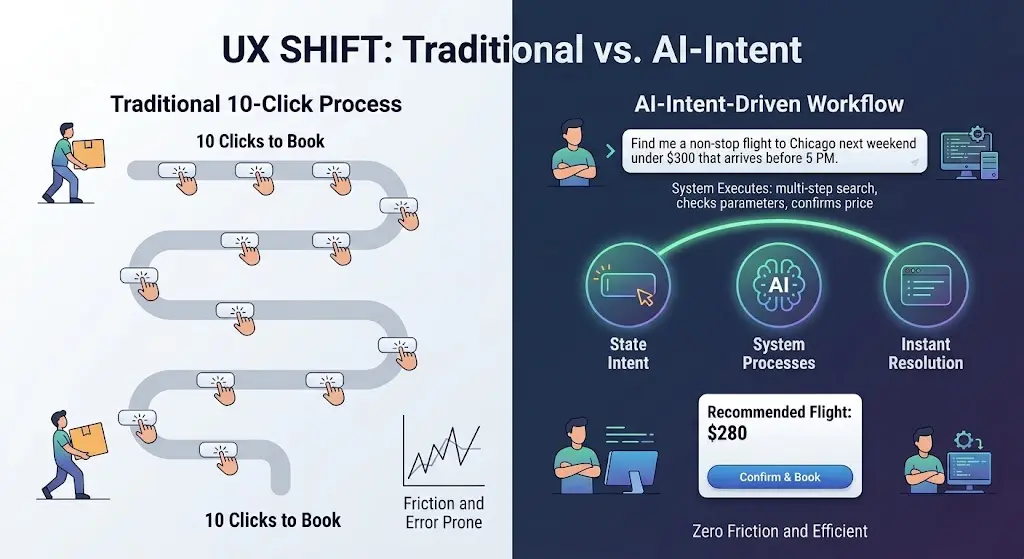
Executive Overview
For nearly half a century, the digital world has been tethered to a mechanical contract: if you want a machine to do something, you must speak its language. Since the commercialization of the Graphical User Interface (GUI) by the Xerox Star and its subsequent popularization by the original Apple Macintosh, software interactions have relied heavily on point-and-click paradigms. Booking a trip, purchasing retail goods, or researching a complex medical symptom has required navigating an intricate labyrinth of digital architecture. Users routinely click through navigation menus, adjust abstract range sliders, complete multi-step checkout forms, dismiss intrusive cookie banners, and toggle dozens of browser tabs simply to cross-reference basic information.
Digital engagement metrics—such as time on site, page views per session, and click-through rates—have historically rewarded friction. Websites were intentionally engineered to maximize user interaction volume, forcing humans to spend more time managing software than actually achieving their real-world goals.
That contract is now officially expiring.
Driven by rapid advancements in artificial intelligence, deep learning, and large language models (LLMs), a new paradigm of web design is emerging: Intent-Driven Design. Rather than expecting users to learn complex navigation trees and click through elaborate sales funnels, this philosophy shifts the burden of execution to the software itself. By capturing high-level human goals via natural language or ambient context, modern web platforms silently execute the grunt work in the background. The ultimate goal of modern web design is no longer to build prettier buttons or flashier animations; it is to eliminate the interface entirely.

Detailed Chronology: From Mechanical UIs to Intent-Driven Systems
To understand the magnitude of this transition, it is helpful to trace the evolution of human-computer interaction (HCI) from mechanical labor to autonomous execution.
The Command-Line Era (1950s–1970s)
In computing’s infancy, interfaces were text-based and exclusionary. Users had to master rigid, unforgiving syntaxes just to instruct a computer to perform basic file operations. The interaction was precise, but the cognitive load was astronomical.
The Graphical User Interface (1980s–2010s)
Pioneered at Xerox PARC and commercialized by Apple and Microsoft, the GUI democratized computing by replacing text commands with visual metaphors—desktops, folders, wastebaskets, and clickable buttons. Point-and-click interactions turned abstract operations into physical gestures. While revolutionary, this paradigm established a new form of friction: the multi-step process. To achieve a simple outcome, users were forced to execute dozens of discrete mechanical inputs.
The Mobile and App Explosion (2010s–2020s)
The rise of smartphones compressed the desktop paradigm into touchscreens, proliferating apps that demanded continuous tapping, swiping, and scrolling. Digital real estate became fiercely contested, leading to hyper-optimized conversion funnels designed to keep users hooked within walled gardens.
The Rise of Intent-Driven Systems (Present and Beyond)
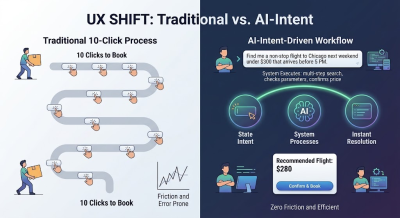
Today, we are witnessing the obsolescence of the multi-step click process. Consider the traditional workflow of booking a flight online:
- Navigate to an aggregator site and dismiss promotional modals.
- Manually input departure and arrival airports.
- Select travel dates via a calendar drop-down.
- Filter by stops, airlines, departure times, and baggage limits.
- Sort through dozens of tabular results, opening multiple tabs to compare prices.
- Select a flight, manually input passenger details, choose seats, decline insurance upsells, and enter payment information across multiple consecutive screens.
This is a textbook point-and-click UI paradigm. The computer acts as a passive container of data, while the human acts as an exhausted micro-manager, manually orchestrating every micro-step.
Intent-driven design flips this dynamic entirely. Instead of forcing users through the mechanical steps of how to find a flight, the interface asks a singular, human-centric question: What are you trying to accomplish? When a user expresses a high-level goal—such as, "Find me a non-stop flight to Chicago next weekend under $300 that arrives before 5 PM"—the software reads the intent, executes the multi-step search queries behind the scenes, cross-references live inventories, and presents a single, actionable resolution. Ten clicks dissolve into one clear outcome.
Supporting Context & Metrics: Platforms Leading the Revolution
This shift is not a theoretical vision of the distant future; it is actively reshaping the web today. Several pioneering web platforms are already replacing traditional buttons with intent-capturing workflows.
1. Perplexity AI: Search Without the Open Tabs
Traditional search engines like Google were historically built as directories. A user typed a keyword, and the interface rewarded them with ten blue links. The actual work of opening five tabs, skimming long articles, dodging display ads, and manually synthesizing an answer was left entirely to the user.
Platforms like Perplexity AI allow users to perform instant, intent-based searches. Instead of forcing users to click through multiple sources to aggregate data, the interface synthesizes a custom, context-aware answer complete with citations, bypassing the traditional link-and-tab routine.
2. Vercel v0: Web Design Without Dragging and Dropping
For years, creating a web interface meant using visual builders like Figma or complex drag-and-drop editors. Designers and developers spent hours manually drawing rectangles, picking hexadecimal color codes, adjusting padding values, and writing cascading style sheets (CSS).
Tools like Vercel v0 let creators bypass manual layout building entirely. By typing a natural language prompt—such as, "Build a modern SaaS analytics dashboard with a dark mode toggle and real-time revenue charts"—the platform generates fully functional, production-ready UI components on the fly.
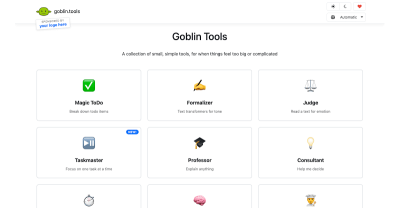
3. Goblin.tools: Breaking Down Overwhelming Tasks
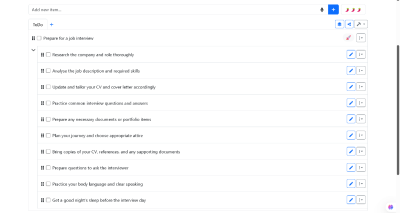
Traditional productivity tools require users to manually construct task lists, drag items across Kanban boards, and assign micro-deadlines. Goblin.tools is a specialized AI suite designed to remove administrative friction for neurodivergent individuals or anyone experiencing task paralysis. A user inputs an overwhelming goal—such as "Clean the entire house"—and the system automatically breaks it down into granular, manageable, step-by-step checklists with zero configuration required.
The Core Pillars of Intent-Driven Web Design
When traditional menus, sidebars, and forms are stripped away, how do web platforms remain functional and reliable? Designers pioneering this space rely on three foundational pillars:
| Pillar | Traditional UX Approach | Intent-Driven UX Approach |
|---|---|---|
| User Input | Micro-actions (Clicks, dropdowns, toggles, form fields) | High-level goals (Natural language, ambient context, behavioral habits) |
| Interface State | Static layouts (Every visitor sees the exact same structural template) | Generative UI (Layouts and widgets rendered dynamically on the fly) |
| Task Execution | Manual execution orchestrated step-by-step by the human user | Autonomous execution managed by background AI agents with easy rollbacks |
1. High-Level Goals and Ambient Context
Invisible interfaces do not always wait for explicit text commands; they leverage ambient context to anticipate human needs. Guided by industry standards such as Apple’s Human Interface Guidelines on Contextual & Ambient Design, modern systems read environmental metadata—device state, location, time of day, and past interaction patterns—to trigger proactive utility.
2. Generative UI
In legacy web design, every user sees the exact same page layout. An e-commerce platform displays the exact same navigation bar whether a visitor is looking for customer support or checking order status.
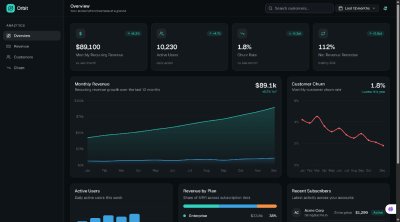
As highlighted in Nielsen Norman Group’s analyses on AI as a new UX paradigm, computing is shifting from command-based interaction to outcome-specification. This enables Generative UI, where interfaces materialize dynamically based on immediate context. If a user expresses a desire to compute complex financial projections, the interface generates a dynamic financial calculator widget on demand, which then dissolves once the goal is accomplished.
3. Execution by AI Agents and Reversibility
Traditional interfaces are obsessed with friction-heavy prevention, constantly peppering users with confirmation modals ("Are you sure you want to delete this file?").
Intent-driven interfaces adapt Jakob Nielsen’s classic usability heuristics concerning user control and error recovery by shifting the safety net from prevention to easy reversibility. Because autonomous agents take actions on behalf of the user, products prioritize frictionless rollback mechanisms. A prominent "Undo" button, simple revision prompts ("Make this summary shorter"), and transparent audit logs replace intrusive warning dialogs.
Official Statements and Industry Perspectives
The philosophical foundation of this movement builds directly upon long-standing Human-Computer Interaction (HCI) concepts. Design theorist Golden Krishna famously argued in his seminal book, The Best Interface Is No Interface, that adding screens, buttons, and app icons is often an admission of design failure.
Similarly, Don Norman’s principles of human-centered design emphasize that tools should adapt to human cognitive models rather than forcing humans to adapt to mechanical constraints.
In a recent exploration of AI-driven UX paradigms, interaction design researchers noted:
"The ultimate goal of modern web design is no longer to build prettier buttons or flashy animations; it is to eliminate the interface entirely. Rather than designing static buttons and rigid forms, we need to learn to map and present dynamic, generative UI components that adapt on the fly to user intent."
However, industry experts also sound notes of caution. The Stanford Human-Computer Interaction (HCI) Group emphasizes that when software acts on inferred intent rather than explicit commands, automation must maintain strict boundaries to prevent users from feeling patronized or manipulated. Ethical frameworks developed by organizations like the Center for Humane Technology warn that transparent feedback loops are mandatory. According to the Google PAIR (People + AI Research) Guidebook, systems must explicitly state their interpretation of a user’s prompt ("Searching for non-stop flights to Chicago under $300…") so users can calibrate trust and correct misinterpretations instantly.
Future Outlook: The Death of Engagement Metrics
For decades, the digital product industry has evaluated software success through engagement metrics like time spent in app, click-through rates, and page views per session. Websites were deliberately engineered to maximize visual engagement and interaction volume.
The philosophy of intent-driven design turns these metrics upside down. Aligned with the Center for Humane Technology’s "Time Well Spent" movement, the ultimate test of a modern digital product is no longer how visually captivating its buttons are, but rather: How effectively did this software solve the problem and get out of the user’s way?
We are entering an era where web applications will no longer be measured by the aesthetic complexity of their user interfaces, but by their ability to render those very interfaces obsolete. The future of the web is not more interaction—it is seamless, invisible completion.