In the modern digital landscape, Search Engine Results Page (SERP) tracking has evolved far beyond manual spreadsheets and sporadic weekly rankings checks. For digital marketing agencies, enterprise brands, and growing ecommerce businesses, monitoring organic search visibility with precision is no longer optional—it is a vital operational requirement. Today’s search results are hyper-dynamic, hyper-localized, and heavily influenced by evolving elements like AI Overviews, featured snippets, knowledge cards, and local pack listings.
Relying on outdated metrics or guesswork leaves organizations blind to algorithmic shifts, competitor maneuvers, and traffic fluctuations. To successfully validate SEO investments, tie keyword performance to real business revenue, and capture high-value SERP real estate, modern marketers require robust, real-time tracking architecture.
This comprehensive review examines the mechanics of top-tier search intelligence software for 2025. We break down the 9 core features every enterprise-grade rank tracker must possess, evaluate the top 7 SERP tracking tools currently dominating the market—covering both dedicated standalone solutions and feature-rich all-in-one SEO platforms—and offer actionable insights to help you choose the right system for your organization’s unique needs.
Detailed Chronology: The Evolution of Rank Tracking
To understand where SERP tracking is today, it helps to examine how the discipline has matured over the past decade.
The Spreadsheet Era (Early 2010s): SEO professionals relied heavily on manual spreadsheets, updating ranking data once a week or month. Data was frequently skewed by personalization, geo-location variances, and massive human error, making it nearly impossible to prove immediate ROI to stakeholders.
The Rise of Automated Trackers (Mid-2010s): Standalone SaaS solutions emerged to automate daily data pulls. Tools began offering basic multi-device checks (desktop vs. mobile) and rudimentary competitor tracking, though update cycles could take days across large keyword portfolios.
The Feature-Rich & All-In-One Era (Late 2010s to 2020s): As search engines grew more complex—introducing visual carousels, People Also Ask (PAA) boxes, and localized pack listings—trackers evolved. Platforms integrated advanced data visualizations, granular tagging, historical tracking, and direct APIs into reporting tools like Google Looker Studio and Databox.
The Modern AI & Real-Time Era (2025 and Beyond): Today, tracking tools must account for artificial intelligence integrations, rapid on-demand data refreshes, and multi-engine capabilities (Google, Bing, Baidu, Yandex, YouTube). Modern platforms bridge the gap between simple position monitoring and deep, AI-driven content gap analysis, giving marketers the exact insights needed to capture zero-position features and combat volatility.
Supporting Context & Metrics: Why Invest in SERP Tracking Software?
Tracking changes in your keyword positions is only the tip of the iceberg. Modern SERP tracking software acts as an analytics engine that proves the value of your organic search campaigns. According to recent industry benchmarks, organizations that implement granular, daily tracking alongside revenue attribution models are able to pivot their content strategies 40% faster than those relying on legacy reporting.
The right software enables marketing teams to:
Validate SEO and content marketing budgets by directly correlating ranking spikes to organic traffic and bottom-line revenue.
Identify immediate keyword opportunities and low-hanging fruit (e.g., jumping from position 4 to position 1 by tweaking meta tags or optimizing internal links).
Monitor mobile versus desktop performance variations to capture device-specific audiences.
Detect sudden algorithm updates or technical drop-offs within hours rather than weeks.
9 Essential Features to Look for in SERP Tracking Software
When evaluating solutions for your tech stack, ensure the platform delivers on these nine critical pillars:
1. Access Accurate On-Demand Ranking Updates
SERP positions fluctuate rapidly throughout the day. Waiting days for a scheduled sync is no longer acceptable. You need tools that offer automatic 24-hour updates supplemented by manual, on-demand refresh buttons. Tools like AccuRanker lead this category by allowing users to instantly pull fresh data for entire keyword portfolios at the click of a button.
2. Monitor Performance Across SERP Features
Winning a traditional top-3 ranking is only part of the battle. Capturing "Position #0"—such as AI Overviews, featured snippets, video carousels, and local pack cards—requires specialized tracking. Look for dashboards that monitor 50+ distinct SERP features simultaneously, displaying precisely which keywords trigger them and where your assets stand.
3. Track SERP Movement Across All Major Search Engines
While Google commands the lion’s share of global search traffic, international campaigns often require multi-engine visibility. Ensure your chosen tracker supports search engines beyond Google, including Bing, Baidu, Yandex, and YouTube—a capability crucial for global brands and multi-market agencies.
4. Granular Tracking (By Location and Device)
Local SEO campaigns require hyper-specific geographic tracking—down to the zip code or city block level. Furthermore, mobile-first indexing makes device-specific segmentation vital. Platforms like Semrush allow users to filter rankings seamlessly across countries, states, cities, and specific devices.
5. Map SERP Movements to Traffic and Revenue/Conversions
Rankings without revenue context mean very little to executive boards. Advanced trackers integrate directly with analytics platforms like Google Analytics or Adobe Analytics, combining keyword data (search volume, Share of Voice) with behavioral and financial metrics (bounce rate, conversions, load times, revenue) into unified reports.
6. View Historical Rank Performance
Point-in-time data limits strategic foresight. A comprehensive tracker should store and display extensive historical rank trends, allowing your team to analyze seasonality, track how past algorithmic updates impacted specific keyword groups, and measure long-term trajectory against competitors.
7. Run Competitor Comparisons
Knowing where you stand is good; knowing how your market share stacks up against key rivals is better. Top-tier tools group keywords into rank brackets (e.g., 1–3, 4–10, 11–50) and provide side-by-side competitor matrices to highlight exactly where you are gaining or losing ground.
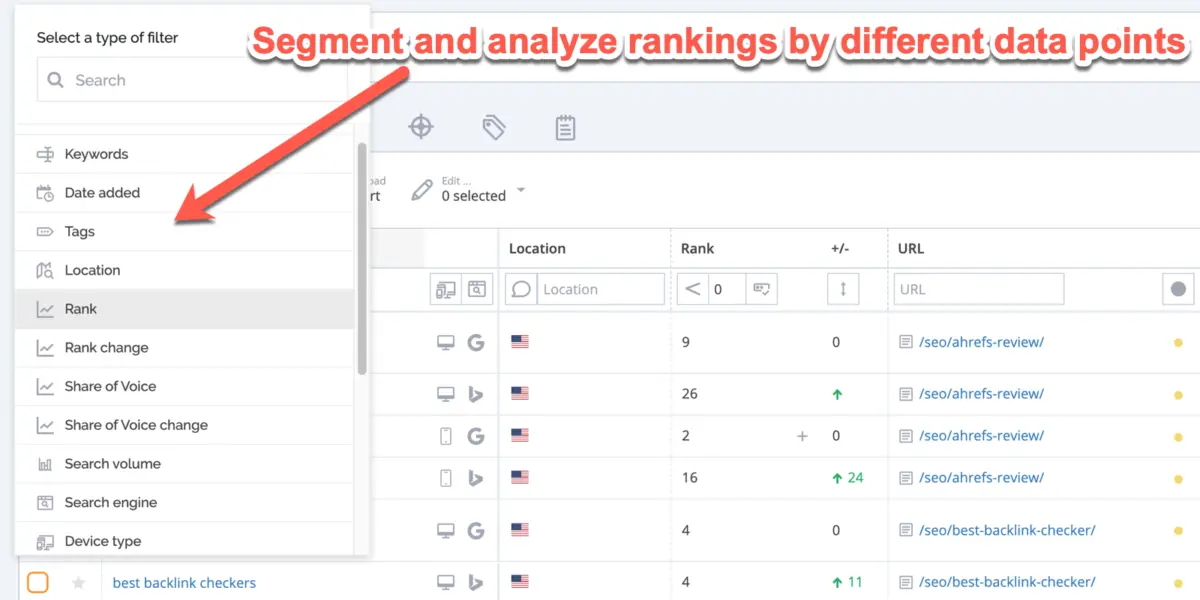
8. Tag and Segment Rankings Data
Large keyword portfolios can become unwieldy without proper organization. Keyword tagging lets you categorize terms by marketing funnel stage, topic cluster, product category, or content type, allowing you to run segmented performance reports tailored to specific stakeholders.
9. Generate White-Label Reports
For agencies and enterprise consultants, client-ready reporting is essential. Look for software that offers native white-label scheduling or robust integrations with visualization tools like Google Looker Studio and Databox to present clean, branded metrics automatically.
Official Statements & Industry Expert Perspectives
Industry leaders emphasize the importance of blending advanced rank tracking with visualization and attribution tools to maximize clarity for clients and stakeholders:
"The thing that really got me using them heavily in the last month or two is their Google Data Studio connector. Combining the tag feature, as well as the Share of Voice metric from AccuRanker has been a big help in making these reports immediately digestible."
— Ian Howells, Co-Founder, Traffic Think Tank
"It’s by far the best keyword ranking tracker in the market and has a ton of great reporting functions. If you want visibility on large volumes of keywords housed within a nice dashboard — this is for you."
— Matthew Howells-Barby, Co-Founder, Traffic Think Tank
7 Best SERP Tracking Tools to Consider in 2025
The market is filled with options, but a select few platforms consistently deliver the speed, accuracy, and depth required by modern SEO professionals. Here is our curated shortlist, divided into dedicated standalone solutions and all-in-one SEO suites.
Standalone SERP Trackers
1. AccuRanker
Overview: AccuRanker is widely regarded as one of the fastest and most accurate standalone SERP tracking platforms on the market. Trusted by over 32,000 companies—including major brands like HubSpot, IKEA, and Kinsta—it is built specifically for agencies and enterprise teams needing lightning-fast data.
Key Strengths: On-demand data updates, comprehensive SERP feature analysis, advanced Share of Voice metrics, and deep integrations with Google Analytics and Looker Studio.
Pricing: Subscription plans scale based on tracked keyword volume, starting at approximately $116/month for up to 1,000 keywords.
2. ProRankTracker
Overview: A cost-effective, highly reliable standalone rank tracking and reporting tool utilized by over 60,000 users worldwide.
Key Strengths: Excellent multi-language support, robust video rank tracking (YouTube), localized tracking precision, and scalable white-label reporting.
Pricing: Flexible tier structures starting at $39/month.
3. Advanced Web Ranking (AWR)
Overview: A veteran standalone SERP tracker utilized by thousands of enterprises and in-house teams (including Microsoft) to monitor multi-location performance.
Key Strengths: High cloud-processing speed, extensive search engine coverage, and powerful custom reporting builders.
Pricing: Subscription plans begin at $99/month.
All-In-One SEO Platforms with Powerful SERP Trackers
4. Semrush (Position Tracker & SERP Gap Analyzer)
Overview: Semrush is a powerhouse all-in-one digital marketing suite trusted by over 10 million users globally, including enterprise giants like Samsung, Vodafone, and Booking.com. Its Position Tracking tool rivals the speed and accuracy of dedicated standalone trackers.
Key Strengths: Daily rank updates, local map pack tracking, multi-device comparison, and the innovative SERP Gap Analyzer app in the Semrush App Center, which scans search engine results to uncover under-optimized content and low-hanging fruit keywords.
Pricing: Comprehensive platform subscriptions start at $139.95/month.
5. SERPWatcher (by Mangools)
Overview: Created by the Mangools team, SERPWatcher is an affordable, visually intuitive tracker trusted by major brands like Airbnb and Adidas.
Key Strengths: The proprietary Performance Index metric, which measures organic traffic potential based on current rankings, alongside user-friendly dashboards and auxiliary SERPChecker tools.
Pricing: Entry-level plans begin at $29.90/month.
6. SE Ranking
Overview: An exceptionally versatile all-in-one SEO toolset featuring a highly reliable Position Tracking module that simulates real user behavior across targeted geographic coordinates.
Key Strengths: 100% accurate location-based simulation, robust competitor ranking distribution analysis, and comprehensive site audit integrations.
Pricing: Plans start at $52/month based on daily updates for 500 keywords.
7. Nightwatch
Overview: A precision-driven daily rank tracker trusted by high-growth companies like Shopify, Scotiabank, and Coinbase, capable of extracting rankings across over 107,000 worldwide locations.
Key Strengths: Advanced data segmentation, incredible geographic depth, and clean, modern user interfaces.
Pricing: Offers a 14-day free trial, with paid plans starting at $32/month for up to 250 keywords.
Future Outlook: What Lies Ahead for SERP Tracking?
As search engines continue to integrate generative artificial intelligence, zero-click searches, and conversational interfaces into their core products, the nature of visibility is shifting. The traditional blue link is sharing screen space with dynamic conversational summaries and rich media modules.
Looking forward, the best SERP tracking tools will not only monitor traditional numerical positions but will also quantify brand presence within AI-generated answers, measure sentiment shifts across multi-modal search engines, and provide predictive intelligence that automates content optimization before traffic drops occur.
Whether you choose a dedicated specialist tool like AccuRanker for sheer speed and depth, or opt for an all-in-one powerhouse like Semrush for comprehensive digital marketing visibility, investing in the right tracking infrastructure today ensures your organization remains resilient, competitive, and profitable in the search landscape of tomorrow.


![7 Best SERP Tracking Tools for 2022 [In-Depth Review]](https://www.robbierichards.com/wp-content/uploads/2020/05/Best-SERP-Trackers.jpg)
![7 Best SERP Tracking Tools for 2022 [In-Depth Review]](https://www.robbierichards.com/wp-content/uploads/2020/04/image16-2.png)
![7 Best SERP Tracking Tools for 2022 [In-Depth Review]](https://www.robbierichards.com/wp-content/uploads/2020/04/image2-3.png)
![7 Best SERP Tracking Tools for 2022 [In-Depth Review]](https://www.robbierichards.com/wp-content/uploads/2020/04/image6-2.png)
![7 Best SERP Tracking Tools for 2022 [In-Depth Review]](https://www.robbierichards.com/wp-content/uploads/2020/04/image15.jpg)
![7 Best SERP Tracking Tools for 2022 [In-Depth Review]](https://www.robbierichards.com/wp-content/uploads/2020/04/image12-1.png)
![7 Best SERP Tracking Tools for 2022 [In-Depth Review]](https://www.robbierichards.com/wp-content/uploads/2020/04/image13-2.png)
![7 Best SERP Tracking Tools for 2022 [In-Depth Review]](https://www.robbierichards.com/wp-content/uploads/2020/04/image3.jpg)
![7 Best SERP Tracking Tools for 2022 [In-Depth Review]](https://www.robbierichards.com/wp-content/uploads/2018/08/rj-employee_Robbie-color-new.png)
![7 Best SERP Tracking Tools for 2022 [In-Depth Review]](https://www.robbierichards.com/wp-content/uploads/2020/05/Databox-SEO-dashboard-1.jpg)
![7 Best SERP Tracking Tools for 2022 [In-Depth Review]](https://www.robbierichards.com/wp-content/uploads/2020/04/image4-2.png)
![7 Best SERP Tracking Tools for 2022 [In-Depth Review]](https://www.robbierichards.com/wp-content/uploads/2020/04/image5.jpg)
![7 Best SERP Tracking Tools for 2022 [In-Depth Review]](https://www.robbierichards.com/wp-content/uploads/2020/05/AccuRanker-Google-Data-Studio-integration.jpg)
![7 Best SERP Tracking Tools for 2022 [In-Depth Review]](https://www.robbierichards.com/wp-content/uploads/2018/11/Ian-Howells2.png)
![7 Best SERP Tracking Tools for 2022 [In-Depth Review]](https://www.robbierichards.com/wp-content/uploads/2019/01/Google-Data-Studio-KW-rankings-dashboard.png)
![7 Best SERP Tracking Tools for 2022 [In-Depth Review]](https://www.robbierichards.com/wp-content/uploads/2025/01/AccuRanker-home-page.jpg)
![7 Best SERP Tracking Tools for 2022 [In-Depth Review]](https://www.robbierichards.com/wp-content/uploads/2015/01/matthew-barby.jpg)
![7 Best SERP Tracking Tools for 2022 [In-Depth Review]](https://www.robbierichards.com/wp-content/uploads/2022/06/image1-1.png)
![7 Best SERP Tracking Tools for 2022 [In-Depth Review]](https://www.robbierichards.com/wp-content/uploads/2025/01/Semrush-SERP-Gap-Analyzer-1024x447.png)
![7 Best SERP Tracking Tools for 2022 [In-Depth Review]](https://www.robbierichards.com/wp-content/uploads/2025/01/Semrush-SERP-Gap-Analyzer-Search-Console-integration.png)
![7 Best SERP Tracking Tools for 2022 [In-Depth Review]](https://www.robbierichards.com/wp-content/uploads/2020/04/image10-2.png)
![7 Best SERP Tracking Tools for 2022 [In-Depth Review]](https://www.robbierichards.com/wp-content/uploads/2025/01/Advanced-Web-Ranking.jpg)