

Executive Overview
In the sprawling, multidisciplinary ecosystem of modern digital product development, few challenges are as pervasive, persistent, and quietly damaging as the problem of naming. Whether it is a software engineer trying to parse an ambiguous JavaScript variable, a product manager struggling to explain a low-adoption feature, or a UI designer attempting to structure a scalable design token taxonomy, the words we choose profoundly shape our software, our workflows, and our cross-functional collaborations.
Naming is hard because language itself is fluid, subjective, and prone to siloed dialects. Designers speak in visual hierarchies and spatial metaphors; developers communicate in programmatic logic and state machines; product managers deliberate over business metrics and user journeys; and end-users experience the interface through the pragmatic lens of their immediate tasks. When these four groups fail to share a common vocabulary, friction ensues. Teams waste countless hours debating what to call the exact same component, feature, or asset, leading to fragmented codebases, inconsistent user interfaces, and widespread internal confusion.

This comprehensive guide serves as an authoritative compendium of practical frameworks, battle-tested methodologies, and high-value resources curated to solve the nomenclature crisis. Spanning everything from foundational HTML classes and color variables to intricate multi-brand design token taxonomies and user-centric feature naming, this article provides the structural clarity required to build scalable, resilient, and universally understood digital experiences.
The Anatomy of the Naming Crisis: Why Words Matter
The aphorism attributed to computer scientist Phil Karlton—"There are only two hard things in Computer Science: cache invalidation and naming things"—rings equally true in the realm of user experience (UX) and interface design. The language we deploy does more than simply label artifacts; it actively constructs our conceptual models.

When names are too generic (such as calling a button .btn or a container .box), they strip away semantic meaning, forcing developers and designers to inspect implementation details to understand intent. Conversely, when names are too specific (such as naming a component .blue-submit-button-footer), they destroy flexibility, creating brittle styling structures that shatter the moment a redesign introduces a new brand color or placement.
The root cause of this tension is linguistic fragmentation. In a typical product organization, siloed teams develop localized dialects:

- The Designer’s Dialect: Focuses on layout, visual properties, and atomic elements (e.g., Rectangle 42, Drop Shadow Large).
- The Developer’s Dialect: Focuses on structural hierarchy, DOM elements, and programmatic abstractions (e.g.,
div.flex-col-reverse,handleClickPrimary). - The Product Manager’s Dialect: Focuses on feature parity, business outcomes, and analytics tracking (e.g., UserOnboardingStep2VariantB).
- The User’s Dialect: Focuses on mental models, tangible outcomes, and plain language (e.g., Billing History, Save Progress).
Bridging these dialects is not merely an exercise in semantic neatness; it is an operational imperative. Low feature adoption and poor interface discoverability can frequently be traced back to opaque naming conventions that fail to resonate with how users actually think and speak.
Detailed Chronology & Frameworks for Comprehensive Naming
To establish a bulletproof naming infrastructure across an organization, teams must approach nomenclature systematically across multiple layers of the product stack. Below is a structured blueprint detailing how to tackle naming across code, color systems, layout layers, design tokens, UI components, and features.

1. Inspiring Code and Semantic Elements
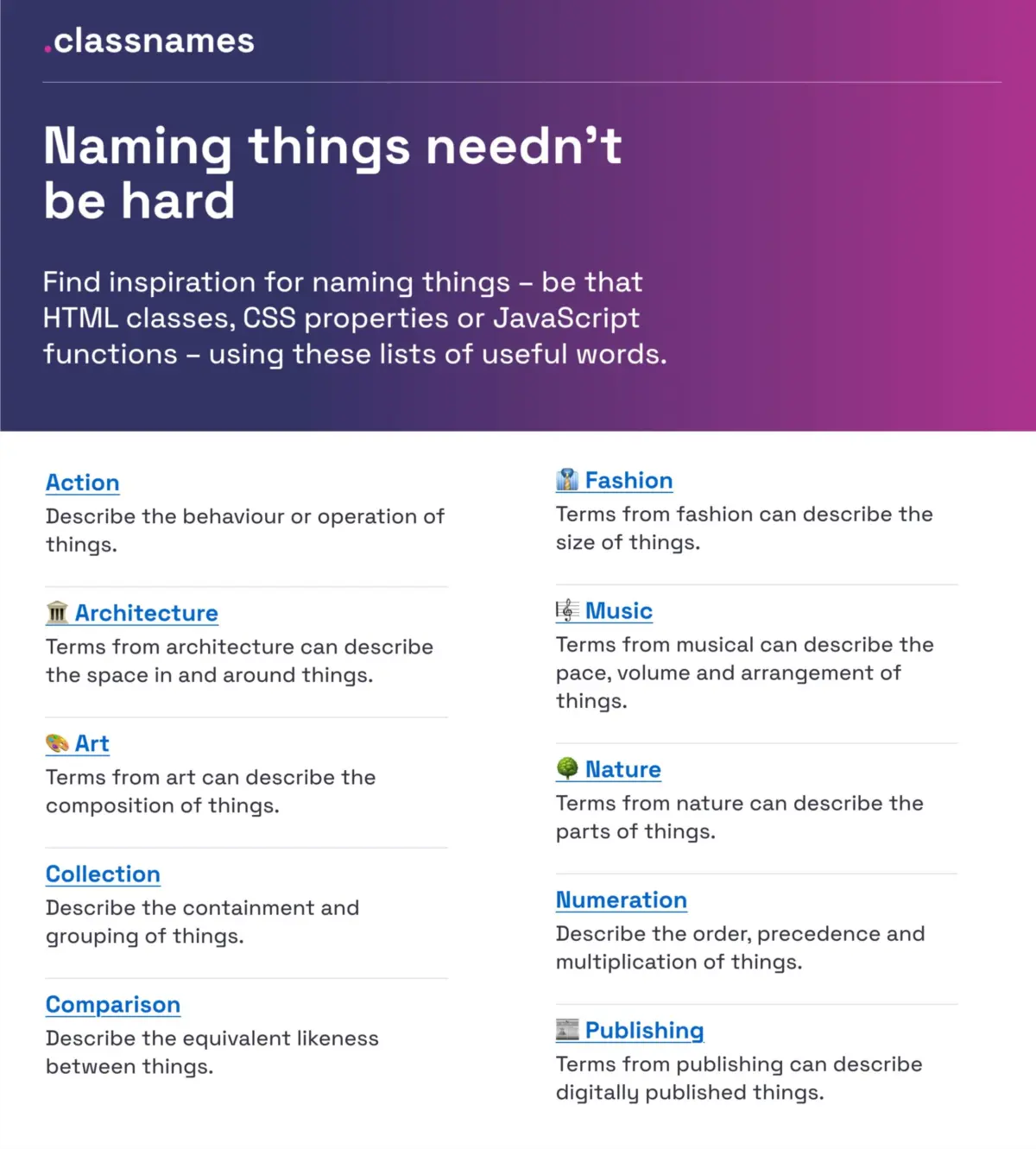
When looking for inspiration for HTML classes, CSS properties, or JavaScript functions, developers often fall into repetitive, unimaginative patterns. To break out of this echo chamber, resources like Classnames (developed by Paul Robert Lloyd) provide meticulously curated, thematically grouped lists of words.
- Moving beyond basic utility terms, these collections incorporate evocative terminology drawn from nature, architecture, publishing, fashion, theater, and art.
- By employing richer metaphors, developers can construct semantic class names that communicate systemic relationships, behaviors, and groupings with surgical precision.
2. Standardizing Color Nomenclature
Color naming is notoriously subjective. One team member’s "Periwinkle" is another’s "Soft Indigo." To eliminate ambiguity, David Aerne’s expansive Color Names repository—housing over 30,000 unique, crowdsourced color names paired with accessible tools like the Color Parrot picker—serves as an invaluable baseline. Establishing a definitive color dictionary ensures that design tokens and CSS variables maintain absolute consistency across multi-platform applications.

3. Structuring Layers, Groups, and Components
In design tools like Figma or Sketch, messy file organization scales exponentially, choking design systems before they even launch. Javier Cuello’s framework for design layer and group best practices highlights the core pillars of effective naming:
- Logical Structure: Names must follow a predictable, hierarchical pattern.
- Conciseness: Keep names short without sacrificing clarity.
- Universality: The terminology must be instantly understood by every member of the design and engineering squads.
- Abstraction from Visual Properties: Avoid naming layers after transient visual styles (e.g., avoid
.RedBoxin favor of.AlertContainer).
4. Designing Scalable Design Token Taxonomies
As organizations grow to support multiple brands, themes, and products (such as Intuit’s portfolio featuring Mailchimp, QuickBooks, TurboTax, and Mint), a rigid, single-tier token structure inevitably breaks. Nate Baldwin’s case study on Intuit’s design token taxonomy outlines the rigorous criteria required to design a flexible, multi-tier token system.
Similarly, the Vodafone UK Design System team demonstrated architectural mastery through their Variables Taxonomy Map in Figma. Building upon Nathan Curtis’s foundational work, Vodafone established a four-tier architecture connecting tokens seamlessly:
- Brand Tokens: Core variables tied to overarching visual identities.
- Primitive Tokens: Raw values (colors, spacing scales, typographic sizes).
- Semantic Tokens: Contextual variables that assign meaning to primitives (e.g.,
color.background.error). - Component/Page Tokens: Highly specific variables mapped directly to individual UI elements or page contexts.
For teams building similar systems, interactive solutions like Romina Kavcic’s Design Token Naming Guide + Builder and accompanying Design Token Names Inventory spreadsheet provide structured, filterable frameworks to manage hundreds of variables without losing administrative oversight.

5. Categorizing UI Components
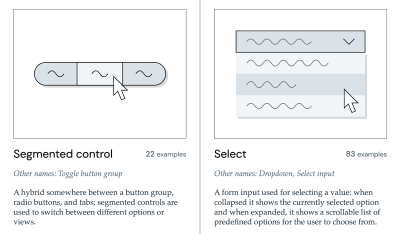
Reinventing the wheel when naming standard interface elements is a massive drain on productivity. Iain Bean’s Component Gallery aggregates dozens of real-world design systems, documenting more than 50 common UI components—from accordions to visually hidden text—alongside the alternative aliases they go by in the wild. Pairing this with visual dictionaries like Name That UI ensures that designers and developers speak the exact same language when referencing interactive elements.
6. Naming User-Facing Features for Maximum Adoption
Even the most brilliantly engineered feature will suffer from abysmal adoption rates if its discoverability is crippled by obscure internal codenames. As Erin Gannon notes in her practical guide on feature naming, product nomenclature must be relentlessly driven by user needs and outcomes.

- Avoid internal corporate jargon, clever marketing puns, or technical acronyms.
- Center feature names around the user’s "job-to-be-done."
- Conduct qualitative research: ask users to describe a feature’s utility in their own words, and integrate their exact vocabulary into the interface.
7. Product and Service Nomenclature
At the macro level, naming a standalone product or service requires balancing market differentiation, trademark clearance, and brand resonance. Open-source repositories like Onym aggregate brainstorming tools, etymological resources, sprint methodologies, and vetting frameworks to guide cross-functional teams through the perilous waters of product naming.
Supporting Context & Metrics: The Cost of Semantic Misalignment
While naming is frequently treated as an aesthetic or secondary concern, its failure incurs massive quantifiable costs across software development lifecycles:

- Onboarding Latency: New engineers and designers spend an average of 15% to 20% more time getting up to speed in repositories with undocumented, ad-hoc naming conventions.
- Refactoring Debt: Poorly named design tokens and CSS classes account for up to 30% of unnecessary code bloat during routine style updates and design system migrations.
- Conversion Drop-offs: Features launched with obscure, engineering-driven internal titles experience up to a 45% lower initial discovery rate compared to features named using direct, user-tested mental models.
By investing in systematic nomenclature early in the product lifecycle, organizations drastically reduce cognitive load, accelerate velocity, and foster seamless handoffs between design, product, and engineering.
Official Guidance and Industry Best Practices
Leading design systems teams and accessibility advocates emphasize several golden rules for maintaining pristine naming hygiene:

- Adopt a Unified Taxonomy: Establish a centralized source of truth (such as a shared Figma variables map or documented token dictionary) that maps design tokens directly to code variables.
- Audit for Naming Conflicts: Treat conflicting terminology as technical debt. Maintain a dedicated backlog for reviewing, deprecating, and renaming ambiguous classes, tokens, and component variants.
- Prioritize Plain Language: In user-facing copy and feature titles, clarity always trumps cleverness. Ensure that the interface speaks the user’s language, not the organizational chart’s language.
- Document the "Why": When introducing abstract or semantic names, include contextual documentation explaining the rationale behind the choice to prevent future teams from misunderstanding the intent.
Future Outlook: The Evolution of Naming in the Age of AI
As artificial intelligence and automated design-to-code pipelines become deeply integrated into software development, the importance of rigorous naming conventions is set to accelerate exponentially. AI interface design patterns, automated code generation tools, and intelligent design systems rely entirely on semantic clarity to interpret intent and generate accurate UI code.
When tokens, classes, and components are structured with clean, predictable taxonomies, AI models can reason about layouts, accessibility requirements, and state changes with superhuman accuracy. Conversely, messy, ambiguous naming structures will cause AI-driven automation to fail, producing brittle code and broken user experiences.

Mastering the lexicon of digital products is no longer just about keeping codebases clean—it is about future-proofing organizations for an era where human intent must be seamlessly translated into machine execution. By leveraging established taxonomies, community-driven component galleries, and user-centric naming frameworks, product teams can finally bridge the gap between design and code, driving clarity, efficiency, and exceptional user value.