In the realm of digital product development, computing science has historically prioritized execution over nomenclature. Yet, modern software engineering and UX design operate in a shared linguistic space where one timeless adage continually proves true: there are only two hard things in computer science: cache invalidation and naming things.
The language we choose does not merely label our work; it actively shapes our conceptual models, dictates team dynamics, and frames the ongoing dialogue between cross-functional squads. When design systems falter, when codebases grow brittle, and when new software features suffer from abysmal user adoption rates, the root cause is frequently traced back to a systemic failure of vocabulary. Ambiguous, overly generic names obscure intent, while overly rigid, hyper-specific designations strangle flexibility and reuse.
This comprehensive guide explores the complexities of nomenclature across the digital landscape. Drawing on cutting-edge industry practices, open-source repositories, and enterprise-level case studies from global brands, we examine the structural frameworks required to name everything from microscopic code variables and UI layers to complex design tokens, visual elements, and whole consumer-facing products. By establishing a unified taxonomy, product teams can bridge the persistent translation gaps between designers, developers, product managers, and end-users.
Detailed Chronology: The Evolution of Digital Nomenclature
To understand why naming remains a chronic pain point in modern product development, we must trace how software architecture and design tools have evolved over the past two decades.
The Wild West of Web Development (Late 1990s – Early 2010s)
In the infancy of web design, CSS classes and HTML identifiers were concocted on the fly with little regard for scalability. Developers relied heavily on visual descriptors or arbitrary abbreviations—such as .blue-box, .left-sidebar-2, or #main_header_wrapper_final.
As applications scaled, this localized approach collapsed. A redesign that changed a sidebar from blue to grey immediately invalidated the semantics of .blue-box, forcing developers to either maintain misleading codebases or engage in tedious refactoring cycles. Design files in early vector tools suffered from parallel chaos, littered with layers named Rectangle 402, Group copy 3, and Path_final_v2.
The Rise of Modular Design Systems (Mid 2010s – 2020)
As digital products matured into complex, multi-platform ecosystems, the industry recognized that software needed to be built like modular architecture. methodologies like BEM (Block, Element, Modifier), SMACSS, and atomic design forced teams to think systematically about UI components.
Concurrently, the introduction of design tokens transformed how styling values were stored and transferred between design tools and code repositories. However, this transition created a new linguistic bottleneck. Without an agreed-upon taxonomy, design systems teams struggled to establish hierarchies that satisfied both aesthetic flexibility and programmatic logic. Engineers wanted structural, state-based identifiers, while designers naturally gravitated toward visual or brand-centric terminologies.
The Unified, Multi-Brand Taxonomy Era (Present Day)
Today, enterprise organizations manage massive multi-brand portfolios from a single design system. Companies like Intuit, Vodafone, and global SaaS providers must construct design token taxonomies that effortlessly cascade across distinct product lines, themes, and regional markets. Modern nomenclature is no longer viewed as an afterthought or a trivial administrative task; it is recognized as a foundational architecture that dictates developer velocity, design consistency, and end-user comprehension.
Supporting Context & Metrics: The Cost of Semantic Friction
The friction caused by poor naming conventions manifests in quantifiable inefficiencies across the product lifecycle. When team members speak in different "dialects"—the designer’s dialect, the developer’s dialect, the product manager’s dialect, and the user’s dialect—valuable hours are lost translating concepts and clarifying intent.
The Four Dialect Problem in Product Teams
The Designer Dialect: Tends to focus on spatial relationships, visual states, brand expressions, and immediate user feedback (e.g., Primary Button Hover, Card Elevation High).
The Developer Dialect: Prioritizes component encapsulation, state machines, variable scopes, and programmatic constraints (e.g., Button–disabled, Surface-Container-Highest).
The Product Manager Dialect: Centers on business metrics, user journeys, feature discovery, and value delivery (e.g., Onboarding-Upsell-Module, Checkout-Friction-Reducer).
The User Dialect: Relies on plain, action-oriented language driven by immediate needs and mental models (e.g., Save My Progress, Billing History).
When these four groups fail to harmonize their vocabulary, systems fracture. For instance, low feature adoption is frequently diagnosed as a UX problem when it is actually a discoverability and naming failure. If a feature’s name does not map onto the user’s mental model or job-to-be-done, the user will bypass it entirely, regardless of how polished the underlying interface may be.
Practical Strategies for Naming UI Components and Assets
Mastering nomenclature requires a combination of creative exploration, strict structural rules, and reliance on peer-tested community standards. Below are the definitive frameworks and tools for naming every layer of the digital stack.
1. Naming Code, Classes, and Functions
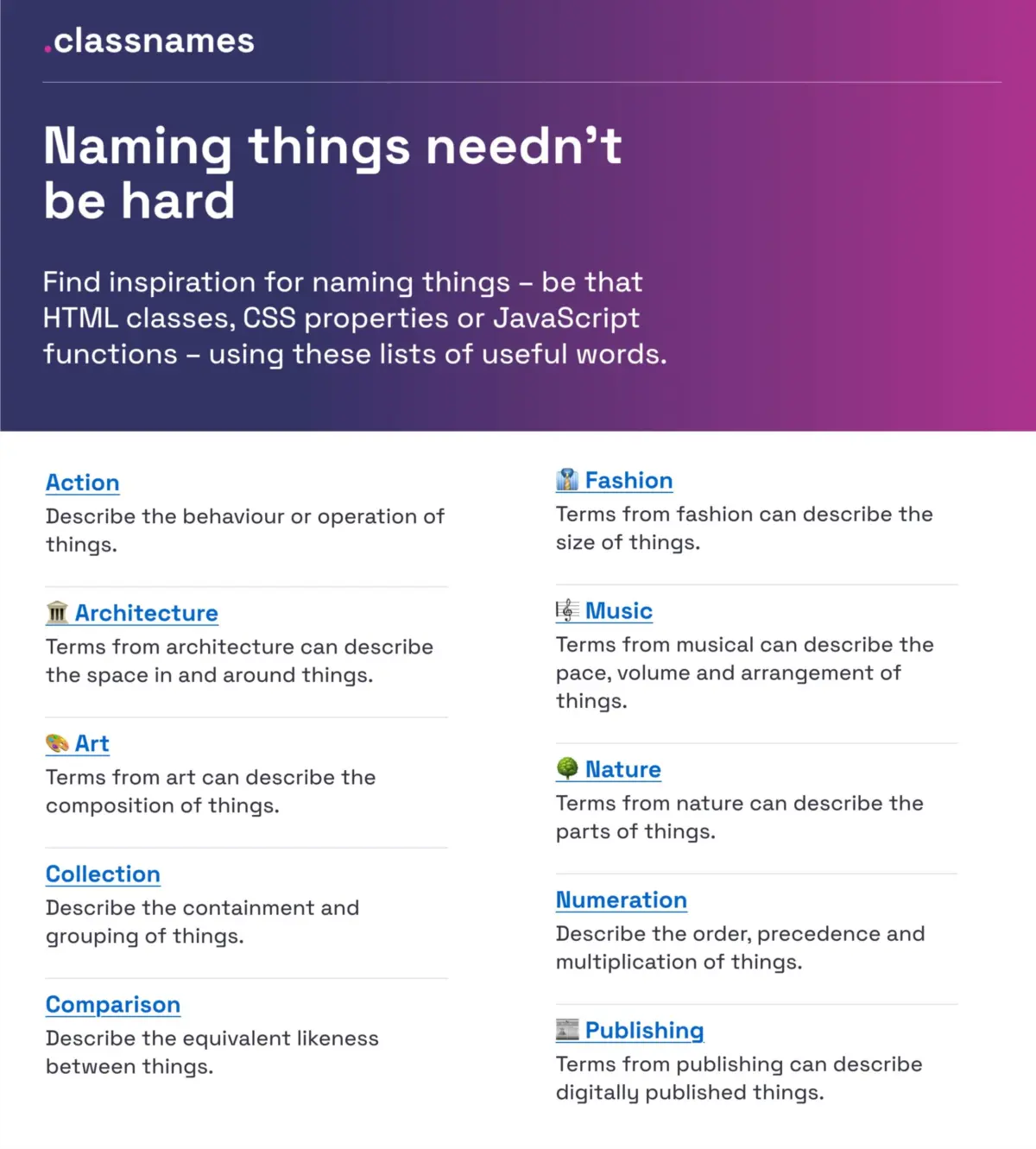
When searching for inspiration beyond standard technical descriptors, resources like Classnames provide thematically grouped lists of words that encourage creative thinking. Instead of defaulting to generic terms, developers can draw from structured vocabularies covering behavior, grouping, and association, as well as unconventional thematic collections drawn from nature, architecture, publishing, and the arts.
2. Standardizing Colors and Design Tokens
Naming colors has historically been subjective and chaotic. Repositories like David Aerne’s Color Names project—featuring over 30,000 unique, user-contributed color names paired with search tools like Color Parrot—demonstrate the power of giving concrete identities to chromatic values.
At an enterprise level, design token naming requires strict architectural rigor. Building on foundational concepts by experts like Nathan Curtis, modern token systems generally follow a multi-tier taxonomy:
Global/Primitive Tokens: Raw values detached from context (e.g., blue-500, spacing-16).
Semantic/Alias Tokens: Tokens assigned to a specific purpose or intent (e.g., color-background-interactive-primary).
Component-Specific Tokens: Highly contextual tokens scoped to a single UI element (e.g., button-bg-color-active).
Advanced implementations, such as the Vodafone UK Design System’s Variables Taxonomy Map, illustrate how multi-brand and multi-themed environments manage complex token connections from brand primitives down to page-level semantics. Similarly, tools like Romina Kavcic’s Design Token Naming Guide and accompanying spreadsheet inventories offer practical frameworks to maintain bird’s-eye visibility across expansive token trees without losing track of states, roles, and categories.
3. Layers, Groups, and Components in Design Files
Effective design file hygiene relies on clear, scalable naming conventions. According to design system best practices outlined by experts like Javier Cuello, an effective layer or component name must possess the following characteristics:
Conciseness: Short and easily scannable in a dense layer tree.
Universal Meaning: Instantly understood by any team member or incoming contributor.
Property Independence: Avoids hardcoding visual properties (e.g., avoid naming a component BlueButton when its color may dynamically shift based on themes).
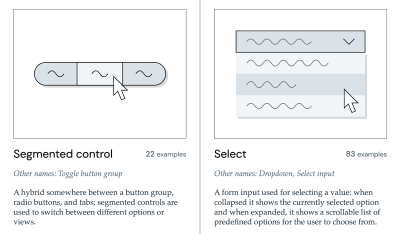
For interface components specifically, referencing established repositories like Iain Bean’s Component Gallery or visual dictionaries like Name That UI allows designers and developers to align with industry-standard terminology across more than 50 common UI patterns, from accordions to visually hidden elements.
4. Crafting Discoverable Feature Names
Naming new software features requires shifting the perspective entirely outward toward the end-user. As outlined in practical UX frameworks by Erin Gannon, feature nomenclature must be driven by user needs and concrete problems rather than internal engineering codenames.
Signal Value and Outcomes: A feature name should clearly communicate the "job-to-be-done."
Adopt the User’s Lexicon: Conduct user interviews to discover how target audiences naturally describe their tasks, then mirror that exact phrasing in the UI copy.
Official Statements and Industry Insights
Industry leaders continually emphasize that nomenclature is an organization-wide discipline rather than a superficial styling preference.
"The language we use shapes the way we think about things, but also the conversation we have about it. That’s why we have so much confusion about colors, icons, UI components, and features — and that’s why we struggle to name design tokens, HTML classes, and variables."
— The Smashing Editorial Collective
When enterprise design systems successfully unify their token taxonomies, the cultural shift within the engineering and design organizations is profound. Teams transition from reactive firefighting and arguing over arbitrary naming conventions to proactive, scalable product development. By establishing an authoritative, shared dictionary, organizations eliminate the "translation tax" that drains productivity across cross-functional squads.
Future Outlook: The Next Horizon in Digital Taxonomy
As the digital product landscape continues to evolve, the methodologies governing nomenclature are poised for further automation and standardization.
AI-Assisted Taxonomy Generation: Future design systems and codebases will likely leverage Large Language Models (LLMs) trained on established design token taxonomies and UI component galleries to automatically suggest semantically correct, compliant names for new variables and components in real time.
Automated Semantic Linting: Code linters and design system plugins will evolve beyond syntax checking to enforce naming hygiene automatically—flagging generic terms like box-1 or primary-new and suggesting contextual, semantic alternatives based on organizational rulesets.
Cross-Platform Synchronization: As tools bridge the gap between design files and production code even further, unified naming maps will serve as an automated, single source of truth that updates design tokens, documentation, and codebase variables simultaneously across multi-brand architectures.
Wrapping Up
The right name is ultimately the one that is well-understood, universally accepted, and actively utilized by both the product team and the end-user. Much of the daily friction in software development stems not from technical limitations, but from speaking in disparate dialects. By investing time in establishing robust naming conventions, eliminating naming conflicts, and treating vocabulary as a core architectural asset, organizations can drastically reduce confusion, foster seamless collaboration, and build more resilient, intuitive digital products.