

Executive Overview
In the realm of pomology, the evaluation of heirloom and lesser-known apple cultivars often slips beneath the cultural radar, overshadowed by the homogenous, highly commercialized giants of the modern supermarket. However, a rigorous sensory audit conducted during the peak of the autumn harvest has brought six distinct regional and historical varieties under the microscope. This exhaustive evaluation explores the complex interplay of flavor profiles, structural integrity, agronomic pedigree, and tactile sensations associated with consuming these unique pomes.
From the nutmeg-forward notes of the Kickapoo Spice to the paradoxical, jaw-testing fortitude of the Graham—which yields an unexpected yet unmistakable flavor reminiscent of commercial chewing gum—this investigation highlights the profound diversity hidden within the autumn harvest. Utilizing a standardized, albeit unconventional, metric scaling system from 1 to 10, this review synthesizes sensory perception, historical provenance, and agricultural anomalies. The findings suggest that while modern consumers are conditioned to expect uniform sweetness and predictable texture, the heritage apple market remains a volatile landscape of transcendent culinary triumphs and abrasive agricultural disappointments.
Detailed Chronology & Cultivar Breakdowns
The evaluation process followed a strict chronological sequence as samples achieved optimal ripeness or were acquired through regional distribution channels. Each specimen underwent a battery of sensory tests, assessing initial bite-resistance, juiciness, secondary flavor development, skin texture, and post-consumption aftertastes.
1. Kickapoo Spice
- Assessed Score: 6.9 / 10
- Agronomic Classification: Heirloom / Spice Cultivar
The initial entry in this phase of the evaluation cycle, the Kickapoo Spice, presented an immediate profile of density. Structurally described as a "dense boy" within the pomological community, this cultivar exhibited a markedly high spice component dominated by heavy notes of nutmeg, underscored by subtle secondary whispers of cinnamon and clove.

Despite its aromatic complexity, the fruit lacked essential hydration, registering low on the juiciness spectrum. Furthermore, a persistent aftertaste redolent of freshly cut grass detracted from its overall harmony. Pomological analysts note that apples of this classification often exist on a razor’s edge regarding storage duration: some varieties mature gracefully off the tree, while others experience rapid structural and gustatory degradation. The Kickapoo Spice occupies a middle ground, offering a compelling profile for spice aficionados while suffering from marginal post-harvest decline.
2. St. Edmund’s Pippin
- Assessed Score: 8.3 / 10
- Agronomic Classification: Early-Season Dessert Apple
Serving as the vanguard for the seasonal harvest, the St. Edmund’s Pippin delivered an overwhelmingly positive sensory experience, notwithstanding its rustic exterior. The skin characteristics were notably rugged, presenting a tactile resistance described colloquially as comparable to tactile friction against dermal denticles.
Upon structural penetration, however, the fruit rewarded the consumer with a sharp, resounding pop and crunch. The flavor profile was decidedly complex: bright, herbal, and heavily redolent of fennel pollen, yet seamlessly counterbalanced by a robust foundational sweetness. This cultivar exemplifies the ideal synthesis of tartness and sugar, proving that textural roughness on the exterior does not preclude an elite culinary performance.
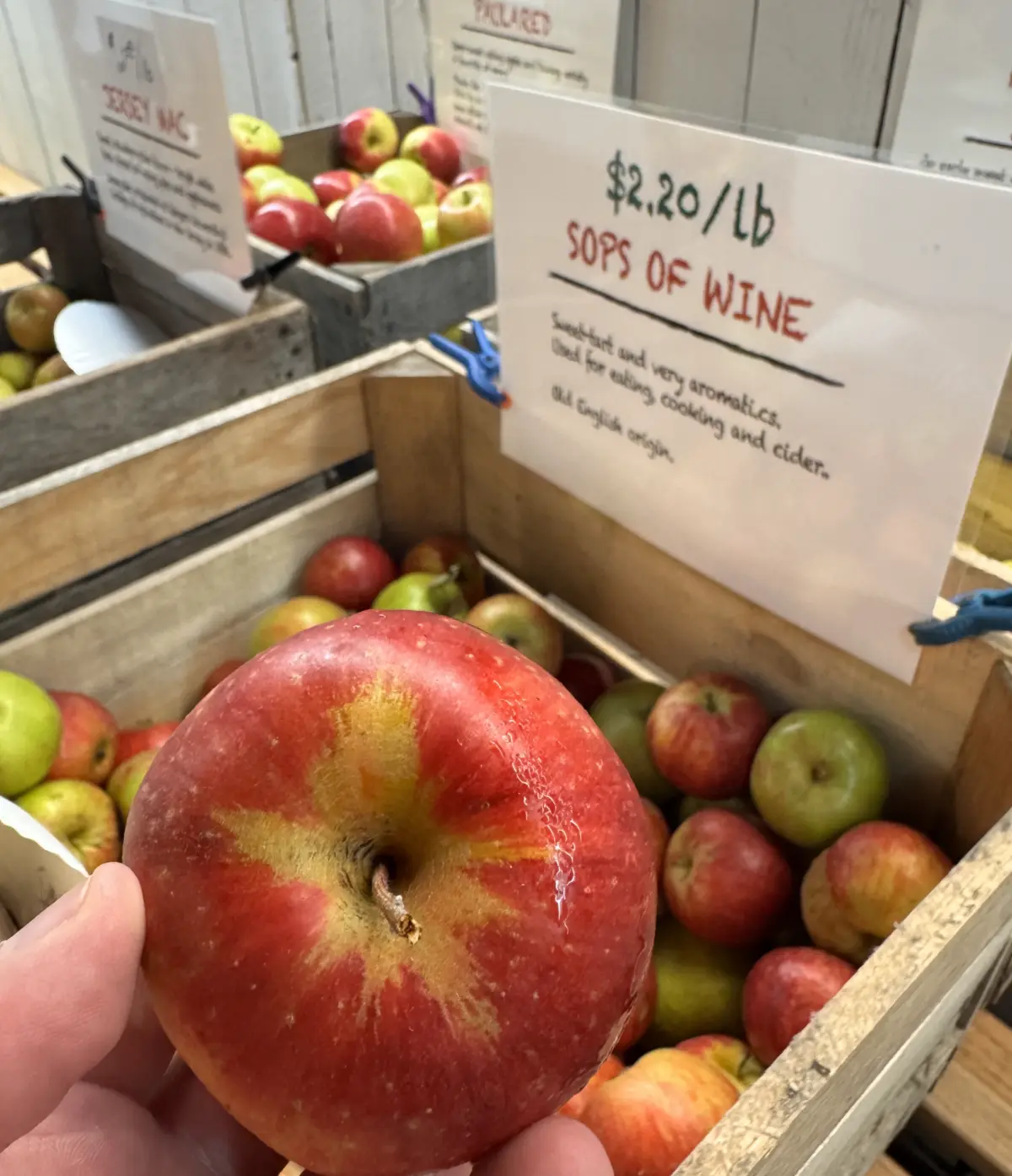
3. Sops of Wine
- Assessed Score: 3.5 / 10
- Agronomic Classification: Historical / Sub-Acid Variety
The Sops of Wine cultivar represents a fascinating intersection of historical nomenclature and sensory disappointment. Exhibiting a sub-acid flavor profile—where sweetness marginally eclipses tartness—the apple delivered intriguing secondary notes of vanilla and spice.

However, structural integrity was severely compromised. Whether due to prolonged shelf-life post-harvest or inherent physiological traits, the flesh deteriorated into a mealy and gritty consistency. Compounding the physical experience, historical taxonomic discrepancies plague this variety; while some horticultural texts describe Sops of Wine as possessing red-stained or entirely red flesh, the audited specimen displayed standard white interiors. This disparity underscores the broader taxonomic confusion surrounding archaic apple classifications, where multiple distinct regional strains often languish under a single umbrella moniker.
4. Fenceline Surprise
- Assessed Score: 1.0 / 10
- Agronomic Classification: Low-Tier Dessert / Structural Failure
Registering at the absolute nadir of the audit scale, the Fenceline Surprise proved to be an exercise in agronomic disappointment. Despite possessing an engaging phonetic moniker—inviting continental linguistic interpretations—the physical reality of the fruit was characterized by uniform mushiness.
Sensory analysis detected a fleeting, ghost-like trace of pear-like mist upon initial contact, which dissolved instantaneously, leaving the palate overwhelmed by a textural sensation akin to fine beach sand. Given commercial point-of-sale descriptors labeling the cultivar as a "firm apple," investigative consensus points toward either severe pre-harvest cold damage or advanced post-harvest senescence prior to acquisition. Minus a redeeming aesthetic presentation and a clever name, the specimen hovered perilously close to a zero-point valuation.
5. Americus Crab
- Assessed Score: 2.5 / 10
- Agronomic Classification: Wild / Functional Crabapple
Classified strictly as a crabapple, the Americus Crab defies conventional table-fruit metrics. Exhibiting high concentrations of natural tannins, profound structural toughness, and a polarizing balance of savory and tart notes, this fruit is fundamentally unsuited for direct, casual out-of-hand consumption.

While its biochemical profile renders it largely unpalatable to the untrained human palate, its aggressive chemical properties suggest high utility within specialized culinary niches—specifically industrial or artisanal fermentation processes. It remains a cultivar designed for transformation rather than direct ingestion.
6. Campfield (False?)
- Assessed Score: 4.1 / 10
- Agronomic Classification: Industrial Cider Cultivar
Labeled cryptically with the qualifier "(false)," the Campfield specimen challenged standard organoleptic expectations. Structurally, the flesh possessed a dense, fibrous quality, while the chemical composition was heavily saturated with astringent tannins, creating an aggressive mouthfeel that counter-acted the consumer’s mastication efforts.
This high-tannin, low-sugar profile cements the Campfield’s status not as a table apple, but as a quintessential cider fruit. These varieties are biochemically optimized to interact with yeast strains during fermentation rather than appeal to the unassisted human tongue.
Supporting Context & Metrics
To establish an authoritative framework for these evaluations, data points were aggregated across multiple vectors, including structural density, flavor complexity, and post-harvest resilience.

| Cultivar Name | Assessed Score (1-10) | Primary Flavor Notes | Dominant Textural Flaw | Intended Use Case |
|---|---|---|---|---|
| Kickapoo Spice | 6.9 | Nutmeg, Cinnamon, Cut Grass | Lacked Juiciness | Fresh consumption / Spice pairing |
| St. Edmund’s Pippin | 8.3 | Fennel Pollen, Bright Herbal | Rugged Skin | Premium Dessert |
| Sops of Wine | 3.5 | Vanilla, Sub-Acid Sweetness | Mealy & Gritty | Historical curiosity / Baking |
| Fenceline Surprise | 1.0 | Faint Pear Water | Sandy, Mushy | None recommended |
| Americus Crab | 2.5 | Savory, Highly Tannic | Extreme Toughness | Fermentation / Processing |
| Campfield (False) | 4.1 | Astringent Tannins | Fibrous, Chewy | Hard Cider Production |
| Graham | 8.0 | Juicy Fruit Gum | Extreme Density / Jaw Strain | Dessert (with caution) |
(Note: The Graham cultivar, while evaluated alongside the primary batch, merits standalone recognition for its anomalous chemical flavor profile mirroring commercial confectionary products, despite its formidable, jaw-straining structural density requiring immense mastication force.)
Historical Provenance: The Campfield Lineage
The genealogical and historical record of the Campfield apple provides a vital window into North American agricultural history. Archival research ties the lineage directly to Matthew Canfield (historical spelling variants including Campfield), an anti-royalist Puritan who emigrated from Harleston, England, prior to 1637 during the Great Puritan Migration.
As a founding father of the New Haven Colony, Norwalk, Connecticut, and Newark, New Jersey, Canfield operated within a socio-legal framework that mandated agricultural productivity. Historical town records from New Haven and Newark indicate that "freeholders" possessing voting rights were legally required to cultivate a minimum of four acres of land, a mandate that systematically catalyzed the establishment of early American orchards.
Furthermore, civic records document Canfield’s involvement in infrastructural development—funding a local corn mill and procuring "three barrels of good cider made of winter fruit." His descendants subsequently populated both sides of the American Revolutionary War, with factions later recognized as United Empire Loyalists in Nova Scotia. The preservation of the Campfield cultivar serves as a living monument to early colonial agricultural policy, linking civic governance, land-use mandates, and pomological development.

Future Outlook
As the investigation into regional and heirloom pomology expands, upcoming fieldwork will shift focus toward the northeastern United States and Canadian providential orchards. The forthcoming audit phase promises to subject a new cohort of northern cultivars to the same rigorous, uncompromising sensory framework.
Consumers, orchardists, and agrarian historians are advised to monitor subsequent publications for emerging data regarding post-frost apple performance, regional microclimate impacts on tannin accumulation, and further anomalies in historical nomenclature. The pursuit of the ultimate pomological specimen remains ongoing, driven by rigorous inquiry and an unwavering appetite for the harvest.