

Executive Overview
In the realm of digital product creation, a foundational truth often goes unacknowledged: naming is hard. The language we choose does far more than merely label artifacts; it fundamentally shapes how we conceptualize systems, drives cross-functional conversations, and dictates the overall usability of software. Across the tech industry, organizations continuously grapple with ambiguity surrounding colors, icons, user interface (UI) components, and core features. This linguistic friction cascades downstream, resulting in poorly structured design tokens, messy HTML class architectures, and inconsistent variables.
When names are too generic, they become devoid of context, leaving engineers and designers guessing what a specific element is meant to achieve. Conversely, when names are too specific, they choke flexibility, rendering components brittle and un-reusable as products scale.
Addressing this systemic challenge requires moving away from ad-hoc nomenclature and adopting structured, scalable, and human-centric naming conventions. This comprehensive guide explores the multifaceted world of digital taxonomy—drawing on industry best practices, innovative repositories, and real-world design system case studies—to help product teams establish a unified language.

Detailed Chronology: The Evolution of Digital Taxonomy
The modern digital ecosystem evolved from simple, static web pages into sprawling, multi-brand, cross-platform applications. This evolution directly parallels the growing complexity of our naming conventions.
Phase One: The Wild West of Web Development (Early 2000s)
In the early days of front-end development, naming conventions were largely an afterthought. Developers relied on idiosyncratic abbreviations (#nav2, .txt-box-blue) or descriptive physical traits (.float-left, .red-text). Design tools like Photoshop treated layers simply as "Layer 1 copy," leading to chaotic handoffs. As codebases expanded, this lack of structure bred cascading styling conflicts, untestable UI components, and severe communication breakdowns between design and engineering teams.
Phase Two: Modular Systems and Methodology (2010s)
Recognizing the unsustainable nature of ad-hoc naming, the industry pivoted toward modular design methodologies. Frameworks like BEM (Block, Element, Modifier) introduced strict structural rules for CSS classes, drastically reducing specificity wars. Simultaneously, the rise of design systems forced a reckoning in how teams categorize interface elements. Designers and developers began realizing that they were speaking entirely different dialects—using different terms for the exact same interface components—causing friction during implementation.

Phase Three: Tokenization and Multi-Brand Scaling (Present Day)
Today, the digital landscape is defined by design tokens—atomic design decisions stored as variables to power multi-platform, multi-theme experiences. Enterprises like Intuit and Vodafone manage portfolios comprising dozens of brands, requiring sophisticated token taxonomies. Naming has evolved from a local coding task into a strategic architectural discipline that bridges design tokens, UI components, code variables, and user-facing feature copy.
Supporting Context & Metrics: Resources and Methodologies
Navigating the labyrinth of digital nomenclature no longer requires reinventing the wheel. A robust ecosystem of open-source tools, repositories, and frameworks now exists to guide practitioners.
1. Breaking Out of Code-Brain: General Naming Inspiration
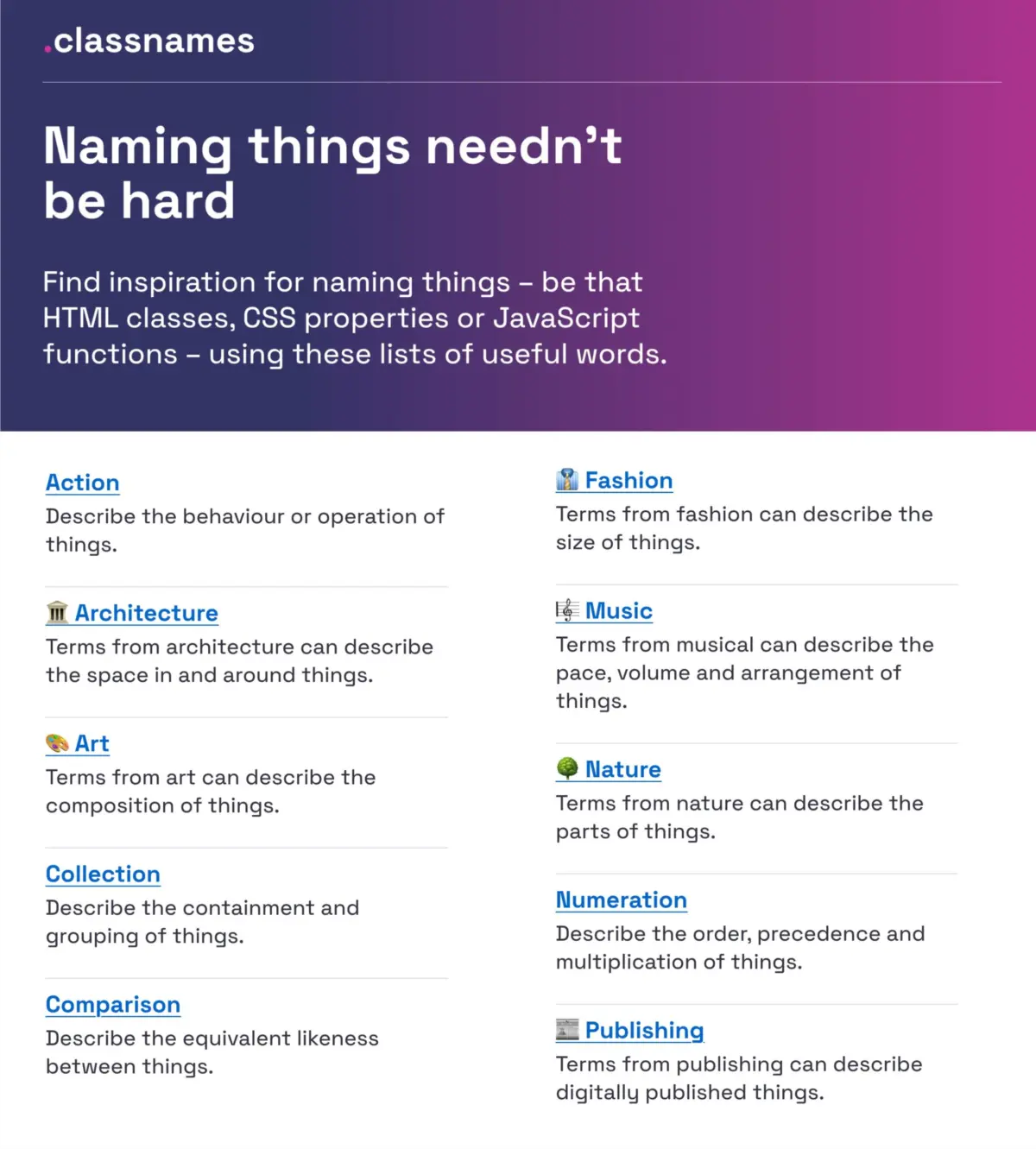
When looking for inspiration for HTML classes, CSS properties, or JavaScript functions, traditional vocabulary can feel limiting. Classnames (created by Paul Robert Lloyd) is a brilliant resource that pushes developers to think outside the box. It provides thematically grouped lists of words categorized by behavior, likeness, order, and grouping. Beyond standard technical terms, it incorporates collections inspired by nature, art, theater, music, architecture, fashion, and publishing, injecting much-needed semantic clarity into codebases.

2. Solving the Color Identity Crisis
Color nomenclature has historically relied on hex codes (#1EA7FD) or rigid, inflexible scales (blue-500). To humanize and systematize color choices, David Aerne maintains a massive repository of color names via Color Names, featuring over 30,000 unique, user-contributed and referenced color names. Coupled with interactive tools like the Color Parrot color picker and name search, these resources provide teams with intuitive ways to assign memorable, evocative names to their palette tokens.
3. Layer and Group Hygiene in Design Tools
Before code even enters the picture, design files must be structured logically. Javier Cuello outlines foundational best practices for naming layers, groups, and components in design tools like Figma. An effective design layer name possesses a logical structure: it is short, meaningful, universally understood, and decoupled from temporary visual properties. Establishing clear do’s and don’ts prevents design system bloat and ensures seamless collaboration across multi-designer squads.
4. Structuring Design Token Taxonomies
Scaling a design system across multiple enterprise products requires a bulletproof token taxonomy. Consider the challenges faced by Intuit—parent company to Mailchimp, QuickBooks, TurboTax, and Mint. To unify these disparate properties, the team engineered a flexible design token system extending far beyond a single brand theme.

Similarly, the Vodafone UK Design System team released their comprehensive Variables Taxonomy Map on Figma. This system maps out the anatomy and categorization of design tokens across four distinct collections:
- Brand / Primitives: Raw values (colors, spacing scales).
- Semantics: Context-aware tokens mapping roles to primitives.
- Components: Specific UI element states and attributes.
- Pages: Contextual overrides for specific views.
For practitioners looking to build their own systems, tools like Romina Kavcic’s Design Token Naming Guide + Builder and her Design Token Names Inventory spreadsheet offer interactive frameworks and bird’s-eye spreadsheet views to filter, scale, and manage tokens effortlessly.
5. UI Component Standardization
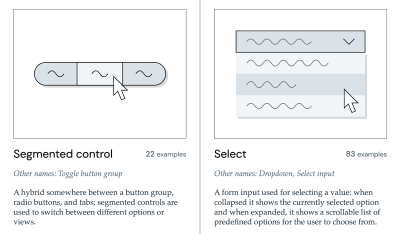
When struggling to name a specific interface pattern, looking at established design systems is the most efficient shortcut. Iain Bean’s Component Gallery serves as an exhaustive index, collecting interface components from real-world design systems. It maps out over 50 UI components—ranging from accordions to visually hidden text—alongside the alternative names those components go by across the industry. For a purely visual reference, tools like Name That UI provide a quick dictionary of common interface patterns.

6. Feature Discovery and User-Centric Naming
Low feature adoption is frequently a symptom of poor discoverability caused by confusing internal jargon. Erin Gannon’s practical guide, "What Do We Call This Thing?", outlines how features must be named to match user mental models. Effective feature names:
- Are driven by actual user needs and problems.
- Signal the tangible value or outcome (the "job-to-be-done").
- Tap into the user’s own language, captured through qualitative research rather than boardroom brainstorming.
7. Product and Service Nomenclature
At the highest level of abstraction, naming a product or service requires balancing market differentiation with immediate clarity. Onym is an invaluable open-source repository that organizes tools, methodologies, vetting prompts, brainstorming sprints, and reading lists to guide teams through brand and product naming processes.
Official Statements & Industry Insights
Industry leaders consistently emphasize that naming is not merely an aesthetic choice, but an operational imperative that dictates organizational efficiency.
"The right name is the one that is well-understood and used consistently by both the team and the users. So much time is wasted speaking about the very same thing but in different dialects—the designer’s dialect, the developer’s dialect, the product manager’s dialect, and the user’s dialect. That fragmentation is what quietly breeds frustration and confusion."
— Vitaly Friedman, Editor-in-Chief, Smashing Magazine
By bridging the linguistic gaps between departments, companies can drastically reduce cognitive overhead. When product managers, UX designers, and front-end engineers share a unified dictionary, handoffs become seamless, code review cycles accelerate, and accessibility compliance improves.

Future Outlook: The Road Ahead for Digital Taxonomy
As artificial intelligence, automated design-to-code pipelines, and token-driven architectures continue to mature, the precision of our digital lexicon will become even more critical.
- AI-Assisted Semantic Validation: Future design system pipelines will likely incorporate automated linters that check code and design tokens against semantic dictionaries (such as those provided by Color Names or Component Galleries), flagging overly generic or conflicting nomenclature before code reaches production.
- Unified Multi-Platform Tokens: The boundaries between design tools (Figma, Penpot) and code repositories (GitHub, GitLab) are dissolving via design token synchronization protocols (such as W3C Design Tokens Community Group specifications). Standardizing naming structures will allow zero-latency updates from a designer’s taxonomy map straight into production codebases.
- Human-Centric Enterprise Systems: As software systems grow more complex, organizations will increasingly formalize "Lexicon Teams"—cross-functional governance squads dedicated entirely to maintaining the semantic integrity of internal tools, design systems, and external product features.
Wrapping Up
Ultimately, meticulous attention to naming is an investment in team empathy. By paying attention to naming conflicts, establishing robust taxonomies, and listening closely to the everyday vocabulary of our users, we eliminate friction. It is one of those foundational, fine-grained details that radically reduces confusion, elevates the quality of digital products, and empowers multidisciplinary teams to build better, more accessible web experiences together.