

Executive Overview
In the realm of digital product development, software architecture, and design systems, a universal truth prevails: naming is hard. As computer science pioneer Phil famously noted, there are only two hard things in computer science: cache invalidation and naming things. Yet, the broader discipline of interface design expands this challenge across multidisciplinary teams, bridging the linguistic divides between designers, developers, product managers, and end-users.
The language we choose does more than merely label artifacts; it fundamentally shapes how we conceptualize problems, structure codebases, organize design systems, and communicate across disciplines. When nomenclature is poorly defined, teams experience friction, building internal systems that speak different "dialects." A designer might refer to an interactive surface as a "card," a front-end engineer might tag it as a .panel class in CSS, and a product manager might track it in a roadmap as an "info-module." This linguistic fragmentation breeds confusion, slows velocity, and directly impacts feature adoption.

This comprehensive guide serves as an authoritative framework for mastering nomenclature in digital products. By synthesizing cutting-edge resources, real-world case studies from industry giants like Intuit and Vodafone, and practical methodologies from leading design systems experts, this article explores how to establish scalable, intuitive, and universally understood naming conventions for UI components, color systems, design tokens, and digital features.
Detailed Chronology & Evolution: From Ad-Hoc Labeling to Systematic Taxonomies
To understand the modern state of nomenclature in UI/UX, one must trace the evolution of how digital artifacts have been named over the past two decades.

In the early days of the web and graphical user interface design, naming was largely ad-hoc. Developers relied on idiosyncratic shortcuts, shorthand, and visual descriptions (e.g., .red-box-big or #sidebar_nav_2), while designers relied on arbitrary layer names like Rectangle 404 or Group Copy 2. As projects scaled, this lack of standardized structure resulted in brittle codebases and untellable design files, where maintaining brand consistency or executing a global re-skinning required manual, error-prone updates across hundreds of files.
The turning point arrived with the advent of atomic design, scalable design systems, and tokenized architecture. Organizations realized that design elements needed to be treated with the same semantic rigor as back-end code.

- Phase 1: Visual-First Naming (Late 2000s). Names were tightly coupled to appearance (e.g.,
.blue-text,bold-header). This failed instantly when a redesign called for changing blue text to green, rendering the class name semantically obsolete. - Phase 2: Component-Centric Naming (Mid 2010s). The rise of frameworks like React and methodologies like BEM (Block, Element, Modifier) shifted focus toward component structure. Names became structural and modular (e.g.,
card__title--large), reducing specificity issues while introducing new challenges regarding reusability. - Phase 3: Systemic Token Taxonomies (Present Era). Modern enterprises now abstract values into multi-layered design tokens (Primitive, Semantic, and Component tokens). This evolution allows massive multi-brand conglomerates—such as Intuit and Vodafone—to manage thousands of variables across diverse product ecosystems without breaking brand continuity.
Supporting Context & Metrics: The Anatomy of an Effective Name
Choosing the right name requires balancing two extremes: being too generic (rendering the element ambiguous and prone to misuse) or being too specific (stripping away flexibility and future-proofing).
According to guidelines compiled by design systems expert Javier Cuello, an effective name adheres to several core criteria:

- Logical Structure: It fits neatly within an established hierarchical taxonomy.
- Conciseness: It is short enough to read at a glance without sacrificing clarity.
- Universality: It is known and intuitively understood by every stakeholder, regardless of discipline.
- Semantic Independence: It avoids being tied to transient visual properties (e.g., avoiding
.float-rightor.gray-bg).
Naming UI Components
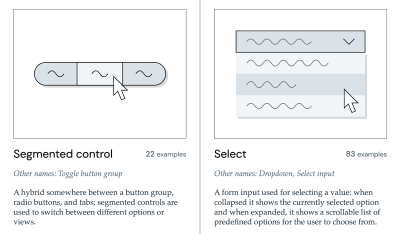
When struggling to name a UI component, looking at established design systems is the most reliable shortcut. Iain Bean’s Component Gallery serves as an invaluable archive, mapping real-world interface components from dozens of production-grade design systems. Tracking over 50 UI components—ranging from standard accordions to complex visually hidden states—the gallery illuminates alternative names and contextual variants used across the industry.
Complementing this, tools like Name That UI provide a visual dictionary of common interface components, bridging the gap between colloquial design terminology and standardized system names.

The Linguistic Inspiration Engine
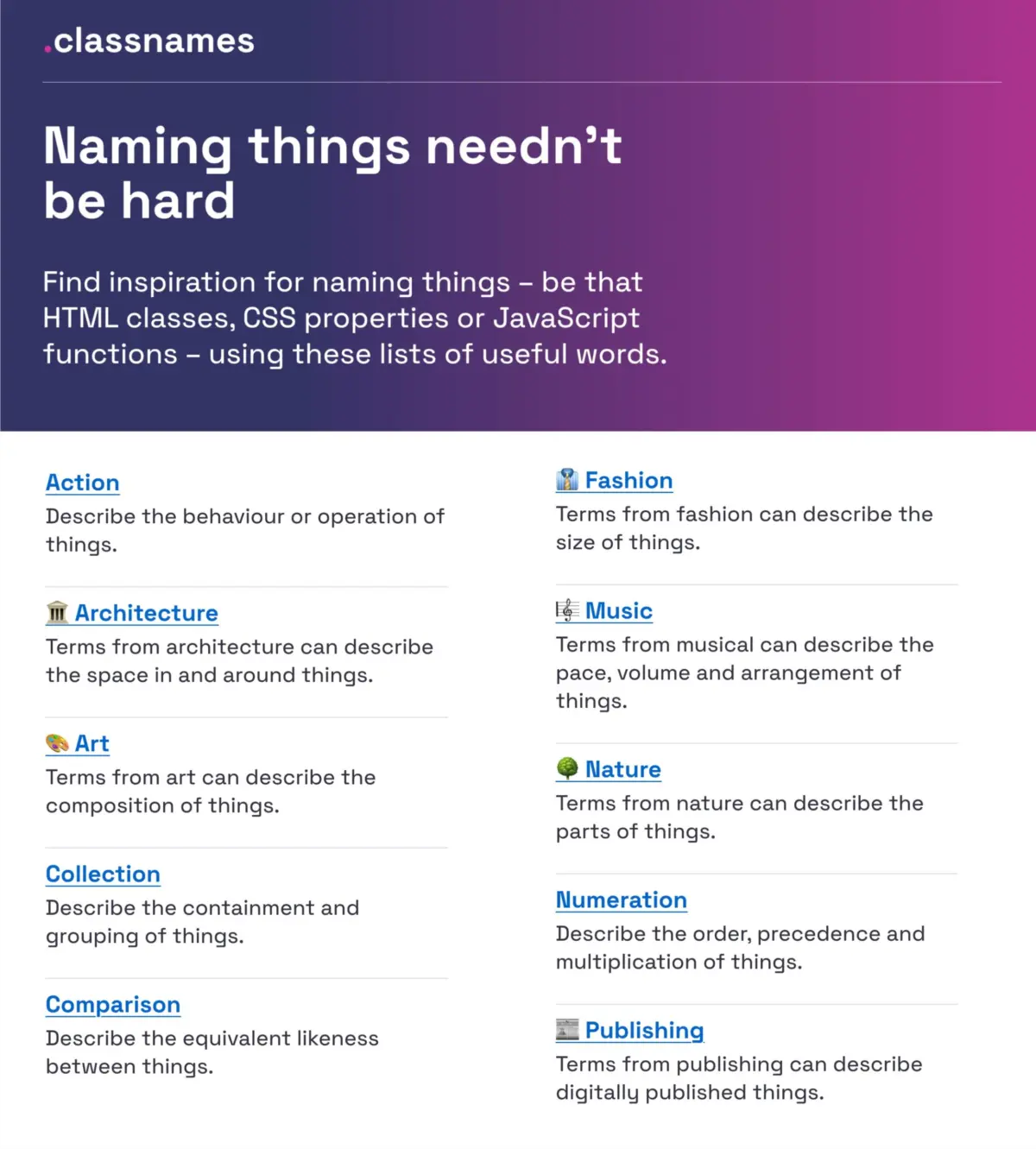
For developers and designers struggling to find fresh terminology for HTML classes, CSS custom properties, or JavaScript functions, resources like Classnames (curated by Paul Robert Lloyd) offer thematic lists of words. Rather than falling back on tired programming tropes, professionals can draw from interdisciplinary domains—such as architecture, theater, music, fashion, publishing, and nature—to establish evocative, non-conflicting names for behavioral states, groupings, and structural associations.
Case Studies: Enterprise Naming at Scale
1. Intuit: Crafting a Flexible Design Token Taxonomy
Managing design tokens across an umbrella of powerhouse products—including Mailchimp, QuickBooks, TurboTax, and Mint—presents an immense architectural challenge. Nate Baldwin documented Intuit’s journey in developing a flexible design token taxonomy capable of serving diverse brand themes while maintaining a unified foundational system.
Intuit’s primary pain point was the rigidity of their legacy token structure, which was too tightly coupled to individual brand aesthetics. By redefining their taxonomy around semantic layers and contextual roles, the team created a robust structure that allowed new acquisitions and sub-brands to inherit foundational styling effortlessly. The key takeaway for engineering and design teams is the separation of concerns: separating what a token is (primitive values) from what a token does (semantic application).
2. Vodafone UK: The Variables Taxonomy Map
The Vodafone UK Design System team faced a similar challenge in orchestrating a multi-brand, multi-themed ecosystem. Their published Variables Taxonomy Map in Figma breaks down the anatomy and categorization of design tokens into an impeccably structured hierarchy of collections.

Building upon Nathan Curtis’s foundational work on token naming, Vodafone’s map illustrates four distinct collections:
- Brand & Primitives: Raw values (e.g., hex codes, base spacing integers).
- Semantics: Contextual application tokens (e.g., background-color-primary-default).
- Components: Specific component-level mappings.
- Pages/Contexts: Page-level or theme-specific overrides.
This meticulous mapping ensures that any stakeholder can instantly deduce where a token is utilized and what it represents simply by reading its identifier.

Feature Naming and User-Centric Discovery
While internal technical naming impacts development velocity, external feature naming directly dictates business success and user adoption. As UX writer and strategist Erin Gannon outlines in her definitive guide, low feature adoption is frequently a symptom of poor discoverability caused by ambiguous or overly clever naming.
Feature adoption is a sequential funnel: a user must discover a feature, understand its utility, try it, learn it, and eventually integrate it into their existing daily workflow. Clever, internal code-names (often retained long past product launch) routinely fail this funnel because they speak the company’s internal dialect rather than the user’s language.

Best practices for naming new features include:
- Job-to-be-Done (JTBD) Focus: Names should signal the value or outcome a feature delivers.
- User Vocabulary Integration: Conduct user interviews and ask participants to describe a workflow or problem in their own words. Adopt the terminology they naturally use.
- Avoiding Jargon: Strip away corporate acronyms and internal marketing buzzwords in favor of plain, descriptive language.
Practical Toolkits for Modern Teams
To operationalize these principles, teams can leverage a suite of specialized open-source tools and repositories:

- Color Nomenclature: Sourced from thousands of user contributions and historical references, David Aerne’s Color Names repository (paired with interfaces like Color Parrot) catalogs over 30,000 unique color names, complete with pickers and search utilities to eliminate generic hex-labeling.
- Token Structuring: Romina Kavcic’s Design Token Naming Guide + Builder offers an interactive environment for configuring custom naming structures incorporating components, categories, states, and roles. This is complemented by the Design Token Names Inventory spreadsheet, providing a bird’s-eye view across four structural levels.
- Product & Service Naming: For macro-level naming initiatives, Onym serves as an open-source repository organizing brainstorming frameworks, vetting methodologies, etymological resources, and expert guides for naming new products and services.
Future Outlook
As the digital landscape evolves toward hyper-personalized interfaces, automated design-to-code pipelines, and AI-assisted engineering, the importance of disciplined nomenclature will only accelerate. Artificial intelligence models rely heavily on semantic clarity; autonomous agents parsing poorly named codebases or disjointed design tokens will inevitably introduce systemic errors.
The future of naming lies in hyper-standardized, machine-readable taxonomies that remain profoundly human-centric. By bridging the linguistic gaps between designers, developers, and product managers through shared glossaries, robust token architectures, and user-aligned feature naming, organizations can eliminate costly cognitive friction. Ultimately, investing time in refining your team’s vocabulary is not an administrative chore—it is a foundational strategic advantage that accelerates velocity, enhances accessibility, and ensures long-term product scalability.