In the realm of digital product creation, a foundational truth often gets overlooked: the language we use actively shapes the way we think, build, and collaborate. "Naming things is hard"—a timeless adage within the software engineering and design communities—captures a daily operational friction that drains productivity across cross-functional teams. When designers speak in visual dialects, developers communicate through structural abstractions, product managers rely on feature roadmaps, and users bring their own intuitive vocabulary to the interface, translation breakdowns occur. These linguistic silos lead to systemic confusion surrounding colors, icons, user interface (UI) components, and core features. Consequently, teams struggle to establish cohesive design tokens, predictable HTML classes, and robust code variables.
Choosing the right name requires walking a delicate tightrope. Names that are too generic leave stakeholders guessing about intent and functionality, while names that are too specific stifle flexibility, scalability, and code reuse. This comprehensive guide explores the structural anatomy of naming across the digital ecosystem. By examining industry-tested frameworks, open-source repositories, and advanced taxonomies for UI components, color systems, design tokens, and digital features, teams can bridge the communication gap, eliminate ambiguity, and build unified, scalable digital products.
Detailed Chronology: The Evolution of Naming Best Practices in Digital Design
To understand how modern design and engineering systems handle nomenclature, it is helpful to review the chronological progression of how teams have attempted to solve the naming crisis over the past decade:
The Wild West Era (Early Web & App Development): Naming conventions were largely ad-hoc. Developers relied on idiosyncratic shortcuts (btn1, box-red), while designers used unstructured layer names (Rectangle 40, Group Copy 2). This led to high technical debt and steep onboarding curves for new team members.
The BEM & Methodology Boom (Mid-2010s): Introduction of rigorous naming methodologies like BEM (Block, Element, Modifier), SMACSS, and OOCSS. These systems brought unprecedented predictability to CSS architectures, teaching the industry the value of structured, decoupled component naming.
The Design Systems Revolution (Late 2010s): With the advent of centralized design systems (Figma component libraries paired with code repositories), the need to synchronize designer and developer vocabularies became urgent. Atomic Design principles popularized structural hierarchies (Atoms, Molecules, Organisms), though finding exact literal names for components remained a subjective hurdle.
The Design Token Era (Present Day): Modern multi-platform, multi-brand applications require abstract, semantic, and primitive variables. Frameworks spearheaded by companies like Intuit, Vodafone, and Eightshapes have transformed token taxonomy into a formal, highly structured science connecting brand foundations directly to UI components.
Poor naming conventions are rarely viewed as critical system bugs, yet their downstream impacts are measurable across key performance indicators in software delivery and user engagement:
Reduced Development Velocity: According to internal design system audits across enterprise organizations, up to 15% of frontend development time is wasted debating component names, searching for mislabeled design tokens, or refactoring classes due to naming collisions.
Feature Discovery and Low Adoption: As highlighted by UX research, new product features often suffer from low adoption rates not because of poor utility, but due to poor discoverability driven by confusing labels. When feature titles fail to map to a user’s "job-to-be-done" or their native vocabulary, engagement plummets.
Cross-Disciplinary Friction: When design systems lack a unified taxonomy, designers and engineers speak different dialects. A button state might be called active in the design file, selected in the requirements document, and pressed in the codebase. This cognitive overhead increases the frequency of bugs during QA cycles.
Deconstructing the Craft: How to Name UI Components, Colors, and Systems
1. Finding Inspiration for HTML Classes, Functions, and Layers
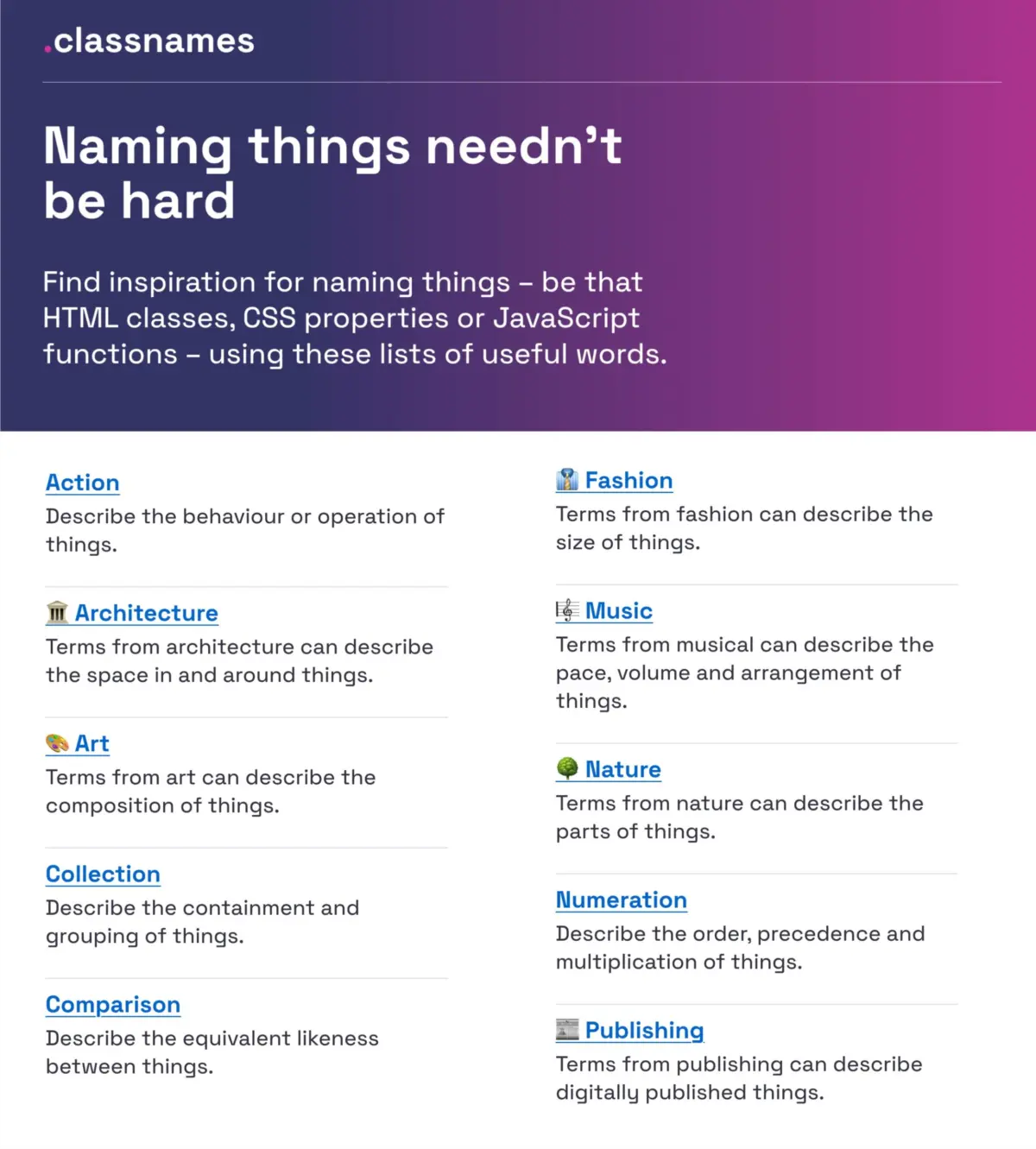
When looking for inspiration for HTML classes, CSS properties, or JavaScript functions, resources like Classnames (built by Paul Robert Lloyd) offer thematic lists of words designed to push developers outside conventional naming habits. Instead of defaulting to overused terms, Classnames provides organized vocabularies covering behavior, likeness, order, grouping, and associations. It even introduces unexpected thematic collections drawn from nature, art, theater, music, architecture, fashion, and publishing.
Similarly, Javier Cuello’s research on Design Best Practices for Naming establishes that an effective name must possess a logical structure, remain concise, carry clear meaning, be universally understood across disciplines, and avoid direct ties to fleeting visual properties.
2. Taming the Spectrum: How to Navigate Color Nomenclature
Choosing intuitive names for color palettes has historically been an exercise in frustration. Standard hex codes are machine-readable but human-unfriendly, while basic color names (blue-1, dark-gray) lack semantic context. David Aerne’s Color Names repository—featuring over 30,000 unique, crowdsourced color titles—alongside tools like Color Parrot, provides a vital safety net for developers and designers seeking creative, memorable handles for complex color variables.
3. Establishing a Scalable Design Token Taxonomy
Building a flexible design token taxonomy that operates seamlessly across multiple products, brands, and themes is one of modern design operations’ greatest challenges. For instance, the parent company behind Mailchimp, QuickBooks, TurboTax, and Mint (Intuit) faced the daunting task of scaling a unified token ecosystem beyond isolated brand themes. Nate Baldwin’s extensive case studies on Intuit’s token architecture highlight the necessity of moving away from fragile naming structures toward a systemic hierarchy.
Expanding on this, the Vodafone UK Design System Team published their Variables Taxonomy Map, a sophisticated Figma-based framework that breaks down the anatomy of design tokens into four interconnected collections:
Brand & Primitive Tokens: Raw values (colors, spacing scales) independent of context.
For teams looking to build their own systems, Romina Kavcic’s Design Token Naming Guide & Builder, paired with her Design Token Names Inventory spreadsheet, offers a practical four-level structure that provides a bird’s-eye view of all system tokens without losing track of modes and themes.
4. Harmonizing UI Component Names
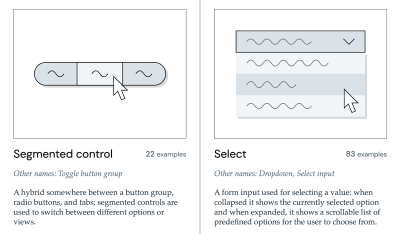
When struggling to name a complex interface element—such as an accordion, a modal overlay, or a visually hidden utility—designers no longer need to invent terminology from scratch. Iain Bean’s Component Gallery aggregates real-world examples from dozens of production design systems across more than 50 UI components, cataloging the various aliases each component goes by in the wild. This resource is complemented by Name That UI, a visual dictionary designed to align team vocabulary instantly.
5. Crafting Feature Names That Drive User Adoption
Erin Gannon’s practical guide, “What Do We Call This Thing?”, addresses the psychological lifecycle of feature adoption. For a user to embrace a new feature, they must first discover it, understand its utility, try it, learn its mechanics, and finally integrate it into their daily workflow.
To achieve this, feature names must:
Be driven strictly by user needs and underlying problems.
Signal the tangible value or outcome (the "job-to-be-done").
Tap directly into the user’s native language rather than internal corporate jargon. Conducting lightweight lexical research—asking users to describe a task in their own words—ensures the product interface speaks the user’s language.
6. Naming Products and Services
At the highest macro level, finding the right moniker for an entire product or service requires rigorous exploration. Onym, an open-source curation of naming resources, aggregates brainstorming methodologies, vetting frameworks, etymological guides, sprint structures, and professional literature to assist organizations in avoiding costly branding missteps.
Official Industry Insights & Expert Perspectives
Industry leaders continue to emphasize that nomenclature is not merely an aesthetic choice, but an architectural pillar of software maintainability.
"The right name is the one that is well-understood and actively used by both the development team and the end users. So much time is wasted speaking about the very exact same conceptual thing, but doing so in entirely different dialects—the designer’s dialect, the developer’s dialect, the product manager’s dialect, and the user’s dialect. That fragmentation is what quietly generates daily friction and user confusion."
— Vitaly Friedman, Editor-in-Chief, Smashing Magazine
Design token pioneers like Nathan Curtis have long argued that structured taxonomies act as a contract between design tools and codebases. When token names follow predictable modifiers (e.g., context.element.property.modifier), automated pipelines can translate Figma variables directly into CSS custom properties with zero human translation error.
Future Outlook: The Next Horizon in Semantic Design Systems
As the digital design industry matures, the intersection of automated design tokens, AI-assisted coding assistants, and multi-platform component libraries points toward a future where rigid naming conventions become even more critical. Key trends shaping the future of digital nomenclature include:
AI-Driven Semantic Validation: Future design system tooling will likely incorporate intelligent linters that scan Figma files and code repositories in real-time, automatically flagging naming violations, generic token usages, and cross-disciplinary communication gaps before code is merged.
Automated Token Pipelines: With W3C Design Token Community Group standards solidifying, the gap between designer-facing variables and developer-facing code variables will continue to shrink, demanding hyper-standardized taxonomies.
Localized Lexicon Mappings: Enterprise multi-brand design systems will increasingly support dynamic naming localization matrices, ensuring that semantic tokens adapt not only to visual themes (dark mode, high contrast) but also to regional linguistic nuances without breaking the underlying component architecture.
By investing time in establishing robust naming conventions, utilizing shared community galleries, and auditing token taxonomies, product teams can eliminate cognitive friction, accelerate development velocity, and deliver intuitive digital experiences that resonate effortlessly with users.