

Executive Overview
The autumn harvest of 2026 has brought forth a tumultuous bounty of pomological curiosities, capturing the attention of culinary connoisseurs, heirloom fruit preservationists, and casual snack enthusiasts alike. Following the initial wave of regional tastings, a secondary, highly anticipated cohort of heirloom, cider, and rare dessert apples has undergone rigorous sensory evaluation.
This comprehensive review initiative—colloquially championed by the burgeoning "Apple Snack Gang"—seeks to document the physical, chemical, and organoleptic properties of lesser-known varieties currently circulating through niche markets and artisanal orchards.

The scope of this investigation spans seven distinct cultivars: Kickapoo Spice, St Edmunds Pippin, Sops of Wine, Fenceline Surprise, Americus Crab, Campfield (False), and Graham. Through strict empirical assessment, evaluating metrics ranging from structural density and skin texture to volatile aromatic profiles and secondary metabolite concentration (such as tannins and organic acids), this report outlines a wide spectrum of culinary viability.
While certain varieties—notably the fruit-gum-inflected Graham and the vibrant, fennel-noted St Edmunds Pippin—exceeded performance expectations, others plummeted to historic lows due to structural degradation, terminal mealy textures, and excessive astringency. As agricultural and geopolitical distribution shifts, understanding the historical lineage, storage behaviors, and structural anomalies of these specific cultivars remains paramount for both modern consumers and legacy orchardists.

Detailed Chronology of the Tasting Trials
The testing protocol for the second phase of the 2026 harvest commenced under controlled ambient conditions following a multi-day post-harvest acquisition window. Each cultivar was subjected to standardized preliminary visual inspections, density testing via manual incisal resistance, and multi-stage flavor profiling.
1. Kickapoo Spice
- Initial Impression: The trial opened with the Kickapoo Spice, a dense, heavy specimen whose nomenclature immediately invokes rustic Americana and acoustic-rock nostalgia. Visually imposing and structurally compact, the apple presented as a "dense boy" of the orchard.
- Sensory Evaluation: The aromatic and flavor profiles skewed heavily toward high-spice components, dominated by a robust concentration of nutmeg, secondary hints of cinnamon, and a subtle baseline of clove. True to its moniker, the spice notes were uncommonly prominent. However, the fruit lacked essential hydration, registering as distinctly unjuicy. An anomalous, lingering aftertaste reminiscent of freshly cut grass detracted from the experience, suggesting sub-optimal maturation or improper cold-storage duration.
- Final Assessment: Despite structural quirks, it earned a respectable score of 6.9 out of 10.
2. St Edmunds Pippin
- Initial Impression: Serving as the maiden proper tasting of the seasonal kickoff, the St Edmunds Pippin immediately established a high benchmark for quality. The exterior skin exhibited a tactile, weathered roughness likened to biological dermal armour, yet this exterior belied an exceptional interior dynamism.
- Sensory Evaluation: Upon biting into the flesh, evaluators noted an explosive, sharp-breaking acoustic pop and satisfying mechanical crunch. The flavor profile was simultaneously bright, herbal—evoking distinct notes of fennel pollen—and naturally sweet. This specimen successfully navigated the delicate equilibrium between tart acidity and mellow sugars, cementing its status as an elite funky dessert apple.
- Final Assessment: Garnering an impressive score of 8.3 out of 10, it stands as a premier example of heirloom excellence.
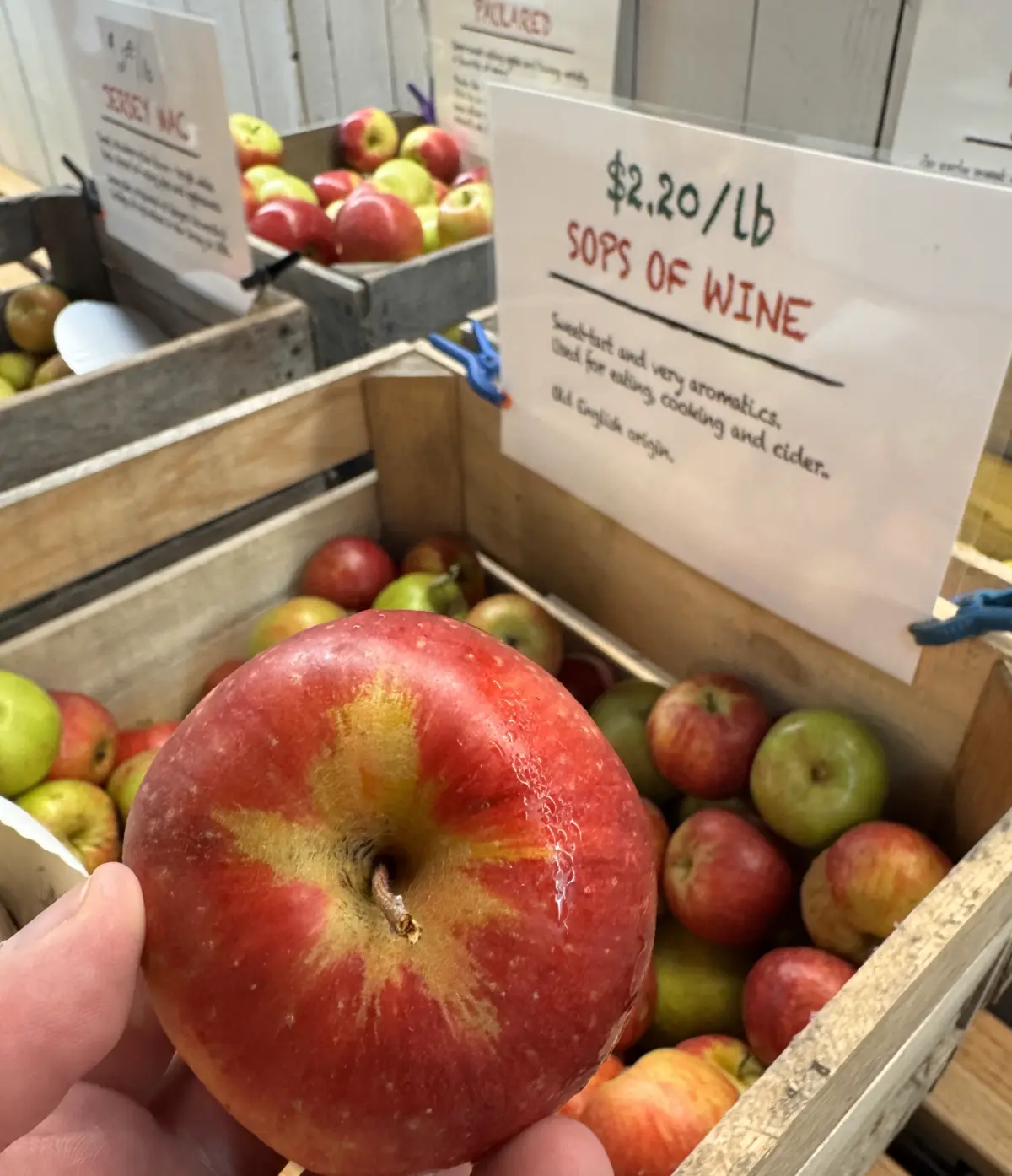
3. Sops of Wine
- Initial Impression: Encounters with the Sops of Wine cultivar immediately provoked psychological and literary associations, linking its historic moniker to cinematic depictions of tragic antiquity.
- Sensory Evaluation: Unfortunately, the physical reality of the specimen failed to match its dramatic legacy. While the fruit exhibited intriguing, complex baseline flavors leaning toward "sub-acid" sweetness interspersed with delicate notes of vanilla and spice, the structural integrity had severely degraded. The texture was persistently mealy and gritty, indicating the fruit had lingered far too long past its optimal harvest window. Furthermore, despite historical descriptions indicating red-fleshed anomalies or distinct internal staining, this particular sample offered standard white flesh, reinforcing ongoing debates regarding whether "Sops of Wine" represents a singular genetic lineage or a broad umbrella term for disparate historic varieties.
- Final Assessment: Due to structural failure and mealy degradation, the cultivar received a disappointing 3.5 out of 10.
4. Fenceline Surprise
- Initial Impression: True to its paradoxical moniker, the Fenceline Surprise delivered an unexpected outcome characterized entirely by subpar culinary performance.
- Sensory Evaluation: Marketed with signage denoting a "firm apple," the reality upon consumption was a stark contrast. The fruit offered a completely bland, mushy consistency. A faint, fleeting top-note reminiscent of misted pear juice materialized momentarily before dissolving entirely, leaving the palate coated in an unpalatable, sandy texture akin to beach sediment. Whether victim to a naturally grumpy batch or advanced post-harvest decay, the specimen offered virtually no redeeming qualities for fresh eating.
- Final Assessment: Scoring a dismal 1.0 out of 10, the solitary point was salvaged solely by its sophisticated nomenclature and aesthetic presentation.
5. Americus Crab
- Initial Impression: Classified strictly as a crabapple, the Americus Crab presented unique taxonomic and linguistic talking points, evoking comparisons to old-timey adventure serials and industrial-era machinery.
- Sensory Evaluation: As expected from wild or semi-wild crabapple stock, consumption out-of-hand was an aggressive physical challenge. The fruit was exceptionally tough, heavily fortified with high concentrations of astringent tannins, and balanced between aggressive savory notes and sharp tartness. It is emphatically not optimized for casual snacking, though it holds latent potential for culinary processing or specialized blending.
- Final Assessment: The cultivar was assigned a niche score of 2.5 out of 10.
6. Campfield (False)
- Initial Impression: Labeled cryptically as "(false)," the Campfield specimen sparked immediate speculation regarding horticultural misidentification or deceptive breeding lines.
- Sensory Evaluation: Texturally, the flesh was dense, chewy, and reminiscent of a callused thumb. Chemically, it was overly sweet yet overwhelmed by a high tannin load that produced a reciprocal astringency—a sensation colloquially described as the fruit "eating the consumer back." These structural properties align perfectly with traditional cider-making requirements rather than direct human consumption, necessitating fermentation to unlock true palatability.
- Final Assessment: The trial yielded a score of 4.1 out of 10 for direct consumption.
7. Graham
- Initial Impression: The final evaluation subject, the Graham, proved to be the physical titan of the tasting circuit. Exceptionally dense and structurally impenetrable, it required extraordinary mechanical force to breach.
- Sensory Evaluation: The initial bite offered the catastrophic structural fracture of a calving glacier, posing immediate ergonomic challenges to human dentition. However, once the exterior defense was breached, the reward was profound: an intensely juicy interior profile whose volatile aromatic compounds delivered an unmistakable, unrestrained flavor of commercial Juicy Fruit gum.
- Final Assessment: Despite the immense jaw-strength required to access the fruit, the extraordinary flavor profile secured a robust 8.0 out of 10.
Supporting Context & Metrics
To establish analytical rigor within these pomological evaluations, specific sensory metrics have been systematically tracked across the 2026 harvest cohort. The following matrix outlines the comparative performance indices:

| Cultivar Name | Primary Flavor Notes | Structural Integrity Score (1-10) | Hydration / Juiciness Index | Final Evaluated Score |
|---|---|---|---|---|
| Kickapoo Spice | Nutmeg, Cinnamon, Cut Grass | 7.5 | Low | 6.9 / 10 |
| St Edmunds Pippin | Fennel Pollen, Herbal, Sweet-Tart | 8.5 | High | 8.3 / 10 |
| Sops of Wine | Vanilla, Sub-acid Spice | 3.0 | Low (Mealy) | 3.5 / 10 |
| Fenceline Surprise | Faint Pear (Fleeting) | 1.5 | Low (Mushy) | 1.0 / 10 |
| Americus Crab | Savory, High Tannin, Tart | 6.0 | Dry/Tough | 2.5 / 10 |
| Campfield (False) | Tannic, Cloying Sweetness | 5.0 | Chewy | 4.1 / 10 |
| Graham | Juicy Fruit Gum | 9.0 (Too Hard) | Extreme | 8.0 / 10 |
Historical Lineage and Horticultural Provenance
A critical discovery during the evaluation of the Campfield lineage brought to light profound historical connections linking colonial agriculture with modern heirloom preservation. Historical data indicates that the traditional Campfield apple traces its roots to Matthew Canfield (historically documented under various spellings including Campfield), an anti-royalist Puritan migrant who arrived from Harleston, England, prior to 1637 during the Great Puritan Migration.
As a founding father of the New Haven Colony, Norwalk, Connecticut, and Newark, New Jersey, Canfield’s agricultural mandates shaped early American pomology. Town records from New Haven and Newark reveal strict legal requirements mandating that freeholders cultivate designated acreage into functional orchards. Canfield’s historical homestead famously sustained commercial-scale production of winter fruit, supplying three barrels of high-grade cider to municipal projects and embedding cider-apple DNA directly into the geographic foundation of the American mid-Atlantic.

The existence of variations and "false" classifications within contemporary nurseries underscores the ongoing genealogical complexities of tracking 17th-century agricultural imports through centuries of open pollination and grafting practices.
Future Outlook
As the 2026 harvest season progresses, regional distribution patterns indicate a shifting focus toward northern and eastern microclimates. Scheduled expeditions spanning New York State, New England, and cross-border Canadian orchards promise to introduce fresh cultivars into the testing pipeline.

With field researchers actively mobilizing to intercept regional pomological variations, future iterations of these trials will continue to document the fragile balance between heirloom preservation, agricultural resilience, and sensory hedonism. Consumers, orchardists, and apple enthusiasts are encouraged to monitor upcoming appearances and contribute regional specimens to ongoing field assessments.