

Executive Overview
In the realm of modern agricultural critique, few endeavors match the unyielding dedication of the independent pomological reviewer diving headfirst into peak autumn harvest. Following a heavily anticipated initial assessment—the chronicles of which are already etched into the digital annals—the vanguard of the "Apple Snack Gang" has returned to the tasting table. This second installment of the 2026 seasonal evaluation brings a diverse, idiosyncratic, and occasionally adversarial batch of cultivars under the microscope.
From the densely spiced anomalies of the American orchard landscape to historically loaded cider varieties that demand the intervention of fermentation before they are fit for human consumption, this season’s crop has tested the limits of human dental fortitude and sensory imagination. This report synthesizes the qualitative metrics, tasting notes, historical anomalies, and definitive ratings for six distinct apple cultivars: Kickapoo Spice, St Edmunds Pippin, Sops of Wine, Fenceline Surprise, Americus Crab, Campfield (False), and the jaw-shattering Graham.

As regional touring schedules loom for the lead critic—extending through New York, New England, and parts of Canada—this comprehensive review serves as both a warning to casual snackers and an essential guide for hardcore pomology enthusiasts navigating the unpredictable waters of autumn fruit harvesting.
Detailed Chronology of the Tasting Sessions
The methodology of the 2026 harvest evaluation relies on rigorous, unvarnished, immediate sensory feedback. Each specimen was examined for tactile skin integrity, acoustic and mechanical snap upon initial biting, primary and secondary flavor profiles, juice distribution, and structural integrity relative to post-harvest storage timelines.

1. Kickapoo Spice
- Initial Assessment: Bearing a nomenclature that immediately evokes acoustic rock history, the Kickapoo Spice presents as a dense, structurally imposing specimen.
- Flavor and Texture Mechanics: Exhibiting an exceptionally high spice component—dominated by heavy notes of nutmeg, supplemented by subtle undertones of cinnamon and clove—the fruit lives up to its titular descriptor. However, it severely underperformed in hydration metrics, registering as notably non-juicy. An unexpected and counterproductive aftertaste reminiscent of freshly cut grass suggested suboptimal storage life.
- Maturity Analysis: Horticultural experts note that apples exist on a binary spectrum post-harvest: some mature gracefully away from the branch, while others initiate an immediate descent toward degradation. This specimen appeared caught in an awkward transitional phase.
- Rating: 6.9 / 10
2. St Edmunds Pippin
- Initial Assessment: Serving as the maiden proper tasting of the season, the St Edmunds Pippin established an exceptionally high benchmark for subsequent evaluation, despite a rough, shark-skin-like tactile exterior.
- Flavor and Texture Mechanics: Upon impact, the fruit delivered an intensely satisfying auditory and tactile pop and crunch. The flavor profile defied conventional sweetness, offering a brilliant, sharp-breaking, and herbal complexity highlighted by distinct fennel pollen vibes, perfectly harmonized against a foundational sugary sweetness. It represents the gold standard of funky, unconventional heirloom fruit that manages to satisfy universal palate expectations.
- Rating: 8.3 / 10
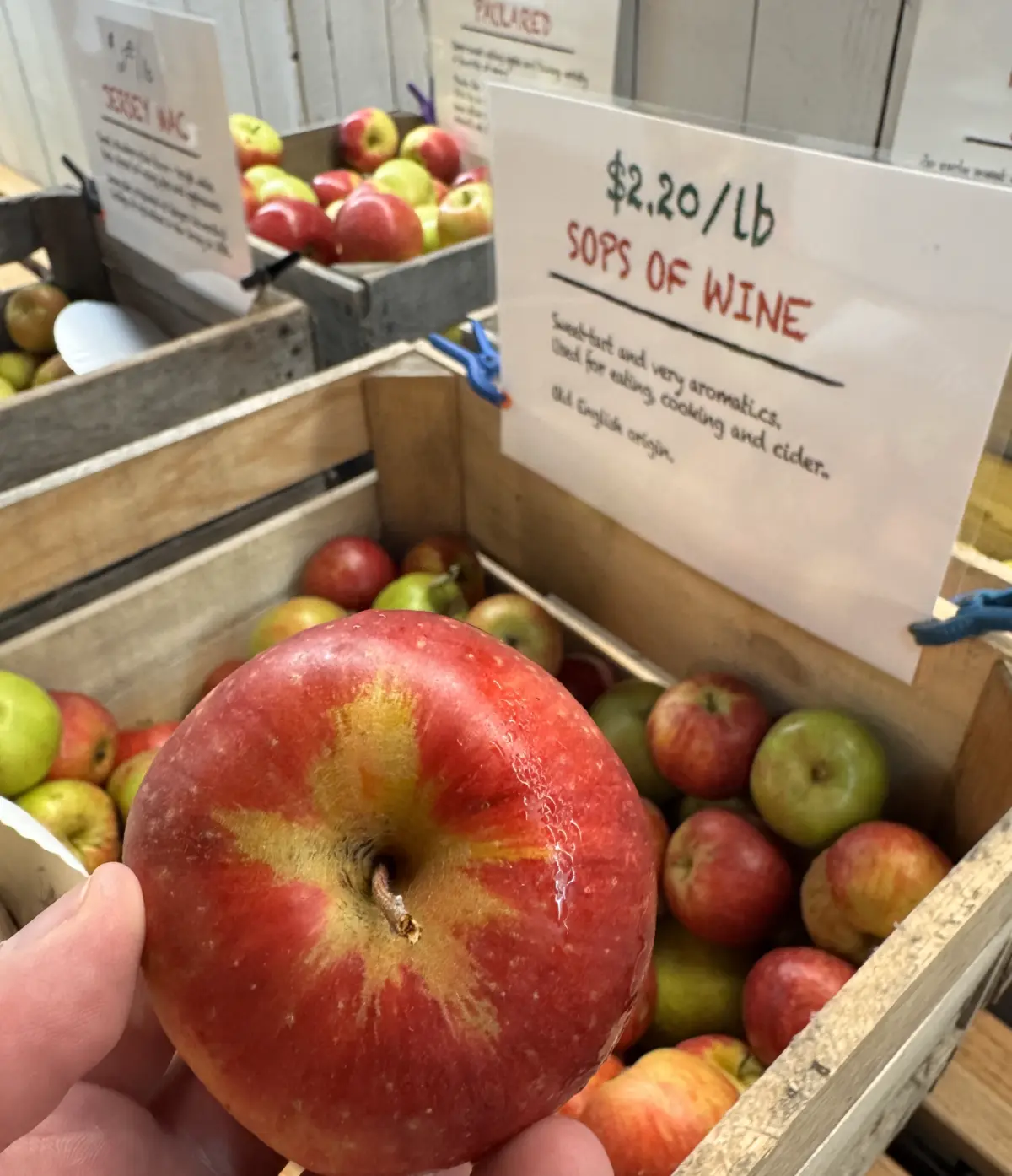
3. Sops of Wine
- Initial Assessment: A historically rich variety that immediately triggered idiosyncratic psychological associations—specifically cinematic invocations of doomed literary feasts—the Sops of Wine proved to be a study in sensory dissonance.
- Flavor and Texture Mechanics: While the flavor profile delivered an agreeable, funky complexity categorized by sub-acid sweetness, vanilla, and spice notes, the structural integrity of the flesh was severely compromised. Exhibiting a mealy, gritty texture, the fruit suggested over-ripeness or an extended duration away from the tree. Furthermore, while pomological literature often cites the Sops of Wine as featuring red-fleshed attributes or red-streaked white meat, this particular specimen displayed standard white flesh, fueling ongoing debates regarding whether "Sops of Wine" represents a single stable cultivar or a catch-all umbrella term for legacy English and American apples.
- Rating: 3.5 / 10
4. Fenceline Surprise
- Initial Assessment: Living up to its ironic moniker, the primary surprise of the Fenceline Surprise is its profound lack of culinary merit.
- Flavor and Texture Mechanics: Marketed under signage describing it as a "firm apple," this specimen translated into a remarkably bland, pulpy mush. A fleeting, highly muted whisper of pear juice flavor vanished almost instantaneously upon contact with the palate, leaving behind a dry, sand-like residual texture. The evaluation concludes that the fruit was either harvested prematurely from a disgruntled orchard batch or subjected to prolonged cold storage decay prior to acquisition.
- Rating: 1.0 / 10 (Saved from absolute zero only by its aesthetic geometry and poetic nomenclature.)
5. Americus Crab
- Initial Assessment: Operating on the absolute periphery of culinary consumption, the Americus Crabapple introduces severe challenges to the casual consumer.
- Flavor and Texture Mechanics: As a true crabapple, this cultivar is unapologetically aggressive. Highly savory, intensely tart, physically rigid, and saturated with tannins, it is categorically unsuited for casual out-of-hand snacking. It functions instead as an esoteric novelty for consumers drawn to culinary elements that border on the inadvisable.
- Rating: 2.5 / 10
6. Campfield (False)
- Initial Assessment: Labeled cryptically with the qualifier "(false)" in its registry data, this specimen provoked both comedic speculation and deep historical investigation.
- Flavor and Texture Mechanics: Structurally, the fruit offered a chewy, callused tactile experience—overly sweet yet simultaneously high in astringent tannins that created the uncanny sensation of the fruit consuming the consumer. As a textbook cider apple, its true potential is locked behind the biochemical transformation of fermentation.
- Rating: 4.1 / 10
7. Graham
- Initial Assessment: The structural heavy-hitter of the season, the Graham variety presented as a density monolith capable of threatening the anatomical stability of the human jaw.
- Flavor and Texture Mechanics: Armored with a crystalline, rock-hard exterior that resisted even basic dental penetration, the fruit fractured under pressure with the acoustic violence of a calving glacier. However, once breached, the internal reward was astonishing: an unabashed, highly concentrated flavor profile identical to classic Juicy Fruit chewing gum.
- Rating: 8.0 / 10 (Deducted slightly for the extreme physical exertion required to gain entry.)
Supporting Context & Metrics
To provide a comprehensive overview of the 2026 harvest assessment, the following data table summarizes the evaluated cultivars across key pomological parameters:
| Cultivar | Texture & Density | Primary Flavor Notes | Structural Integrity | Final Score |
|---|---|---|---|---|
| Kickapoo Spice | Dense / Mealy | Nutmeg, Cinnamon, Cut Grass | Moderate | 6.9 / 10 |
| St Edmunds Pippin | Crisp / Sharp-Breaking | Fennel Pollen, Herbal Sweetness | Excellent | 8.3 / 10 |
| Sops of Wine | Gritty / Mealy | Vanilla, Spice, Sub-acid | Compromised | 3.5 / 10 |
| Fenceline Surprise | Bland / Mushy | Faint Pear Whisper | Degraded | 1.0 / 10 |
| Americus Crab | Rigid / Tough | Savory, Tart, High Tannin | Extreme | 2.5 / 10 |
| Campfield (False) | Chewy / Astringent | Tannic Sweetness | Industrial (Cider) | 4.1 / 10 |
| Graham | Impenetrable / Hard | Juicy Fruit Gum | Maximum Density | 8.0 / 10 |
Historical & Archival Interlude: The Legacy of Campfield
The evaluation of the Campfield variety opened an unexpected window into early American colonial history. Archival research links the lineage of the Campfield (or Canfield) apple directly to Matthew Canfield, an anti-royalist Puritan who emigrated from Harleston, England, prior to 1637 during the Great Puritan Migration.

As a founding father of the New Haven Colony, Norwalk, Connecticut, and Newark, New Jersey, Canfield operated within a socio-agricultural framework where municipal law dictated orchard cultivation. Historical town records from New Haven and Newark outline strict mandates requiring land-owning "freeholders" to dedicate specific acreage to fruit trees. Canfield’s historical footprint includes active participation in civic infrastructure—such as funding corn mills, assessing swine damage, and examining boundary fences—alongside massive hard cider production utilizing winter fruit varieties like the Campfield. The survival of these legacy cider apples serves as a living, organic archive of seventeenth-century agricultural policy in the American Northeast.
Future Outlook
As the 2026 harvest season progresses into its next phase, the operational focus of the Apple Snack Gang shifts northward and eastward. With an upcoming professional itinerary spanning New York, New England, and the Canadian provinces, the investigative team anticipates encountering a fresh slate of regional cultivars, localized heirloom variants, and frost-kissed orchard offerings.

Consumers, orchardists, and regional growers are formally invited to submit local apple samples for prospective evaluation. As demonstrated by this season’s extremes—ranging from the sublime herbal perfection of the St Edmunds Pippin to the structural devastation of the Graham—the world of specialty apples remains an unpredictable, highly rewarding frontier of agricultural journalism.