

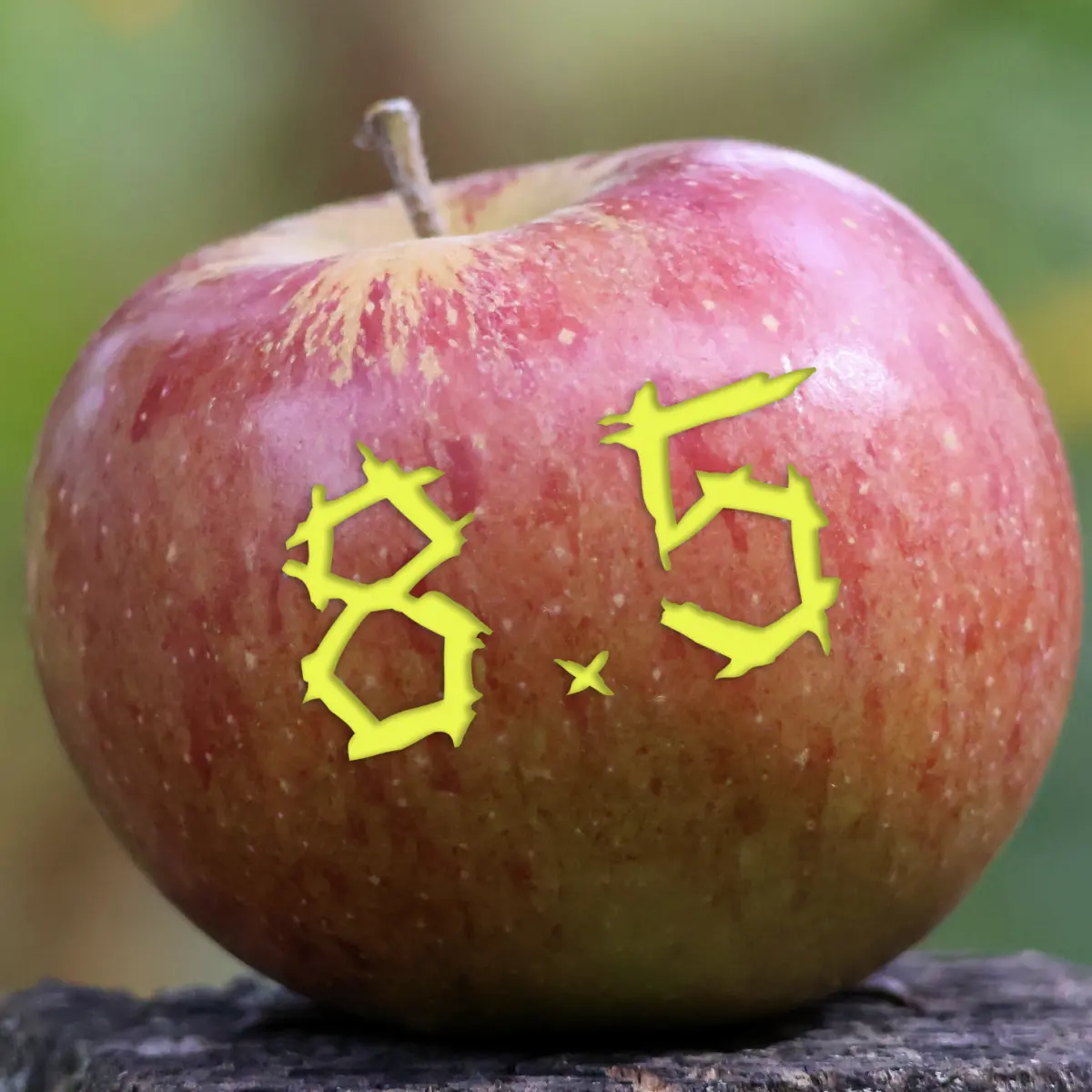
Executive Overview
In the realm of modern fruit consumption, few agricultural products suffer as profoundly from logistical mismanagement and out-of-season cold storage as the Macoun apple (Malus domestica). Long dismissed by casual consumers who encounter it in a moribund, mealy state during the bleak depths of January, the Macoun has frequently been mischaracterized as a second-tier, if not entirely offensive, cultivar.
However, recent field testing conducted at Tabora Farms reveals a startling agricultural dichotomy: when harvested at peak season and consumed fresh from a local orchard, the Macoun transcends its grim reputation. It emerges as a top-tier snack apple defined by a complex sensory profile, featuring delicate floral aromatics, a vibrant copy-paper-white interior, and a uniquely effervescent flavor profile that bridges berry-bubblegum sweetness with a crisp, Sprite-like tartness.
This investigative review examines the anatomy of the Macoun apple, the perils of global supply chain storage, and why provenance remains the single most critical factor in determining whether you are consuming an artisanal masterpiece or, quite literally, "wet trash."
Detailed Chronology: From Scrotum-Textured Despair to Orchard-Fresh Epiphany
To truly understand the redemption of the Macoun, one must first confront its darker historical counterpart: the off-season grocery store specimen.
The Winter Disaster
Our investigative timeline begins in January—universally recognized as a wasteland for pomological integrity. Encountered under the fluorescent lights of a major big-box supermarket, a January Macoun is a tragic victim of hyperbaric fruit chambers and chemical manipulation. Stored in facilities utilizing magic beams and atmospheric controls designed to trick the fruit into artificial stasis, these apples experience a slow, agonizing death of the soul while their structural integrity collapses.
Consumers biting into one of these winter casualties are met with a terrifying mouthfeel resembling aged leather and a flavor profile reminiscent of licking the exhaust pipe of a 1993 Dodge Durango. The psychological damage inflicted by these winter impostors has led many to utter phrases no fruit lover should ever have to repeat: "Fuck these apples."
The Tabora Farms Intervention
Seeking to test the hypothesis that bad apples are frequently just poorly timed apples, a field expedition was launched to Tabora Farms during peak autumn harvest. The transformation was instantaneous and absolute.

Upon biting into the fresh, locally sourced Macoun, the experience broke entirely with the winter paradigm. The skin exhibited an eccentric, almost theatrical reaction: it sloughed off the flesh instantly upon impact, sliding away like the skin of a river-logged corpse. While initially startling and texturally confronting, this peculiar characteristic vanished quickly, clearing the way for an unadulterated sensory experience.
The aroma shifted seamlessly from a generic, pleasant meadow wildflower scent into deep, evolving notes of blooming rose. The internal flesh presented a bold, uncompromising copy-paper-white color. Structurally, the apple achieved a rare balance: it was crisp without being overly hard or aggressive on the teeth, yielding gracefully to the bite.
[January Supermarket Macoun] ──> [Hyperbaric Cold Storage] ──> [Textural Despair: Durango Tailpipe Notes]
[Peak-Season Orchard Macoun]  ──> [Tabora Farms Harvest]   ──> [Sensory Triumph: Sprite Effervescence & Rose]
Supporting Context & Metrics: Origins, Nomenclature, and Flavor Physics
To contextualize the Macoun’s unique standing in the pomological landscape, it is essential to examine its heritage, taxonomy, and physical metrics.
Horticultural Lineage and Etymology
Bred in the early 20th century—making it a relatively recent addition to the historical catalog of cultivated apples—the Macoun is a New York native, despite frequently being mistaken for a Canadian export. Its parentage traces back to the legendary McIntosh and the historic Jersey Black, a genetic pairing that heavily influences its distinct "McTintoshy" vibe.
Nomenclature has proven to be a persistent hurdle for enthusiasts. Commonly mispronounced with a Southern lilt as MAY-coon (akin to Macon, Georgia), the correct pronunciation varies between ma-COWN, ma-COON, and ma-COWAN. This linguistic division traces back to its namesake, William Tyrell Macoun, a prominent Canadian horticulturist based in Ottawa whose surname has baffled casual shoppers for generations.
Quantitative Pomology & Sensory Breakdown
| Metric / Attribute | Evaluation | Notes |
|---|---|---|
| Visual Appearance | 8.5 / 10 | Deep crimson-to-purple blush; bold copy-paper-white interior flesh. |
| Skin Texture | Eccentric | Prone to immediate sloughing upon initial bite; yields to reveal aromatics. |
| Aromatics | Complex | Evolves rapidly from generic wildflower meadow notes to distinct rose petals. |
| Mouthfeel & Crunch | 8.0 / 10 | Yielding and crisp rather than aggressively hard; highly "crushable." |
| Flavor Profile | 9.0 / 10 | Initial berry-bubblegum sweetness undercut by a sneaky, effervescent tartness. |
| Final Score | 8.5 / 10 | Top-tier snack apple (provided it bypasses the big-box January trap). |
Official Statements and Industry Perspectives
The debate surrounding seasonal fruit quality has drawn commentary from agricultural purists, culinary critics, and local orchardists alike.
According to regional orchard operators, the modern consumer’s aversion to certain heirloom and mid-century cultivars is almost entirely a symptom of industrial supply chains. "When you pull a Macoun out of a 10-month-old controlled-atmosphere warehouse, you are eating a ghost," notes one agricultural insider. "The chemical preservation processes lock in the sugars while destroying the delicate volatile organic compounds responsible for the floral and effervescent notes. You are tasting the ghost of an apple, not the apple itself."

Pomological researchers echo this sentiment, emphasizing that varieties rich in delicate malic acid and floral esters—such as the Macoun, Honeycrisp, and Cox’s Orange Pippin—degrade exponentially faster than thick-skinned commercial monoliths like the Red Delicious.
Furthermore, culinary critics have highlighted the Macoun’s versatility. While primarily celebrated here as a high-speed, crushable snack fruit, its balance of sweet berry-bubblegum undertones and surprising Sprite-like effervescence makes it a prime candidate for fresh cider blending and light autumn salads, provided the cook exercises discretion regarding harvest windows.
Future Outlook: The Ongoing Quest for Pomological Truth
As the agricultural sector continues to grapple with the demands of year-round supermarket stocking versus regional seasonality, reviews like this serve as a vital consumer roadmap. The ongoing 2025 and 2026 apple review initiatives—spanning historical and contemporary varieties from the Gravenstein and Hubbardston Nonesuch to the contentious Honeycrisp and the esoteric Black Oxford—prove that public interest in artisanal fruit evaluation is experiencing a renaissance.
Moving forward, the primary challenge facing fruit enthusiasts is education. Consumers must be taught to recognize the profound gulf separating locally sourced orchard harvests from long-haul commercial logistics.
For the Macoun, its reputation has been thoroughly rehabilitated. It stands vindicated as an 8.5-out-of-10 masterpiece of modern pomology. So long as buyers avoid the January traps laid by major big-box retailers and seek out local producers like Tabora Farms during the authentic harvest window, the Macoun will continue to deliver its signature floral, effervescent, and deeply satisfying snacking experience.
Appendix: Comprehensive Cross-Reference of Evaluated Cultivars (2025–2026 Index)
For researchers tracking the broader trajectory of regional apple evaluations, the following historical and contemporary varieties have been cataloged across recent field seasons:
- 2026 Season Highlights: Gravenstein, Hubbardston Nonesuch, Lamb Abbey Pearmain, Hewes Crab, Opalescent, Chenango Strawberry, William’s Pride, Blenheim Orange, Golden Nugget, Doctor Harvey, Kickapoo Spice, St Edmunds Pippin, Sops of Wine, Fenceline Surprise, Americus Crab, Campfield, Graham, Jonagold, Reine des Reinettes, Glockenapfel, Franc Rambour, Grimes Golden, Ambrosia, Star Lady (Api Etoile), Karmijn de Sonnaville, SnapDragon, Nodhead, Calville Blanc d’Hiver, SweeTango, and Blue Pearmain.
- 2025 Season Highlights: Honeycrisp, Sweetie, Crimson Crisp, Knobbed Russet, Cortland, Maiden’s Blush, Cox’s Orange Pippin, Ingrid Marie, Hudson’s Golden Gem, Holstein, Suncrisp, Ashmead’s Kernel, Orleans Reinette, Black Gilliflower, Red Delicious, Jonathan, Ruby Mac, Crimson Topaz, Esopus Spitzenburg, Mutsu, Hunnyz, Winesap, Stayman Winesap, Winter Banana, Ribston Pippin, Rhode Island Greening, Roxbury Russet, Opal, Cosmic Crisp, Black Oxford, Ananas Reinette, Sugarbee, Granny Smith, LucyGlo/LucyRose, Ludacrisp, D’arcy Spice, Lemonade, and Wild Twist.
