

Executive Overview
The landscape of search engine optimization (SEO) is undergoing a paradigm shift. Gone are the days when a weekly manual spreadsheet update sufficed for monitoring a brand’s digital footprint. Today’s search engine results pages (SERPs) are volatile, hyper-personalized, device-fragmented battlegrounds dominated by dynamic elements such as AI Overviews, People Also Ask (PAA) boxes, local map packs, and video carousels.

For modern digital marketing agencies, in-house teams, and enterprise brands, tracking organic growth requires real-time precision. Investing in dedicated Search Engine Results Page (SERP) tracking software is no longer a luxury—it is an absolute operational necessity. Modern tools must do more than just record a static position number; they must map ranking fluctuations directly to traffic acquisition, user behavior, and revenue generation.

This comprehensive guide investigates the 7 best SERP tracking tools for 2025. We evaluate these platforms based on accuracy, on-demand update capabilities, cross-engine compatibility, geographic and device granularity, competitor intelligence, and data integration flexibility. Whether you require a specialized standalone rank tracker or a robust module housed within an all-in-one SEO suite, this analysis breaks down the leading options to help you future-proof your organic search strategy.

Detailed Chronology: The Evolution of Rank Tracking
To understand why modern SERP tracking requires sophisticated software, it helps to examine how the monitoring process has evolved over the past decade:

- The Manual Era (Pre-2015): SEO practitioners relied heavily on manual data collection, logging into local search sessions or using basic desktop scrapers. Spreadsheets were updated weekly or monthly, yielding heavily delayed insights that failed to capture daily algorithm volatility.
- The Scheduled Daily Update Era (2015–2020): Cloud-based SaaS tools entered the market, offering automated daily cron jobs that checked keyword positions across major search engines. While this eliminated manual data entry, data was often siloed, and users had to wait for batch processing cycles to view fresh rankings.
- The Real-Time, Multi-Device, and SERP Feature Era (2020–2023): As Google integrated rich snippets, vertical carousels, and local packs, rank trackers evolved. Platforms introduced on-demand data refreshes, mobile-vs-desktop segmentation, and deep feature-tracking capabilities to capture how real estate on the screen was shifting away from traditional blue links.
- The AI-Driven and Integrated Ecosystem Era (2024–2025+): With the rollout of generative search experiences and AI Overviews, SERP trackers have transformed into predictive intelligence engines. Modern tools now integrate machine learning models, advanced natural language processing, and deep analytics connectors (such as Google Looker Studio and enterprise data warehouses) to correlate SERP movements directly with business KPIs and bottom-line revenue.
Supporting Context & Metrics: Why SERP Trackers Matter
Validating SEO performance and securing continued budget allocations require verifiable data. According to industry benchmarks, organizations that leverage granular SERP tracking tools achieve a significantly higher return on investment (ROI) from their content strategies compared to those relying on aggregated high-level metrics.

Key Metrics to Monitor
- Share of Voice (SoV): Measures your brand’s overall visibility within the search results for a specific set of target keywords, factoring in search volume.
- SERP Feature Ownership: Tracks how many Position #0 spots, AI Overviews, and knowledge panels your domain controls versus competitors.
- Traffic and Revenue Correlation: Maps keyword position movements directly to landing page sessions, conversion rates, and financial return via web analytics integrations.
- Rank Distribution Trends: Groups keywords into performance tiers (e.g., Positions 1–3, 4–10, 11–50) to evaluate overall portfolio health and identify quick-win optimization targets.
The 9 Essential Features to Look For in SERP Tracking Software
Before diving into the top tools, it is vital to understand the foundational features that separate mediocre software from enterprise-grade platforms:

- On-Demand Ranking Updates: Real-time ranking data prevents you from waiting days for automated batch updates during volatile algorithm updates.
- SERP Feature Monitoring: Comprehensive tracking of 50+ SERP features (including AI Overviews, featured snippets, and local packs) to identify opportunities to steal competitor visibility.
- Cross-Engine Compatibility: Ability to track movements across Google, Bing, Baidu, Yandex, and YouTube for international and regional campaigns.
- Granular Geographic and Device Tracking: Localized tracking down to the country, state, city, or zip code level, coupled with distinct mobile and desktop comparisons.
- Traffic and Revenue Mapping: Direct integration with Google Analytics or Adobe Analytics to tie keyword movements to bottom-line conversions.
- Historical Performance Tracking: Deep data retention that allows users to view full historical trends and benchmark performance against competitors over years, not just days.
- Competitor Intelligence & Gap Analysis: Automated grouping of competitor keywords and identification of optimization gaps in existing content.
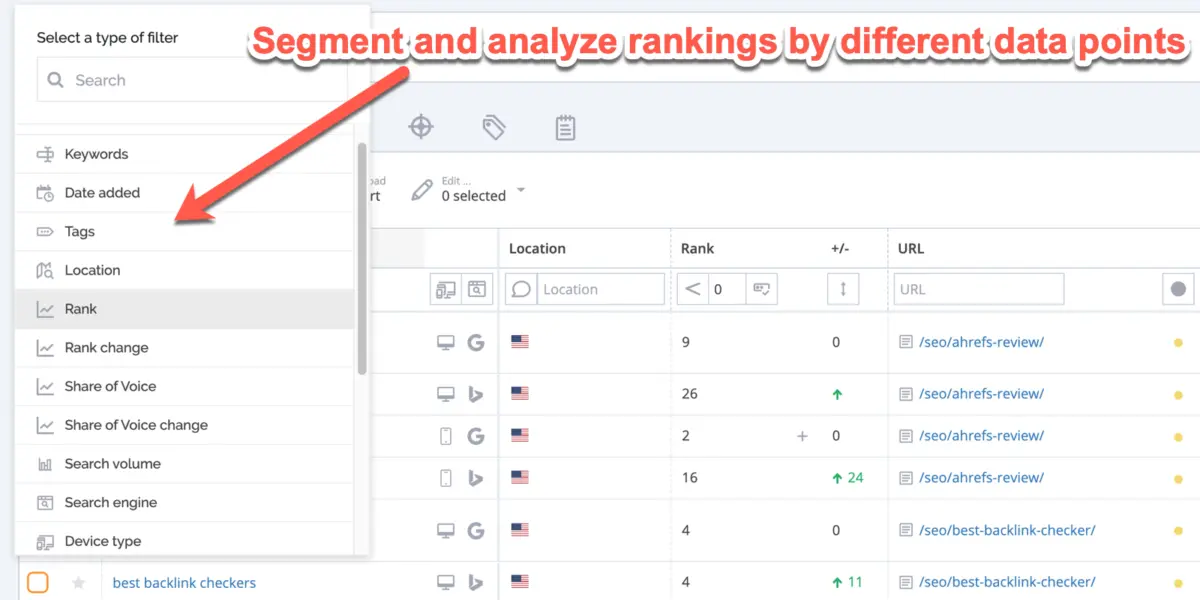
- Tagging and Segmentation: Advanced categorization of keywords by topic, funnel stage, content asset type, and custom tags.
- White-Label Reporting and Integrations: Native export capabilities and seamless API/connector support for third-party reporting platforms like Looker Studio and Databox.
The 7 Best SERP Tracking Tools for 2025
1. AccuRanker
- Overview: AccuRanker is a powerhouse standalone SERP tracking tool relied upon by over 32,000 companies, including industry giants like HubSpot, IKEA, and Kinsta. It is built specifically for agencies and enterprise brands that demand lightning-fast, highly accurate data.
- Standout Features: Automatic 24-hour keyword set updates with an instant on-demand refresh button; advanced Share of Voice analytics; deep integration with Google Analytics and Adobe Analytics for revenue mapping; and robust Looker Studio connectors.
- Best For: Agencies, enterprise brands, and professionals who prioritize raw speed, data accuracy, and granular reporting.
- Pricing: Starts at $116/month for up to 1,000 tracked keywords.
2. Semrush (Position Tracker & SERP Gap Analyzer)
- Overview: Serving over 10 million users globally (including Samsung and Vodafone), Semrush is a premier all-in-one SEO platform. Its Position Tracking Tool and App Center extensions rival the accuracy of dedicated standalone trackers.
- Standout Features: Hyper-accurate daily rank tracking from international to hyper-local levels; robust competitor comparison buckets; and the innovative SERP Gap Analyzer app, which scans Google to uncover under-optimized content and integrates seamlessly with Google Search Console.
- Best For: Digital marketing professionals and enterprises looking for an all-in-one suite that does not compromise on tracking accuracy.
- Pricing: Subscription plans start at $139.95/month.
3. ProRankTracker
- Overview: Trusted by over 60,000 customers, ProRankTracker is a cost-effective, highly reliable standalone tracking and reporting solution.
- Standout Features: Scalable tracking across local and international markets; multi-language support; dedicated video marketing rank tracking; and flexible reporting dashboards.
- Best For: SEM agencies, ecommerce brands, and video marketers seeking high-volume tracking on a budget.
- Pricing: Plans start at $39/month.
4. Advanced Web Ranking (AWR)
- Overview: AWR is a veteran standalone SERP tracker utilized by major enterprises like Microsoft. It is engineered for heavy-duty reporting and complex organizational hierarchies.
- Standout Features: Unlimited user seats on most plans; robust white-label reporting engines; white-glove data security; and comprehensive multi-engine tracking.
- Best For: Large in-house teams and agencies managing extensive client portfolios that require deep customization.
- Pricing: Plans start at $99/month.
5. SERPWatcher (by Mangools)
- Overview: Developed by Mangools, SERPWatcher is designed for users who value simplicity, visual appeal, and affordability without sacrificing essential data points. Trusted by brands like Airbnb and Adidas.
- Standout Features: The proprietary Performance Index, which calculates organic traffic potential based on current rankings and search volumes; clean, intuitive dashboards; and seamless integration with Mangools’ broader SEO toolkit (including SERPChecker).
- Best For: Small business owners, startups, and freelancers looking for an easy-to-use, visually stunning interface.
- Pricing: Plans start at $29.90/month.
6. SE Ranking
- Overview: SE Ranking is a comprehensive all-in-one SEO platform featuring a highly reliable Position Tracking module that simulates real user behavior across target locations and devices.
- Standout Features: 100% accurate location-based tracking simulation; comprehensive site auditing tools bundled in; and flexible subscription scaling.
- Best For: Small-to-medium businesses and digital agencies seeking a balanced, feature-rich all-in-one platform.
- Pricing: Starts at $52/month (based on daily updates for 500 keywords).
7. Nightwatch
- Overview: Trusted by enterprise brands like Shopify, Coinbase, and Scotiabank, Nightwatch is renowned for its unmatched geographical reach, pulling accurate data from over 107,296 locations worldwide.
- Standout Features: Massive location database; custom data segmentation engines; automated auditing; and clean visualization dashboards.
- Best For: Global enterprises, international brands, and agencies with hyper-localized geographic targeting requirements.
- Pricing: Offers a 14-day free trial, with paid plans starting at $32/month for up to 250 keywords.
Official Industry Statements & Expert Perspectives
Industry leaders continue to emphasize the integration of modern tracking metrics into client-facing workflows:

- Ian Howells (Co-Founder, Traffic Think Tank): "The thing that really got me using [AccuRanker] heavily in the last month or two is their Google Data Studio connector. Combining the tag feature, as well as the Share of Voice metric, has been a big help in making these reports immediately digestible."
- Matthew Howells-Barby (Co-Founder, TrafficThinkTank): "It’s by far the best keyword ranking tracker in the market and has a ton of great reporting functions. If you want visibility on large volumes of keywords housed within a nice dashboard — this is for you."
Future Outlook: What Lies Ahead for SERP Tracking
As we look further into the decade, the trajectory of SERP tracking will be defined by artificial intelligence and machine learning. Search engines are no longer static directories of blue links; they are conversational, generative engines.

Future-proof SERP tracking tools will need to evolve beyond simple position-checking to measure Share of Model—evaluating how frequently a brand is cited within AI-generated summaries and conversational search outputs. Furthermore, predictive analytics will allow marketers to forecast algorithm updates before they fully roll out, turning reactive tracking into proactive optimization.

Making Your Final Choice
- If you need a dedicated, high-speed standalone tracker with unmatched on-demand capabilities, choose AccuRanker.
- If you prefer an all-in-one SEO ecosystem equipped with advanced competitor analysis and gap identification, choose Semrush.
- If you are operating on a lean budget but refuse to compromise on visual clarity and ease of use, explore SERPWatcher or ProRankTracker.
Evaluate your agency’s or enterprise’s specific workflow demands, test out a trial period, and implement a robust SERP tracking solution to secure your organic growth in 2025 and beyond.
