In the modern digital landscape, the phrase "content is king" is frequently overshadowed by a more pragmatic reality: visibility is currency. For enterprise brands, lean startup founders, and agency veterans alike, the foundation of any profitable online marketing campaign begins and ends with keyword research. Yet, navigating the serpentine lists of top-performing SEO software found across the web often leaves digital marketers paralyzed by choice. With hundreds of tool roundups boasting anywhere from 10 to 100 solutions, practitioners are left wondering which platforms actually drive ROI.
To cut through the noise, a definitive industry survey was conducted, putting a single, uncompromising question to 139 of the world’s leading search marketing professionals, international SEO managers, and digital growth architects:
"If you could only use 3 tools for keyword research, which 3 would you choose?"
Rather than compiling a generic directory of software features, this investigative roundup went straight to the source. The collective insights of these 139 experts reveal a definitive leaderboard, highlighting a clear industry consensus dominated by powerhouse platforms like Semrush, Ahrefs, and the foundational Google Keyword Planner. This report examines the mechanics behind the top-voted tools, analyzes how industry leaders leverage them to engineer profitable campaigns, and explores the evolving philosophy of modern keyword research.
Detailed Chronology & Methodology: Cutting Through the Noise
The proliferation of software options in the search engine optimization (SEO) ecosystem has created a paradox of choice. To establish a true industry benchmark, responses were gathered over several iterations from a diverse cohort of practitioners representing brands such as Lululemon, Shopify, Rankings.io, and Screaming Frog.
Rather than treating keyword research as an isolated mechanical task, the survey uncovered a sophisticated workflow. Most experts advocate for a multi-tiered methodology:
Discovery & Ideation: Using autocomplete, forum mining, and data aggregators to unearth seed terms.
Competitive Intelligence: Reverse-engineering competitor domains to uncover high-intent traffic gaps.
By analyzing the aggregated data by vote count, a definitive podium emerged at the top of the leaderboard.
The Leaderboard: A Closer Look at the Industry Giants
1. Semrush (87 Votes)
Crowned as the top-voted keyword research tool among the surveyed experts, Semrush stands as an industry-leading, all-in-one SEO and digital marketing suite. Boasting one of the largest keyword databases on the market—spanning over 23 billion keywords across 142 international databases—Semrush provides deep topical and competitor keyword intelligence for both organic SEO and pay-per-click (PPC) campaigns.
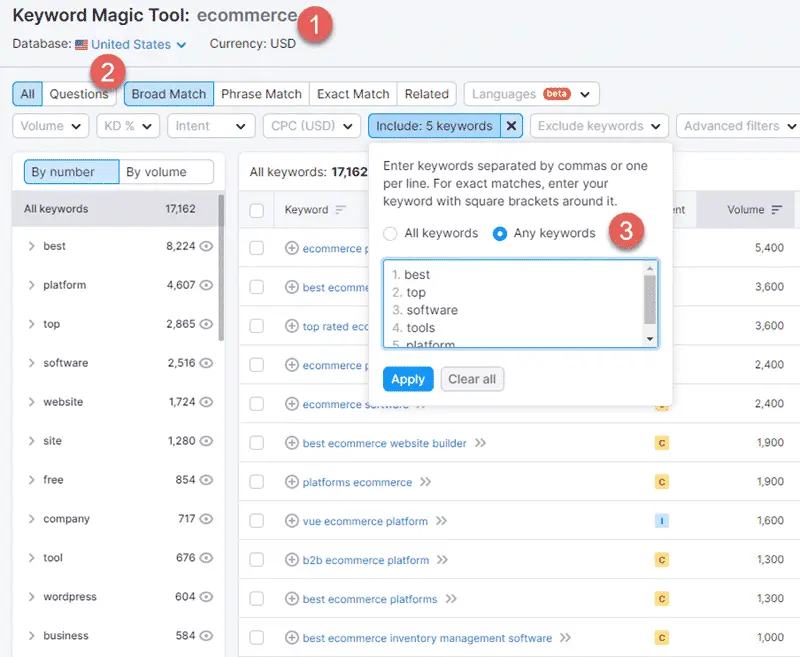
The Keyword Magic Tool: Highly praised across the expert panel, this feature allows marketers to group keywords by topic, search intent, question type, and SERP features. Users can easily filter by keyword difficulty and seamlessly push curated lists into position-tracking or PPC modules.
The Keyword Gap Tool: A favorite for competitive analysis, this tool offers a side-by-side comparison of up to five competing domains, identifying missed ranking opportunities and overlapping targets in seconds.
2. Google Keyword Planner (57 Votes)
As a free platform directly tied to the Google Ads ecosystem, the Google Keyword Planner remains a staple, though its utility has evolved. Experts note that while it provides official search volume data to active advertisers, non-advertisers receive only broad traffic ranges. Lacking advanced filtering and organic difficulty metrics, it is primarily recommended as a foundational baseline for PPC insights and initial seed-term expansion rather than standalone organic SEO research.
3. Ahrefs Keywords Explorer (55 Votes)
A close competitor to Semrush, Ahrefs commands fierce loyalty among technical SEOs and content strategists. Its Keywords Explorer report allows users to generate thousands of keyword opportunities across major search engines including Google, Bing, YouTube, and Amazon. Standout features include advanced SERP position history, click-through metrics, and robust backlink integration that helps practitioners accurately gauge ranking difficulty.
Expert Insights: Strategies from the Front Lines
The survey responses underscore that no single tool operates in a vacuum. Industry leaders rely on synergistic combinations to build robust content ecosystems.
Luke Monaghan (International SEO Manager, Lululemon): Highlights Semrush for competitive visibility insights, SISTRIX for historical performance and visibility charts, and Keywordtool.io for long-tail contextual keyword variants.
Paul Shapiro (Technical SEO Lead, Shopify): Urges marketers to look beyond basic toolkits, advocating for advanced semantic tools like MarketMuse for topic modeling, and human-centric approaches like Seed Keywords to capture actual consumer search language.
Brendan Hufford (Growth Content Marketer, ActiveCampaign): Shifts the focus from rigid keyword metrics to search intent. Hufford emphasizes using Ahrefs to reverse-engineer consistently ranking content, paired with human analysis to ensure the content format matches user intent (e.g., quick bullet points vs. exhaustive guides).
Carrie Hill (Local SEO Analyst, Sterling Sky): Takes a contrarian approach, noting that direct conversations with clients and customer service teams often unearth more authentic search terminology than software alone, bridging the gap between local intent and semantic mapping.
Supporting Context & Metrics: The Human Element vs. Automation
A recurring theme among top practitioners is the danger of relying solely on automated data. As noted by Christine Churchill (President and CEO, KeyRelevance), dumping raw tool outputs directly into PPC or organic campaigns without qualitative review is a recipe for disaster.
Similarly, veterans like Kurt Frankenberg and Jay Acunzo advocate for "ground-level" keyword research—talking directly to customers, monitoring community forums, and mining internal search logs. Tools like AnswerThePublic, alsoasked.com, and Google Autocomplete play a vital role in capturing these human-centric, question-based queries, ensuring that content strategies address real-world conversational search patterns.
Furthermore, technical tools like Google Search Console (GSC) are frequently highlighted as underutilized goldmines. By mining GSC data for queries generating high impressions but low click-through rates, site owners can uncover "low-hanging fruit" optimization opportunities on pages that Google already deems relevant.
Future Outlook: The Evolution of Keyword Discovery
As search engines incorporate sophisticated natural language processing, machine learning, and semantic intent modeling, the definition of keyword research is undergoing a fundamental transformation. Emerging tools leveraging AI—such as Keyword Insights for automated keyword clustering and MarketMuse for content gap modeling—signal a shift away from isolated keyword strings toward comprehensive topical authority.
Despite these technological leaps, the core principle remains unchanged: successful search marketing requires a balanced arsenal. Whether combining the massive databases of Semrush and Ahrefs with qualitative customer interviews, or utilizing Chrome extensions like Keywords Everywhere for rapid SERP analysis, the consensus among 139 experts is clear. Mastery of search visibility belongs to those who view tools not as magic wands, but as analytical lenses to better understand human intent.