

Executive Overview
In the modern digital publishing ecosystem, speed and accuracy are the twin currencies of the professional freelance writer. Whether crafting an in-depth fintech feature, a B2B SaaS case study, or a high-profile journalistic profile, the foundation of authoritative content almost always rests on the shoulders of the Subject Matter Expert (SME) interview. Traditionally, however, extracting gold from these conversations required a punishing logistical tax: manual transcription.
A standard 20-minute conversation with an industry expert frequently yields upwards of 3,000 words of dialogue. Without automated assistance, writers historically faced the grueling task of scrubbing through audio recordings five or six times just to secure accurate quotations. This manual bottleneck routinely consumed an hour or more of labor for every twenty minutes of tape, fracturing the writer’s focus, stalling project timelines, and eroding effective hourly rates.
Enter AI-driven transcription software—a technological shift that has fundamentally reshaped how independent content creators manage their workflows. Among the pioneers in this space is Otter.ai, a platform that has quietly become a staple for thousands of freelance professionals since its widespread adoption around 2020.
This report investigates whether Otter’s $100-annual Pro tier delivers genuine return on investment (ROI) for writers who conduct regular interviews. By analyzing time-saving metrics, workflow integration, technological limitations, and comparative alternatives, we explore how automated transcription is redefining modern content production.
Detailed Chronology: The Evolution of Interview Workflows
To understand the transformative impact of tools like Otter.ai, one must examine the historical workflow of the interview-dependent freelance writer. For decades, the process was bound by rigid, low-tech constraints.
Phase 1: The Era of Manual Note-Taking and Analog Recording (Pre-2015)
In the early days of digital freelancing, writers relied heavily on microcassette recorders, digital voice recorders, or early computer software like Skype recorders. Conducting an SME interview meant splitting cognitive bandwidth:
- The Dual Burden: The writer had to actively engage the expert, steer the narrative arc, ask follow-up questions, and simultaneously scribble shorthand notes or type frantically on a keyboard.
- The Result: Conversations often suffered because the writer was distracted by documentation. Nuanced points were missed, and the resulting articles lacked conversational depth.
Phase 2: The Rise of Human Transcription Services (2015–2020)
As the gig economy expanded and budgets for digital content grew, many writers outsourced the burden of transcription to human-powered services or overseas virtual assistants. While this solved the immediate problem of physical labor, it introduced a new set of friction points:
- The Waiting Game: Human transcription typically required a turnaround time of three to five business days unless a steep "rush fee" was paid.
- The Deadline Crunch: For agile freelancers working on tight, one-week turnarounds—where a writer must source an expert, conduct an interview, research, draft, and edit within days—waiting nearly a week for a transcript was a project killer.
Phase 3: The AI Revolution and Real-Time Transcription (2020–Present)
The integration of automated speech recognition (ASR) and generative AI completely collapsed the timeline between conversation and composition. Platforms like Otter.ai shifted the paradigm from post-interview waiting to instant gratification.
- Immediate Availability: Transcripts generate in real time as the call concludes.
- Cognitive Freedom: Writers are now liberated to give 100% of their attention to the interviewee, safe in the knowledge that every syllable is being captured securely in the background.
Supporting Context & Metrics: Calculating the Freelance ROI
For self-employed professionals operating on tight margins, software subscriptions must justify their cost down to the penny. At roughly $100 per year ($8.33/month billed annually), Otter Pro occupies a specific financial niche. To evaluate its viability, we must examine the hard metrics of time saved and effective hourly rates.
The Mathematics of Time Savings
Consider a standard freelance assignment: a 1,000-word article commissioned for $1,200, requiring a single SME interview. A typical workflow breaks down as follows:
- Research & Prep: 1 hour
- Interview Execution: 0.5 hours
- Outlining & Drafting: 3 hours
- Transcription & Quote Verification: 1 hour (historically)
- Total Time Invested: 5.5 hours
- Effective Hourly Rate: ~$218 per hour
By introducing an AI transcription tool that drops the post-call transcription and cleanup phase from 60 minutes to roughly 10 minutes, the metrics shift dramatically:
- Research & Prep: 1 hour
- Interview Execution: 0.5 hours
- Outlining & Drafting: 3 hours
- Transcript Cleanup & Verification: 0.16 hours (10 minutes)
- Total Time Invested: 4.66 hours
- Effective Hourly Rate: ~$257 per hour
Multiply this time savings across three or four interview-heavy articles per month, and a writer reclaims between 3 to 5 hours of billable or rest time monthly. In this context, the $100 annual subscription pays for itself within the first month of operation.
Key Technological Features Driving Efficiency
Beyond basic text conversion, modern transcription suites offer specialized features tailored to content creators:
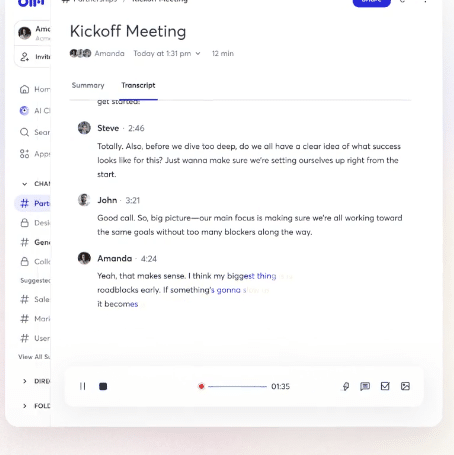
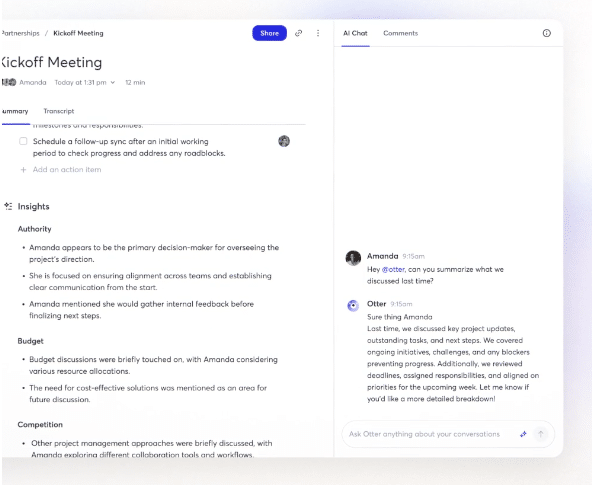
- AI Chat Search: When an expert veers into complex tangents or references multiple interconnected points across a 45-minute call, finding specific quotes can be tedious. AI chat features allow users to query the transcript directly (e.g., "What did the expert say about credit card fraud?"), instantly pulling up relevant sections and summaries.
- Audio-Linked Playback: Clicking any line in the text transcript immediately triggers the corresponding audio timestamp. This is essential for verifying ambiguous phrasing, correcting technical jargon, or ensuring context is preserved before publication.
- Calendar Sync & Auto-Join: Integrations with major calendar applications allow bots to automatically join scheduled Zoom, Google Meet, or Microsoft Teams calls without manual intervention.
Official Industry Analysis & Limitations
While the advantages are clear, objective journalism requires an examination of the platform’s constraints. User feedback and professional reviews highlight several operational challenges that writers must navigate.
1. The Accuracy Gap
While marketing materials often tout accuracy rates of up to 95%, real-world conditions during SME interviews typically yield an 80% to 85% accuracy rate. Technical vocabulary, industry acronyms, and unfamiliar proper nouns are frequently mangled by automated algorithms.
- The Safeguard: Professional writers view transcripts as working drafts rather than final copy. Rigorous verification—clicking back through the audio to confirm quotes—remains a non-negotiable step in ethical journalism.
2. Hardware and Speaker Identification Constraints
- Speaker Mode Dependency: Depending on system configurations, if a user wears headphones during a call, software may only capture the user’s voice rather than the remote speaker, necessitating reliance on computer speakers or specific audio-routing software.
- Attribution Errors: In multi-speaker environments, webinars, or panel discussions, automated diarization (speaker separation) can struggle, occasionally mislabeling participants or defaulting to generic designations like "Speaker 1" and "Speaker 2."
Comparative Landscape: How Otter Stacks Up
While competitors such as Fireflies.ai, Fathom, and Rev offer robust alternatives, many long-form writers remain anchored to tools that have proven reliable across years of production cycles. Free tiers (such as Otter’s Basic plan, which offers 300 minutes per month with 30-minute session limits) provide adequate runway for evaluation before committing capital.
Future Outlook: The Next Generation of Content Creation
As artificial intelligence continues to permeate every corner of the digital economy, the role of the freelance writer is evolving from manual laborer to strategic editor and curator.
The integration of advanced speech-to-text engines is merely the baseline. Looking forward, the convergence of automated transcription with generative large language models (LLMs) points toward workflows where raw interview transcripts can be automatically synthesized into structured article outlines, social media promotional copy, and SEO-optimized summaries within seconds of a call ending.
For independent professionals, mastering these tools is no longer optional—it is a competitive necessity. Those who embrace efficiency-boosting platforms will continue to scale their output, protect their profit margins, and dedicate more cognitive energy to what truly matters: deep reporting, creative storytelling, and compelling prose.
