

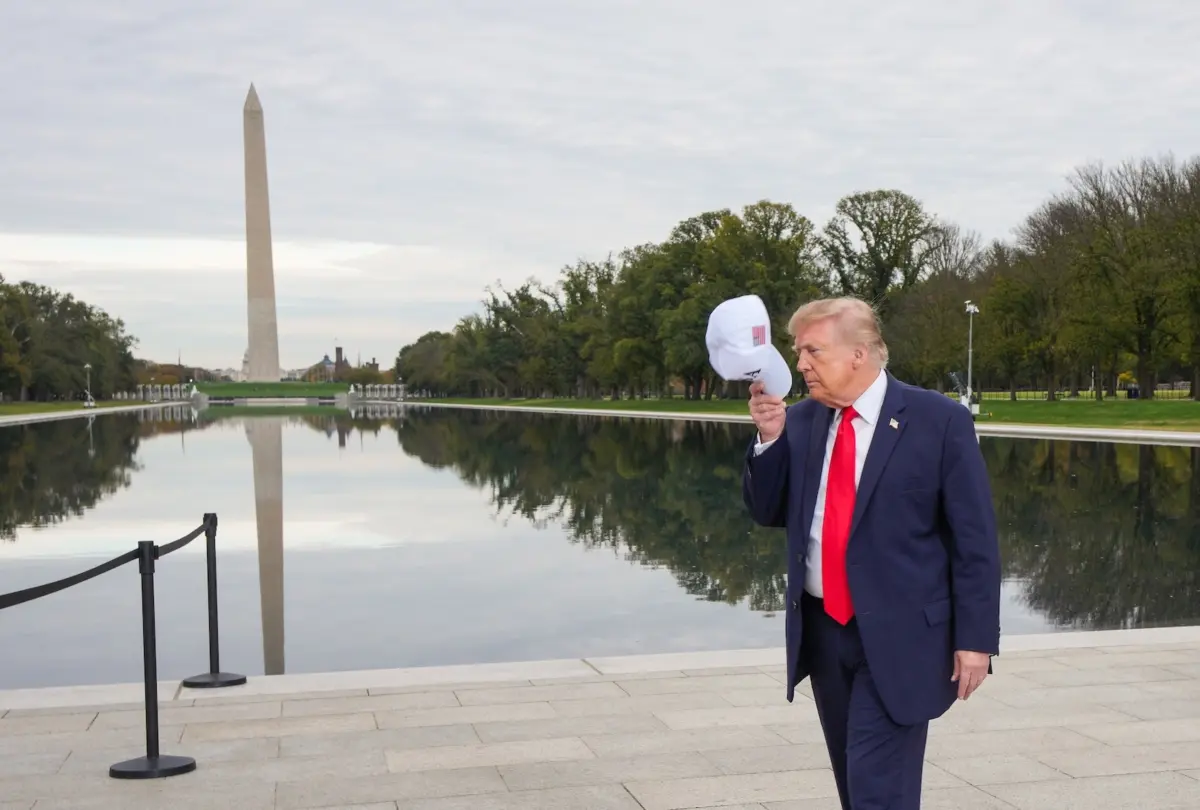
WASHINGTON — On the eve of the most consequential midterm elections of the decade, President Donald Trump stood before the Lincoln Memorial Reflecting Pool on Monday to
deliver a sprawling, unorthodox closing argument. More than twenty-three minutes into a nearly hour-long address, the president seemed to brace his base for what final polling suggests could be a historic realignment in Congress, framing the choice before voters in apocalyptic terms while dwelling on local D.C. infrastructure and long-running grievances.
As millions of Americans prepared to cast their ballots on Tuesday to determine control of the House of Representatives and the Senate for the remainder of Trump’s second term, the political landscape was defined by an unprecedented surge in early voting. Yet, even as local election offices reported shattered turnout records from South Carolina to Texas, the closing days of the campaign exposed a deep chasm between a defiant White House and a rapidly shifting electoral map.
Executive Overview
The final 24 hours of the 2026 midterm election cycle crystallized a tense political moment. President Trump’s final rally-style speech in the nation’s capital underscored the defensive posture of a Republican Party fighting to retain its razor-thin majorities in Washington. Eschewing a strict focus on legislative achievements or economic data, Trump spent significant portions of his address harping on Washington construction projects, rehashing controversies surrounding monument vandalism, and even joking that the iconic reflecting pool should be named after him.
When he finally pivoted to the ballot box, the president launched a blistering attack on the Democratic opposition, warning that a victory for his political rivals would empower those who "hate America."
Simultaneously, electoral analysts and late-breaking polling data indicate that the Democratic Party holds a formidable advantage heading into Election Day. According to final aggregations from the New York Times/Siena University and the Cook Political Report, Democrats are positioned not only to defend their ground but potentially to secure significant pickups in both chambers, threatening to hand the GOP a sweeping defeat and hand the opposition its strongest congressional majority since 2009.
Detailed Chronology: The Final Campaign Stretch
The Lincoln Memorial Address
The setting for Trump’s closing speech—the Lincoln Memorial Reflecting Pool—carries heavy symbolic weight and has served as a focal point of controversy throughout his second term. Speaking against the backdrop of federal monuments, the president used the platform to rally his core supporters to protect Republican congressional majorities.
However, the address wandered through grievances far removed from the immediate economic and social anxieties driving voters to the polls. Trump spent considerable time complaining about local Washington, D.C., construction projects and reviving conspiracy theories regarding the vandalism of national monuments—a sore spot stemming from contractor disputes earlier in the year.
It was not until well past the midway point of the speech that Trump addressed the looming elections directly. Acknowledging the historical headwinds facing a sitting president’s party during a midterm cycle, Trump appeared to preemptively concede the difficulty of the map.
"Now that doesn’t happen because usually whoever the sitting president is, Republican or Democrat, uh, good or bad… for some reason the sitting president doesn’t win the midterms, but we gave this a very strong shot," Trump told the crowd.
Smashed Records and the Early Vote Surge
While Washington listened to the president’s grievances, election officials across the country were managing an unprecedented logistical wave. Early voting numbers have obliterated past benchmarks in numerous battlegrounds.
- Texas: More than 7.7 million voters cast their ballots early, blowing past the previous midterm record set during the high-turnout cycle of 2018.
- The Carolinas and Ohio: South Carolina and Ohio both registered historic volumes of early participation, driven by intense interest in competitive statewide and congressional contests.
- National Totals: Nationwide, approximately 50 million ballots had been logged prior to Election Day. Crucially for Democrats, data from several key states indicated an elevated share of registered Democrats participating early.
Despite these dramatic figures, nonpartisan election experts cautioned against drawing definitive conclusions before polls close. According to New York Times analyses, roughly half of the anticipated total vote is expected to be cast in person on Election Day itself, creating a volatile dynamic where early momentum could be offset by traditional voting patterns.
Supporting Context & Metrics: The Polling Reality
The collision between aggressive early voting and final tracking polls sets the stage for a dramatic election night. For months, political analysts have tracked a tightening race, but the final week of polling has broken decisively in favor of the Democrats.
Senate Battlegrounds
According to the final New York Times/Siena University polls released on the eve of the election, the Democratic Party maintains leads in all seven states deemed likeliest to decide the balance of power in the upper chamber:
- Michigan
- Kansas
- Texas
- Maine
- Ohio
- Alaska (trailing narrowly)
- Iowa (trailing narrowly)
Should these numbers hold, the Senate—currently under narrow Republican control—would tilt firmly toward the opposition, complicating executive appointments and judicial confirmations for the remainder of Trump’s term.
House Projections
The picture in the House of Representatives is similarly bleak for the GOP. The Cook Political Report expanded its projection map in the final days of the cycle, forecasting additional Democratic pickups in competitive districts across North Carolina, Florida, Tennessee, and Virginia.
The report’s final model projects that Democrats are on track to net between 15 and 25 seats, which would consolidate a projected majority of 230 to 240 seats. If realized through a clean sweep of toss-up districts, it would grant Democrats their largest majority in the lower chamber since 2009, severely curtailing the administration’s legislative agenda.
Official Statements & Rhetorical Escalation
The closing days of the 2026 campaign have also been marked by sharply escalated rhetoric from the White House, as the administration attempts to energize an electorate fatigued by years of sharp partisan division.
In his remarks at the reflecting pool, President Trump framed the stakes not merely as a policy dispute, but as a defense of the nation’s foundational identity:
"When you vote, remember a party that hates America cannot be allowed to rule over the people who built our country," Trump declared. He asserted that Democrats aimed to "blow all of this up by electing communist jihadists."
This language reflects a broader Republican messaging strategy in the final hours, seeking to nationalize local races by binding congressional opponents to the most polarizing wings of the progressive movement. Democrats, conversely, have focused their closing arguments on healthcare access, reproductive rights, and checks and balances on executive power, largely ignoring the administration’s cultural counter-offensives in favor of ground-game mobilization.
Future Outlook: Governing in a Divided or Shifted Capital
As Americans head to the polls, the institutional architecture of Washington hangs in the balance. The implications of Tuesday’s vote will reverberate instantly through the halls of power, dictating the political reality of the federal government through 2028.
Scenario A: The Democratic Sweep
If the final polling models prove accurate and Democrats capture majorities in both the House and the Senate, President Trump will face an entirely recalibrated political battlefield. Divided government would instantly halt the administration’s legislative ambitions, replacing proactive policymaking with high-stakes legislative standoffs over the federal budget, debt ceilings, and potential oversight investigations. Furthermore, a hostile Senate would wield the power to grind federal and judicial nominations to a halt, fundamentally altering the trajectory of the executive branch’s second term.
Scenario B: The Republican Firewall Holds
Conversely, should the traditional mid-cycle correction fail to materialize—or if the massive early turnout proves less predictive than Republican strategists hope—defying the final polls will be viewed as a historic triumph for Trump’s political coattails. Retaining control of Congress would empower the administration to accelerate its second-term priorities, secure its judicial footprint, and push through sweeping regulatory and fiscal changes without legislative obstruction.
As election workers prepare to process tens of millions of ballots—from the record-shattering queues in Texas to the fierce battlegrounds of the industrial Midwest—the nation stands at a precipice. By Wednesday morning, the rhetoric at the Lincoln Memorial will fade, replaced by the hard arithmetic of a transformed American electorate.
