

Executive Overview
For years, frontend development has marched toward a singular promise: native browser capabilities will eventually liberate us from complex JavaScript workarounds. When a feature like CSS Container Queries, the :has() relational pseudo-class, or native CSS nesting lands in browsers, it is often greeted with celebratory pull requests. Developers routinely delete dozens of lines of imperative JavaScript, swap a ResizeObserver for a few declarations of declarative styles, and watch the diff turn overwhelmingly red.
It feels like an unmitigated win—less code, zero bundle-size overhead, and a return to the platform’s native strengths.
However, as frontend engineer Gabriel Shoyombo explores in a revealing analysis of architectural migrations, local simplicity does not automatically equate to system-wide simplicity. Swapping out a JavaScript implementation for a modern CSS feature often shifts logic into a shared ecosystem without accounting for how the new code interacts with existing layout contexts, the CSS Cascade, and the browser’s rendering engine.
While the individual code snippet shrinks, the wider application can become dramatically harder to reason about, debug, and maintain. This investigative deep dive examines the multi-faceted friction points that emerge when modern CSS features collide with legacy codebases, evaluating the delicate balance between local elegance and systemic complexity.
Detailed Chronology: The Lifecycle of a Flawed Migration
To understand how modern CSS features introduce architectural friction, one must examine the typical lifecycle of a refactoring task. The process usually begins with an isolated component and ends with subtle, hard-to-reproduce bugs scattered across the application.
Phase 1: The Greenfield Illusion vs. Brownfield Reality
Most documentation, tutorials, and conference talks regarding modern CSS features are written from a greenfield perspective—assuming a clean slate where styles and behaviors are designed in harmony from day one. In reality, enterprise applications are brownfield environments built on layers of accumulated patterns, legacy stylesheets, and auxiliary scripts.
Consider a standard component pattern: a dashboard card that shifts from a single-column layout to a two-column grid when allotted sufficient space. Historically, developers relied on a JavaScript ResizeObserver to monitor the element’s width and toggle a utility class (.card--wide):
const card = document.querySelector('.card');

new ResizeObserver(([entry]) =>
  card.classList.toggle('card--wide', entry.contentRect.width > 480);
).observe(card);
Paired with corresponding CSS:
.card--wide .card__body
  display: grid;
  grid-template-columns: 160px 1fr;


.card--wide .card__title
  font-size: 1.5rem;
Upon adopting modern CSS, a developer recognizes that a Container Query can eliminate the JavaScript boilerplate entirely:

.card
  container-type: inline-size;


@container (width > 480px)
  .card__body
    display: grid;
    grid-template-columns: 160px 1fr;
Phase 2: The Silent Fracture
The pull request is submitted, reviewed, and approved within minutes because the net reduction of code is obvious. Yet, migrations rarely happen in a single, atomic sweep.
In this scenario, the developer successfully added the @container rule and removed .card--wide .card__body. However, two remnants survived:
- The
ResizeObserverscript remained registered in an independent utility file. - The
.card--wide .card__titlerule lingered in a global stylesheet because no one performed a deep search for the associated utility class.
For a time, everything appears functional because both implementations coincidentally share the 480px threshold. But weeks later, a product designer requests a breakpoint adjustment to 600px. The developer updates the container query, completely unaware of the lingering JavaScript observer and the orphaned title selector.
Between 480px and 600px, the card enters an unwritten, unintended hybrid state: its body remains single-column, but its title abruptly scales up. None of these bugs live in the new lines of CSS; they are the direct byproduct of split ownership between languages.
Supporting Context & Metrics: Unpacking Systemic Complexity
Shoyombo’s analysis aligns with a broader industry discourse surrounding modern frontend complexity. In April 2026, developer Igor Roztropiški published an influential essay titled "Modern Frontend Complexity: Essential or Accidental?", questioning whether contemporary architectures have truly simplified software delivery or merely shifted cognitive overhead elsewhere.
The ensuing discussions across developer communities revealed a deep ideological split. Critics argue that modern tooling often promises "less code" but merely delivers "less work upfront," leaving developers to grapple with implicit runtime behaviors. Proponents, meanwhile, emphasize that native CSS features restore expressive power to the browser, eliminating the need for heavy JavaScript-driven abstractions.
The reconciliation of these viewpoints hinges on a critical distinction: A native feature only reduces complexity when it completely replaces existing behavior without disrupting the surrounding system. When introducing modern CSS, developers routinely disturb four distinct "housemates" within the application architecture.
1. The Layout Rearrangement (container-type)
Declaring container-type: inline-size feels like an isolated instruction telling the browser to let child elements query an element’s width. However, according to specification standards, this single property applies style and inline-size containment, which inherently establishes a new Block Formatting Context (BFC).
Establishing an unexpected BFC alters fundamental layout mechanics:

- Margins Stop Collapsing: Vertical margins that previously slipped through parent boundaries now remain trapped, inadvertently expanding container dimensions.
- Floats Impose Boundaries: Elements that once gracefully wrapped around floated images are suddenly forced outward, altering spatial relationships across the page.
- Content-Sized Cards Collapse: Size containment prevents elements from deriving dimensions from their contents. If a component lacks explicit sizing rules, inline-size containment can collapse its width to zero, causing elements to vanish entirely from the viewport.
2. The Cascading Reach (:has() and Nesting)
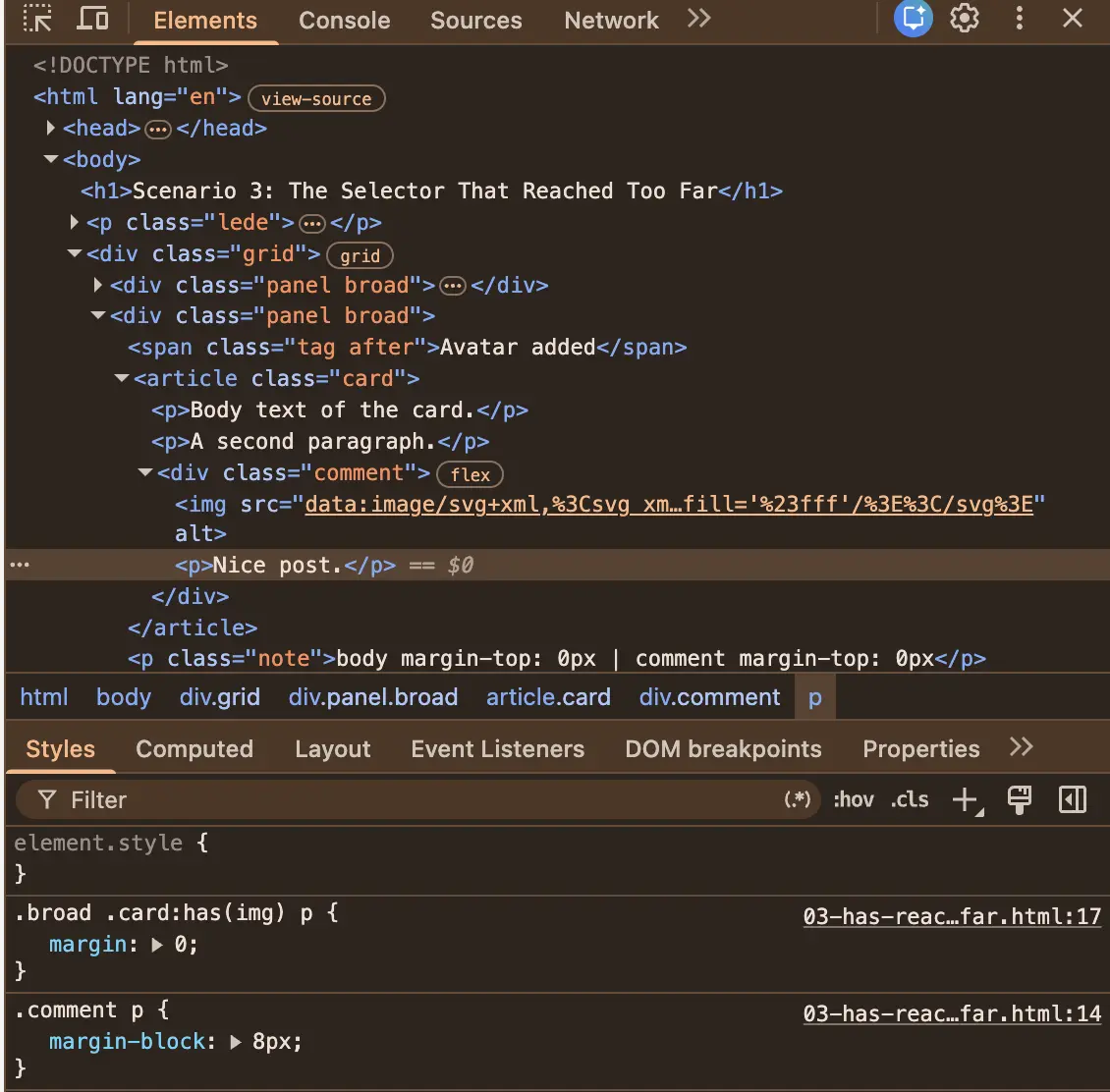
Advanced selectors like :has() and native CSS nesting enable hyper-concise code, but they also broaden the blast radius of style rules. For instance, attempting to strip paragraph margins from cards containing a hero image via .card:has(img) p can easily overreach, inadvertently silencing spacing rules inside nested comment components that happen to reside within the article tree.
Similarly, native nesting inherits the specificity rules of :is(), where the & selector absorbs the highest specificity of its parent selector list. A seemingly innocuous nested rule can accidentally override targeted utility classes elsewhere in the application, igniting an unintended specificity war.
3. The Performance Trade-Off
A pervasive myth in frontend development is that moving logic from JavaScript to CSS guarantees performance improvements. While delegating layout observation to the browser engine eliminates main-thread script execution overhead, it can introduce unexpected rendering costs.
Benchmarking heavy lists reveals nuanced performance behaviors. For example, anchoring a :has() selector to high-level elements like body introduces modest, often negligible overhead. However, combining multiple broad declarative selectors can trigger cascading style recalculations across thousands of DOM nodes simultaneously. In high-density interfaces, overlapping structural queries can degrade frame rates, shifting rendering bottlenecks from the script processor to the layout engine without clear visibility in standard code reviews.
Future Outlook: Best Practices and the Migration Checklist
As browsers continue to evolve at a rapid pace, the boundary between JavaScript logic and CSS declarations will continue to blur. Future specifications promise even smarter styling capabilities, reactive state handling within stylesheets, and deeper integration between layout engines and application state.
However, tooling advancements will not eliminate the need for architectural discipline. To harness the power of modern CSS without falling into the trap of accidental complexity, engineering teams must adopt a rigorous, systematic approach to migrations.
The Migration Checklist
Before merging a pull request that replaces JavaScript with modern CSS, developers should evaluate the following six architectural questions:
- Did the old logic completely vacate the premises? Verify that all associated JavaScript observers, event listeners, and toggle classes have been entirely purged from the codebase.
- What layout contexts did we accidentally alter? Check whether properties like
container-typeor grid/flex adjustments inadvertently created new block formatting contexts or containment boundaries. - Does the new selector reach further than intended? Audit compound selectors (such as
:has()or deeply nested rules) to ensure they cannot inadvertently match unrelated child components. - Where does this rule sit in the Cascade? Confirm that cascade layers, specificity weights, and stylesheet import orders will not cause legacy rules to unpredictably override the new implementation.
- Have we measured the rendering impact? Profile heavy DOM structures under stress testing to verify that declarative queries do not trigger excessive style recalculations.
- Is this tested as a migration or a greenfield? Evaluate the changes within the context of the existing application’s accumulated debt, rather than assuming pristine isolation.
Conclusion
Modern CSS represents one of the most significant leaps forward in the history of web development. Features like container queries, native nesting, and relational pseudo-classes empower developers to build responsive, resilient interfaces with a fraction of the traditional overhead.
Yet, capability does not automatically equal simplicity. When a pull request deletes more code than it adds, it should prompt celebration—followed immediately by architectural scrutiny. By treating modern CSS features not as isolated shortcuts, but as new roommates sharing a complex architectural apartment, teams can ensure their applications remain scalable, maintainable, and remarkably robust.
