

Executive Overview
For the past several years, the technology sector has operated under a collective, unshakeable delusion: that the global populace is waking up each morning with an insatiable, desperate hunger for more artificial intelligence. Corporate boardrooms, venture capital firms, and enterprise software giants have silently—and often loudly—assumed that humanity is practically begging for new AI workflows, generative text boxes, autonomous agents, and "smart" integrations to magically replace legacy practices and outmoded human processes.
Yet, as the initial gold rush of generative AI matures, a stark and inconvenient reality is coming to light. People do not want more AI. At least, they do not want it packaged, forced, and envisioned the way tech executives currently imagine it.
Data from recent enterprise adoption studies and user experience research reveals a widening chasm between corporate tech agendas and human desires. Many high-profile AI features suffer from remarkably low user adoption and retention rates, despite requiring astronomical delivery costs and carrying severe reputational risks for the companies deploying them. Rather than sparking joy, excitement, or a frictionless productivity revolution, uninvited AI tools often induce anxiety, friction, resistance to change, and deep-seated fears regarding job security.
This article explores the growing AI adoption gap, examining why treating "AI" as a standalone value proposition is fundamentally flawed. We will look at how modern AI often exacerbates organizational dysfunction rather than curing it, why users are pushing back against the "chat-bot-for-everything" paradigm, and what the tech industry must learn about shifting from "AI-first" disruption to "AI-second" augmentation.
Detailed Chronology: The Rise of the Forced AI Paradigm
To understand how the technology ecosystem arrived at this point of profound user friction, it is necessary to examine the trajectory of the recent AI boom.
Phase 1: The Generative Gold Rush (2022–2023)
Following the public release of breakthrough large language models, the tech industry entered a phase of unbridled euphoria. Prompted by the fear of missing out (FOMO), companies across every conceivable sector—from financial institutions to kitchen appliance manufacturers—scrambled to stamp "Powered by AI" onto their product roadmaps. During this era, novelty reigned supreme. Users were initially captivated by the mere capability of machines generating coherent text, synthesizing images, and mimicking human conversation. Speed of deployment became the ultimate corporate metric.
Phase 2: The Integration and Fragmentation Era (2024–2025)
As the novelty faded, companies began embedding generative features into everyday enterprise and consumer software. However, rather than thoughtfully engineering these capabilities into existing routines, organizations treated AI as a bolt-on feature. Workers were suddenly forced to juggle conversational sidebars, generative writing assistants, and fragmented automation tools alongside their traditional software stacks. Instead of streamlining work, this era initiated a cycle of platform-switching and context-pasting that began to tax human attention spans.
Phase 3: The Productivity Paradox and Pushback (2026 and Beyond)
Today, we are firmly entrenched in a period of reckoning. Comprehensive productivity tracking and UX telemetry have begun to expose the hidden costs of reckless AI integration. Far from reducing human workloads, poorly designed AI implementations have intensified them. Organizations are now grappling with the fallout of the "AI adoption gap"—a phenomenon where millions are spent on licenses and infrastructure, only for employees to quietly bypass the tools or spend excessive hours correcting AI-generated errors, filtering out algorithmic slop, and managing unpredictable agentic workflows.
Supporting Context & Metrics: The Real Cost of "Smart" Features
Corporate leadership frequently frames AI adoption as a binary choice between hyper-efficient technological progress and stagnant human inefficiency. However, everyday users do not evaluate software through philosophical lenses; they evaluate features against features. If a traditional, deterministic feature works reliably every single time, while an AI-driven counterpart is unpredictable, hallucinatory, and high-maintenance, the user will invariably choose the former.
The Myth of AI as a Value Proposition
As prominent design authorities like the Nielsen Norman Group have pointed out, "Powered by AI" is not a value proposition. Simply stating that a tool uses artificial intelligence does not automatically translate to a better customer experience or an excited user base.

Furthermore, AI acts as an organizational amplifier. It excels at magnifying existing shortcuts, shortcomings, and technical debt. If a company suffers from poor data quality, broken internal communication, toxic political silos, or inconsistent strategic priorities, AI cannot magically dissolve those cultural fractures. Instead, it metabolizes those internal inconsistencies and hands the resulting chaos directly to the user, forcing human workers to make sense of algorithmic confusion.
The AI Productivity Paradox
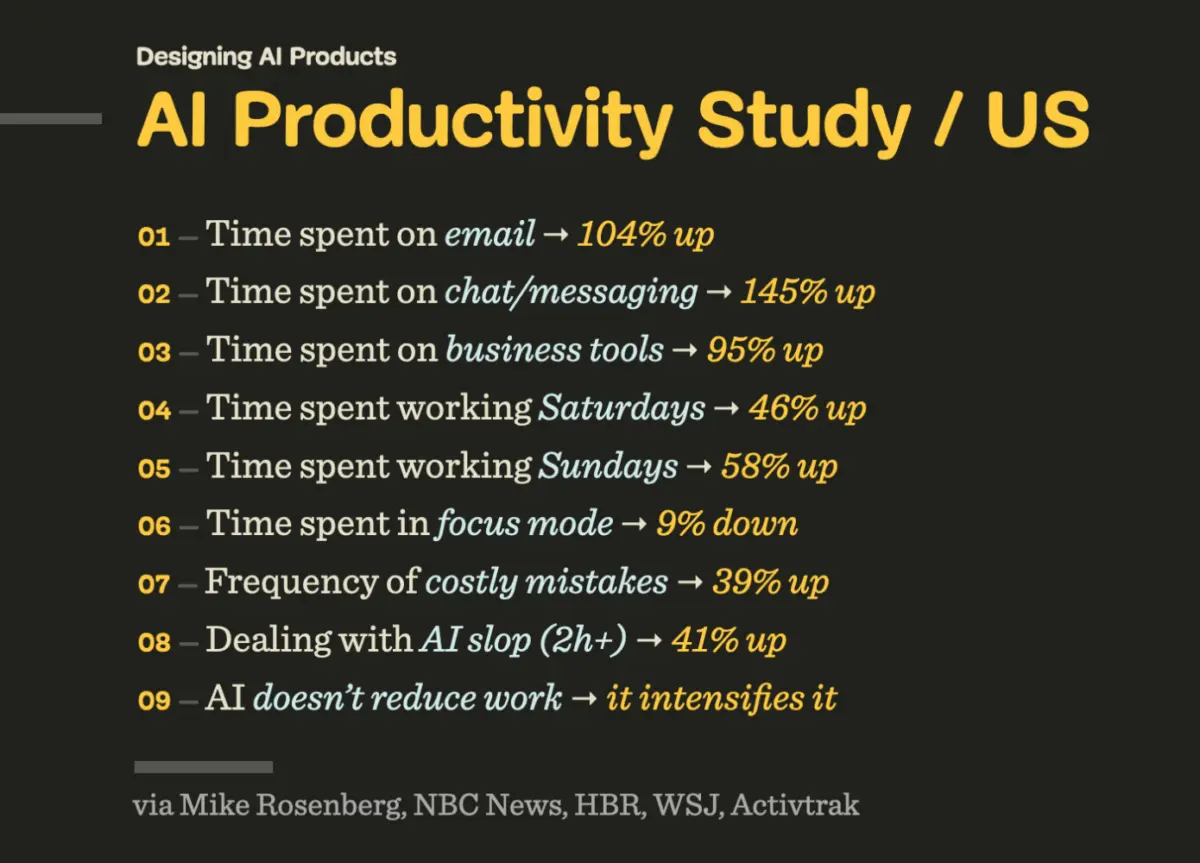
Recent multi-industry productivity studies paint a startling picture of how modern AI tools affect daily operations. Far from freeing up leisure time, the widespread push for generative automation has correlated with significant spikes in workplace friction:
- Surging Communication Overhead: Time spent managing emails and digital communication channels has spiked by over 100% in many surveyed organizations as teams parse automated outputs and manage AI-generated correspondence.
- Extended Workweeks: Incidents of employees working late into weekends (Saturdays and Sundays) have risen sharply.
- Degraded Focus: Dedicated focus modes and deep-work periods have declined.
- The Cost of "AI Slop": Professionals report spending substantial portions of their day reviewing, correcting, and cleaning up after AI-generated errors—a phenomenon colloquially known as dealing with "AI slop."
As business analyst Mike Rosenberg and various workplace studies summarize: AI does not reduce work; it intensifies it.
Official Statements & Industry Perspectives
The cultural backlash against unbridled, indiscriminate AI integration is finding voice among prominent thinkers, designers, and organizational leaders who are urging a return to human-centric design principles.
In a widely shared industry perspective, technology leader Bo Young Lee succinctly captured the collective sentiment of consumers exhausted by relentless technological overreach:

"I don’t want to read books written by AI. I don’t want to gaze upon paintings by AI. I don’t want AI to teach my children. I don’t want to have an AI therapist. I don’t want AI making my medical decisions. I want AI to do all the physical and mental labor that taxes me so I can read books written by humans and go to art galleries to engage with art made by humans. I want AI that makes my life easier rather than forces me to change myself."
This sentiment underscores a vital truth: people are not asking for a magical text box to converse with throughout every minute of their personal and professional lives. They do not dream of AI-narrated children’s books, autonomous financial swarms operating unchecked within their bank accounts, or conversational refrigerators.
Instead, human desires remain steadfastly human. People want tools that are fast, accessible, reliable, predictable, and useful—every single time. They want software that respects their existing mental models, adapts to how they naturally think, and operates quietly in the background.
Future Outlook: The Rise of "AI-Second" Design
If the current generation of "AI-first" products is stumbling, what does the future hold? The path forward requires a radical philosophical shift among product designers, UX architects, and enterprise decision-makers.
1. Moving from "AI-First" to "AI-Second"
The most successful tools of tomorrow will not shout about their underlying machine learning models. They will not force users to completely overhaul their established workflows in favor of chat interfaces. Rather, they will be "AI-second."

An AI-second tool is subtle, humble, calm, and ambient. It takes a supportive role in the background, stepping in exclusively to shoulder the remarkably dull, repetitive, and mentally exhausting tasks that human beings find zero pleasure in performing. When AI automates tedious data entry, cleans up messy formatting, or surfaces buried documents without requiring explicit prompt engineering, its value becomes immediately self-evident.
2. Preserving Human Joy and Agency
Automation should expand human headspace, not shrink it. Many professions most exposed to AI automation—such as writing, software development, design, and public relations—also contain deeply rewarding, creative dimensions that require human taste, intuition, and lived experience. When AI strips away the boring logistical overhead of these jobs while leaving the creative core intact, it enhances productivity and restores joy to daily work.
3. Redefining Success Metrics
To survive the current adoption plateau, enterprise leadership must stop measuring success by the sheer volume of AI features shipped. Instead, metrics must focus on:
- Cognitive Load Reduction: Do these features genuinely decrease mental fatigue, or do they add another layer of software monitoring?
- Error Rate and Trust: Are users spending less time fixing algorithmic hallucinations than they would spend doing the task manually?
- Voluntary Retention: Are employees choosing to use the feature because it genuinely solves a problem, or are they complying under top-down mandates?
Conclusion
Ultimately, the future of technology does not belong to those who build the most complex, all-encompassing artificial intelligence systems. It belongs to those who respect humanity.
People do not need more AI in their lives for the sake of artificial progression; they need technology that quietly handles the friction of modern existence so they can spend more time doing what they love—interacting with other human beings, engaging with authentic human culture, and living un-optimized lives.

As the tech industry recalibrates, designers and leaders would do well to remember that between an imperfect human and an unpredictable algorithm, people will choose the human connection every single time.
