

Executive Overview
In the realm of digital product design and software engineering, a persistent maxim endures: naming things is hard. Yet, this trite observation undersells a fundamental truth of modern development. The language we choose does not merely label our work; it actively shapes our cognitive models and dictates the parameters of cross-functional communication. When design systems fracture, when codebases grow unmaintainable, and when user features suffer from abysmal adoption rates, the root cause is rarely technical incompetence. More often than not, it is a failure of nomenclature.
Miscommunication runs rampant across modern product teams. Designers, developers, product managers, and copywriters routinely speak in disparate dialects, leading to persistent confusion over colors, icons, user interface (UI) components, and core features. This linguistic friction bleeds directly into design tokens, HTML classes, and programmatic variables.
Choosing a name that strikes the right balance is a delicate art. Names that are too generic leave engineers and designers guessing, unable to discern intent or precise functionality. Conversely, names that are too specific paint a product into a corner, completely stripping away the flexibility and reusability required for scalable systems.

This comprehensive guide explores the structural anatomy of effective naming conventions. Drawing upon industry-leading resources, field-tested taxonomies, and strategic frameworks from organizations like Intuit and Vodafone, we examine how to establish a unified vocabulary that bridges the gap between design and code.
Detailed Chronology: The Evolution of Naming Frameworks in Digital Design
To understand how the tech industry arrived at our current obsession with design token taxonomies and component galleries, we must examine how digital nomenclature has evolved over the past decade.
Phase One: The Wild West of Custom Styling (Early 2010s)
In the early days of responsive web design and modular CSS, naming conventions were largely ad-hoc. Developers relied on idiosyncratic abbreviations and visual descriptions—such as .blue-box-large or .text-red—tied strictly to how an element looked rather than what it represented. As applications scaled, this visual coupling became a maintenance nightmare. A simple brand redesign meant rewriting thousands of lines of CSS because structural classes were inextricably bound to hardcoded aesthetic values.

Phase Two: Methodology-Driven Architecture (Mid 2010s)
Recognizing the unsustainable nature of ad-hoc naming, the community introduced strict structural methodologies. Frameworks like BEM (Block, Element, Modifier), SMACSS, and OOCSS swept through the engineering world. These methodologies forced teams to think in components and relationships rather than isolated elements. However, a significant chasm remained: while developers were adopting rigorous taxonomies in code, designers were still naming layers in design tools with chaotic descriptors like Rectangle 4 copy 2 and Group 3.
Phase Three: The Design System Boom and Tokenization (Late 2010s–Present)
As design systems matured into cross-functional single sources of truth, the industry confronted the ultimate naming challenge: bridging the gap between Figma layers, design tokens, and production code. Tech giants like Intuit, Salesforce, and Vodafone began pioneering multi-tiered token taxonomies. Naming evolved from a localized development task into a sophisticated architecture of abstraction—moving systematically from raw primitives to semantic roles and component-specific implementations. Today, nomenclature is recognized as a core pillar of system scalability, directly impacting accessibility, maintainability, and user adoption.
Supporting Context & Metrics: Overcoming Linguistic Friction
The cost of poor naming conventions is measurable. Industry analyses indicate that cross-functional teams waste up to 20% of their development cycles translating requirements and reconciling mismatched terminology between design files and production codebases.

When design systems lack a unified dictionary, teams inadvertently fork their own language. A designer might refer to a collapsible container as an "accordion," an engineer might code it as a "disclosure widget," and a product manager might track it in metrics as a "collapsible section." When these stakeholders enter a meeting, they are speaking the same national language while utilizing entirely different local dialects.
To combat this, modern teams are leveraging specialized resources designed to expand vocabulary, standardize taxonomies, and align cross-functional intent.
Expanding Beyond Code: The Power of Thematic Lexicons
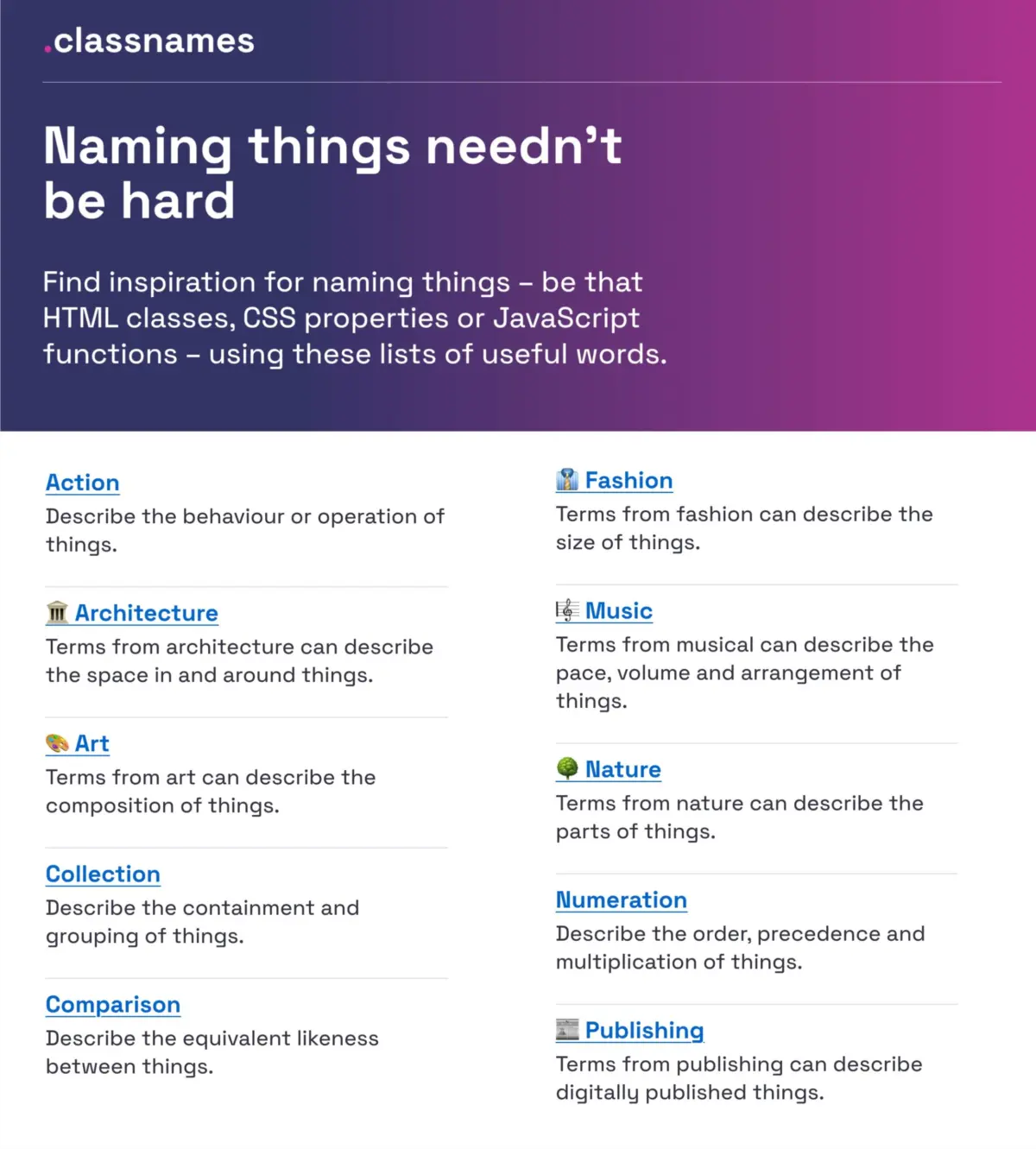
When searching for inspiration for HTML classes, CSS properties, or JavaScript functions, looking inward at technical jargon often leads to dead ends. Resources like Classnames provide thematically grouped lists of words that encourage teams to think outside the traditional development box.

By drawing from domains such as nature, architecture, theater, music, fashion, and publishing, teams can find evocative, highly distinct terms for behavioral states, groupings, and structural hierarchies without resorting to overused tech clichés.
Taming the Color Spectrum
Color nomenclature is notoriously subjective. What one designer calls "Slate," another might classify as "Steel Blue" or "Charcoal." To eliminate ambiguity, repositories such as David Aerne’s Color Names project—featuring over 30,000 unique, user-contributed color names paired with tools like Color Parrot—offer a shared dictionary for digital color tokens. Grounding color names in a stable reference system prevents the chaotic proliferation of hex codes and inconsistent shade designations across disparate product lines.
Official Guidelines & Best Practices from Industry Leaders
To establish a scalable nomenclature framework, practitioners can look to established guidelines developed by leading design system architects.

Structuring Layers and Groups in Design Files
Javier Cuello’s comprehensive research on design best practices outlines the core tenets of effective layer and component naming. According to Cuello, an optimal name must possess four distinct characteristics:
- Logical Structure: It must follow a predictable, repeatable pattern.
- Conciseness: It should be short enough to scan rapidly in a layer panel.
- High Meaning: It must clearly communicate function over form.
- Universal Recognition: It should utilize terms understood by every stakeholder on the team.
Crucially, Cuello emphasizes that names must not relate to visual properties. Naming a component .blue-button is a design anti-pattern; naming it .primary-button or .action-trigger decouples the semantic role from its current aesthetic styling, ensuring long-term resilience.
Scaling Design Token Taxonomies: The Intuit Case Study
Maintaining consistency across a massive product ecosystem—such as Intuit’s suite encompassing Mailchimp, QuickBooks, TurboTax, and Mint—requires an exceptionally disciplined token architecture. Nate Baldwin’s architectural breakdown of Intuit’s design token taxonomy highlights the transition away from fragile, brand-locked naming toward a flexible, multi-tiered token structure.
By categorizing tokens systematically, Intuit ensured that changes to foundational brand variables propagate predictably down to semantic UI implementations without requiring manual overrides in individual product codebases.
Similarly, the Vodafone UK Design System team released their Variables Taxonomy Map in Figma, breaking down the anatomy of design tokens into four distinct, interconnected collections:
- Brand & Primitives: Raw, uncontextualized values (e.g., color hex codes, base spacing integers).
- Semantics: Contextual tokens that describe intent (e.g.,
color-background-interactive-hover). - Components: Encapsulated token mappings tied directly to specific UI components.
- Pages: Page- or context-specific overrides where necessary.
This architecture builds directly upon foundational models like Nathan Curtis’s token-naming principles, enabling any team member to deduce a token’s exact purpose and origin purely from its identifier.

Standardizing UI Component Names
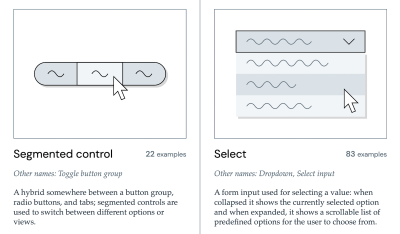
When determining what to call common interface elements, reinventing the wheel is rarely productive. Iain Bean’s Component Gallery aggregates real-world examples and alternative nomenclature for over 50 distinct UI components, from accordions to visually hidden utility classes. Complementary visual dictionaries like Name That UI offer immediate clarity when teams are debating the precise industry-standard term for a novel interaction pattern.
Future Outlook: Feature Discoverability and Product Naming
Nomenclature extends far beyond codebases and design files; it directly impacts user acquisition, retention, and feature adoption. Erin Gannon’s practical framework for naming new product features highlights a critical truth: low feature adoption is frequently a symptom of poor discoverability caused by opaque naming.
Users do not care about internal engineering terminology or corporate branding initiatives. They care about outcomes, jobs-to-be-done, and immediate utility.

- Prioritize User Language: Teams should actively interview users and observe how they describe their workflows using their own words.
- Signal Value, Not Mechanics: Feature names should clearly communicate the value or transformation the user can expect to achieve.
- Bridge the Gap: Eliminate internal codenames before public release to prevent cognitive dissonance during onboarding.
Furthermore, for broader product and service naming, open-source repositories like Onym provide structured methodologies, brainstorming frameworks, and vetting tools to ensure market viability.
Wrapping Up
The ultimate measure of a naming convention is simple: Does the team and the user understand it instantly?
When organizations fail to align on vocabulary, they fracture their internal culture into isolated dialects, resulting in friction, duplicated effort, and user confusion. By investing time in robust taxonomies, leveraging community-driven component galleries, and structuring design tokens with semantic clarity, product teams can eliminate ambiguity.

Clean nomenclature is not merely a matter of aesthetic tidiness; it is the fundamental infrastructure upon which scalable, accessible, and maintainable digital experiences are built.
Editor’s Note
We extend our sincere gratitude to the creators, designers, and engineers who openly share their tools, frameworks, and case studies with the global community. Your contributions make the web a more connected, understandable, and collaborative space.
