

Executive Overview
When Sacha Baron Cohen unveiled his clandestine satirical project, Who Is America?, on Showtime, the cultural impact was immediate, polarizing, and deeply revealing. Billed by the network as "the most dangerous show in history," the series arrived at a fraught socio-political juncture characterized by deep partisan polarization, the mainstreaming of conspiracy theories, and an erosion of institutional trust.
Rather than functioning purely as a traditional comedy, the series operates as a sociological stress test. It interrogates the psychological makeup of a populace that has seemingly lost its collective capacity for critical thinking. Across its premiere episode, the series targets public officials, political operatives, cultural commentators, and everyday citizens, exposing a staggering willingness to suspend disbelief, abandon basic decorum, and compromise ethical standards—all for the intoxicating allure of a camera lens.
This article provides an in-depth analysis of the premiere of Who Is America?, examining its core premises, the subjects who fell into its traps, the broader implications for media literacy, and what the show ultimately tells us about the state of American gullibility in the digital age.
Detailed Chronology: Anatomy of the Premiere
The rollout of Who Is America? was meticulously orchestrated. For months, rumors swirled regarding a secret project spearheaded by the British comedian, accompanied by a wave of frantic pre-release damage control from prominent right-wing figures who realized they had been duped. Figures such as Sarah Palin, Joe Walsh, and Roy Moore launched public tirades against Baron Cohen, attempting to reframe their personal embarrassment as righteous indignation over journalistic dishonesty.
Showtime fed the frenzy by maintaining an aura of secrecy, dropping the show’s title just over a week before its premiere and teasing an exclusive interview with former Vice President Dick Cheney—who ultimately did not appear in the first episode, leaving viewers waiting for the network’s heaviest hitters.
The Characters and Their Marks
Baron Cohen’s return to the faux-documentary format relies on a fresh roster of prosthetically enhanced personas, each designed to exploit specific cultural vulnerabilities:
-
Dr. Billy Wayne Ruddick Jr., Ph.D.: Operating out of the faux-academic website Truthbrary.org, Ruddick is a conspiracy-fluent, motorized-scooter-riding pseudo-intellectual. In the premiere, he sits down with Vermont Senator Bernie Sanders to debate universal healthcare. Despite Ruddick’s transparently absurd framing—including explaining that his motorized scooter is used "to preserve my body’s finite energy" rather than to accommodate a disability—Sanders
maintains a straight face, patiently citing policy statistics long after the line of questioning has descended into pure nonsense.
- Nira Cain-N’Degeocello: A hyper-liberal, NPR-touting activist who travels to the opulent South Carolina home of affluent Donald Trump supporters. Posing as an overzealous progressive examining "white privilege," Cain-N’Degeocello pitches bizarre hypothetical scenarios, such as encouraging his daughter to "free bleed" on the American flag or detailing his wife’s ongoing affair with a dolphin. Rather than questioning the sanity of their guest, the hosts nod along, exemplifying an extreme desire to over-accommodate progressive rhetoric at the expense of basic reality.
- Rick Sherman: An ex-con turned avant-garde artist who visits a Laguna Beach art gallery to showcase portraits rendered in bodily fluids, including feces and semen. While Sherman steps away, the gallery owner addresses the camera, earnestly attempting to legitimize the work with inflated art-world jargon before being presented with a paintbrush fashioned from pubic hair.
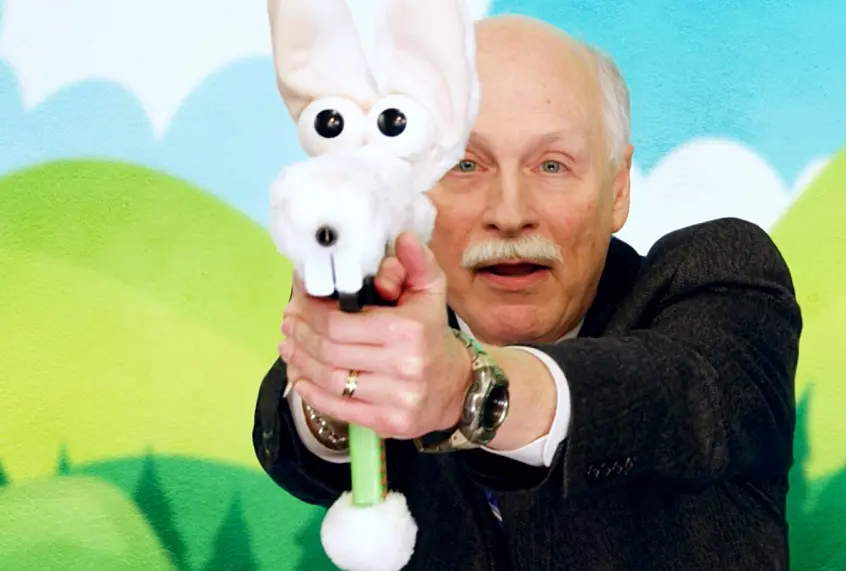
- Col. Erran Morad: A self-styled Israeli anti-terrorism expert and "terrorist terminator" promoting the fictional "Kinderguardians" program. Morad pitches the absurdity of training and arming toddlers in American classrooms as a solution to gun violence. This segment successfully snared prominent conservative figures, including former Congressman Joe Walsh and Representatives Dana Rohrabacher and Joe Wilson, who offered on-camera endorsements of the satirical initiative.
Supporting Context & Metrics: The Erosion of Critical Thought
To understand why Who Is America? resonates—or conversely, why some critics argue its targets are too easy—one must examine the technological and cultural shifts that have transformed the media landscape over the last two decades.
When Baron Cohen rose to international prominence in the late 1990s and early 2000s with Da Ali G Show, the media ecosystem was fundamentally different. Platforms like YouTube, Facebook, and Twitter did not yet dictate the news cycle. Conspiracy theories, junk science, and partisan disinformation did not enjoy the instantaneous, algorithm-driven mainstreaming that defines the contemporary internet. Furthermore, the ubiquitous presence of smartphones and surveillance cameras has cultivated an era where individuals view being on camera not as an interruption, but as an aspirational birthright.
| Era | Media Landscape | Public Attitude Toward Cameras | Proliferation of Disinformation |
|---|---|---|---|
| Early 2000s (Da Ali G Show) | Broadcast & Cable-dominated; nascent internet. | Novelty; caution toward television crews. | Contained primarily to fringe publications and tabloids. |
| Late 2010s (Who Is America?) | Social media-driven; algorithmically accelerated. | Ubiquitous; compulsive desire for visibility and viral fame. | Widespread; institutionalized via junk science, deepfakes, and political posturing. |
This cultural shift has created a populace primed for exploitation. As media analysts note, the issue is no longer merely that fringe actors like Project Veritas or InfoWars utilize hidden-camera hoaxes for sinister political ends; it is that the average citizen has become conditioned to prioritize exposure over critical inquiry. When individuals are so desperate for validation, airtime, or ideological confirmation that they will accept talking points about "Obamanoids" or art made from excrement without blinking, society has crossed a threshold from gullibility into a structural crisis of epistemology.
Official Statements and Industry Reactions
The reception to Who Is America? exposed deep fractures within the political and media establishments. The pre-release fallout featured aggressive pushback from figures caught in Baron Cohen’s crosshairs:
- Sarah Palin publicly denounced the comedian on social media, claiming she was duped into participating by being approached under false pretenses and accusing him of mocking disabled veterans.
- Col. Erran Morad’s targets, including Joe Walsh, doubled down on their public personas even after the trap was sprung. Walsh faced intense scrutiny for enthusiastically endorsing the fictional "Kinderguardians" initiative, offering the chilling soundbite: "The way to stop a bad guy with a gun is a good child with a gun. Happy shooting, kids!"
- Showtime executives defended the project as a vital, boundary-pushing piece of satire that holds a mirror up to contemporary American discourse, emphasizing that public figures willingly signed appearance releases and participated in the interviews under their own volition.
Veteran journalists also weighed in on the project’s methodology. Notably, veteran news anchor Ted Koppel revealed to The Hollywood Reporter that he was approached by Baron Cohen for a project titled Age of Reason, which was pitched as a series of conversations with distinguished experts in science and public policy. Unlike many of his peers, Koppel recognized the incongruity and disengaged before falling victim to the prank.
Future Outlook: The Death of Satire in a Satirical Age
As Who Is America? continued its multi-episode run on Showtime, critics and cultural observers began grappling with a central paradox: Can you effectively satirize a culture that has already normalized the absurd?
For years, political satirists have struggled against a reality where political rhetoric frequently outpaces parody. When elected officials seriously debate policies and share conspiracy theories that would have been dismissed as unhinged fiction a decade ago, the traditional tools of the prankster lose their edge. Baron Cohen’s work demonstrates that the fringe is no longer operating in the shadows; it occupies the mainstream of American political and cultural life.
Ultimately, Who Is America? functions less as a groundbreaking comedy and more as a diagnostic mirror. It confirms that the American public—spanning both the ideological right and left—has cultivated a dangerous tolerance for manipulation, driven by a toxic mix of vanity, partisan tribalism, and media illiteracy. Whether this televised wake-up call will inspire a renewed commitment to critical thinking remains doubtful. In an era where being fooled on national television is frequently worn as a badge of partisan martyrdom, the crisis of gullibility is not ending; it is accelerating.
