

Executive Overview
In what physicists are hailing as a landmark achievement in modern condensed matter physics, an international research collective has successfully demonstrated the creation of a supersolid—a paradoxical quantum state of matter that simultaneously exhibits the rigid, repeating crystalline structure of a solid and the zero-viscosity, frictionless flow of a superfluid—at room temperature.
Published in the peer-reviewed journal Science Advances, the breakthrough obliterates a long-standing technological bottleneck in quantum research. Traditionally, observing and manipulating exotic quantum states has required specialized, multi-million-dollar cryogenic infrastructure capable of chilling matter down to fractions of a degree above absolute zero (-273.15°C or 0 Kelvin). By bypassing the tyranny of extreme cold, this collaborative team—comprising researchers from the Faculty of Physics at the University of Warsaw, the Military University of Technology in Poland, IBM Research Zurich, and the French National Centre for Scientific Research (CNRS)—has opened a wide avenue for integrating quantum phenomena into practical, scalable photonic technologies.
Rather than utilizing conventional atomic gases, the team synthesized this room-temperature supersolid by exploiting hybrid quasiparticles known as exciton polaritons. Confined within a specialized, electrically tunable microcavity constructed from organic semiconductors and liquid crystals, these light-matter hybrids condense into a collective quantum state while operating at temperatures approaching 60°C (140°F). The resulting platform provides not only an unprecedented window into the fundamental rules of quantum mechanics—capturing textbooks examples of spontaneous symmetry breaking—but also introduces the world’s first electrically controllable, room-temperature supersolid architecture.
Detailed Chronology of the Breakthrough
The realization of this room-temperature quantum milestone is the culmination of decades of theoretical speculation, recent technological leaps in material science, and a frantic, highly constrained laboratory campaign.
1. The Theoretical Genesis (1960s–2017)
The conceptual foundation of supersolidity dates back to the late 1960s, when theoretical physicists independently postulated that under the bizarre rules of quantum mechanics, a fluid could theoretically undergo a phase transition where it develops a periodic, crystalline density profile while maintaining superfluidity. For decades, this construct remained confined to paper and chalkboard equations.
It was not until 2017 that experimentalists finally confirmed the existence of supersolids. However, these early demonstrations relied exclusively on Bose-Einstein condensates (BECs) composed of ultracold atomic gases (such as rubidium or dysprosium). Achieving these states required laser cooling and magnetic trapping systems that approached absolute zero—environments so fragile and resource-intensive that they were strictly limited to highly specialized, heavily funded national laboratories.
2. Shifting Paradigms: The TopoLight Consortium
Recognizing that cryogenic requirements would permanently hinder the commercialization and broad exploration of supersolids, the international TopoLight consortium elected to change the fundamental building blocks of the experiment. Instead of chilling heavy atoms, the team turned to exciton polaritons.
Exciton polaritons are quantum quasiparticles that emerge when photons (light) are trapped inside an optical microcavity and strongly couple with electronic excitations (matter) in a semiconductor. Because they inherit properties from both light and matter, polaritons possess an extraordinarily low effective mass compared to atoms. This featherlight characteristic enables them to form Bose-Einstein condensates at vastly higher thermal energies—circumventing the need for cryogenic cooling altogether.
3. The Race Against Time in the Laboratory
Constructing a device capable of stabilizing these polariton condensates at high temperatures was an immense engineering challenge. The researchers engineered an advanced optical microcavity featuring a liquid-crystal structure developed at the Military University of Technology, paired with an organic semiconductor (specifically, methyl-substituted ladder-type poly[paraphenylene], or MeLPPP) synthesized and deposited by IBM Research Zurich.
However, this material pairing introduced a formidable operational constraint: the organic semiconductor gradually reacted chemically with the liquid crystal over time. Consequently, each assembled microcavity had a severely limited operational lifespan, granting the experimental team only a narrow window of a few hours to execute their measurements.
"We had to plan the entire sequence of experiments in advance," recalls Dr. Marcin Muszyński, the study’s first author, now a postdoctoral researcher at The City College of New York. "Repeating a measurement meant fabricating an entirely new sample from scratch."
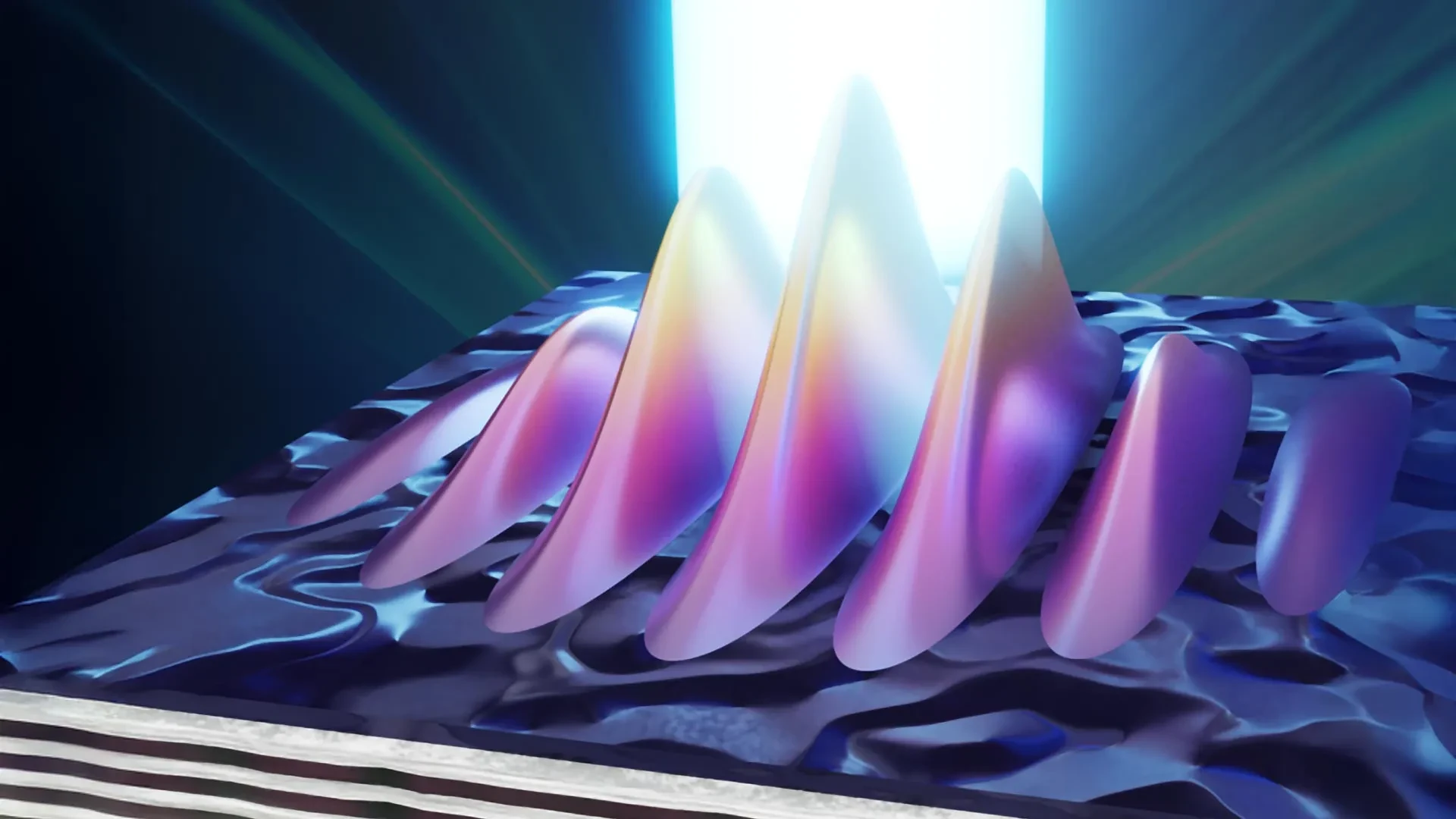
Despite these tight temporal constraints, the meticulous preparation paid off. When the optical microcavity was pumped with laser pulses, the researchers observed definitive proof that the polaritons had entered a supersolid phase: the emergence of spontaneously patterned light fringes coupled with persistent spin helices, confirming both crystalline order and superfluid dynamics simultaneously.
Supporting Context & Metrics
To fully appreciate the magnitude of this achievement, one must examine the specific physical metrics and thermodynamic boundaries that separate traditional quantum experiments from this new paradigm.
The Physics of Exciton Polaritons
To create a supersolid using atomic systems, temperatures must generally be maintained below 1 microkelvin ($mutextK$). In stark contrast, the liquid-crystal microcavities utilized by the TopoLight consortium successfully stabilized polariton condensates at temperatures reaching 60°C (140°F)—operating seamlessly in conditions hotter than a summer day.
| Parameter | Traditional Atomic Supersolids | Polariton Supersolids (This Study) |
|---|---|---|
| Constituent Particles | Ultracold atoms (Rubidium, Dysprosium) | Exciton polaritons (Light-matter hybrids) |
| Operating Temperature | Near Absolute Zero ($sim 0 text K$) | Room Temperature to $60^circtextC$ ($333.15 text K$) |
| Lifespan of State | Relatively stable (seconds to minutes) | Picosecond scale ($sim 10^-12$ seconds), sustained via continuous laser pumping |
| External Control | Magnetic/optical traps (fixed geometries) | Electrically tunable via applied voltage across liquid crystals |
| Primary Limitation | Massive cryogenic hardware, vibration isolation | Chemical degradation of organic-semiconductor interfaces |
Spontaneous Symmetry Breaking and Persistent Spin Helices
When analyzing the experimental data, the research team identified two hallmark signatures of quantum complexity:
- Spontaneous Symmetry Breaking: As the polariton condensate formed, it spontaneously selected a specific spatial density configuration from a multitude of equally probable states. Each time the sample was excited by a laser pulse, the bright interference fringes shifted position, reflecting the system’s ability to freely navigate equivalent energy landscapes.
- Persistent Spin Helices: Beyond spatial density variations, the emitted light exhibited a periodic modulation in its polarization (the orientation of its oscillating electric field). This demonstrated that spatial order and magnetic/spin order were coexisting within the same quantum fluid—a dual-order phenomenon rarely observed in any physical system.
Official Statements from Key Researchers
The collaborative nature of the breakthrough drew praise from the leadership and key investigators across the participating institutions, highlighting the interdisciplinary synergy required to bridge material science, optics, and quantum physics.
"Our liquid-crystal microcavities can operate even at temperatures approaching 60°C," noted Professor Wiktor Piecek from the Military University of Technology, whose research group spearheaded the design and fabrication of the advanced liquid-crystal matrixes.
Commenting on the theoretical implications of the observed phenomena, Professor Guillaume Malpuech of the Institut Pascal at CNRS emphasized the alignment between quantum theory and empirical reality:
"This is a textbook example of spontaneous symmetry breaking. Theory predicted that the supersolid could choose among several equivalent states, and that is exactly what we observed in the laboratory."
From the industrial partnership perspective, Thilo Stöferle of IBM Research Zurich underscored the foundational material science that made the project possible:
"We have studied the organic semiconductor MeLPPP for many years and previously observed Bose-Einstein condensation in this material. This was the first time we combined it with a liquid-crystal microcavity, and that precise integration is what unlocked room-temperature supersolidity."
Future Outlook & Technological Implications
While observing a room-temperature supersolid is a triumph of fundamental physics, the long-term impact of this research lies in its potential to revolutionize applied technologies. By eliminating cryogenic constraints, the discovery bridges the chasm between abstract quantum mechanics and everyday electronics.
1. Neuromorphic and Optical Computing
Modern computing architectures face thermal and energetic walls as electronic transistor scaling slows down. Photonic computing—utilizing light rather than electrons to process data—offers a path toward ultrafast, low-latency processing. The ability to manipulate condensates of light-matter hybrids at room temperature paves the way for neuromorphic computing accelerators, which mimic the dense, parallel interconnectivity of biological brains using optical hardware.
2. High-Sensitivity Optical Sensors
The supersolid phase identified in these microcavities exhibits extreme sensitivity to external perturbations, particularly regarding changes in light polarization and density gradients. This heightened responsiveness could be harnessed to build next-generation optical sensors capable of detecting minute physical, chemical, or biological signals with unprecedented precision.
3. Electrically Tunable Quantum Devices
Crucially, because the microcavity relies on liquid crystals, the optical and quantum properties of the system can be dynamically altered using an external electrical voltage. This electrical tunability represents a massive leap forward. Previous quantum platforms were largely static once constructed; an electrically programmable quantum fluid allows engineers to actively shape, route, and control quantum states on demand.
As the international consortium continues to refine the material stability of their microcavities to extend operational lifespans, the boundary separating theoretical quantum fantasies from practical, room-temperature quantum engineering continues to dissolve.
About the University of Warsaw Faculty of Physics
The University of Warsaw has stood as a pillar of scientific inquiry and academic rigor since its physics and astronomy departments were established within the Faculty of Philosophy in 1816, followed by the inauguration of its Astronomical Observatory in 1825.
Today, the Faculty of Physics encompasses the Institutes of Experimental Physics, Theoretical Physics, and Geophysics, alongside the Department of Mathematical Methods in Physics. Its cutting-edge research spans the entirety of modern physical sciences—from subatomic quantum dynamics to cosmological large-scale structures. Employing over 250 academic teachers and educating approximately 1,350 undergraduates and 150 doctoral candidates, the institution consistently ranks among the global elite, holding a position in the top 150 institutions worldwide for physics education according to Shanghai’s Global Ranking of Academic Subjects.
