


Executive Overview
The debate surrounding artificial intelligence in the creative economy has officially evolved. The initial wave of panic—the fear that generative tools would entirely replace human copywriters—has given way to a more pragmatic, highly competitive reality. AI tools are no longer novelties; they are permanent fixtures of the modern digital landscape. For the modern freelance writer, choosing to ignore these technologies is no longer a badge of honor or a commitment to "authentic craftsmanship." Instead, it is an unnecessary operational handicap.
Yet, a stark dichotomy has emerged across the freelance market. On one side are thriving writers who treat AI as an operational exoskeleton. They leverage large language models (LLMs) and specialized research engines to absorb administrative and logistical friction, freeing up precious cognitive bandwidth for high-value tasks: strategic thinking, human-to-human interviews, original reporting, and deep relationship-building. On the other side are struggling writers falling into two dangerous traps: either ignoring technological advancements entirely and losing ground to faster competitors, or using AI as an uncritical crutch, pumping out homogenized, generic prose that modern clients and sophisticated audiences can spot instantly.
Mastering AI in freelance writing is not about outsourcing the soul of your work to a server farm. It is about strategic delegation. By shifting the tedious, mechanical chores of the writing lifecycle to automated systems, freelancers can produce better work, protect themselves from burnout, and dramatically increase their operational efficiency.
Detailed Chronology: The Evolution of AI in Freelance Workflows
To understand where freelance writing stands today, it is helpful to trace how these tools integrated into daily operations over recent years:
- Phase 1: The Novelty & Panic Era (2022–2023): The public release of advanced conversational models sent shockwaves through the creative community. Writers feared mass obsolescence, while early adopters flooded the market with unedited, robotic content that quickly saturated search engine results pages and client inboxes.
- Phase 2: The Correction & Commoditization Era (2023–2024): As the initial hype plateaued, clients and editors grew hyper-vigilant against AI-generated slop. The market experienced a violent course correction. Writers realized that raw, unprompted AI text was commercially worthless, forcing a pivot toward human-in-the-loop workflows where AI served as a back-end assistant rather than a front-end creator.
- Phase 3: The Integration & Infrastructure Era (2025–Present): Today, AI is deeply embedded in the modern freelance tech stack. Writers no longer ask whether they should use AI, but how to build sophisticated systems using tools like Claude, ChatGPT, Perplexity, and Otter.ai. AI has transitioned from a parlor trick into a fundamental project-management and ideation engine.
10 Ways to Use AI Tools to Enhance Your Freelance Business
To help writers navigate this new era successfully, here are ten proven, practical ways to integrate AI into your daily routine without sacrificing the human elements that make your writing valuable.
1. Beating the Blank Page Paralysis
The single most intimidating moment in any writing project is staring at a blank document. You understand the topic, you have the assignment parameters, but translating that mental momentum into an opening sentence is frequently agonizing.
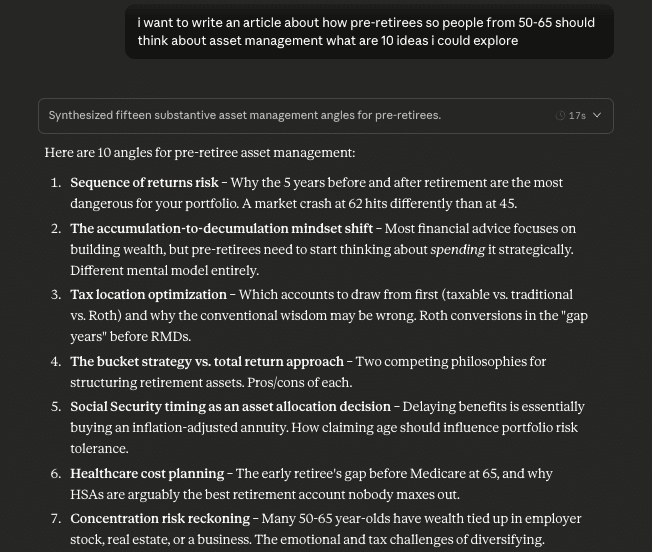
AI excels at breaking this cognitive logjam. Instead of asking an LLM to write your article, use it as a sparring partner to get raw concepts on the screen. Prompt ChatGPT or Claude to generate ten distinct angles on your core topic, suggest unconventional introductions, or list the burning questions a sophisticated reader might ask.
While much of the initial output will be unusable, that is entirely beside the point. The objective is to shatter the paralysis of zero. By having concrete text to react to, edit, or reject, your brain shifts from creation mode to curation mode, accelerating the writing process.
2. Streamlining the Outlining Process
Professional writers know that great content is built on robust architecture. Drafting an outline before writing a blog post, white paper, or pitch ensures logical flow and prevents narrative dead ends.
AI can dramatically accelerate this structural phase. Feed your core topic, target audience, and primary goals into an LLM and ask for a comprehensive structural blueprint. You can even develop standardized intake prompts—such as custom GPTs or Claude projects—that interview you about your research, data points, and overarching thesis before outputting a tailored skeletal framework.
Though you will inevitably refine or discard portions of the AI’s suggestions, it frequently surfaces angles or subheadings you might have otherwise overlooked.
3. Deploying AI as a Research Assistant
Modern freelance writing demands deep, meticulous research. Parsing long-form reports, academic studies, and industry case studies consumes hours of billable time.

AI significantly compresses this cycle. Pasting complex source material into an LLM and asking for executive summaries or key statistical extractions allows for rapid content triage. Furthermore, specialized search engines like Perplexity Pro act as active research assistants, scouring the live web and providing verified data points paired with direct citations.
While this never replaces reading primary source materials, it ensures you don’t waste twenty minutes reading an entire document only to discover the core data is severely outdated. Similarly, running interview transcripts through Claude can immediately surface key quotes and structural themes.
4. Drafting Cold Emails and Letters of Introduction (LOIs)
Client acquisition is the lifeblood of freelance writing, yet writing endless prospecting emails is deeply exhausting. Staring at an empty composition window trying to introduce yourself for the hundredth time drains your emotional energy.
AI can generate structural templates for cold outreach in seconds. However, this comes with a strict caveat: automation must stop before personalization begins. An AI can draft 80% of an introductory email, but the final, human-crafted sentence—referencing a specific company milestone, a recent corporate award, or a newly released white paper—must be yours. Failing to personalize your outreach ensures your pitch is immediately flagged as mass-automated spam.
5. Engineering Headlines and Compelling Hooks
A brilliant article is worthless if no player in the audience clicks the link. Headlines must navigate a narrow channel: compelling without being deceitful, specific without being dry, and concise without losing conceptual weight.
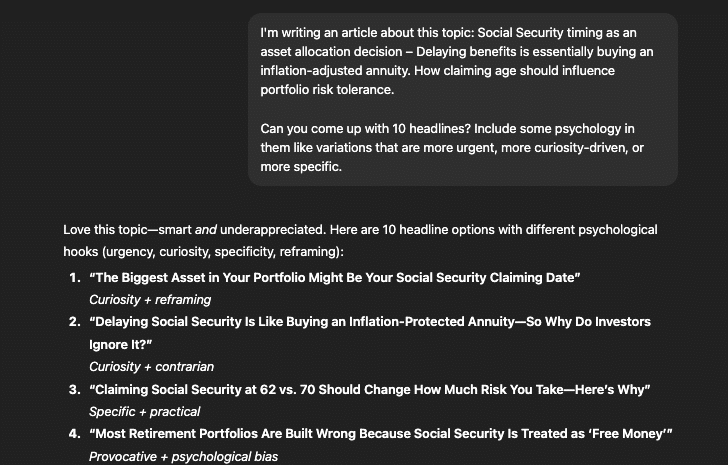
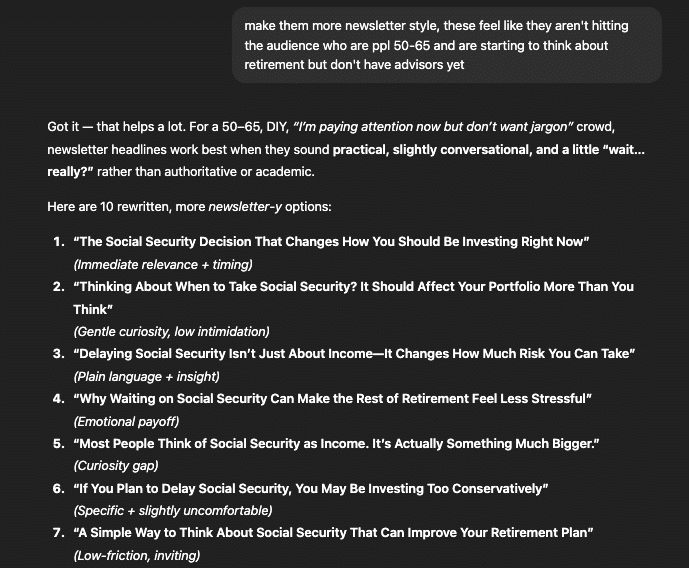
AI is exceptionally good at high-volume ideation. Ask an LLM for ten headline variations calibrated for urgency, curiosity, or specificity. If the first batch misses the mark, provide tighter constraints. More often than not, scanning these AI-generated options will spark an organic idea, or allow you to stitch together fragments from two or three suggestions to craft a headline that hits the mark. The same methodology applies to drafting magnetic introductory hooks.
6. Advanced Editing and Proofreading
Human eyes are notoriously bad at catching our own typographical errors. After reading the same paragraph five times, the brain automatically fills in what it expects to see rather than processing what is actually written on the page.
AI acts as an indispensable fresh set of eyes. Pasting a draft into an LLM and asking it to flag wordiness, convoluted syntax, or ambiguous phrasing can catch structural weaknesses instantly. You can even prompt the AI to role-play as your target audience, telling you precisely where their attention waned or what questions remain unanswered. Combined with dedicated proofreading tools like Grammarly, this workflow ensures polish without stripping away your unique authentic voice.
7. Automated Content Repurposing
Writing a comprehensive 1,500-word article is only half the battle; distributing it across social channels and newsletters is an entirely separate logistical burden.
AI allows you to extract maximum ROI from every piece of writing you produce. By feeding your completed article into Claude or ChatGPT, you can systematically generate platform-specific assets:
- A punchy, hook-driven LinkedIn post extracting core data points.
- A concise newsletter summary highlighting key takeaways.
- A multi-part social thread designed to drive backlink traffic.
This transforms a single piece of heavy-lifting research into 5 to 10 distinct marketing assets, expanding your digital footprint without requiring exponential labor.
8. Rigorous Interview Preparation
Conducting high-impact interviews with Subject Matter Experts (SMEs) requires thoughtful, probing questions. Preparing for these conversations takes substantial time, especially when writing within an unfamiliar industry.

By briefing an AI on your interview subject, their professional background, and your article’s core angle, you can generate a tailored list of ten advanced questions that extract specific, actionable insights. This prepares you to skip basic, easily Googleable questions, respecting your expert’s time and elevating the quality of your final quotes.
9. Managing and Mining Interview Transcripts
Post-interview transcription tools like Otter.ai have transformed reporting, but they leave writers staring down massive walls of unstructured text.
Using native chat features built into transcription platforms or pasting transcripts into an LLM allows you to converse directly with your recorded data. You can command the system to pull every reference to a specific keyword, summarize the expert’s philosophical stance on an issue, or group thematic soundbites by section. Crucially, every direct quote must be cross-referenced against the raw audio before publication to ensure absolute fidelity and prevent AI-induced misattribution.
10. Tracking Marketing and Outreach Metrics
Freelance writers often despise administrative bookkeeping. Maintaining spreadsheets to track Letters of Introduction (LOIs), follow-ups, response rates, and revenue pipelines frequently falls by the wayside.

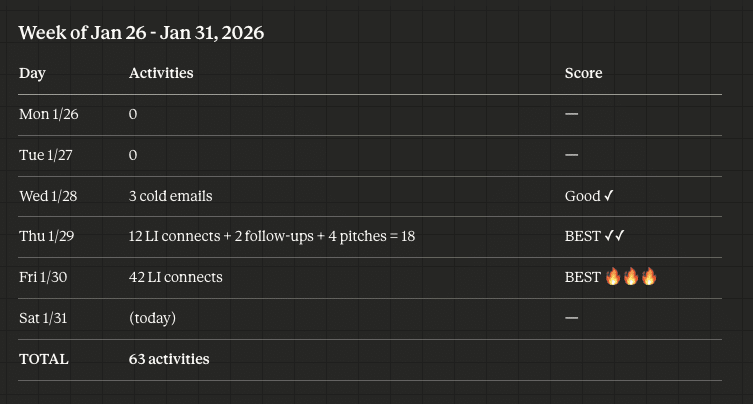
Conversational interfaces like Claude Cowork can act as persistent executive assistants. By logging your weekly marketing sessions—detailing who you contacted, what assets were sent, and responses received—you build an intuitive database. At month’s end, you can query the system for aggregate metrics, conversion rates, and niche performance patterns. Turning your business pipeline into an interactive, gamified scorecard keeps outreach momentum high without forcing you to manually update complex spreadsheets.
What NOT to Do With AI
While the utility of generative tools is undeniable, misuse can permanently damage a writer’s professional reputation. To thrive in the current market, avoid these critical errors:
- Never publish unedited, raw AI copy: Clients and search engines can immediately identify generic, unedited machine text. It lacks nuance, original perspective, and real-world reporting.
- Never outsource original thought: AI can synthesize existing information, but it cannot conduct an exclusive interview, possess a lived experience, or formulate an original investigative hypothesis. That intellectual labor remains your exclusive domain.
- Never abandon verification: Hallucinations remain a persistent vulnerability. Always verify statistics, citations, and direct quotes pulled or summarized by automated tools.
Supporting Context & Metrics
The freelance economy is experiencing a permanent structural shift. According to recent industry analyses, freelancers who successfully integrate AI into their operational pipelines report a 30% to 50% reduction in administrative and drafting friction, allowing them to take on higher-volume contracts and scale their annual revenue. Conversely, writers who resist technological integration face compressed profit margins and burnout as they attempt to compete manually with hyper-efficient peers.
Official Statements & Industry Perspective
Industry leaders emphasize that the value of the human writer is not diminishing—it is simply shifting up the value chain.
"AI tools are not here to replace the critical thinking, relationships, and lived expertise that define great writing," notes Sean Ogle, founder of Location Rebel. "They are here to handle the tedious, mechanical chores of the job. The freelancers who thrive are those who use AI to clear away administrative friction, allowing them to focus entirely on the human elements that make their work uniquely valuable."
Future Outlook
Looking ahead, artificial intelligence will continue to weave itself invisibly into the daily workflows of the digital knowledge economy. The distinction between "AI writers" and "human writers" will dissolve, replaced by a single standard: professional writers augmented by intelligent systems.
Those who master the art of prompt engineering, workflow automation, and rigorous editorial oversight will command higher rates, manage larger client portfolios, and build sustainable, scalable businesses. The tool is only as powerful as the mind wielding it. Start small—integrate one or two of these use cases into your workflow today—and position your freelance business to thrive in the AI era.
