

EXECUTIVE OVERVIEW
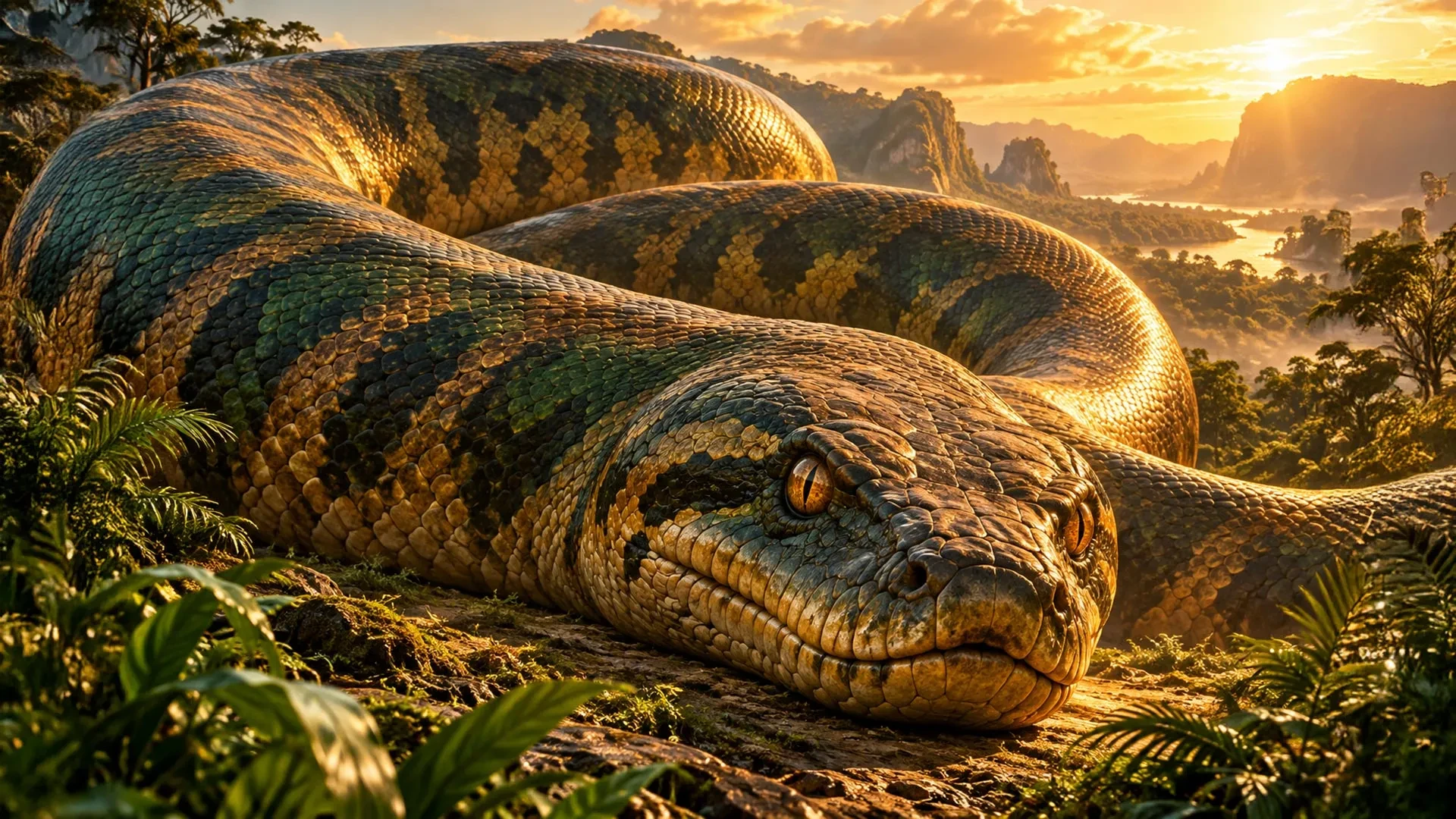
In the sun-baked, mineral-rich earth of the Panandhro Lignite Mine in Kutch, Gujarat, paleontologists have unspooled a fossil record that stretches back 47 million years, resurrecting a creature straight out of evolutionary mythology. Named Vasuki indicus—after the revered mythological serpent entwined around the neck of the Hindu deity Shiva—this colossal reptile stands as one of the largest snakes ever to slither across the surface of the Earth. With estimated lengths reaching an astonishing 15.2 meters (50 feet), Vasuki challenges the long-held reign of Titanoboa as the undisputed heavyweight champion of the prehistoric serpent world.
The discovery, initially brought to light in the journal Scientific Reports by researchers Debajit Datta and Sunil Bajpai from the Indian Institute of Technology (IIT) Roorkee, has sent ripples through the global paleontology community. Operating during the Middle Eocene epoch—a time of global greenhouse conditions and towering tropical canopies—Vasuki was not merely an anatomical anomaly; it was the apex predator of a thriving, complex ecosystem.
Subsequent discoveries published in 2025 have continued to amplify this narrative, revealing a diverse prehistoric landscape in western India populated by everything from aquatic swimmers to competing giant madtsoiid lineages. This investigative report explores the anatomical architecture, climatic catalysts, evolutionary lineage, and broader ecological context of Vasuki indicus, shedding light on a forgotten era when colossal serpents commanded the tropical marshes of the ancient Indian subcontinent.
DETAILED CHRONOLOGY: FROM THE GUJARAT MINES TO GLOBAL SCIENTIFIC SENSATIONALISM
The unearthing of Vasuki indicus is a testament to the rigorous, methodical nature of modern paleontological fieldwork. The story of its discovery unfolds across decades of industrial excavation and meticulous academic analysis in western India.
The Eocene Epoch: A Greenhouse World
To understand the world of Vasuki, scientists must first wind the clock back approximately 47 million years to the Middle Eocene. During this geological epoch, the geography of the planet was vastly different from today. The Indian subcontinent was an island landmass rapidly drifting northward, eventually to collide with the Asian continent.
Global climates during the Middle Eocene were markedly warmer than contemporary baselines. Polar ice caps were virtually nonexistent, and lush, tropical rainforests and expansive mangrove swamps stretched far into higher latitudes. In western India, average surface temperatures hovered around a sweltering 28°C (82°F). This humid, hothouse environment provided an ideal metabolic playground for ectothermic organisms, establishing the stage for extreme gigantism.
The Excavation at Panandhro
The fossilized remains of Vasuki were recovered from the lignite-bearing strata of the Panandhro Lignite Mine in the Kutch district of Gujarat. Lignite, a soft brown coal formed from compressed peat, frequently preserves organic remains under specific anoxic and chemical conditions.
It was here that paleontologists Debajit Datta and Sunil Bajpai came upon a remarkable cache of fossilized vertebrae. Unlike many fossil finds that consist of scattered, heavily fragmented bone chips, the Vasuki cache included 27 vertebrae. Crucially, many of these bones were exceptionally well-preserved, with several remaining articulated in their original anatomical sequence. Based on the degree of ossification and fusion observed in the bone architecture, the research team quickly deduced that these remains belonged to a fully mature, adult specimen.
Formal Description and Naming
In 2024, Datta and Bajpai formally introduced the scientific community to Vasuki indicus. The genus name was chosen to honor Vasuki, the legendary serpent king of Hindu mythology, symbolizing the immense proportions and cultural resonance of the animal. The specific epithet, indicus, anchors the discovery firmly to its geographic point of origin: India.
The momentum of this discovery did not slow down. In subsequent studies published in 2025 within the Journal of Paleontology, Datta and Bajpai expanded their footprint, uncovering additional Eocene fossil deposits in western India. These subsequent finds revealed that Vasuki was not an isolated ecological anomaly. Instead, it was part of a rich, densely populated serpentine community that included ancient aquatic snakes like Pterosphenus rannensis and concurrent lineages of competing mega-snakes.
SUPPORTING CONTEXT & METRICS: ANATOMY, SCALE, AND ECOLOGICAL NICHE
Quantifying the physical dimensions of an extinct animal known primarily from an incomplete vertebral column requires sophisticated comparative osteology. Without a complete skeleton or skull, scientists must rely on mathematical scaling models derived from extant (living) snake species.
Osteological Architecture: The Vertebrae of a Giant
The 27 recovered vertebrae of Vasuki indicus provided an extraordinary window into its biomechanics. Individual vertebrae measured between 37.5 and 62.7 millimeters (1.48 to 2.47 inches) in length, while their widths spanned an immense 62.4 to 111.4 millimeters (2.46 to 4.39 inches).
This exceptional width-to-length ratio is highly diagnostic. It indicates that Vasuki possessed an exceptionally broad, heavy, and robustly built cylindrical body. Unlike slender arboreal snakes built for speed and agility, Vasuki was engineered to support staggering amounts of raw mass.
[Comparative Scale: Max Estimated Lengths]
Vasuki indicus:     ████████████████████ 15.2 meters (50 feet)
Titanoboa:          █████████████████    13.0 meters (43 feet)
Modern Anaconda:    ████                 5.2 meters  (17 feet)
Length Estimation and the Shadow of Titanoboa
To calculate the total body length of the creature, researchers applied regression models comparing the fossilized vertebrae to those of modern snakes of known lengths. Two distinct methodological approaches yielded staggering estimates:
- Method A (Conservative): 10.9 to 12.2 meters (36 to 40 feet).
- Method B (Maximum Extrapolation): 14.5 to 15.2 meters (48 to 50 feet).
At its maximum estimated length of 15.2 meters (50 feet), Vasuki equals or even surpasses Titanoboa cerrejonensis, the colossal fossil snake discovered in the coal mines of Cerrejón, Colombia. Titanoboa, which prowled South American rainforests approximately 60 million years ago, was long held as the undisputed heavyweight champion of the serpentine world, measuring an estimated 13 meters (43 feet).
However, researchers involved in the Vasuki study maintain a healthy scientific caution. Reconstructing an animal from an incomplete vertebral sequence carries inherent statistical variance, and whether Vasuki definitively outweighed or outmeasured Titanoboa remains a subject of ongoing debate within vertebrate paleontology.
Ambush Predator Mechanics and Habitat
Given its titanic proportions, Vasuki was ill-suited for active, high-speed predation. Its immense mass precluded quick bursts of movement or agile stalking. Instead, paleobiologists theorize that Vasuki was a quintessential ambush predator.
The snake likely spent long stretches submerged in shallow, marshy wetlands or concealed along the muddy banks of ancient Eocene river systems. By blending into its tropical environment, Vasuki would have waited motionless until unwary prey ventured within striking distance. Once secured, it would have deployed a strategy akin to modern boids (pythons and anacondas), using its crushing muscular coils to constrict prey, halting blood circulation and inducing circulatory arrest.
While exact dietary targets remain speculative, the sheer scale of the predator suggests it fed upon large Eocene fauna, potentially including primitive whales (early cetaceans), large herbivores, and prehistoric mammals that frequented the swampy margins of ancient India.
OFFICIAL STATEMENTS & RESEARCH PERSPECTIVES
The unveiling of Vasuki indicus has prompted extensive commentary from the researchers spearheading the excavation, as well as the broader paleontological community.
"The discovery of Vasuki indicus is not merely about finding a giant snake; it opens a critical window into the ancient ecosystems of the Indian subcontinent during a period of profound climatic and geographic transformation," noted Dr. Debajit Datta, co-lead researcher from the Indian Institute of Technology Roorkee.
The implications of the discovery stretch far beyond India’s borders, providing a missing puzzle piece in our understanding of the family Madtsoiidae—an extinct lineage of snakes that thrived for roughly 100 million years, stretching from the Late Cretaceous through the Late Pleistocene.
"Madtsoiid snakes managed to colonize vast swathes of the globe, including Africa, South America, Australia, and Europe," explained Dr. Sunil Bajpai, co-author of the study. "Vasuki demonstrates that the Indian subcontinent served as a crucial cradle of evolution and a staging ground for the diversification of these giant reptiles before tectonic shifts allowed them to disperse into southern Eurasia and beyond."
Comparative researchers studying contemporaneous fossil anacondas in South America—such as a 2025 study published in the Journal of Vertebrate Paleontology—have added nuance to the discussion of prehistoric gigantism. These studies emphasize that while warm climates facilitate the energetic demands of large reptiles, gigantism is also governed by complex interplay involving local food webs, habitat availability, and deep evolutionary trajectories rather than temperature alone.
FUTURE OUTLOOK: UNLOCKING THE SECRETS OF ANCIENT MEGA-SERPENTS
As paleontological techniques advance, the study of Vasuki indicus and its Eocene contemporaries is entering a dynamic new phase. Several critical avenues of research will define the coming years of investigation:
1. The Search for Cranial Remains
The most glaring gap in our current understanding of Vasuki is the complete absence of skull material. Recovering cranial elements—such as jawbones, quadrates, or braincases—would allow scientists to reconstruct jaw mechanics, prey preference, and precise phylogenetic relationships with unprecedented accuracy. Future expeditions to the Kutch region will heavily prioritize fine-screen washing of lignite strata to recover micro-fossils and fragile cranial bone fragments.
2. Isotopic Analysis and Dietary Reconstruction
Advanced geochemical techniques, such as stable isotope analysis of tooth and bone apatite (where available) or surrounding matrix carbonates, offer promising pathways to reconstruct the diet and micro-habitat of Vasuki. By measuring carbon and oxygen isotopes, researchers hope to determine whether Vasuki hunted primarily in freshwater, brackish, or terrestrial environments, and whether its trophic level aligned with apex predators of modern river basins.
3. Tectonic and Biogeographic Modeling
As India’s northward drift during the Eocene brought it into collision with the Asian plate, terrestrial migration corridors opened. Future paleogeographic studies will model how these tectonic movements facilitated the transcontinental migration of madtsoiid snakes from India into southern Europe and Africa, tracking the literal footprints of giant serpents across a shifting globe.
Conclusion
Vasuki indicus stands as a monumental discovery in vertebrate paleontology. More than just a contender for the title of history’s largest snake, it serves as a biological archive of a warmer, wilder Earth. By bridging gaps in the fossil record of the Madtsoiidae family and illuminating the rich, marshy ecosystems of Eocene India, Vasuki ensures that the deep history of our planet continues to captivate, astonish, and humble modern science.