

Executive Overview
In the digital product ecosystem, developers, designers, and product managers often find themselves trapped in a Tower of Babel. We debate colors, icons, UI components, and feature specifications, yet we frequently struggle to agree on something as fundamental as a label. As the old adage in computer science goes, "There are only two hard things in computer science: cache invalidation and naming things."
The language we choose does more than just decorate our codebases or Figma files; it actively shapes our cognitive models and dictates the nature of cross-functional team conversations. When our nomenclature is too generic, it lacks context, rendering it vague and uninformative. Conversely, when it is too specific, it boxes us into a corner, completely stripping away the flexibility and reusability vital for scalable digital architecture.

This comprehensive guide explores the structural nuances of digital nomenclature. Drawing from industry-standard methodologies, real-world case studies from tech giants like Intuit and Vodafone, and a curated compendium of open-source resources, this article provides a practical blueprint for establishing a unified vocabulary across design systems, code repositories, and product roadmaps.
Detailed Chronology: The Evolution of Digital Taxonomy
The quest to standardize digital nomenclature has evolved alongside the maturity of the web itself. Understanding this trajectory highlights why naming has shifted from an afterthought to a core pillar of product architecture.

- The Wild West Era (Early Web): Names were chosen arbitrarily based on immediate visual appearance (e.g.,
.red-button-big). Collaboration between designers and developers was largely fractured, resulting in duplicate or conflicting nomenclature. - The Modular CSS Movement (BEM & OOCSS): As applications scaled, methodologies like Block, Element, Modifier (BEM) emerged to bring order to codebases. Naming became architectural, separating components from states.
- The Rise of Design Systems (Mid-2010s): The fragmentation of multi-platform apps forced design and engineering to speak the same language. Tools like Sketch and Figma introduced symbol naming conventions, bridging the gap between graphic elements and front-end components.
- The Design Token Era (Present Day): Modern multi-brand, multi-platform applications require abstracted variables—design tokens—that decouple raw values (like hex codes or pixel spacings) from their semantic application. Today, advanced taxonomy maps dictate everything from core primitives to page-level implementations.
Supporting Context & Metrics: Overcoming the Communication Gap
The friction caused by poor naming is not merely an aesthetic annoyance; it carries a quantifiable cost in team velocity and feature adoption. According to engineering productivity audits, cross-functional teams waste up to 15% of their sprint time translating between "designer dialects" and "developer dialects."
When features suffer from low adoption rates, product teams often look to UX design or marketing as the culprits. However, exhaustive UX research reveals a more fundamental issue: poor discoverability driven by confusing feature names. If a user—or even a team member—cannot intuitively understand what a capability does based on its title, engagement plummets.

To bridge this gap, modern digital teams are turning away from internal jargon and instead anchoring their taxonomy in the user’s own language. By evaluating how users naturally describe their workflows, teams can eliminate cognitive friction and accelerate feature assimilation.
Official Guidelines & Best Practices for Digital Taxonomy
Mastering digital nomenclature requires a systematic approach tailored to each layer of your product stack. Below is a breakdown of how industry leaders tackle naming across different disciplines.

1. General Code and Class Names: Thinking Outside the Box
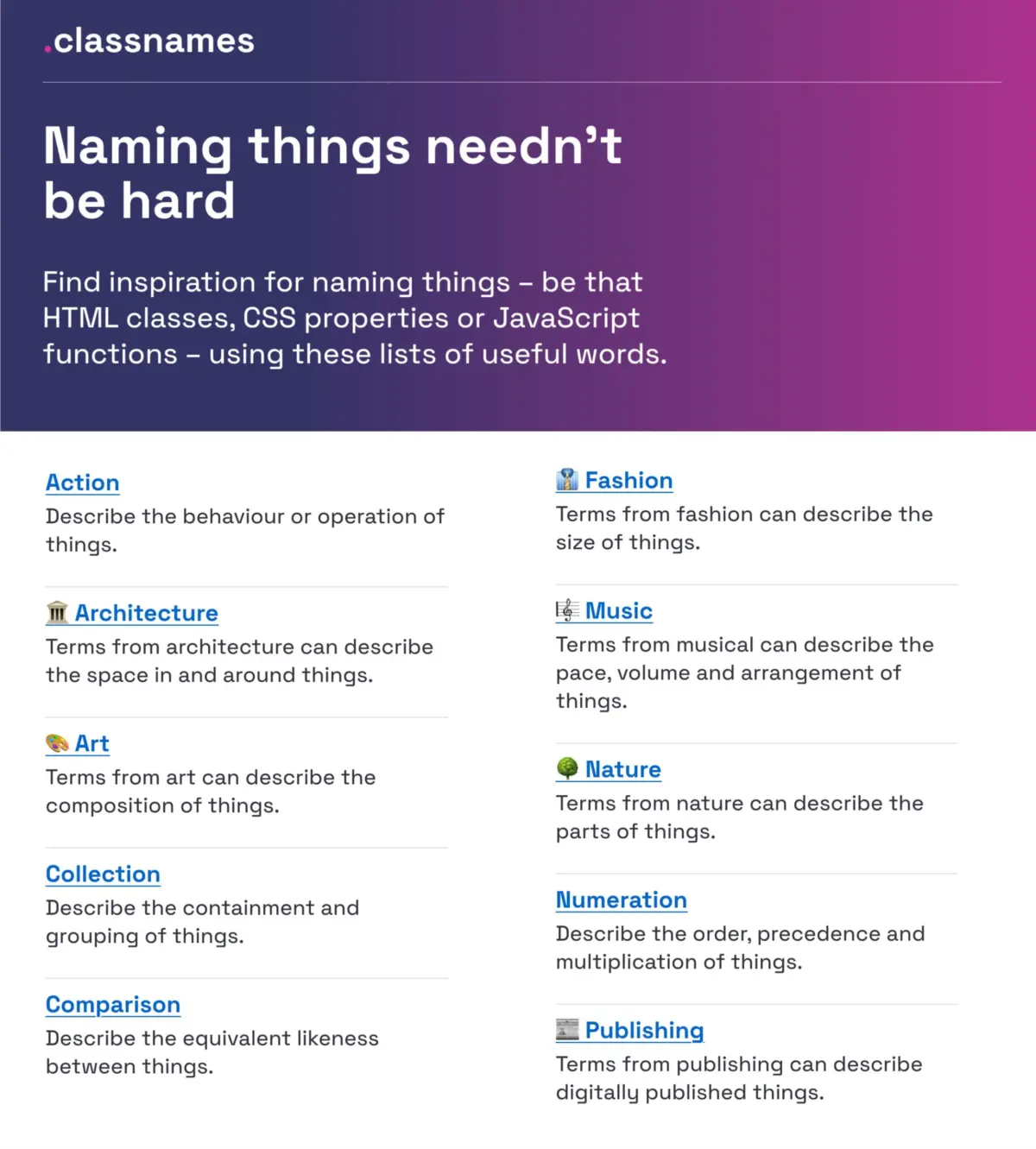
When naming HTML classes, CSS properties, or JavaScript functions, traditional terms can quickly become stale or overloaded. Resources like Classnames offer thematic collections of words drawn from nature, art, theater, music, architecture, fashion, and publishing. These alternatives help developers sidestep naming collisions while introducing meaningful semantic variance into codebases.
2. Color Palettes and Semantic Hues
Managing color variables manually often leads to chaotic naming schemas like blue-light-2 or brand-accent-final. To solve this, developers leverage extensive repositories such as David Aerne’s Color Names, which catalogs over 30,000 unique, user-contributed color identifiers. Coupled with tools like Color Parrot, teams can assign memorable, consistent names to color palettes, transforming abstract hex codes into recognizable design assets.

3. Layers, Groups, and UI Components
In design tools like Figma, messy layers destroy file scalability. Best practices outlined by experts like Javier Cuello dictate that an effective layer or component name must possess a logical structure:
- Do: Keep names short, meaningful, universally understood, and decoupled from temporary visual properties.
- Don’t: Rely on generic labels like
Rectangle 4 copyor state-dependent titles that break when layouts shift.
To see how real-world systems name standard UI elements, Iain Bean’s Component Gallery aggregates over 50 UI components from production-grade design systems, documenting alternative names and structural variations. Similarly, tools like Name That UI act as visual dictionaries to ensure cross-team alignment on common interface patterns.

4. Structuring Design Tokens: The Intuit and Vodafone Case Studies
Scaling a design system across multiple brands requires an advanced token taxonomy.
- Intuit’s Approach: Facing the challenge of unifying massive brands like Mailchimp, QuickBooks, and TurboTax, Intuit developed a flexible token system that extends far beyond a single brand theme, establishing a robust foundational taxonomy.
- Vodafone UK’s Variables Taxonomy Map: Vodafone’s design system team mapped out the anatomy of design tokens into a seamless, multi-tiered hierarchy. Built upon Nathan Curtis’s foundational token work, their system connects brand primitives to semantics and page-level implementations.
For teams looking to build their own, tools like Romina Kavcic’s Design Token Naming Guide & Builder and the accompanying Design Token Names Inventory spreadsheet provide interactive frameworks to structure components, categories, states, and roles without losing track of tokens across complex themes.

5. Naming Products and Features
When naming customer-facing features or new services, the primary driver must be user value. As outlined in practical UX frameworks by Erin Gannon, feature names should reflect the user’s "job-to-be-done." By conducting lexical research—asking users to explain their goals in their own words—product teams can craft titles that map directly onto existing mental models. For holistic product naming, open-source repositories like Onym provide methodologies, brainstorming prompts, and vetting guides to navigate the treacherous waters of product branding.
Future Outlook: The Horizon of Automated Semantics
As artificial intelligence and automated design-to-code pipelines become deeply integrated into software development, the importance of pristine nomenclature will only accelerate. Future design systems will likely rely on automated semantic validators that flag ambiguous variable names, non-accessible component labels, and cross-platform naming mismatches in real time.

Furthermore, the boundary between design tokens and code variables will continue to blur, driven by standardized token formats (such as the W3C Design Tokens Community Group specifications). In this upcoming landscape, teams that invest in a rigorous, human-centered taxonomy today will be uniquely positioned to scale intelligent, multi-platform applications tomorrow.
Wrapping Up
Ultimately, the correct name is simply the one that is universally understood, embraced, and actively utilized by both the product team and the end user. Countless hours are wasted every day because designers, developers, product managers, and users speak entirely different dialects of the same product language.

By auditing your current naming conventions, addressing technical and design debt in your token inventories, and anchoring your feature nomenclature in user-centric language, you can systematically dismantle the barriers of miscommunication. Clean naming is not just a stylistic preference; it is a foundational engineering and design practice that minimizes frustration, boosts adoption, and empowers multidisciplinary teams to build better digital experiences together.