

Executive Overview
In the fast-evolving landscape of artisanal agriculture and heritage fruit curation, few figures possess the unyielding, palate-testing tenacity required to separate pomological triumph from agrarian tragedy. Welcome, once again, to the front lines of the Apple Snack Gang’s annual audit. Following the initial wave of assessments, the spotlight shifts to a fresh, eclectic cohort of cultivars harvested, scrutinized, and definitively rated during the height of the 2026 season.
This investigative review encompasses seven distinct varieties—ranging from dense, nutmeg-heavy oddities to gym-honed iron-clad titans that threaten human jaw integrity. Utilizing a rigorous, if deeply eccentric, organoleptic methodology, this report analyzes flavor profiles, structural integrity, historical provenance, and unexpected sensory hallucinations. As the seasonal migration shifts toward the fertile orchards of New York, New England, and Canada, the findings presented below offer both a cautionary tale for casual consumers and an essential field guide for hardcore fruit enthusiasts.
Detailed Chronology of the 2026 Tasting Trials
The evaluation process followed a strict temporal and sensory sequence, beginning with high-spice experiments and descending into the murky depths of cider-graveyard varieties and deceptive pseudonyms.
1. Kickapoo Spice
- Score: 6.9 / 10
- Profile: Nutmeg, cinnamon, clove, cut grass, dense structure.
The trials commenced with the intriguingly named Kickapoo Spice, a moniker that immediately invokes classic rock iconography. Structurally described as a "dense boy" and a "weird friend," this cultivar presented an unusually high spice component dominated by heavy notes of nutmeg, underscored by subtle whispers of cinnamon and clove.

Despite living up to its descriptor, the fruit lacked essential juiciness. Furthermore, an unexpected aftertaste reminiscent of freshly cut grass introduced a discordant note. Agronomists note that timing remains the absolute dictator of pome success: some fruits improve gracefully in cold storage, while others descend immediately into "crap-town" the moment they sever from the bough. The Kickapoo Spice landed safely in the middle tier, securing a respectable, if humorous, 6.9 out of 10.
2. St. Edmunds Pippin
- Score: 8.3 / 10
- Profile: Fennel pollen, sharp-breaking crunch, herbal-sweet balance.
Marking the first proper apple of the seasonal cycle, the St. Edmunds Pippin offered an immediate masterclass in texture and balance. Though its skin bore a rough, weathered exterior likened colloquially to "licking a shark backward," the biting experience delivered a deeply satisfying pop and crunch.
Flavor-wise, the Pippin overdelivered. It offered a bright, herbal complexity with striking vibes of fennel pollen, harmoniously anchored by a rich natural sweetness. It stands as a premier example of a wonderfully weird, funky heirloom variety that successfully marries tartness with sugar. Earning an impressive 8.3 out of 10, it set an exceptionally high benchmark for the remainder of the harvest.
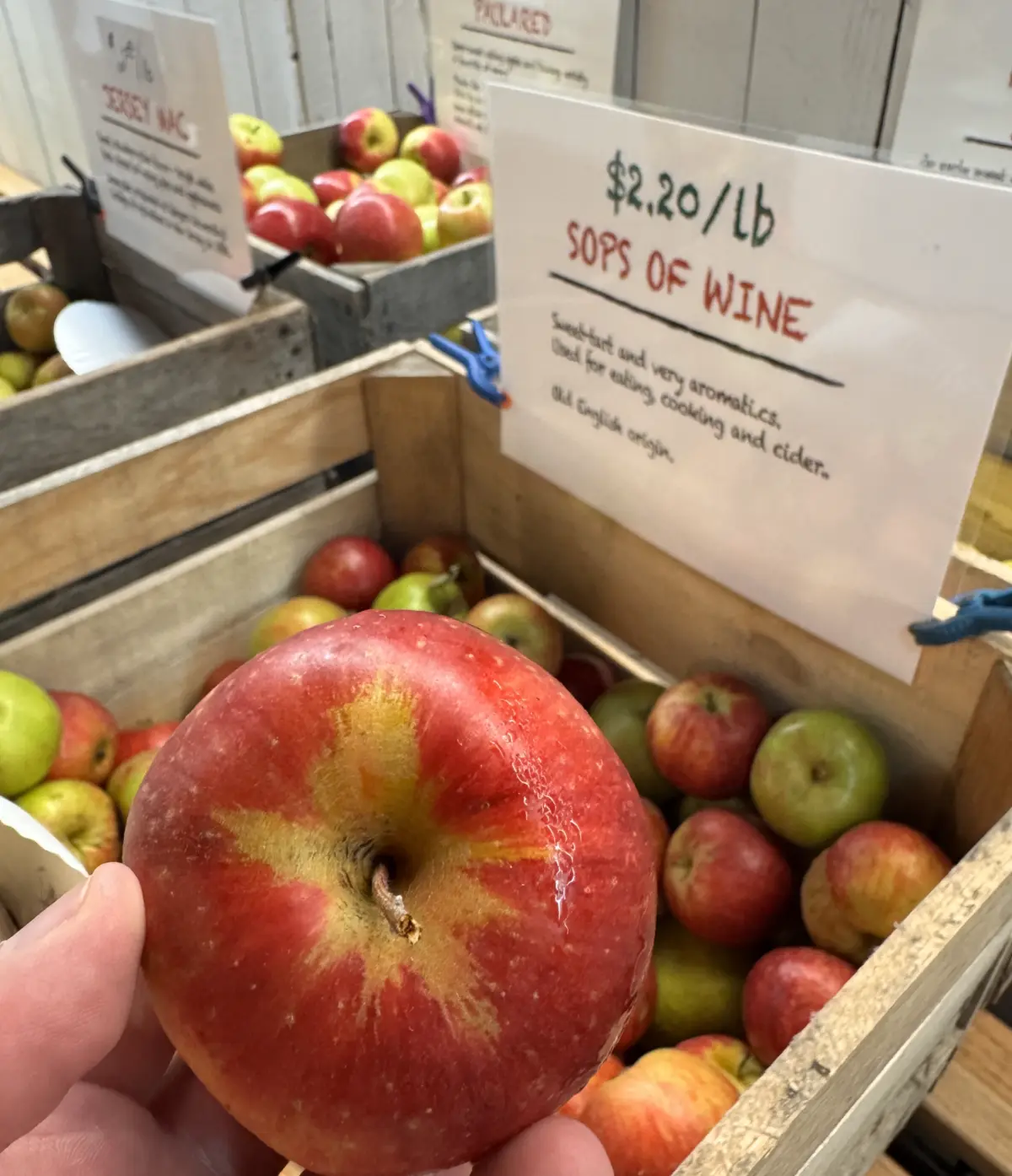
3. Sops of Wine
- Score: 3.5 / 10
- Profile: Vanilla, spice, mealy texture, subacid sweetness.
Moving from triumph to psychological anomaly, the Sops of Wine variety prompted immediate, involuntary cinematic flashbacks—specifically, the haunting imagery of Denethor consuming a tomato in The Lord of the Rings, accompanied by a phantom auditory cue echoing "SOPS OF WINE" within the chambers of the taster’s skull.

Beyond the neurological disturbances, the physical apple offered a mixed bag. While the flavor profile displayed pleasant, funky notes of vanilla and traditional spice with a balanced "subacid" sweetness, the texture was fatally compromised. Mealy, gritty, and structurally fatigued from sitting too long off the tree, the fruit failed to exhibit the classic red-fleshed streaking characteristic of true historical specimens. Adding to the confusion, pomological taxonomy remains disputed as to whether "Sops of Wine" represents a single distinct variety or a catch-all umbrella for various old-world types. Ultimately, it rated a disappointing 3.5 out of 10.
4. Fenceline Surprise
- Score: 1.0 / 10
- Profile: Bland mush, faint pear mist, beach-sand finish.
The Fenceline Surprise lived up to its name by delivering an experience universally categorized as abysmal. While linguistic dabblers might toy with pronouncing the name with a faux-French cadence rather than a standard "fence line," no linguistic flourish could rescue the contents within.
Characterized as a bland mush possessing barely a phantom mist of pear juice flavor, the fruit rapidly disintegrated on the palate, leaving behind a textural sensation akin to chewing beach sand. Given that point-of-sale signage advertised the batch as "firm," investigators concluded the fruit was either deeply mistreated during post-harvest storage or arrived at the market already serving as subterranean worm fodder. Spared a zero solely due to its dignified nomenclature and outward visual aesthetics, it limped across the finish line with a dismal 1.0 out of 10.
5. Americus Crab
- Score: 2.5 / 10
- Profile: Savory, tart, tough, tannin-heavy.
Stepping into the realm of wild genetics, the Americus Crab read more like a fictional steampunk inventor or a silver-age comic book superhero ("America’s Crab: The Super Crab Who Saves America") than a table fruit.

As a wild-type crabapple, expectations were appropriately adjusted. The fruit proved aggressively savory, intensely tart, physically tough, and overwhelmingly heavy in tannins. Designed strictly for wild foraging or specialized transformation rather than casual, out-of-hand snacking, it earns points for sheer character while remaining fundamentally unpalatable to the untrained human tongue. It logs a 2.5 out of 10.
6. Campfield (False?)
- Score: 4.1 / 10
- Profile: Chewy, tannin-rich, highly structured cider apple.
Labeled cautiously with a "(false)" moniker, the Campfield invoked suspicion—is it a "liar apple," a tricksy artifact attempting to wrest away the consumer’s precious sanity?
Palatability-wise, the fruit offered a chewy, callused-thumb consistency. It struggled with an overabundance of sugar colliding with a fortress wall of tannins, creating the uncanny sensation that the fruit was attempting to consume the taster simultaneously. However, pomological research reveals its true identity as an elite cider apple—a medium not meant for direct human consumption until mutated and refined by the alchemical goblins of fermentation.
Supporting Context & Historical Metrics
To fully comprehend the gravity of the Campfield variety, one must examine its deep-rooted historical lineage. Archival records link the fruit directly to Matthew Canfield (variously spelled Campfield), an anti-royalist Puritan who migrated from Harleston, England, during the Great Puritan Migration of 1637.

As a founding father of the New Haven Colony, Norwalk, Connecticut, and Newark, New Jersey, Canfield operated under municipal ordinances that mandated "freeholders" cultivate four acres of land—sparking the rapid expansion of early American orchards. Historical town records from New Haven document Canfield paying his municipal duties with "three barrels of good cider made of winter fruit," while later internment beneath Newark City Hall solidifies his permanent legacy in American pomology. This rich historical tapestry elevates the fruit’s cultural value, even if its direct-consumption metrics land it at a modest 4.1 out of 10.
7. Graham
- Score: 8.0 / 10
- Profile: Glacial fracture, rock-hard density, distinct Juicy Fruit gum flavor.
The crown jewel of the trial’s latter half was the Graham, an apple so structurally dense and hardened that it defied standard human dentition. Boasting washboard abs impervious to birdshot, this cultivar threatened the taster with acute Temporomandibular Joint (TMJ) disorder. Biting into it required brute physical force, causing the flesh to fracture like a calving glacier.
However, the immense labor required to breach the fruit’s exterior yielded a startling sensory reward: upon reaching the interior, the flavor profile erupted into an unmistakable, unreserved, and startlingly direct replication of Juicy Fruit chewing gum. For delivering this whimsical and potent flavor anomaly, the Graham secured an 8.0 out of 10, narrowly missing a higher score only due to the sheer physical toll required to consume it.
Official Statements & Methodological Insights
Pomological investigators emphasize that evaluating heirloom and seasonal apples requires a psychological fortitude equal to physical stamina. As demonstrated across the 2026 trials, fruit morphology is governed by unpredictable variables: storage duration, post-harvest decay rates, tannin saturation, and historical pedigree.

Industry analysts note a growing consumer divide between mainstream, highly uniform supermarket varieties (such as the heavily criticized Red Delicious archetype) and complex, wild, or heritage cultivars that demand specialized culinary application—such as fermentation into hard cider or strategic cellar aging.
Future Outlook & Upcoming Harvest Expeditions
As the autumn season progresses, the investigative focus shifts geographically. With field expeditions officially scheduled for New York, New England, and Canada in the coming weeks, the hunt for elite pomological specimens intensifies.
Local orchardists, agrarian historians, and apple enthusiasts across these regions are formally invited to present their finest, strangest, and most resilient cultivars for immediate field auditing. As the Apple Snack Gang packs its bags for northern latitudes, one certainty remains: the pursuit of the ultimate apple harvest is a relentless, jaw-testing journey with no end in sight.