In the grand tradition of agricultural journalism and unhinged sensory exploration, the self-proclaimed "Apple Snack Gang" has returned with the second installment of their exhaustive pomological audit. Following the release of their initial evaluations—fondly referred to by insiders as a mad batch of orchard reviews—tasters have plunged deeper into the idiosyncratic world of heirloom, rare, and commercially obscure apple varieties.
This latest dispatch covers a diverse cohort of six distinct cultivars: Kickapoo Spice, St Edmunds Pippin, Sops of Wine, Fenceline Surprise, Americus Crab, Campfield (False?), and the jaw-shattering Graham. Ranging from structural marvels boasting uncanny flavor profiles like Juicy Fruit gum to agricultural disasters that taste of beach sand and existential dread, this evaluation period offers a masterclass in the unpredictable nature of post-harvest fruit evolution.
As the investigative team prepares to expand its geographical footprint across New York, New England, and Canada, this report serves as both a celebration of pomological biodiversity and a cautionary tale against unverified roadside produce. Below is the comprehensive, metric-driven autopsy of the harvest’s middle tier.
Detailed Chronology: The Tasting Sessions
The evaluation sessions followed a rigorous, albeit erratic, protocol of tactile inspection, auditory crunch assessment, and psychological introspection. Each specimen was logged, sliced or violently bitten into, and subsequently assigned a numerical score on a proprietary scale ranging from catastrophic failure (1.0) to near-transcendental delight (10.0).
1. Kickapoo Spice
Score: 6.9 / 10
Profile: Nutmeg, cinnamon, clove, and cut grass.
The tasting chronology opened with the Kickapoo Spice, a cultivar whose very nomenclature instantly evoked classic rock associations for the review panel. Physically described as a "dense boy" and a "weird friend," this medium-to-large fruit presented an aggressively high spice component dominated by heavy notes of nutmeg, balanced by secondary waves of cinnamon and clove.
However, structural analysis revealed critical shortcomings in hydration. The fruit lacked expected juiciness, leaving behind an unorthodox aftertaste reminiscent of freshly cut grass. Pomological experts noted that this profile suggests a failure in optimal storage management. Because apples exist on a precarious developmental spectrum—some improving gracefully off the branch while others plummet into mediocrity the moment they sever from the tree—the Kickapoo Spice landed firmly in the middle tier. It is an interesting, intellectually stimulating piece of fruit, ultimately saved by its complex aromatics.
2. St Edmunds Pippin
Score: 8.3 / 10
Profile: Fennel pollen, bright herbs, and sharp-breaking juice.
As the first "proper" apple consumed in the official seasonal rotation, the St Edmunds Pippin established a high-water mark for the audit. Despite possessing a tactile exterior akin to "licking a shark backward," the fruit compensated with an explosive acoustic and physical profile. Upon breaching the skin, tasters reported a deeply satisfying pop and crunch.
Flavor-wise, the Pippin delivered a masterclass in balance. It exhibited sharp-breaking acidity paired with bright, herbal undertones reminiscent of fennel pollen, yet maintained a sturdy baseline of sweetness. This complex tart-sweet equilibrium cemented its status as an elite contender among funky, non-mainstream heirlooms.
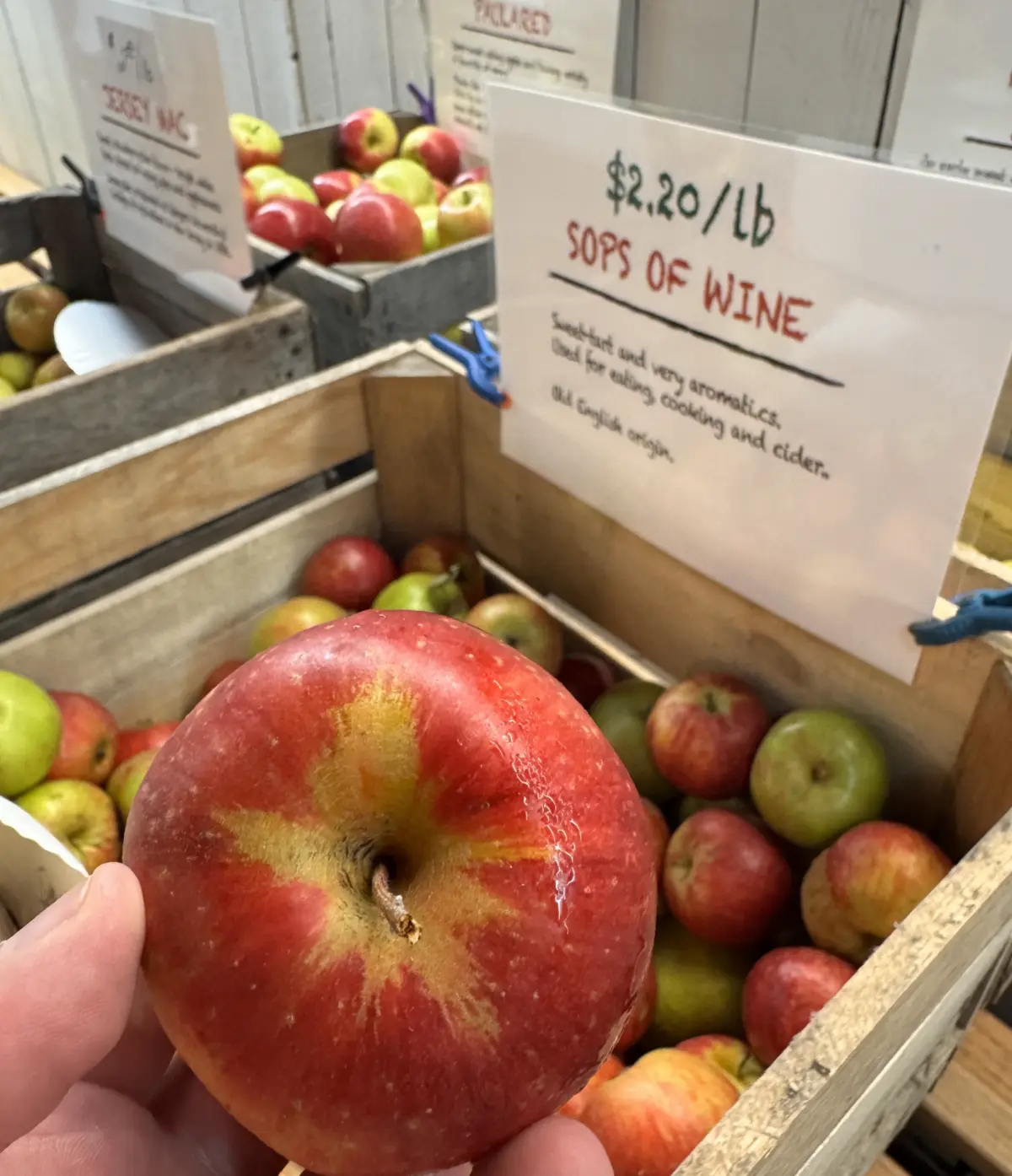
3. Sops of Wine
Score: 3.5 / 10
Profile: Vanilla, spice, and mealy grit.
The encounter with the Sops of Wine cultivar proved to be as much a psychological event as an agricultural one. Triggering auditory hallucinations of Tolkien proportions—specifically, the cinematic imagery of Denethor consuming a tomato accompanied by John Noble’s theatrical intonations—the evaluation quickly took a surreal turn.
Objectively, the fruit suffered from advanced post-harvest degradation. Having lingered too long off the tree, its structural integrity collapsed into a mealy, gritty texture. While aromatic notes of vanilla and spice were present, alongside a pleasant "subacid" sugar-to-acid ratio, the mouthfeel was profoundly compromised. Compounding the confusion, historical discrepancies surrounding the variety—ranging from disputed red-fleshed colorations to its status as a catch-all umbrella term for multiple historic types—left tasters questioning both the fruit’s identity and their own sanity.
4. Fenceline Surprise
Score: 1.0 / 10
Profile: Bland mush, faint pear mist, and beach sand.
True to its foreboding moniker, the Fenceline Surprise delivered an experience best summarized by its 1-out-of-10 rating. While linguistic purists might appreciate the temptation to pronounce the name with a faux-French cadence rather than a standard "fence line," the contents of the skin offered no linguistic or culinary redemption.
The fruit presented as a uniform, bland mush. A transient, highly elusive hint of pear juice flickered across the palate during the initial bite, only to vanish instantly, replaced by a lingering sensation akin to chewing beach sand. Despite signage at the point of acquisition classifying the cultivar as a "firm apple," auditors concluded the specimens were either harvested from a genetically grumpy batch or had achieved the status of "cold worm-food" long before purchase.
5. Americus Crab
Score: 2.5 / 10
Profile: Savory, tart, tough, and heavily tannic.
Stepping out of traditional dessert territory, the Americus Crab—a name universally agreed to sound like a steampunk inventor or a silver-age maritime superhero—pushed the boundaries of what a human being should reasonably consume out of hand.
As a true crabapple, it defied conventional snacking metrics. It was aggressively savory, profoundly tart, structurally unyielding, and saturated with tannins. Auditors noted that while it is entirely unsuited for casual consumption, it possesses a certain rogue charm for those who derive pleasure from eating items explicitly not designed for immediate human digestion.
6. Campfield (False?)
Score: 4.1 / 10
Profile: Chewy, tannic, and fiercely optimized for fermentation.
Labeled ambiguously as "(false)," the Campfield sparked immediate suspicion among the panel, who briefly mistook it for a deceptive, ring-obsessed entity from Middle-earth. Tactilely described as resembling a "chewy callused thumb," the apple fought back. It was simultaneously cloying in its residual sweetness and punishingly high in tannins, creating the uncanny sensation that the fruit was consuming the taster as much as the taster was consuming it.
Historical deep-dives into the cultivar revealed a labyrinthine American narrative. Records trace the lineage to Matthew Canfield (alternately spelled Campfield), an anti-royalist Puritan who arrived in New England during the Great Puritan Migration of 1637. A foundational figure in New Haven, Norwalk, and Newark—where he was eventually buried beneath City Hall—Canfield’s colonial land grants mandated the widespread cultivation of four-acre orchards primarily dedicated to the production of hard cider.
True to its heritage, the Campfield is not designed for the naked human tongue. It demands anthropogenic intervention—specifically, the biochemical transmutation delivered by the "goblins of fermentation."
7. Graham
Score: 8.0 / 10
Profile: Industrial-strength density, glacial fracturing, and pure Juicy Fruit gum.
The undisputed heavyweight champion of the session was the Graham. Structurally, the fruit was so dense and impervious that it posed an immediate occupational hazard to human dentition, likened by reviewers to an apple with "washboard abs you couldn’t pierce with 20-gauge birdshot." Biting into it required maximum muscular exertion, resulting in a structural fracture reminiscent of a calving glacier.
However, the agonizing effort of consumption was met with an almost unbelievable reward. Upon breaching the interior, tasters were hit with an unadulterated, highly concentrated flavor profile identical to classic Juicy Fruit gum. This uncanny, synthetic-tasting sweetness within an heirloom package elevated the Graham to elite status, narrowly missing a higher score only due to the sheer facial reconstruction required to eat it.
Supporting Context & Metrics
To contextualize the findings of this audit, pomologists must evaluate the intersection of storage longevity, tannin concentration, and consumer psychology.
Cultivar
Score (out of 10)
Dominant Texture
Primary Flavor Notes
Intended Utility
Kickapoo Spice
6.9
Dense / Dry
Nutmeg, Clove, Cut Grass
Fresh / Storage-Dependent
St Edmunds Pippin
8.3
Crisp / Juicy
Fennel Pollen, Tart-Sweet
Fresh Consumption
Sops of Wine
3.5
Mealy / Gritty
Vanilla, Subacid Spice
Historical Curiosity
Fenceline Surprise
1.0
Mushy / Sandy
Faint Pear Mist
Avoid
Americus Crab
2.5
Tough / Fibrous
Savory, Tannic, Tart
Foraging / Novelty
Campfield (False?)
4.1
Chewy / Callused
Tannic, Sweet-Binding
Hard Cider Production
Graham
8.0
Glacial / Hard
Juicy Fruit Gum
High-Effort Fresh Snack
The data underscores a vital rule of the modern harvest: structural hardness does not inherently correlate with flavor quality (as proven by the Fenceline Surprise versus the Graham), nor do historical pedigrees guarantee culinary accessibility (exemplified by the cider-centric Campfield).
Official Statements & Industry Outlook
Speaking on behalf of the evaluation committee, lead tasters have emphasized the necessity of expanding geographic parameters. With the harvest season reaching its zenith, regional anomalies in microclimates continue to dictate the volatile quality of heritage crops.
In an official commentary regarding the upcoming northern migration, leadership noted:
"Given the area we are going to—New York, New England, and Canada—you can goddamn jolly well bet we are going to eat some motherfucking apples."
Industry observers anticipate that the team’s foray into northern orchards will yield even wilder genetic variations, particularly as they encounter undocumented roadside trees and long-forgotten colonial plantings.
Future Outlook
As the Apple Snack Gang packs its bags and prepares for its upcoming tour of northeastern orchards and Canadian homesteads, the pomological community stands on high alert. The upcoming weeks are expected to bring a deluge of fresh field data, new cultivar ratings, and undoubtedly more structural jaw injuries.
Consumers, orchardists, and apple monsters alike are advised to monitor the official appearance schedules, prepare local offerings for the traveling panel, and—above all else—exercise extreme caution when approaching any apple whose name sounds like a 17th-century Puritan land dispute or an industrial-strength piece of athletic equipment.