

Executive Overview
In the modern theater of American politics, cultural signifiers often carry more weight than legislative policy. From campaign trail stops at diners to photo-ops featuring local delicacies, the food a politician eats—and how they eat it—has long been weaponized to project authenticity, relatability, and virility. However, the intersection of political theater and dietary habit has recently taken a bizarre and revealing turn.
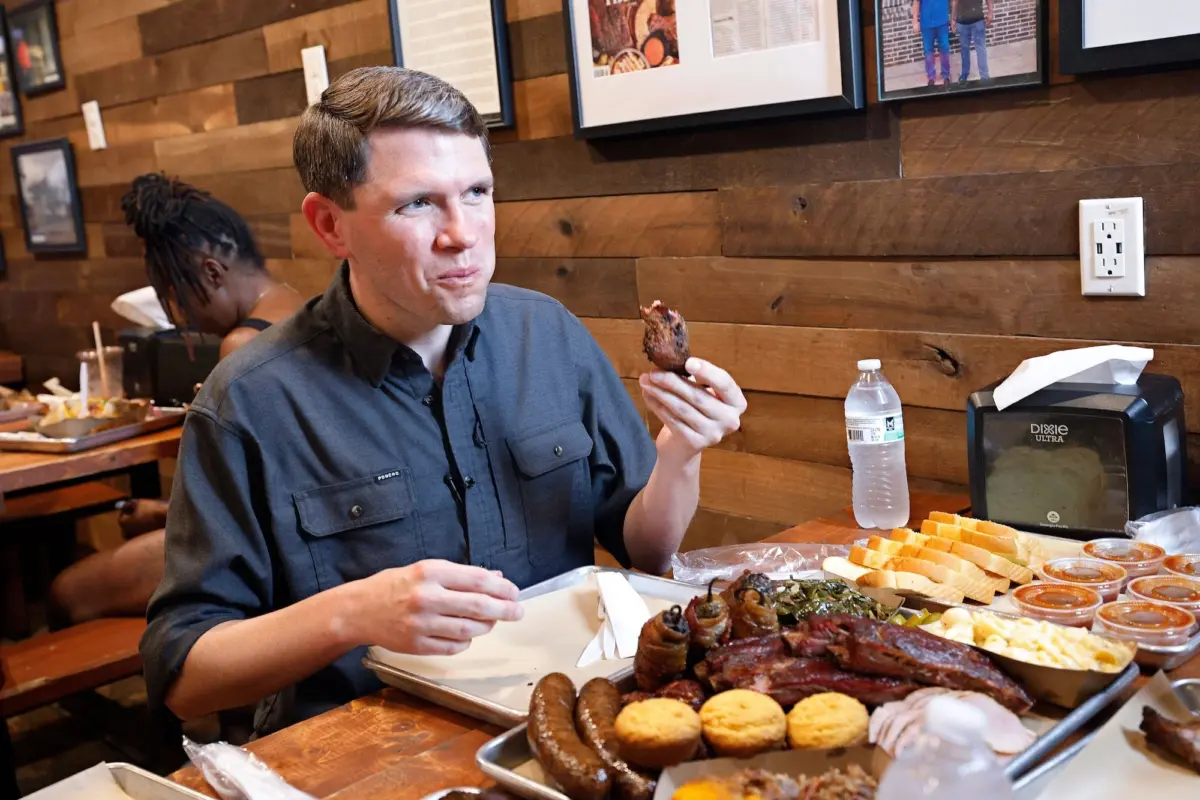
During the heated political cycles leading into late 2026, former President Donald Trump weaponized a completely unsubstantiated dietary conspiracy theory against James Talarico, the Democratic nominee for the U.S. Senate in Texas. According to Trump’s frequently repeated narrative, Talarico—portrayed as a "secret vegan"—attends Texas barbecues, forces down meat to pander to voters, and subsequently retreats behind a tent to vomit.
This elaborate, recurring anecdote is more than mere campaign trail bluster. By linking dietary choices directly to political loyalty, regional heritage, and conservative definitions of manhood, Trump and Texas Attorney General Ken Paxton have turned a false claim about a candidate’s stomach into an explicit test of masculinity. This deep dive explores how the traditional "meat-and-potatoes man" of American folklore has been replaced by a modern political class obsessed with rigid dietary protocols, performative toughness, and bodily surveillance, revealing profound insecurities at the heart of contemporary conservative performance art.
Detailed Chronology: The Anatomy of a Dietary Conspiracy Theory
To understand how a piece of smoked brisket became a partisan battleground, one must trace the timeline of Trump’s fixation on Talarico’s eating habits and how it dovetailed with the broader Texas Senate race.
- The 2022 Precedent: The roots of the "secret vegan" mythology trace back to a 2022 state House campaign in which James Talarico advocated for reducing individual meat consumption for health and environmental reasons. During this campaign, his team purchased vegan products from local Texas businesses to support constituents. Talarico never announced he was a strict vegan, and he has since been frequently photographed eating traditional Texas fare, including chicken, steak, and turkey legs. Despite these public contradictions, the narrative of his supposed dietary aversion took root among conservative operatives.
- October 2, 2026 – The Mobile Rally: Trump escalated the rhetoric during a campaign rally in Mobile, Alabama. Addressing the crowd, he painted a vivid, theatrical picture of Talarico as a vegan forced to consume "meat like a pig" on the campaign trail. Trump introduced the now-infamous detail of the tent, claiming the Democratic nominee routinely slipped behind canvas partitions to "throw up all over the place."
- Mid-October 2026 – Refining the Script: As Trump took the narrative on the road through Nebraska and into Texas, the details shifted to suit the local palate—transforming generically from "meat" to "steak." When Talarico temporarily stepped away from the campaign trail due to a reported bout of the flu, Trump seized on the absence, weaving it into the plot as physical evidence of a body rejecting meat "for political reasons."
- October 7, 2026 – The San Antonio Summit: During a rambling mid-term rally in San Antonio, Trump turned the rhetorical spotlight directly toward Talarico’s Republican opponent, Texas Attorney General Ken Paxton. Praising Paxton’s alignment with traditional Texan archetypes—evoking figures like Davy Crockett and the defenders of the Alamo—Trump declared, "I have a feeling Ken likes meat." The progression was seamless: from barbecue to regurgitation, virility to historical myth-making.
Supporting Context & Metrics: The Evolution of the "Meat-and-Potatoes" Archetype
The political obsession with what men eat is deeply rooted in American pop-culture history, yet its modern manifestation represents a stark departure from the past.
From Unpretentious Self-Assurance to Rigid "Protocols"
Decades of television, country music, and cinematic Americana celebrated the archetype of the "meat-and-potatoes man." As seen in classic television tropes—such as Andy Griffith effortlessly ordering a simple steak and a baked potato while his companion fumbles over a complex French menu—this figure was defined by plainspoken certainty. He knew what he liked, ordered it without apology, and crucially, did not care whether anyone else approved.
Today, that rugged, self-assured independence has vanished, replaced by a hyper-regulated, obedient adherence to strict dietary frameworks.
The Rise of the Political Diet Program
This shift is exemplified not just by campaign trail talking points, but by the actual lifestyle choices of prominent conservative figures. Several senior administration and political figures have openly embraced extreme dietary regimens, most notably the "meat and ferments" protocol popularized by physician Sean O’Mara. This regimen—consisting primarily of grass-fed beef, sauerkraut, and kimchi—leaves little room for culinary improvisation or personal pleasure.
- RFK Jr. and Visceral Fat: Health and Human Services figures like Robert F. Kennedy Jr. have openly championed these restrictive diets, touting their effects on visceral fat and biological optimization.
- The Performance of Purity: Where the traditional meat-and-potatoes diet signaled a cheerful, relaxed lack of fuss, today’s conservative wellness protocols demand bodily surveillance, specialized shopping lists, and an almost devotional, monastic attention to digestion. It is no longer a casual dinner; it is an ideological program.
Cultural Uniformity Disguised as Rugged Individualism
The irony of this contemporary performance is its profound lack of genuine individuality. Much like Trump’s reported penchant for distributing Florsheim leather oxfords to male allies—forcing subordinates to wear matching shoes to prove their loyalty—the modern political right demands total conformity in lifestyle and consumption.
What is marketed as John Wayne-style rugged independence often resembles the conformist choreography of a pop-culture satire. When every man in a political circle must perform the exact same ritualized appreciation for grass-fed beef, fermented cabbage, and frontier ruggedness, the spontaneous expression of manhood evaporates, leaving behind a heavily scripted group project.
Official Statements and Campaign Responses
The absurdity of the "barbarian-at-the-tent" narrative has drawn sharp reactions from across the political spectrum, highlighting the growing chasm between serious policy discussions and the surreal nature of modern electoral theatrics.
- James Talarico’s Campaign: Representatives for the Texas Democratic Senate nominee have repeatedly batted down the claims, characterizing them as bizarre, unfounded distractions from the real issues facing Texans, such as healthcare, education, and economic stability. Campaign surrogates have repeatedly pointed to the optical absurdity of the claims, noting that Talarico’s public consumption of Texas barbecue is well-documented and entirely genuine.
- Ken Paxton’s Camp: Attorney General Ken Paxton’s campaign has leaned into the cultural framing of the race, contrasting Paxton’s unyielding adherence to traditional Texan lifestyle tropes against what they frame as progressive inauthenticity. By aligning himself with Trump’s vivid storytelling, Paxton has implicitly accepted the premise that culinary choices serve as a valid litmus test for political reliability.
- Fact-Checkers and Observers: Media watchdogs and political analysts, including evaluations from independent fact-checking organizations, have universally rated Trump’s claims about Talarico’s vomiting episodes as entirely fabricated. Historians of political communication note that while politicians have long fumbled local foods—such as Gerald Ford famously biting into a San Antonio tamale without removing the corn husk in 1976—those incidents involved observable, accidental mistakes. Trump’s narrative against Talarico breaks new ground by inventing secret, invisible sins that cannot be disproven by physical evidence, because they exist entirely within the realm of political fiction.
Future Outlook: The Exhaustion of Performative Manhood
As American politics marches deeper into an era defined by hyper-partisanship and cultural symbolism, the weaponization of daily habits—from footwear to dietary choices—is unlikely to abate. However, the sustainability of this performative hyper-masculinity faces diminishing returns.
- The Exhaustion of Enforcement: When political belonging depends on adhering to an ever-expanding manual of approved behaviors, the enforcement mechanism eventually turns inward. Maintaining an artificial facade of hyper-vigilant, state-sanctioned manhood is profoundly exhausting.
- Spillover into Broader Social Norms: As observed in the policing of diet and lifestyle, the performance of political tribalism inevitably extends beyond male politicians. It begins to dictate broader societal expectations surrounding gender roles, personal autonomy, and public behavior.
- A Return to Substantive Realities: Ultimately, voters navigating real-world economic pressures, infrastructure challenges, and institutional crises may grow increasingly weary of campaigns that prioritize fictionalized narratives about barbecue tents over tangible governance.
Trump’s obsessive focus on James Talarico rushing behind a canvas partition to reject a brisket sandwich serves as a psychological projection of the conservative political machine itself. For a movement that spends an extraordinary amount of energy policing what men wear, what they eat, and how they project strength, the fear of abandoning the performance is palpable. In the end, the man who feels most compelled to prove his toughness through a rigorous meat protocol may simply be terrified of what happens if he drops the act.