

Executive Overview
In the realm of digital product design and software engineering, a persistent adage echoes through every code repository and design system file: "There are only two hard things in Computer Science: cache invalidation and naming things." While flippantly quoted, this sentiment underscores a profound cognitive bottleneck that plagues cross-functional teams daily. The language we choose does not merely label our creations; it actively shapes the way we think, dictates the parameters of our architectural debates, and serves as the foundational communication layer between designers, developers, product managers, and end-users.
When nomenclature fails, friction multiplies. Teams find themselves speaking in fragmented dialects—designers utilizing visual metaphors, developers leaning on structural abstractions, product managers relying on business jargon, and users stumbling over corporate terminology. This semantic disconnect directly drives widespread confusion surrounding colors, icons, user interface (UI) components, and core product features. It manifests in bloated CSS classes, rigid design tokens, and elusive variables that resist scaling.

Choosing the right name is a delicate balancing act. Names that are too generic strip away necessary context, rendering components ambiguous and difficult to interpret. Conversely, names that are too specific paint teams into architectural corners, sacrificing the flexibility required for modular reuse and multi-brand scalability.
This comprehensive guide explores the structural mechanics of naming things across the digital product lifecycle. Drawing on industry-leading frameworks, open-source resources, and expert design system case studies, we will examine tactical methodologies for naming HTML classes, color palettes, UI layers, design tokens, features, and enterprise-grade products. By aligning team vocabulary with user realities, organizations can eliminate cognitive overhead and foster a unified, scalable approach to digital craftsmanship.

Detailed Chronology & Evolution of Digital Nomenclature
To understand why naming has become such a critical discipline within modern web development and design systems, one must look at how digital architecture has evolved over the past two decades.
The Wild West of Early Web Development
In the infancy of the web, naming conventions were largely an afterthought. Developers relied on idiosyncratic abbreviations (#main-nav-col2, .txt_box), inline styles, and proprietary IDs. As websites grew into dynamic web applications, this ad-hoc approach collapsed under its own weight. Codebases became brittle, and global style sheets turned into "stylesheets of doom," where changing a single class name risked breaking layouts across entire platforms.

The Rise of Methodologies (BEM and Beyond)
Recognizing the unsustainable nature of unstructured naming, the industry entered an era of rigid methodologies. Frameworks like BEM (Block, Element, Modifier) introduced strict structural syntax—such as block__element--modifier—to bring order to CSS class naming. While BEM successfully solved specificity wars and improved component scoping, it also introduced verbose, hard-to-maintain strings that sometimes obscured the actual semantic value of the UI element.
The Design System Revolution and Tokenization
With the advent of atomic design and comprehensive design systems (pioneered by organizations like Salesforce, Shopify, and Intuit), the scope of naming expanded exponentially. Naming was no longer restricted to HTML elements and CSS selectors; it now encompassed Figma layers, component variants, semantic design tokens, multi-brand themes, and user-facing feature sets. Today, naming is treated as a core design discipline—an architectural exercise that requires rigorous taxonomy mapping, cross-team collaboration, and deep alignment with cognitive psychology.

Supporting Context & Methodologies: Tools and Best Practices
Mastering the art and science of nomenclature requires looking beyond internal team debates and drawing inspiration from established resources, community repositories, and battle-tested design systems. Below is a breakdown of the primary domains of digital naming and the resources available to optimize them.
1. General Coding and UI Classes: Thinking Outside the Box
When developers hit a creative wall trying to name JavaScript functions, CSS properties, or structural HTML classes, falling back on terms like wrapper, container, or item leads to muddy code.

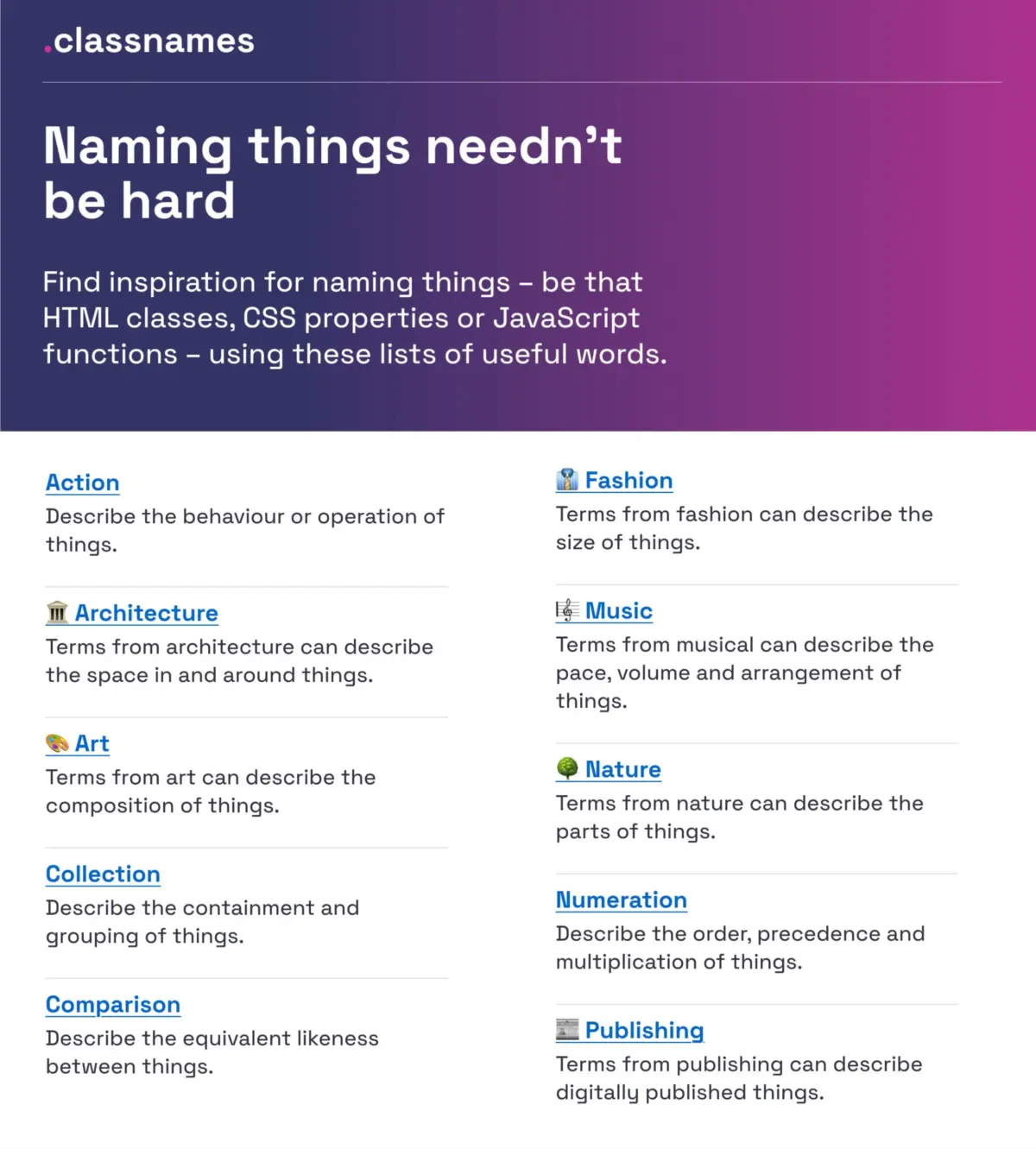
- Resource Spotlight: Classnames (curated by Paul Robert Lloyd) is an invaluable open-source resource that provides thematically grouped lists of words designed to spark lateral thinking. Beyond standard behavioral and structural terms (such as order, grouping, and association), Classnames offers curated vocabularies drawn from unexpected disciplines like architecture, theater, music, fashion, publishing, art, and nature. By leveraging metaphors from the physical world, developers can construct more evocative, precise identifiers.
2. Color Palettes: Moving Beyond Hex Codes
Naming colors is notoriously subjective. Is a specific hex code #2e8b57 best described as "SeaGreen," "ForestMist," or "DeepMoss"?
- Resource Spotlight: David Aerne’s Color Names repository provides a massive, community-driven taxonomy comprising over 30,355 unique color names sourced from diverse references and thousands of user contributions. Accompanied by interactive tools like the Color Parrot picker and search utilities, this repository ensures that teams can abandon arbitrary naming conventions (like
blue-1,blue-2) in favor of rich, recognizable semantic or descriptive tags that scale across design tokens.
3. Layers and Groups: Scalable Figma Architecture
In collaborative design environments like Figma, unorganized layer panels littered with "Rectangle 4 copy" and "Frame 12" destroy handoff efficiency and frustrate engineering teams.

- Resource Spotlight: Design systems consultant Javier Cuello has formalized a comprehensive set of naming best practices for layers, groups, and components. According to Cuello’s guidelines, an effective name possesses a logical structure, remains concise yet meaningful, is universally understood across disciplines, and deliberately avoids tying itself to superficial visual properties (e.g., naming a layer "BlueBox" instead of "PrimaryBanner").
4. Design Token Taxonomies: Multi-Brand Scalability
As enterprise products expand to support multiple brands, dark modes, and white-label themes, flat color palettes and spacing variables break down. A robust design token architecture requires a multi-layered taxonomy.
- Case Study — Intuit: Managing a powerhouse portfolio that includes Mailchimp, QuickBooks, TurboTax, and Mint, the design infrastructure team at Intuit faced the monumental challenge of building a flexible design token system that could serve disparate brands without fracturing. Nate Baldwin’s published case study details how Intuit overcame legacy pain points by establishing a rigorous token taxonomy that separates global primitives from brand-specific and component-level tokens.
- Case Study — Vodafone UK: Similarly, the Vodafone UK Design System team released their Variables Taxonomy Map on Figma, illustrating how to orchestrate a complex multi-brand, multi-themed system. Building upon Nathan Curtis’s foundational work on token naming, Vodafone’s four-tier structure connects brand primitives to semantic values and page-level applications. This ensures that any engineer or designer can immediately deduce a token’s purpose and location simply by reading its name.
- Resource Spotlight: Romina Kavcic’s Design Token Naming Guide + Builder offers an interactive tool for configuring custom naming structures based on components, categories, states, and roles. Complemented by her Design Token Names Inventory spreadsheet, these resources provide a bird’s-eye view of token architectures, allowing teams to filter and scale properties effortlessly.
5. UI Components: The Component Gallery
When establishing a new design system or auditing an existing one, deciding whether to call a disclosure widget an "Accordion," "Collapsible," or "Expander" can spark hours of unproductive debate.

- Resource Spotlight: Iain Bean’s Component Gallery aggregates interface components from dozens of real-world design systems. Cataloging over 50 UI components—complete with alternative naming conventions used across the industry—it serves as an authoritative reference manual. For an even more visual approach, Name That UI functions as a quick-reference visual dictionary for everyday interface patterns.
6. Feature Discovery and Product Naming
Poor feature adoption is frequently mistaken for a lack of user interest when the root cause is actually poor discoverability driven by confusing nomenclature. Features must be discovered, understood, tried, integrated into existing workflows, and eventually mastered.
- Resource Spotlight: In her practical guide "What Do We Call This Thing?", UX writer Erin Gannon emphasizes that high-performing feature names are driven by user problems rather than internal corporate terminology. The golden rule of feature naming is to tap into the user’s own language. By observing how users describe their pain points and desired outcomes during user testing, teams can craft names that signal immediate value (the "job-to-be-done").
- Resource Spotlight: For naming broader products or services, Onym acts as an open-source clearinghouse of brainstorming tools, vetting methodologies, etymologies, and book recommendations to help teams navigate the perilous waters of product naming.
Future Outlook: The Next Frontier of Semantic Design
As artificial intelligence, automated code generation, and token-driven design tools continue to mature, the precision of our nomenclature will become even more critical. AI models, design-to-code compilers, and automated linters rely entirely on predictable, semantic naming conventions to interpret design intent and generate production-ready code.

Furthermore, as design systems evolve into fluid, token-based ecosystems capable of real-time multi-brand adaptation, the gap between design tokens and code variables will continue to narrow. Organizations that invest in rigorous, user-centric naming taxonomies today will find themselves uniquely positioned to scale effortlessly across platforms, devices, and future interaction paradigms.
Wrapping Up
Ultimately, the correct name for any UI component, design token, or digital feature is simply the one that is universally understood and actively utilized by both the product team and the end-user. Countless development hours are wasted every day because cross-functional teams speak in isolated dialects. By bridging the gap between the designer’s vision, the developer’s architecture, the product manager’s strategy, and the user’s everyday language, organizations can dramatically reduce friction and confusion.

The next time you encounter low feature adoption or endless architectural debates over a component’s identifier, examine the nomenclature. Address naming conflicts early, maintain a collaborative backlog for semantic debt, and treat your vocabulary with the same rigorous engineering standards you apply to your codebase. Doing so is not merely an exercise in semantics—it is the foundation of a cohesive, human-centered digital experience.