

Executive Overview
In the modern political information ecosystem, the line between viral outrage and deliberate strategic deflection has effectively dissolved. Nowhere is this dynamic more clearly illustrated than in the marquee 2026 United States Senate race in Texas, where Republican candidate and state Attorney General Ken Paxton found himself facing devastating financial disclosures regarding high-profile donors tied to federal embezzlement charges.
Instead of anchoring a national news cycle, those damaging revelations were entirely swallowed by a wildly coordinated, rapidly debunked conspiracy theory: the baseless claim that his Democratic opponent, Texas state Representative James Talarico, had secretly checked into an Ohio psychiatric facility.
For weeks, Talarico and Paxton had traded the public spotlight on roughly equal footing, reflecting the tight margins of a competitive contest in a historically crimson state. However, that equilibrium shattered when a constellation of right-wing influencers, MAGA media personalities, and high-profile amplifiers—backed rhetorically by Paxton himself and former President Donald Trump—manufactured and propagated a transparent falsehood about Talarico’s health.
While the hoax collapsed under basic journalistic scrutiny with embarrassing speed, its political utility was absolute. By the time the dust settled, a routine medical absence due to the flu had been transformed into a national spectacle, completely eclipsing investigative reporting that detailed Paxton’s financial ties to indicted figures. This episode offers a masterclass in how the "rage economy" operates: weaponizing speed, scale, and algorithmic amplification to obscure political corruption while protecting allied candidates from accountability.
Detailed Chronology: From a Bad Case of the Flu to a Viral Fabrication
The sequence of events leading to the Talarico conspiracy theory highlights the mechanical precision with which modern political disinformation is deployed. The timeline demonstrates that the narrative was not a spontaneous internet rumor, but a calculated escalation designed to exploit a brief, fully explained absence from the campaign trail.
Phase 1: The Routine Absence and the Escalation
In early October 2026, state Representative James Talarico stepped away from the campaign trail for nine days to recover from a severe bout of the flu. There was never any genuine mystery surrounding his whereabouts; Talarico had appeared virtually at a public event to inform attendees and organizers of his illness.
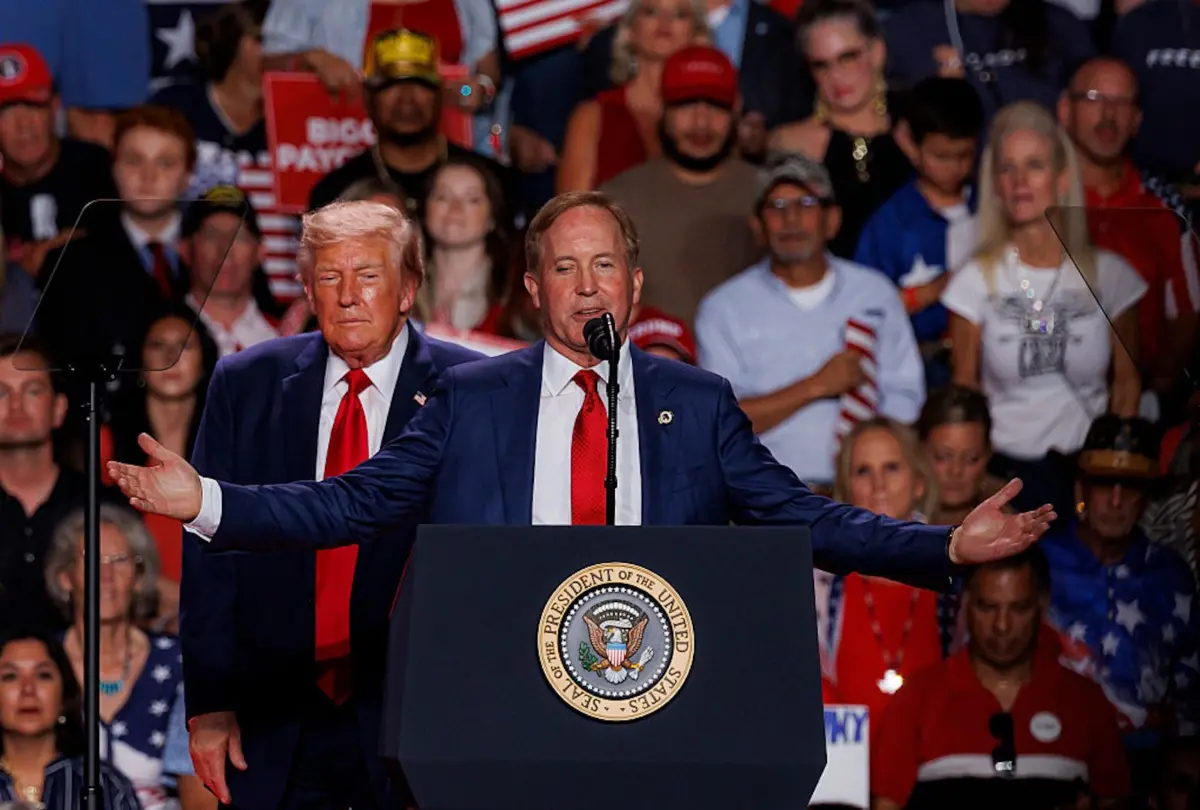
Recognizing a tactical opportunity, Attorney General Ken Paxton weaponized the absence. Rather than treating it as a standard medical leave, Paxton demanded "proof of life" from his opponent, established a specialized tip line to collect information on Talarico’s whereabouts, and led a chant of "Where is James Talarico?" during a campaign rally in San Antonio. Shortly thereafter, former President Donald Trump amplified the attack on Truth Social, dubbing the Democrat "James TalaFREAKo" and declaring him "MISSING IN ACTION."
Phase 2: The Ohio Psychiatric Hoax Goes Viral
As political rhetoric intensified, MAGA influencers filled the information vacuum with increasingly severe insinuations. Former Los Angeles mayoral candidate Spencer Pratt claimed to have unnamed sources placing Talarico in a psychiatric facility.
The rumor achieved its supposed "smoking gun" on a Sunday afternoon. Conservative influencer Nick Sortor—known primarily for filming demonstrations outside Immigration and Customs Enforcement facilities—and self-described provocateur Rhein Amacher claimed that an employee at the Lindner Center of Hope in Mason, Ohio, had confirmed Talarico was a patient who had just been discharged. Sortor released a short audio clip, and platform owner Elon Musk repeatedly amplified the claim to his vast follower base on X (formerly Twitter).
The reach was immediate and astronomical. According to data cited in subsequent analyses, fifty synchronized accounts pushed the claim within a twenty-minute window, accumulating 9.3 million views. One account went so far as to post the exact same text 83 times in under two hours.
Phase 3: Rapid Collapse and Hard Proof
The fabrication unraveled almost as quickly as it spread. Journalists, including reporters at The Bulwark, obtained the full, unedited audio recording of the phone call cited by the influencers. The recording revealed that the hospital employee on the other end of the line repeatedly and explicitly denied that anyone named James Talarico was or had ever been in their patient registry.
Furthermore, the physical timeline made the conspiracy chronologically impossible:
- Saturday Evening: Amacher claimed he made the calls verifying the hospitalization.
- Friday Prior: Talarico had appeared visibly in public at the Austin City Limits Music Festival.
- Saturday Prior: Talarico attended a Kacey Musgraves concert in Texas.
It was a physical impossibility for Talarico to be discharged from an Ohio psychiatric facility on Saturday when time-stamped security footage, photographic evidence, and public sightings proved he was safely in Austin, Texas. By Sunday evening, the Lindner Center of Hope issued an unequivocal public statement confirming that Talarico had never been a patient.
Supporting Context & Metrics: The Mechanics of the "Rage Economy"
The Talarico health hoax cannot be understood as an isolated prank or an accidental internet rumor. It represents a systemic feature of what Talarico has characterized as the "rage economy"—an ecosystem where conspiracy theorists capture clicks, platform owners monetize user engagement, and the public is left manipulated and misinformed.
The Economics of Disinformation
In a healthy information ecosystem, claims grow more credible as verifiable evidence accumulates, and falsehoods are penalized by audience attrition. In the modern right-wing media apparatus, however, the incentive structures are inverted. Claims derive their influence not from factual accuracy, but from sheer velocity and the number of impressions they generate.
[ Traditional Information Model ]
Claim Offered -> Evidence Evaluated -> Accuracy Verified -> Credibility Established

[ The "Rage Economy" Model ]
Claim Manufactured -> High-Velocity Amplification -> Massive Engagement -> Strategic Deflection Achieved
Metrics from the Talarico episode underscore this skewed dynamic:
- First-Wave Saturation: Just 50 coordinated accounts generated over 9.3 million views within minutes of the initial push.
- Algorithmic Supercharging: Amplification by high-profile figures like Elon Musk injected the falsehood directly into mainstream feeds, bypassing traditional editorial gates.
- Immunity to Correction: Even after the hospital issued formal denials and The New York Times published time-stamped security evidence confirming Talarico’s presence in Austin, prominent figures—including media personality Megyn Kelly and White House Deputy Chief of Staff Stephen Miller—continued to demand answers or maintain insinuations.
Concomitant Cultural and Rhetorical Attacks
The mental hospital hoax was merely the most extreme iteration of a broader, coordinated campaign designed to paint Talarico as abnormal, untrustworthy, or unfit for high office. Pro-Paxton super PACs previously deployed advertisements superimposing the candidate’s face onto a cutout in a dress. Throughout the campaign, allied surrogates have openly questioned his masculinity, marital status, and sexuality—culminating in remarks by Vice President JD Vance at a Tyler, Texas rally overtly insinuating Talarico’s sexual orientation. Other attempts to "other" the candidate included bizarre, unfounded claims that he was a strict vegan.
When a political candidate’s substantive policy positions on the economy, healthcare, and infrastructure prove difficult to dismantle through standard debate, the default strategy of the MAGA media machine is to construct an elaborate caricature—replacing the real opponent with a fictional persona designed to elicit visceral disgust or ridicule.
The Disappearing Scandal: Following the Paxton Money Trail
While millions of social media users were consumed by a fake medical emergency in Ohio, a genuine financial scandal involving Attorney General Ken Paxton vanished from the public consciousness.
On the Monday following the peak of the Talarico hoax, The Wall Street Journal published a bombshell investigative report detailing Paxton’s deep financial entanglements with individuals accused of massive financial crimes:
- The Fugitive Donation: Just days after being formally indicted for embezzlement, a fugitive donor contributed $25,000 directly to Paxton’s campaign coffers.
- The Dubai New Year: Paxton rang in 2025 at an exclusive New Year’s Eve party in Dubai. The gathering was attended by two men who had been federally indicted by prosecutors for allegedly looting millions of dollars from an Illinois hospital network.
- The Ahmed Contributions: Records filed with the Texas Ethics Commission revealed that one of those indicted attendees, Anosh Ahmed, funneled $190,000 to Paxton’s political campaigns between 2022 and 2024.
In a normal political cycle, revelations that a sitting state attorney general—and candidate for the U.S. Senate—was accepting vast sums of money from individuals accused of bleeding healthcare institutions dry would dominate news headlines for weeks. It raises fundamental questions of loyalty: does the attorney general serve the people of Texas, or does he answer to individuals facing federal corruption charges?
Instead of sparking a debate over ethics and integrity in public office, the story was successfully buried beneath a manufactured avalanche of digital noise. No formal conspiracy was required to achieve this deflection; the infrastructure of modern right-wing media naturally rewards the generation of dirt and shields its perpetrators from consequences when the allegations are exposed as fraudulent. Paxton himself catalyzed the narrative from the campaign stage, while digital influencers executed the rest.
Official Statements & Responses
The fallout from the twin narratives—the disproven health hoax and the verified financial corruption—has drawn sharp rebukes from legal experts, ethics watchdogs, and political campaigns alike.
- James Talarico’s Campaign: In statements following the collapse of the Ohio rumor, Talarico condemned the episode as a symptom of a broken political culture. Speaking at a CNN town hall, he emphasized: "We have built a system where conspiracy theorists collect clicks, platform owners collect profits, and the public gets angrier without becoming any better equipped to solve the country’s problems."
- The Lindner Center of Hope: In a definitive public statement issued on Sunday evening, hospital administrators firmly pushed back against the viral claims: "At no time has anyone by the name of James Talarico been a patient within our healthcare system. The reports circulating on social media are entirely fabricated."
- Legal and Media Observers: Constitutional and media ethics scholars have noted that the ease with which influencers fabricated hospital records and propagated medical misinformation exposes potential legal liabilities, including defamation and tortious interference. However, as past political flashpoints demonstrate, the absence of immediate legal penalties encourages bad actors to prioritize short-term political distraction over long-term credibility.
Future Outlook: The New Normal of Information Warfare
The Talarico-Paxton Senate race serves as an ominous blueprint for future American elections. It demonstrates that in an era dominated by algorithmic amplification and hyper-partisan media ecosystems, truth is no longer a self-correcting mechanism in real-time political combat.
When campaigns and their media surrogates realize that a lie can travel millions of impressions deep before the truth can put its boots on, the incentive to manufacture outrage permanently displaces substantive policy debate. For Texas voters—and the American electorate at large—the challenge moving forward is not merely discerning what is true, but learning to recognize when a blazing, impossible scandal has been intentionally manufactured to obscure a very real, very quiet abuse of public trust.