

Executive Overview
While high-profile legal battles over White House press credentials—such as those involving CNN, Politico, and MS NOW—regularly command national headlines, a quieter, equally consequential constitutional struggle is unfolding far from Washington, D.C. Across America, state and local journalists are facing an escalating campaign of restricted access, punitive policies, and administrative stonewalling by the very public officials they are charged with holding accountable.
From Utah to Florida, and from Kansas to Iowa, local watchdogs are finding themselves systematically shut out of government spaces, denied press credentials based on their editorial viewpoints, and cut off from essential lines of communication. This localized press access crisis is not merely an occupational hazard for reporters; it represents a direct threat to the public’s First Amendment right to transparent, accountable governance.
Fuelled by intensifying political polarization, the widespread erosion of the traditional local news ecosystem, and the normalization of hostility toward the press, political leaders at the state and municipal levels are increasingly bypassing independent watchdogs altogether. By leveraging administrative hurdles, restrictive media policies, and retaliatory measures, officials are attempting to control their own narratives. The result is a fractured information landscape where public stories take longer to report, cost more to investigate, and, in many cases, are shelved indefinitely—leaving communities in the dark about the inner workings of their local governments.
Detailed Chronology of Access Conflicts
The erosion of local and state press access has accelerated rapidly over the past decade, marked by a series of deliberate policy shifts, legislative actions, and legal confrontations across multiple states.
Utah: The Fight Over Independent Credentials
The battle lines in Utah were drawn at the start of last year when Bryan Schott, a veteran political journalist and founder of Utah Political Watch, sought press credentials for the Utah State Legislature. Having previously covered state politics for The Salt Lake Tribune, Schott found his application summarily rejected by legislative media liaisons Alex Musselman and Aundrea Peterson, who informed him that capitol credentials were not issued to blogs, independent operators, or freelance journalists.
The denial followed a pattern of friction; just days prior to his application, Peterson had sent Schott text messages criticizing a story he published regarding allegations that Senate President J. Stuart Adams had violated campaign disclosure laws. Labeling Schott "someone who claims to be a journalist," legislative staff effectively barred him from capitol media areas, governor’s press conferences, and essential press distribution lists.
In January 2025, Schott filed a federal lawsuit alleging viewpoint-based discrimination in violation of the First Amendment. Over the summer, a panel of federal judges revived his lawsuit, sending it back to a lower court to determine whether the legislature had unconstitutionally targeted him based on his reporting.
Kansas: Restricting the Statehouse Press Corps
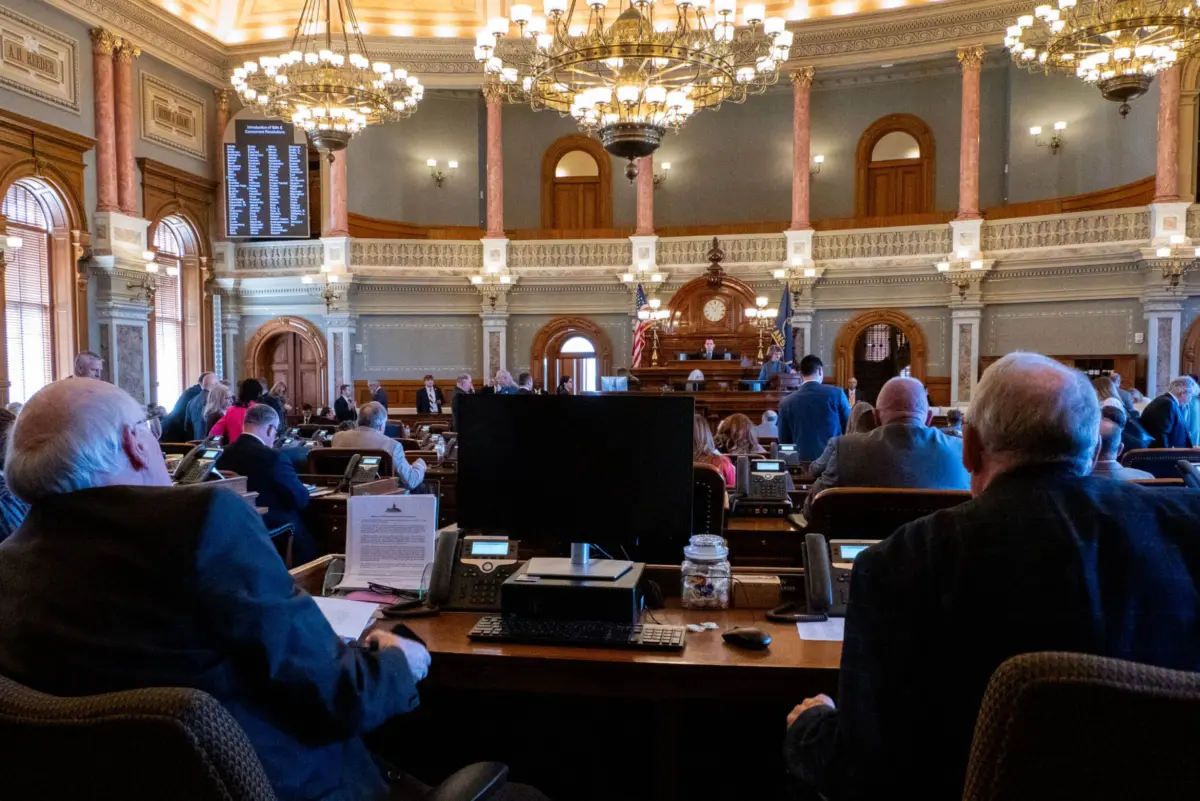
In Kansas, the press access squeeze has been enacted through structural and financial policy changes within the statehouse. When Sherman Smith, editor-in-chief of the nonprofit digital outlet Kansas Reflector, began reporting full-time on the Kansas Statehouse in 2018, legislative committee hearings routinely drew a half-dozen reporters. By 2025, Smith often found himself as the sole journalist in the room.
The environment deteriorated further following the 2024 elections. In January 2025, Kansas House Speaker Dan Hawkins eliminated the House’s designated press area, relegating reporters to a standing-only zone along the back wall where taking notes or approaching lawmakers was prohibited. Shortly thereafter, House Republicans began routinely closing their caucus meetings to the press—a practice that had previously been a rare occurrence.
Compounding these restrictions, state Sen. Virgil Peck proposed aggressive rent increases for outlets holding physical offices in the statehouse, moving from a fixed rate of $100 per year to an initial rate of $1 per square foot per month—a move Peck explicitly linked to his frustration with what he termed inaccurate reporting. Though subsequent proposals to raise rates even higher failed, the financial and physical pressures on statehouse reporters have fundamentally altered the mechanics of legislative oversight in Kansas.
Iowa: Administrative Gatekeeping and Legal Pushback
In Iowa, independent political journalist Laura Belin, editor of Bleeding Heartland, spent five years locked in a bureaucratic struggle to secure press credentials to cover the Iowa House. First denied in 2019 under the rationale that credentials "are not issued to members of the public," Belin systematically jumped through every administrative hoop requested by House Clerk Meghan Nelson, even re-tagging thousands of posts to explicitly delineate news from analysis.
It was not until Belin filed a federal lawsuit against Nelson in January 2024 that she was finally granted credentials for the remainder of the legislative session. While the credentials restored her access to the House press box and floor conversations, Belin continues to face exclusion from select campaign events, restricted access at gubernatorial press briefings under Gov. Kim Reynolds, and ongoing battles over public records. Notably, Belin and other Iowa journalists previously sued Gov. Reynolds in 2021 over open-records violations, ultimately securing a settlement and an admission of delayed compliance by the state.
Miami: Weaponizing Legacy Media Policies
At the municipal level, David Villano, editor of the Coconut Grove Spotlight, has encountered institutional resistance in Miami. Around the time the Spotlight launched in 2024 to provide renewed oversight of Miami City Hall, the city began aggressively enforcing a dormant 2011 media policy requiring prior approval for any city employee speaking to the press.
Confronted with widespread silence, unanswered interview requests, and months-long delays on public records requests, the Miami News Trust (publishing as the Spotlight) filed a federal lawsuit against the city in June 2026. The litigation contends that the restrictive media policy violates both the First Amendment rights of municipal employees and the outlet’s constitutionally protected newsgathering capabilities.
Supporting Context & Metrics: The Decline of the Local Watchdog
The systematic reduction of press access does not occur in a vacuum; it coincides with a profound structural contraction of the American local news industry.
According to a landmark 2026 study by Muck Rack and Rebuild Local News, the number of full-time local journalists in the United States has plummeted by a staggering 75% since 2002. While overall numbers of statehouse reporters have fluctuated—with a Pew Research Center study noting an increase in total bodies since 2014—the number of reporters dedicated full-time to covering state government has steadily dwindled.
This decline has created a destructive feedback loop. As legacy newspapers lay off veteran municipal reporters—such as the recent cuts at the Miami Herald—public officials become less accustomed to rigorous scrutiny. When independent digital outlets and nonprofit newsrooms step up to fill the void, they are frequently met with institutional hostility rather than cooperation.
Political scientists and media watchdogs point to a confluence of factors driving this hostility:
- The Rise of Direct Communications: Social media and digital publishing tools allow politicians to broadcast their messages directly to constituents without the friction of journalistic filtering or critical questioning.
- Intensified Polarization: Political leaders increasingly view independent journalism not as a pillar of democracy, but as a partisan threat, utilizing credentialing and access as tools of political punishment.
- National Trickle-Down Effects: A pervasive anti-media rhetoric cultivated at the national level has trickled down into state capitols and city council chambers, emboldening local officials to bar journalists, restrict physical access, and delegitimize non-traditional reporting entities.
Official Statements and Legal Perspectives
The legal arguments underpinning these access disputes center squarely on the First Amendment and the prohibition of viewpoint-based discrimination by state actors.
Attorneys and journalists involved in ongoing litigation maintain that while government bodies possess broad authority to manage internal spaces, they cannot selectively exclude journalists based on the critical nature of their reporting.
"It is pretty much the same argument that’s happening right now in the CNN versus Trump case on a national level," noted Bryan Schott, drawing a direct parallel between federal press bans and his own exclusion from the Utah Legislature.
For independent publishers, the stakes are existential. David Villano of the Coconut Grove Spotlight emphasized that his outlet’s litigation in Miami seeks foundational protections:
"What we are insisting upon is some sort of proactive language within some policy document that advises and reminds employees of their rights under the Constitution to speak freely on matters of their expertise with the media without prior approval."
Conversely, public officials and legislative leaders who have enacted restrictive measures frequently defend their actions through the lens of order, decorum, and standardizing who qualifies as a legitimate member of the press. In Kansas, proponents of higher statehouse office rents and restricted floor access have argued that legacy arrangements disproportionately favored traditional media, while critics of independent sites frequently attempt to recharacterize investigative journalists as political activists. However, defendants in several of these high-profile lawsuits—including representatives for the Utah Legislature, the Kansas House Speaker, and the City of Miami—have repeatedly declined or failed to respond to media requests for comment regarding their specific access policies.
Future Outlook: The Cost to the Public
As these legal battles wind their way through federal and state courts, the immediate future of local accountability journalism remains precarious.
The financial toll of litigation, combined with the exorbitant costs and persistent delays associated with public records requests, places an immense burden on nonprofit and independent newsrooms. When reporters are forced to spend valuable time and resources fighting simply to enter a legislative chamber, interview a municipal employee, or receive a press release, the ultimate casualty is the citizenry.
Every journalist interviewed regarding these access restrictions echoes a resilient refrain: “They can’t stop me from continuing to report on them.” Through sheer persistence, public records demands, and alternative sourcing, local watchdogs continue to uncover stories that officials would prefer remain hidden.
Yet, the structural barriers erected by local governments fundamentally alter the quality and speed of civic reporting. Stories are delayed, inquiries are stonewalled, and complex policy decisions are executed in the dark. Without decisive judicial intervention reaffirming that government-controlled spaces and information channels cannot be weaponized against critical watchdogs, the American public risks losing the fundamental transparency required to hold its elected leaders accountable.