How are you currently monitoring your movement in the Search Engine Results Pages (SERPs)? Are you still relying on manual spreadsheets diligently updated each morning, or are you operating blind, waiting days or weeks for fragmented data updates?
In the hyper-competitive digital landscape of 2025, neither approach is viable. Modern search engine optimization (SEO) requires managing thousands of keywords, analyzing multi-faceted competitor movements, and tracking dynamic SERP features across global locations, languages, and devices. Modern search environments—dominated by AI Overviews, localized map packs, and continuous algorithmic shifts—demand high-frequency, granular intelligence.
SERP tracking software automates this oversight, empowering digital marketers, agencies, and enterprise brands to monitor targeted keywords, evaluate SERP features, and establish clear correlations between organic visibility and bottom-line revenue. This comprehensive review examines the vital features required in enterprise-grade SERP tracking software, contrasts the leading standalone platforms with all-in-one SEO suites, and delivers an authoritative evaluation of the seven best tools available for 2025.
Detailed Chronology: The Evolution of Rank Tracking
To understand why modern SERP tracking tools have become sophisticated intelligence platforms, it is essential to look at how the technology has evolved over the last decade:
The Spreadsheet Era (Pre-2012): SEO professionals relied heavily on manual browser queries or basic scraper scripts. Data was localized, volatile, and prone to severe inaccuracies due to personal search histories and lack of data centers.
The Rise of Automated Weekly Cron Jobs (2012–2016): Desktop-based software and early cloud platforms introduced automated tracking, but updates were constrained by server limitations, usually restricting data refreshes to weekly intervals.
Daily Cloud-Based Intelligence (2016–2020): Cloud infrastructure allowed platforms to scale. Daily automated rank updates became the industry standard, and tools began incorporating SERP feature tracking (such as featured snippets and knowledge cards) as Google introduced rich results.
Real-Time, Multi-Engine & AI Integration (2020–Present): Today, tracking extends far beyond basic positions. With the introduction of generative search features, AI Overviews, hyper-local zip-code tracking, and on-demand API data refreshes, SERP trackers have transformed into predictive business intelligence systems. Platforms now ingest billions of data points daily to measure true Share of Voice rather than isolated numerical rankings.
Supporting Context & Metrics: Why SERP Tracking is Non-Negotiable
Validating SEO efforts and justifying budget allocations to executive stakeholders requires precise, granular data. A robust SERP tracking solution does far more than show a number going up or down; it offers strategic context across several vital operational pillars:
1. On-Demand Ranking Updates
Traditional tools force users to wait for scheduled batch updates. In fast-moving industries, algorithmic volatility means positions can shift dramatically within hours. On-demand tools allow users to trigger instant data refreshes via API or dashboard clicks, ensuring decision-makers never act on stale information.
2. Multi-Engine & Global Coverage
While Google remains the dominant global search engine, localized and international campaigns often require multi-engine visibility. Tracking performance across Bing, Baidu, Yandex, and YouTube ensures comprehensive optimization coverage for international enterprises.
3. Granular Targeting (Location and Device)
National rankings are no longer enough. Local SEO campaigns require zip-code-level tracking to capture local map packs. Furthermore, desktop and mobile algorithms differ significantly; tracking device-specific positions is critical for capturing mobile-first traffic.
4. Revenue Attribution
The ultimate metric for SEO is not traffic—it is revenue. Advanced trackers integrate with analytics suites (such as Google Analytics or Adobe Analytics) to map ranking movements directly to conversions, bounce rates, and overall business growth.
The 7 Best SERP Tracking Tools for 2025
The market is saturated with options, but only a handful deliver the accuracy, speed, and analytical depth required by modern professionals. Below is our curated shortlist, divided into dedicated standalone trackers and comprehensive all-in-one SEO suites.
1. AccuRanker (Best Standalone SERP Tracker)
Overview
AccuRanker is widely recognized as the premier standalone SERP tracking platform. Trusted by over 32,000 companies—including enterprise giants like HubSpot, IKEA, and Kinsta—it is engineered for speed, accuracy, and deep data analysis.
Best Features
On-Demand Data Refreshes: Automatically updates keyword sets every 24 hours, with manual on-demand refreshes available instantly at the click of a button.
Comprehensive SERP Feature Analysis: Tracks over 50 distinct SERP features (including AI Overviews and featured snippets) within a single unified view.
Advanced Landing Page Reporting: Combines keyword metrics with Google Analytics and Adobe Analytics data to display traffic, bounce rates, and revenue impact per URL.
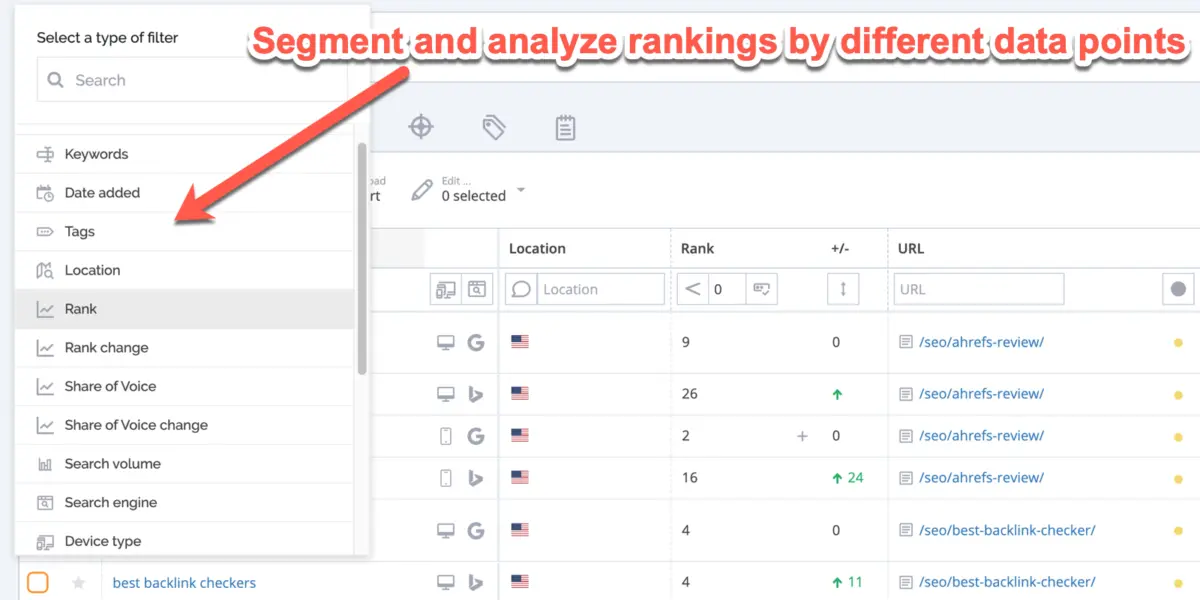
Flexible Tagging and Segmentation: Groups keywords by topic, funnel stage, or device to calculate precise Share of Voice metrics.
Who Is It For?
Agencies, enterprise brands, and SEO professionals who require real-time data accuracy, robust API access, and granular competitor monitoring.
Pricing
Subscription plans scale based on tracked keyword volume, starting at $116/month for up to 1,000 keywords.
2. Semrush Position Tracker and SERP Gap Analyzer
Overview
Semrush is an industry-standard all-in-one SEO platform utilized by over 10 million marketing professionals and major brands like Samsung, Vodafone, and Booking.com. Its Position Tracking Tool rivals the accuracy of any dedicated standalone tracker.
Best Features
Granular Local and Device Tracking: Monitors rankings down to the zip-code/city level, differentiating seamlessly between desktop and mobile results.
SERP Gap Analyzer App: Available via the Semrush App Center, this tool scans SERPs for a seed topic to uncover under-optimized content and competitor weaknesses, drastically reducing manual keyword research time.
Visibility Score: Measures overall organic visibility progress against targeted competitors over customized historical periods.
Who Is It For?
Digital marketing teams, e-commerce brands, and agencies seeking a powerful, all-in-one marketing suite that includes elite rank tracking capabilities.
Pricing
Semrush platform subscription plans start at $139.95/month.
3. ProRankTracker
Overview
ProRankTracker is a cost-effective, highly scalable standalone tracking solution trusted by over 60,000 users worldwide. It specializes in delivering accurate, multi-device ranking data across international markets and localized search engines.
Best Features
Extensive Localization: Tracks rankings across global locations down to exact city and zip-code coordinates.
Comprehensive Video Tracking: Offers robust rank tracking capabilities for YouTube videos, making it ideal for multi-channel video marketers.
Automated Client Reporting: Features flexible, white-label reporting options that can be scheduled for automated delivery.
Who Is It For?
SEM agencies, multi-location businesses, and video marketers looking for high-accuracy tracking at an accessible price point.
Pricing
Plans start at $39/month.
4. Advanced Web Ranking (AWR)
Overview
Advanced Web Ranking (AWR) is a veteran standalone SERP tracker utilized by thousands of in-house marketing teams and enterprise brands, including Microsoft. It is renowned for its enterprise-grade reporting engine and deep historical data access.
Best Features
Unlimited User Access: Most AWR plans allow unlimited team members, making it ideal for large, collaborative agency environments.
Custom White-Label Dashboards: Highly configurable reporting templates that match enterprise brand guidelines.
Cloud and Local Deployment: Offers flexible infrastructure options for enterprise data security requirements.
Who Is It For?
Enterprise brands and large agencies managing massive keyword volumes that require customizable, scalable reporting frameworks.
Pricing
Subscription tiers start at $99/month.
5. SERPWatcher (by Mangools)
Overview
SERPWatcher is the dedicated rank-tracking tool within the Mangools all-in-one SEO ecosystem. Celebrated for its intuitive interface, it is trusted by global brands like Airbnb and Adidas.
Best Features
Performance Index: Calculates a proprietary metric showing overall organic traffic potential based on current keyword positions and search volumes.
Interactive Visualizations: Clean, simplified charts that make tracking ranking changes effortless for non-technical stakeholders.
SERPChecker Integration: Connects directly with Mangool’s analysis suite to evaluate competitor authority metrics directly from the SERP.
Who Is It For?
Small business owners, startups, and freelancers who want simple, highly visual rank tracking without a steep learning curve.
Pricing
Mangools bundles start at $29.90/month.
6. SE Ranking
Overview
SE Ranking is a robust all-in-one SEO platform featuring a highly accurate Position Tracking Tool. The platform simulates user behavior within exact geographical coordinates to guarantee reliable data integrity.
Best Features
100% Accurate Localization: Simulates real user queries down to precise geographical targets to eliminate data skewing.
Comprehensive Competitor Matrix: Side-by-side comparison of keyword visibility, estimated traffic value, and ranking distribution.
Marketing Plan Integration: Built-in task manager and auditing tools to guide execution based on tracked ranking drops.
Who Is It For?
Small-to-medium businesses and digital agencies looking for an affordable, feature-rich all-in-one toolkit.
Pricing
Plans start at $52/month (based on daily updates for 500 keywords).
7. Nightwatch
Overview
Nightwatch is a precision-driven daily SERP tracker trusted by enterprise leaders like Shopify, Scotiabank, and Coinbase. It aggregates ranking data across more than 107,000 global locations.
Best Features
Advanced Data Segmentation: Allows users to segment keywords using custom tags, filtering by intent, funnel stage, or content type.
Site Audit Integration: Combines technical SEO site auditing with high-frequency ranking data.
Clean Reporting Interface: Modern, distraction-free dashboards designed for executive presentation.
Who Is It For?
Freelancers, growing agencies, and large enterprises that require precise global location tracking and clean data segmentation.
Pricing
Paid plans start at $32/month for up to 250 keywords, backed by a 14-day free trial.
Official Statements & Industry Expert Insights
Industry leaders consistently emphasize the importance of pairing raw rank data with actionable reporting and analytics integrations:
"It’s by far the best keyword ranking tracker in the market and has a ton of great reporting functions. If you want visibility on large volumes of keywords housed within a nice dashboard—this is for you."
— Matthew Howells-Barby, Co-Founder, TrafficThinkTank
"The thing that really got me using them heavily in the last month or two is their data connector. Combining the tag feature, as well as the Share of Voice metric, has been a big help in making these reports immediately digestible."
— Ian Howells, Co-Founder, Traffic Think Tank
Future Outlook: The Next Generation of SERP Tracking
As search engines evolve in 2025 and beyond, SERP trackers will continue to adapt to non-traditional result formats. The rise of zero-click searches, AI-generated summaries, and hyper-personalized user results means that traditional position tracking (e.g., holding the absolute #1 spot) is shifting toward Share of Screen (SoS) and Visibility Index metrics.
Future-proof SEO strategies will no longer focus solely on numerical rankings. Instead, marketers will leverage advanced SERP tracking tools equipped with AI gap analysis, multi-engine intelligence, and deep analytics integrations to secure sustainable organic growth and demonstrable ROI. Selecting the right tool today depends entirely on your specific organizational structure, budget, and data granularity requirements—whether you opt for a dedicated powerhouse like AccuRanker or an all-in-one ecosystem like Semrush.


![7 Best SERP Tracking Tools for 2022 [In-Depth Review]](https://www.robbierichards.com/wp-content/uploads/2020/05/Best-SERP-Trackers.jpg)
![7 Best SERP Tracking Tools for 2022 [In-Depth Review]](https://www.robbierichards.com/wp-content/uploads/2020/04/image16-2.png)
![7 Best SERP Tracking Tools for 2022 [In-Depth Review]](https://www.robbierichards.com/wp-content/uploads/2020/04/image2-3.png)
![7 Best SERP Tracking Tools for 2022 [In-Depth Review]](https://www.robbierichards.com/wp-content/uploads/2020/04/image6-2.png)
![7 Best SERP Tracking Tools for 2022 [In-Depth Review]](https://www.robbierichards.com/wp-content/uploads/2020/04/image15.jpg)
![7 Best SERP Tracking Tools for 2022 [In-Depth Review]](https://www.robbierichards.com/wp-content/uploads/2020/04/image12-1.png)
![7 Best SERP Tracking Tools for 2022 [In-Depth Review]](https://www.robbierichards.com/wp-content/uploads/2020/04/image13-2.png)
![7 Best SERP Tracking Tools for 2022 [In-Depth Review]](https://www.robbierichards.com/wp-content/uploads/2020/04/image3.jpg)
![7 Best SERP Tracking Tools for 2022 [In-Depth Review]](https://www.robbierichards.com/wp-content/uploads/2018/08/rj-employee_Robbie-color-new.png)
![7 Best SERP Tracking Tools for 2022 [In-Depth Review]](https://www.robbierichards.com/wp-content/uploads/2020/05/Databox-SEO-dashboard-1.jpg)
![7 Best SERP Tracking Tools for 2022 [In-Depth Review]](https://www.robbierichards.com/wp-content/uploads/2020/04/image4-2.png)
![7 Best SERP Tracking Tools for 2022 [In-Depth Review]](https://www.robbierichards.com/wp-content/uploads/2020/04/image5.jpg)
![7 Best SERP Tracking Tools for 2022 [In-Depth Review]](https://www.robbierichards.com/wp-content/uploads/2020/05/AccuRanker-Google-Data-Studio-integration.jpg)
![7 Best SERP Tracking Tools for 2022 [In-Depth Review]](https://www.robbierichards.com/wp-content/uploads/2018/11/Ian-Howells2.png)
![7 Best SERP Tracking Tools for 2022 [In-Depth Review]](https://www.robbierichards.com/wp-content/uploads/2019/01/Google-Data-Studio-KW-rankings-dashboard.png)
![7 Best SERP Tracking Tools for 2022 [In-Depth Review]](https://www.robbierichards.com/wp-content/uploads/2025/01/AccuRanker-home-page.jpg)
![7 Best SERP Tracking Tools for 2022 [In-Depth Review]](https://www.robbierichards.com/wp-content/uploads/2015/01/matthew-barby.jpg)