In the fast-paced ecosystem of modern search engine optimization (optimization), relying on manual spreadsheets is a relic of the past. As search algorithms grow increasingly sophisticated and dynamic, digital marketers, agency leaders, and enterprise SEOs require real-time, highly granular data to justify budgets and validate campaigns. Search Engine Results Page (SERP) tracking tools have evolved far beyond simple rank checkers; today, they are complex data engines designed to monitor dozens of SERP features, track hyper-local geographic movements, and tie search visibility directly to bottom-line revenue.
With the proliferation of AI-driven search experiences, zero-click queries, and continuous algorithm updates, choosing the right SERP tracker for 2025 is a foundational decision. This review explores the critical criteria required for modern search tracking, evaluates the industry’s top software options—spanning both specialized standalone platforms and comprehensive all-in-one SEO suites—and provides a definitive framework to help organizations select the right tool for their unique operational needs.
Detailed Chronology: The Evolution of Rank Tracking
To understand where SERP tracking stands today, it is helpful to examine how the discipline has matured over the past decade:
The Spreadsheet Era (Pre-2015): SEO practitioners manually typed URLs into search bars or relied on basic scraping scripts that often yielded skewed, data-center-specific results. Tracking was typically performed on a weekly or monthly cadence.
The Rise of Automated Cloud Trackers (2015–2018): Dedicated SaaS solutions emerged, offering daily automated updates. Tools began incorporating multi-location checks and basic search engine expansion beyond Google (such as Bing and Yahoo).
The Multi-Feature & API Era (2019–2022): As Google introduced an array of rich results—Featured Snippets, People Also Ask (PAA) boxes, local packs, and video carousels—trackers evolved to monitor these specific layout elements. Integration with data visualization tools like Google Data Studio (now Looker Studio) became an industry standard.
The AI and Real-Time Data Age (2023–Present): With the integration of generative AI search features and AI Overviews, position tracking has grown exponentially more complex. Modern platforms now offer on-demand data refreshes, deep analytics integrations, and automated content gap analysis to help brands capture shifting search real estate.
Modern SEO is a board-level investment. To defend these budgets, digital marketers must bridge the gap between abstract ranking positions and concrete business metrics. Accurate SERP tracking software enables teams to establish clear causality between optimization efforts and revenue generation.
The 9 Essential Features of Modern SERP Trackers
When evaluating the market, software must be measured against a rigorous checklist of capabilities:
On-Demand Ranking Updates: Rapid algorithm updates demand real-time data access. Leading tools provide daily automated updates coupled with manual, on-demand refresh triggers.
SERP Feature Monitoring: Capturing traditional blue links is no longer enough. Software must track over 50 distinct SERP features—including AI Overviews, knowledge cards, and carousels—to uncover Position #0 opportunities.
Multi-Engine Support: While Google dominates global market share, comprehensive tracking must extend to Bing, Baidu, Yandex, and YouTube, depending on geographic and vertical targets.
Granular Geo-Targeting and Device Segmentation: Visibility varies dramatically by device type (desktop vs. mobile) and geographic coordinate (ranging from country-wide views down to specific postal codes).
Traffic and Revenue Attribution: Integrating rank data with web analytics platforms (such as Google Analytics or Adobe Analytics) maps landing page rankings directly to traffic, bounce rates, and conversions.
Historical Performance Analysis: Point-in-time metrics offer limited utility. Robust tools maintain deep historical archives, allowing teams to visualize trend lines over months or years.
Competitor Intelligence: Segmenting keyword rankings into actionable buckets (e.g., positions 1–3, 4–10, 11–50) highlights where market share is being won or lost against key rivals.
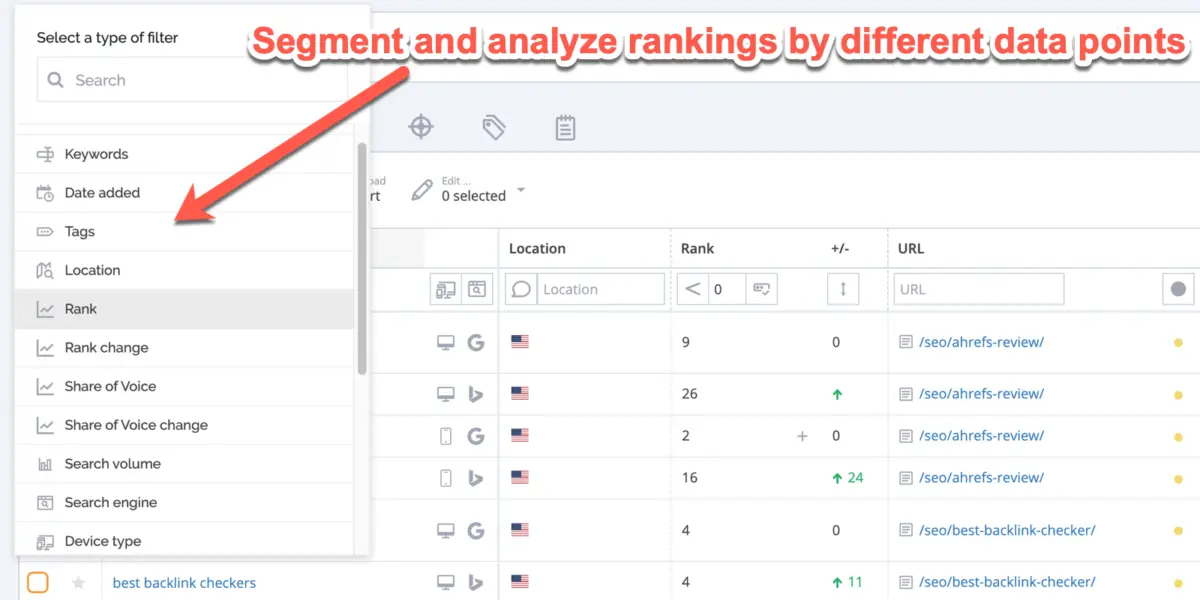
Tagging and Data Segmentation: Organizing large keyword portfolios by user intent, content type, marketing funnel stage, or product category is essential for enterprise-scale management.
White-Label and Advanced Reporting: Native report generation and seamless API connectors (to platforms like Looker Studio and Databox) allow agencies to deliver polished, branded performance updates to clients.
The 7 Best SERP Tracking Tools for 2025
The market features an array of exceptional platforms. Below is an in-depth breakdown of the top standalone trackers and all-in-one SEO suites available today.
1. AccuRanker
Type: Standalone SERP Tracker
Overview: Trusted by over 32,000 companies—including enterprise giants like HubSpot, IKEA, and Kinsta—AccuRanker is widely regarded as one of the fastest and most accurate specialized rank trackers on the market.
Key Strengths: It offers automated 24-hour updates accompanied by an instant, on-demand refresh button. Its sophisticated SERP Analysis tool tracks over 50 features in a single view, while deep integrations with Google Analytics and Looker Studio enable seamless revenue attribution via the Landing Pages report.
Ideal For: Agencies, enterprise brands, and SEO professionals who demand real-time, high-volume keyword tracking and pristine reporting.
Pricing: Starts at $116/month for up to 1,000 keywords.
2. Semrush (Position Tracker & SERP Gap Analyzer)
Type: All-in-One SEO Platform & Tracker
Overview: Serving over 10 million users across brands like Samsung, Vodafone, and Booking.com, Semrush provides an industry-leading Position Tracking Tool backed by robust ecosystem apps.
Key Strengths: Semrush’s daily rank tracking rivals dedicated standalone tools in accuracy. Furthermore, the specialized SERP Gap Analyzer (available via their App Center) scans Google SERPs to identify under-optimized content, integrating directly with Google Search Console to deliver automated, actionable content optimization recommendations.
Ideal For: Digital marketing teams and enterprises seeking a comprehensive, all-in-one marketing suite with elite rank tracking capabilities.
Pricing: Platform subscriptions start at $139.95/month.
3. ProRankTracker
Type: Standalone SERP Tracker
Overview: Supporting over 60,000 customers, ProRankTracker is a scalable, cost-effective solution built specifically for accurate ranking, analysis, and reporting across global markets.
Key Strengths: Excellent international scope, multi-device tracking, and robust reporting infrastructure tailored for agencies and video marketers.
Ideal For: SMBs, international brands, and agencies looking for reliable, budget-friendly tracking across multiple languages and locations.
Pricing: Plans start at $39/month.
4. Advanced Web Ranking (AWR)
Type: Standalone SERP Tracker
Overview: A veteran in the SEO space, AWR is utilized by thousands of in-house teams and enterprise brands (including Microsoft) for secure, highly customized rank monitoring.
Key Strengths: Highly customizable reporting, flexible cloud deployment options, and dependable data accuracy across diverse localized search parameters.
Ideal For: Large enterprises and agency teams requiring strict data governance and tailored white-label reporting outputs.
Pricing: Subscriptions start at $99/month.
5. SERPWatcher (by Mangools)
Type: All-in-One Suite Component
Overview: Developed by Mangools, SERPWatcher is celebrated for its clean, intuitive user interface and accessibility, earning the trust of global brands like Airbnb and Adidas.
Key Strengths: The proprietary Performance Index metric aggregates search volume, current ranking positions, and estimated traffic potential into a single, highly digestible score. Paired with SERPChecker, it offers streamlined competitive insights.
Ideal For: Startups, small business owners, and freelancers who prioritize simplicity without sacrificing core tracking accuracy.
Pricing: Mangools bundles start at $29.90/month.
6. SE Ranking
Type: All-in-One SEO Platform
Overview: SE Ranking has carved out a substantial market share by offering a feature-rich, highly accurate position-tracking module that simulates real user behavior across targeted locales.
Key Strengths: Comprehensive competitor matrix, professional white-label reporting, and flexible pricing structures tailored to exact keyword volumes and update frequencies.
Ideal For: Small-to-midsize agencies and growing businesses seeking an affordable, balanced SEO toolset.
Pricing: Starts at $52/month (based on daily updates for 500 keywords).
7. Nightwatch
Type: Standalone SERP Tracker
Overview: Trusted by enterprise entities such as Shopify, Scotiabank, and Coinbase, Nightwatch delivers ultra-precise daily tracking across more than 107,000 global locations.
Key Strengths: Advanced data segmentation, exceptional location granularity, and clean data visualization designed to handle complex international site architectures.
Ideal For: Freelancers, growing agencies, and large enterprises managing multi-region campaigns.
Pricing: Plans start at $32/month for up to 250 keywords (with a 14-day free trial).
Official Statements & Industry Perspective
Industry leaders consistently emphasize that the choice of tracking software dictates the speed and clarity of strategic decision-making.
Reflecting on reporting workflows, Ian Howells, Co-Founder of Traffic Think Tank, notes:
"The thing that really got me using [AccuRanker] heavily in the last month or two is their Looker Studio connector. Combining the tag feature, as well as the Share of Voice metric… has been a big help in making these reports immediately digestible."
Similarly, Matthew Howells-Barby, Co-Founder of TrafficThinkTank, highlights the value of specialized dashboard interfaces:
"It’s by far the best keyword ranking tracker in the market and has a ton of great reporting functions. If you want visibility on large volumes of keywords housed within a nice dashboard—this is for you."
These endorsements underline a central tenet of modern SEO: data collection is only half the battle; the ability to cleanly communicate insights to stakeholders is what drives ultimate business value.
Future Outlook: What Lies Ahead for SERP Tracking
As we look deeper into 2025 and beyond, the SERP tracking landscape will continue to transform under the weight of artificial intelligence and shifting consumer search habits. Key trends to watch include:
Deeper AI Integration: Traditional ten-blue-link tracking will increasingly take a backseat to monitoring AI-generated summaries and conversational search touchpoints. Trackers will need to quantify brand visibility inside generative answer blocks.
Hyper-Personalization: Search results are becoming hyper-localized and personalized based on user intent history. Advanced trackers will evolve to simulate these granular user personas at scale.
Unified Marketing Dashboards: The boundary between organic search data and paid search, social, and conversion analytics will continue to blur, requiring tracking tools to offer frictionless API connectivity to broader business intelligence stacks.
Choosing the Right Tool for Your Business
Selecting a SERP tracker ultimately depends on your organization’s scale, budget, and operational focus. If your primary objective is lightning-fast, dedicated rank tracking with robust agency reporting, a standalone platform like AccuRanker is an exceptional investment. Conversely, if you require an all-in-one marketing suite that bundles keyword tracking with comprehensive site auditing and content optimization apps, Semrush remains an industry benchmark.
Evaluate your keyword volume, reporting requirements, and geo-targeting needs today to ensure your search visibility strategy remains resilient, accurate, and profitable throughout 2025 and beyond.


![7 Best SERP Tracking Tools for 2022 [In-Depth Review]](https://www.robbierichards.com/wp-content/uploads/2020/05/Best-SERP-Trackers.jpg)
![7 Best SERP Tracking Tools for 2022 [In-Depth Review]](https://www.robbierichards.com/wp-content/uploads/2020/04/image16-2.png)
![7 Best SERP Tracking Tools for 2022 [In-Depth Review]](https://www.robbierichards.com/wp-content/uploads/2020/04/image2-3.png)
![7 Best SERP Tracking Tools for 2022 [In-Depth Review]](https://www.robbierichards.com/wp-content/uploads/2020/04/image6-2.png)
![7 Best SERP Tracking Tools for 2022 [In-Depth Review]](https://www.robbierichards.com/wp-content/uploads/2020/04/image15.jpg)
![7 Best SERP Tracking Tools for 2022 [In-Depth Review]](https://www.robbierichards.com/wp-content/uploads/2020/04/image12-1.png)
![7 Best SERP Tracking Tools for 2022 [In-Depth Review]](https://www.robbierichards.com/wp-content/uploads/2020/04/image13-2.png)
![7 Best SERP Tracking Tools for 2022 [In-Depth Review]](https://www.robbierichards.com/wp-content/uploads/2020/04/image3.jpg)
![7 Best SERP Tracking Tools for 2022 [In-Depth Review]](https://www.robbierichards.com/wp-content/uploads/2018/08/rj-employee_Robbie-color-new.png)
![7 Best SERP Tracking Tools for 2022 [In-Depth Review]](https://www.robbierichards.com/wp-content/uploads/2020/05/Databox-SEO-dashboard-1.jpg)
![7 Best SERP Tracking Tools for 2022 [In-Depth Review]](https://www.robbierichards.com/wp-content/uploads/2020/04/image4-2.png)
![7 Best SERP Tracking Tools for 2022 [In-Depth Review]](https://www.robbierichards.com/wp-content/uploads/2020/04/image5.jpg)
![7 Best SERP Tracking Tools for 2022 [In-Depth Review]](https://www.robbierichards.com/wp-content/uploads/2020/05/AccuRanker-Google-Data-Studio-integration.jpg)
![7 Best SERP Tracking Tools for 2022 [In-Depth Review]](https://www.robbierichards.com/wp-content/uploads/2018/11/Ian-Howells2.png)