

Executive Overview
In the realm of digital product development, an old programming adage often rings true: "There are only two hard things in Computer Science: cache invalidation and naming things." Yet, this challenge extends far beyond the domains of software engineering; it pervades user experience (UX) design, visual systems, product strategy, and design token management. The language we choose does not merely label digital artifacts—it actively shapes our mental models, governs interdisciplinary conversations, and directly influences user adoption.
When teams struggle with ambiguous terminology, the friction manifests as misaligned design tokens, convoluted HTML classes, inconsistent Figma layers, and low feature adoption. Too often, names are either too generic, rendering them opaque and meaningless, or too specific, stripping away the flexibility required for scalable digital systems.
This comprehensive investigation explores the anatomy of effective nomenclature. By drawing upon industry-leading practices, community-driven resources, and real-world case studies from tech powerhouses like Intuit and Vodafone, this guide provides a practical roadmap for eliminating semantic ambiguity across design and code.

Detailed Chronology: The Evolution of Digital Taxonomy
The maturation of design systems over the past decade has fundamentally transformed how digital artifacts are named and organized. Understanding this evolution helps teams navigate current practices and avoid legacy pitfalls.
Phase 1: The Wild West of Custom Styling (Early Web Era)
In the early days of web development, naming conventions were largely ad-hoc. Developers relied on idiosyncratic abbreviations (#main-col, .txt-red, btn1) that carried meaning for a single creator but proved indecipherable to incoming team members. Design files in Photoshop or early Sketch lacked unified token structures, treating colors and typography as static, unlinked properties.
Phase 2: The Methodology Boom (BEM, SMACSS, and Atomic Design)
As codebases grew, the industry recognized an urgent need for structure. The introduction of methodologies like BEM (Block, Element, Modifier) brought semantic predictability to CSS classes. Simultaneously, Brad Frost’s Atomic Design revolutionized UI composition by categorizing components hierarchically into atoms, molecules, organisms, templates, and pages. This period established the foundational vocabulary that design systems rely on today.

Phase 3: The Design Token Revolution and Multi-Brand Scalability
As enterprise applications expanded to support multiple brands, dark modes, and cross-platform ecosystems (web, iOS, Android), simple class naming was no longer enough. The concept of design tokens emerged to store design decisions persistently. However, this introduced a new naming hurdle: creating taxonomies flexible enough to span thousands of variables without collapsing under their own weight. Today, modern product teams treat naming not as an afterthought, but as an architectural discipline requiring rigorous governance, multi-tiered taxonomies, and cross-functional alignment.
Supporting Context & Metrics: Unifying the Lexicons
Miscommunication in product development often stems from what can be described as dialect fragmentation. Designers speak the dialect of visual aesthetics and layout relationships; developers speak the dialect of logic, encapsulation, and DOM structures; product managers speak the dialect of business value and user journeys; and end-users speak the dialect of everyday utility.
When these groups use different terms for the exact same interface element, cognitive friction skyrockets. Statistics consistently show that features suffer from low adoption not because they lack utility, but because of poor discoverability tied to counter-intuitive nomenclature. If a user cannot immediately understand what a feature does based on its title, trial drops to near zero.

To bridge these gaps, the industry has produced a wealth of open-source inventories, repositories, and frameworks designed to standardize vocabulary.
1. Breaking Out of Code Boxes: Inspiration for HTML and CSS
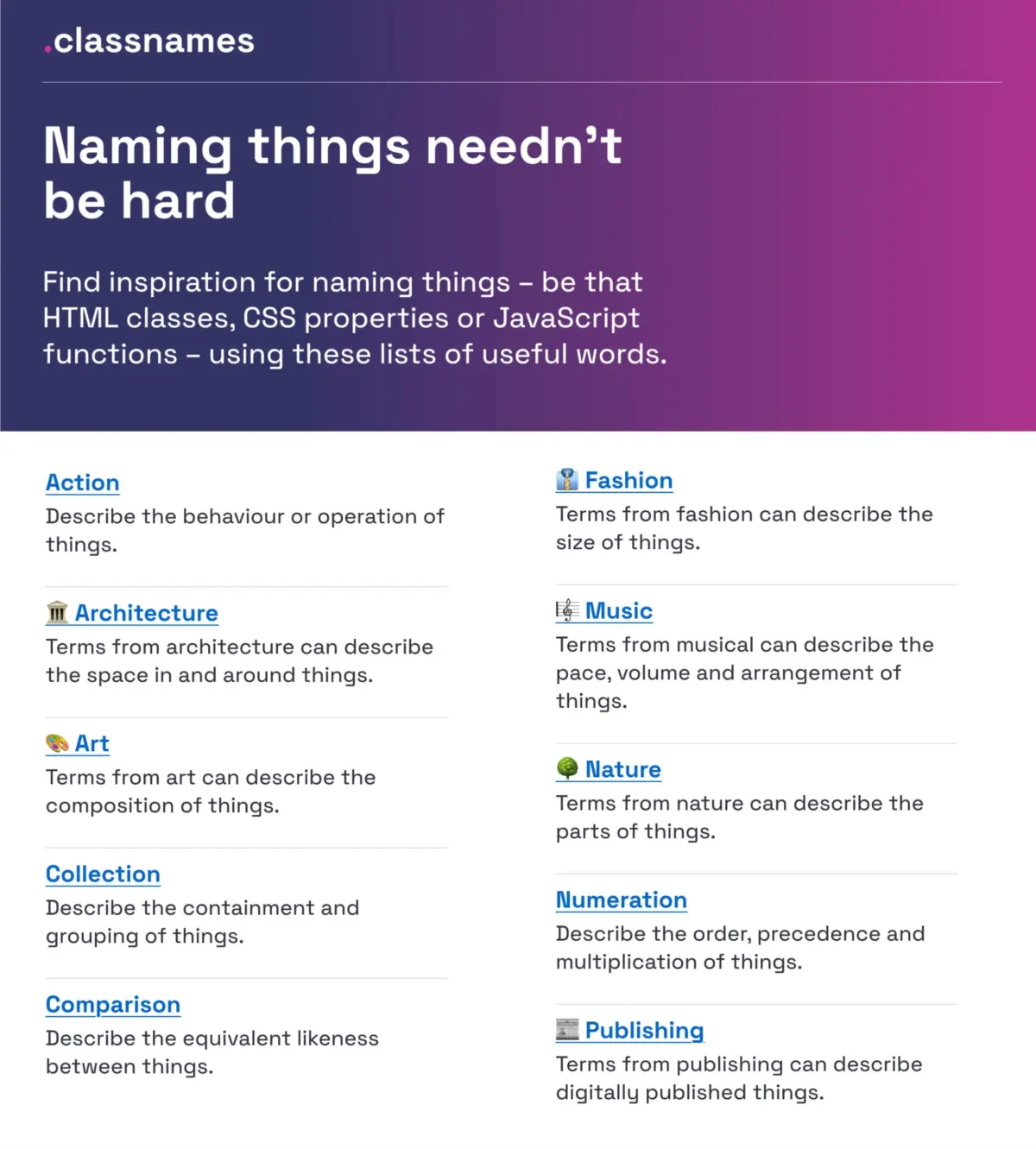
When searching for expressive HTML classes, CSS properties, or JavaScript functions, developers often fall back on repetitive terms like container, wrapper, or box. Paul Robert Lloyd’s Classnames resource serves as an antidote to this creative fatigue. The platform provides thematically grouped lists of words categorized by behavior, likeness, order, grouping, and association. It introduces thematic collections drawn from nature, art, theater, music, architecture, fashion, and publishing—encouraging developers to think laterally while maintaining code readability.
2. Taming the Rainbow: Color Taxonomies
Naming colors has historically relied on hexadecimal codes or overly literal descriptions (dark-blue-v2). To solve this, David Aerne maintains an expansive repository of color names (Color Names), housing over 30,355 unique color designations sourced from community contributions and varied references. Accompanied by interactive color pickers like Color Parrot, these tools offer practical alternatives for design token architects who need semantic color names that remain meaningful outside of raw visual hex values.

3. Layer and Group Discipline in Design Files
In scalable design systems, messy Figma files are liabilities. Javier Cuello’s comprehensive guide on naming best practices outlines how to structure layers, groups, and components consistently. According to Cuello, an effective name must possess a logical structure, remain concise, carry clear semantic meaning, be universally understood by the team, and—crucially—avoid reference to transient visual properties (such as avoiding .blue-box in favor of .status-container).
4. Real-World Taxonomies: The Intuit Case Study
Building a flexible design token taxonomy that operates seamlessly across disparate financial and productivity products—such as QuickBooks, Mailchimp, TurboTax, and Mint—presents a monumental naming challenge. Nate Baldwin documented Intuit’s journey in creating a unified token system. By diagnosing the pain points of their legacy taxonomy, Intuit established a rigorous set of criteria that allowed design tokens to transcend individual brand themes, establishing a resilient foundational architecture for their entire software suite.
5. Leveraging Design System Inventories
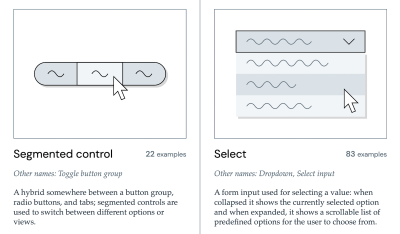
When struggling to name a standard UI component, reinventing the wheel is counterproductive. Iain Bean’s Component Gallery bridges this gap by aggregating real-world examples and variant names for over 50 interface components—ranging from accordions to visually hidden utility classes. For an even more rapid visual reference, tools like Name That UI function as visual dictionaries for common interface elements.

6. Designing Features for Discoverability
Erin Gannon’s practical guide, "What Do We Call This Thing?", addresses feature adoption hurdles head-on. Gannon emphasizes that optimal feature names must be rooted in user needs and problem spaces. They should signal the ultimate value or outcome (the "job-to-be-done") by tapping directly into the user’s everyday vernacular rather than internal corporate jargon.
7. Multi-Brand Mastery: Vodafone UK’s Variables Taxonomy Map
Addressing complex multi-brand environments, the Vodafone UK Design System team released their Variables Taxonomy Map on Figma. Built upon Nathan Curtis’s foundational work on token architecture, this map delineates four distinct collections—bridging brand primitives, semantics, and page-level variables. It ensures that any team member can instantly trace where a token is utilized and what it represents simply by reading its identifier. Similarly, Romina Kavcic’s Design Token Naming Guide + Builder and accompanying spreadsheet inventory provide interactive frameworks for structuring components, categories, states, and roles without losing track of system scale.
8. Product and Service Naming Repositories
For macro-level naming—such as branding products or services—resources like Onym provide open-source repositories of brainstorming tools, vetting methodologies, etymological insights, and strategic guides to steer teams away from common naming pitfalls.
Official Statements & Industry Insights
Industry leaders consistently emphasize that naming is an exercise in empathy and communication governance.
"The language we use shapes the way we think about things, but also the conversation we have about it. That’s why we have so much confusion about colors, icons, UI components, features — and that’s why we struggle to name design tokens, HTML classes, and variables."
— Design System Community Consensus
Furthermore, systems architects point out that clear nomenclature directly reduces technical and design debt. When a design token’s name accurately reflects its semantic role rather than its hard-coded value (e.g., using --color-surface-brand-primary instead of --blue-500), future maintenance and theme-switching become frictionless operations.

Future Outlook: The Next Frontier of Semantic Architecture
As artificial intelligence, automated code generation, and multi-platform design tokens converge, the importance of pristine nomenclature will only accelerate. AI-driven design assistants and code generation models rely heavily on semantic clarity to correctly interpret prompts, assemble UI layouts, and bind variables.
In the near future, we can anticipate several key shifts in how organizations approach naming:
- Automated Governance Linters: Design systems will increasingly feature automated linters within Figma and code repositories that flag non-compliant token names, ambiguous class selectors, and untracked layer labels in real-time.
- Dynamic Semantic Mapping: Tools will evolve to automatically translate between the "dialects" of product management, design, and engineering, maintaining live glossaries that eliminate cross-departmental translation friction.
- Intent-Driven Tokenization: Token architecture will shift further away from physical properties toward intent-driven primitives, allowing interfaces to adapt dynamically to contextual user needs, accessibility requirements, and environmental variables seamlessly.
Wrapping Up
Ultimately, the correct name for any digital artifact is simply the one that is universally understood, agreed upon, and actively utilized by both the multidisciplinary product team and the end-user. Countless hours are wasted daily when designers, developers, product managers, and users speak about the exact same interface element in divergent dialects.

By auditing existing vocabularies, adopting established community taxonomies, establishing robust design token hierarchies, and proactively addressing naming conflicts, product teams can drastically reduce frustration and foster a frictionless, highly collaborative engineering and design environment.