

Published: October 18, 2026
Location: Washington, D.C. / Nationwide
Executive Overview
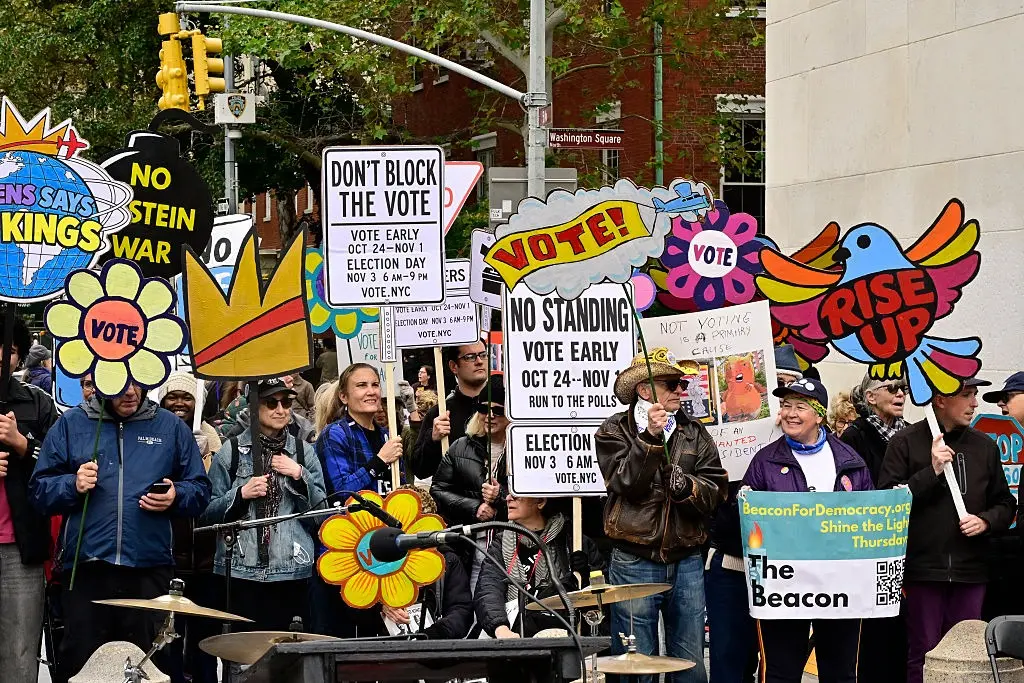
The nationwide "No Kings" movement, which emerged as a formidable wave of street protests following Donald Trump’s return to the White House, executed a strategic pivot on Saturday, October 18, 2026. Rather than gathering merely to voice dissent in public squares, demonstrators shifted their focus toward the ballot box, organizing coordinated rallies across the United States to drive early voter turnout ahead of the high-stakes November 3 midterm elections.
Billed officially by organizers as a nonpartisan mobilization dedicated to expanding voter participation and safeguarding election integrity, the Saturday demonstrations drew hundreds of thousands of participants to major metropolitan hubs, including Washington, D.C., New York, Los Angeles, and Atlanta. However, the movement’s strict adherence to nonpartisan messaging faced immediate friction on the ground. Across multiple locations, grassroots participants openly defied directives from national organizers, explicitly calling for Democratic victories and framing the midterms as a direct referendum to strip power from President Trump and the Republican congressional majority.
This tactical evolution arrives against a backdrop of intense legal and political friction surrounding voting access. Just days prior to the rallies, the Trump administration launched a high-profile federal lawsuit against California election officials regarding mail-in ballots, escalating tensions over election administration nationwide. As the countdown to November 3 enters its final stretch, the "No Kings" phenomenon stands as a test case of whether decentralized street activism can successfully translate into coordinated electoral mobilization.
Detailed Chronology: From Street Marches to Early Voting Drives
The trajectory of the "No Kings" movement has served as a primary barometer of progressive and anti-administration sentiment since Donald Trump commenced his second term. Initially defined by sweeping, high-visibility marches that paralyzed traffic and dominated national news cycles, the coalition recognized that sustained political impact required channeling momentum into concrete electoral action.
The Saturday Mobilizations
On Saturday, October 18, 2026, the movement manifested in a decentralized wave of early-voting rallies.
- Washington, D.C.: Demonstrators converged on the National Mall near the Lincoln Memorial, hoisting prominent placards bearing imperatives such as "VOTE EARLY" and "HANDS OFF MY VOTE!" Speakers emphasized that public demonstrations must be matched by administrative action at polling stations.
- New York City & Los Angeles: Massive crowds turned out in Manhattan and Southern California, transforming what historically would have been traditional protest venues into voter-registration and early-voting staging grounds. Volunteers circulated clipboards, handed out sample ballots, and provided logistics for drop-off locations.
- Atlanta: In the heart of Georgia, a crucial battleground state, local leaders addressed energized crowds. Atlanta City Councilman Michael Julian Bond delivered a stirring address emphasizing the irreplaceable leverage of the electorate. Invoking pop-culture icons of resilience, Bond told the gathered throng, "You don’t see Superman giving up his power. You don’t see Black Panther giving up his power."
The Tension Between Official Stance and Grassroots Intent
Despite the concerted efforts of national leadership to maintain a strict nonpartisan posture—emphasizing democratic participation writ large rather than specific party victories—activists on the ground frequently discarded official talking points in favor of explicit partisan alignment.
In Alexandria, Virginia, interviews conducted by reporters with participants revealed a stark divergence from organizational guidelines. When reminded of the coalition’s nonpartisan rules, several protesters brushed them aside, arguing that the gravity of the political moment necessitated blunt partisanship. "We got to take the power away from Trump, from the Republicans," one demonstrator asserted candidly.
This dynamic underscores a perennial friction point within broad-based social movements: the challenge of containing decentralized, highly motivated grassroots participants within the guardrails established by central coordinators.
Supporting Context & Metrics: The Legal and Political Landscape
Saturday’s rallies did not occur in a vacuum; they unfolded amid a rapidly escalating national battle over the mechanics of voting, administrative oversight, and ballot security.
The Department of Justice and California Litigations
The political atmosphere intensified sharply on Thursday, October 15—just 48 hours before the nationwide rallies—when the Trump administration’s Justice Department filed a federal lawsuit against California election officials. The legal challenge targets mail-in voting protocols, specifically focusing on ballots originating from individuals whom federal authorities have flagged as potential noncitizens.
Following the filing of the lawsuit, the DOJ issued sweeping warnings to local election officials nationwide, signaling potential criminal investigations into jurisdictions that fail to adequately scrub voter rolls of disputed registrations. Civil rights organizations and state attorneys general immediately condemned the move as an act of voter intimidation designed to suppress turnout in progressive strongholds ahead of the midterms.
The Stakes of the 2026 Midterms
The November 3 midterm elections represent a critical structural turning point for the remainder of Trump’s presidential term. Control of both the House of Representatives and the Senate hangs in the balance, determining whether the executive branch faces a legislative check or an unobstructed path for its policy agenda.
Political analysts note that early voting numbers are historically predictive of overall turnout trends. By leveraging the emotional momentum of the "No Kings" movement to drive early voting, organizers hope to bank vital votes before potential administrative bottlenecks, weather disruptions, or last-minute legal challenges can disrupt polling on Election Day itself.
Official Statements and Institutional Responses
Navigating the delicate line between civic engagement and partisan advocacy has required careful public relations management from the leadership of the "No Kings" coalition.
The Movement’s Defense
Addressing the divergence between official policy and grassroots behavior, "No Kings" national spokesperson Eunic Epstein-Ortiz issued statements defending the coalition’s structural integrity. Epstein-Ortiz reiterated that the movement is fundamentally a peaceful, nonpartisan coalition dedicated to democratic engagement, voter protection, and constitutional accountability.
Legal experts consulted regarding the protests noted that individual citizens exercising their right to free speech by advocating for specific candidates does not legally implicate national organizers or jeopardize the tax-exempt or coalition status of the organizing entities, provided institutional structures maintain formal neutrality.
Counter-Perspectives from the Right
Conservative commentators and Republican strategists have viewed the "No Kings" transition with skepticism, arguing that the movement’s nonpartisan branding is a transparent rhetorical veneer masking a traditional Democratic get-out-the-vote (GOTV) apparatus. Critics point to instances like the demonstrations in Alexandria, Virginia, as proof that the initiative is functionally an arm of the progressive resistance, designed to energize the Democratic base under the guise of civic neutrality.
Furthermore, administration allies defended the DOJ’s recent legal actions in California, framing the oversight of voter rolls not as voter suppression, but as a necessary and vital intervention to preserve the integrity of the franchise against systemic vulnerabilities.
Future Outlook: The Road to November 3 and Beyond
As the calendar ticks down to Election Day on November 3, 2026, the success of the "No Kings" pivot will ultimately be measured in quantitative outcomes: turnout percentages, early voting volume in key suburban and urban precincts, and the final legislative balance of power in Washington.
Key Variables to Watch
- Voter Turnout Metrics: Whether the energy visible in city plazas and near monuments translates into record-shattering early ballot returns across swing districts in states like Georgia, Arizona, Pennsylvania, and Wisconsin.
- Legal Challenges: How federal courts handle the fast-tracked lawsuits regarding voter rolls and mail-in ballot verification, and whether injunctions or rulings disrupt voting operations in the final days of the campaign.
- Movement Cohesion: Whether national organizers can maintain discipline over messaging, or if the grassroots tendency toward overt partisan declarations will alienate moderate voters who might otherwise support nonpartisan election integrity initiatives.
The "No Kings" movement has successfully transitioned from a transient expression of public outrage into an organized electoral force. Whether this pivot will redraw the political map of the United States or simply intensify the polarization already defining the era will be answered decisively at the ballot box in the coming weeks.