

Executive Overview
The landscape of journalism—both within the corridors of Washington power and across volatile international frontlines—faces an escalating crisis of access, institutional hostility, and ethical turbulence. Recent weeks have illuminated a profound deterioration in the traditional compact between the press, the government, and the public. In Washington, the Trump administration’s systematic dismantling of traditional press pool arrangements continues to upend decades-old protocols, sidelining major news networks in favor of partisan alternatives like Real America’s Voice. This institutional friction coincides with administrative instability, most visibly underscored by the historically brief, five-day tenure of White House Press Secretary Katie Zacharia.
Simultaneously, the perils confronting reporters in the field have reached alarming levels. The violent, coordinated assault on Washington Post photojournalist Heidi Levine by masked Israeli settlers in the West Bank highlights the physical dangers borne by media workers documenting conflict zones and localized human rights abuses. Domestically, lapses in institutional editorial standards—such as CBS News correspondent Jan Crawford’s public praise of a heckler confronting a political candidate—have injected fresh urgency into debates over journalistic neutrality and social media conduct.
Beneath these high-profile conflicts lies a broader, systemic erosion of transparency. As local news ecosystems shrink due to economic pressures, state and local officials are increasingly emboldened to stonewall records requests and restrict access, mirroring the adversarial tactics deployed at the highest levels of the federal government. This comprehensive report examines the intersecting crises threatening contemporary journalism, analyzing the structural shifts in press access, the administrative volatility of the current political cycle, the physical risks to reporters abroad, and the internal ethical struggles confronting legacy media organizations.
Detailed Chronology
The unfolding tensions between the executive branch, international actors, and the media are defined by a rapid sequence of events that have redefined the boundaries of press freedom and institutional accountability.
- September 18: President Donald Trump enacts a directive banning major media outlets—specifically CNN, Politico, and MS NOW—from participating in standard White House pool rotations and access privileges.
- September 24: Right-wing digital network Real America’s Voice announces the launch of
RAVpool.org, offering its newly acquired secondary White House pool footage and notes free of charge to all media outlets and the public. - Late September: Major television networks resume standard pool coverage rotations but collectively refuse to occupy the primary pool slots vacated by CNN on days the network is systematically excluded.
- Early October: Real America’s Voice assumes the secondary TV pool slot for the third time following CNN’s exclusion, stepping in as legacy networks decline to fill the void. Concurrently, Scripps News issues internal guidance stating it will utilize secondary slots only if they do not supplant the primary TV pool.
- October 13: Katie Zacharia delivers her first and only official press briefing as White House Press Secretary on the South Lawn of the White House.
- Friday, October 16: Zacharia’s five-day tenure as press secretary officially ends following a turbulent public debut, persistent scrutiny over credential discrepancies, and controversial late-night media appearances.
- October 16 (West Bank): Washington Post photojournalist Heidi Levine is severely beaten by a group of masked Israeli settlers while documenting the olive harvest in the West Bank, sustaining multiple fractures and traumatic injuries despite wearing prominent "PRESS" insignia.
- October 17–19: Discrepancies emerge regarding the origin of Zacharia’s damaging Fox News interviews. Leaked text messages reported by The New York Post indicate Zacharia pushed for the appearances herself, contradicting initial reports that cast the interviews as a "sanctioned hit" engineered by White House Chief of Staff Susie Wiles.
- Sunday, October 18: CBS News chief legal correspondent Jan Crawford issues a public apology on social media and deletes a post praising a town hall participant who aggressively confronted Democratic U.S. Senate nominee Abdul El-Sayed, acknowledging a violation of network editorial standards.
Supporting Context & Metrics
The Structuring and Restructuring of the White House Press Pool
The traditional framework of the White House press pool—designed to ensure that a representative cohort of journalists can document executive actions and share text, audio, and visual materials with the broader press corps—has undergone radical revision. Historically managed by the independent White House Correspondents’ Association (WHCA), the pool rotation system was restructured when the White House assumed direct control of pool administration.
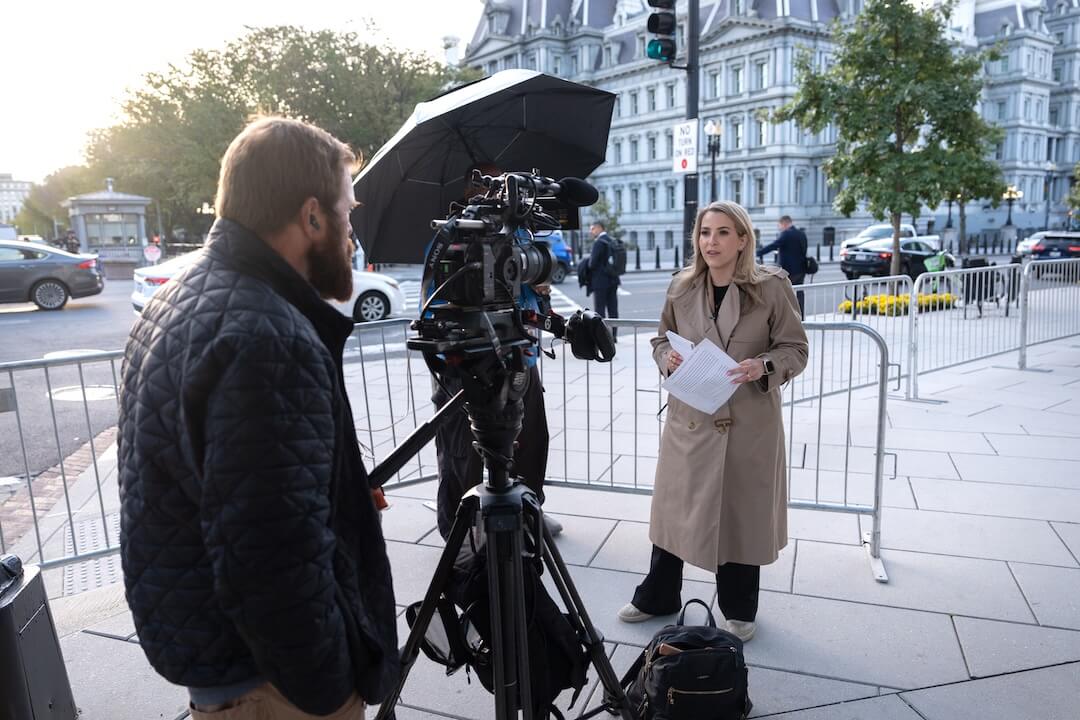
The introduction of the "secondary TV slot" by the administration has served as a mechanism to integrate non-traditional, often highly partisan media outlets into the rotation. While a May 2025 analysis by Poynter noted that the secondary slot has occasionally been allocated to mainstream operations, its primary beneficiaries have been conservative platforms.
[Traditional WHCA Pool Management]
       │
       ▼ (White House Assumes Control)
[Primary Slot Access Restrictions]
       │
       ├── CNN, Politico, MS NOW Excluded
       ├── Major Networks (ABC, CBS, FOX, NBC) Refuse Replacement Slots
       ▼
[Secondary Slot Activation]
       └── Real America's Voice / Alternative Outlets Fill Void
This restructuring mirrors earlier administrative responses to legal challenges. When a federal judge ordered the White House to restore access to The Associated Press after the outlet was barred over a naming dispute regarding the "Gulf of America," the administration eliminated dedicated wire-service slots altogether. By establishing a secondary print slot and forcing the AP into a broader rotation with dozens of lesser-known outlets, the executive branch effectively diluted the structural privileges traditionally afforded to foundational wire services.
Escalating Local Government Stonewalling
The hostility toward institutional press corps at the federal level is increasingly mirrored at state and local jurisdictions. Following the establishment of federal efficiency initiatives, the Kansas Senate created its own Committee on Government Efficiency (COGE). When journalists at the Kansas Reflector filed public records requests under state laws mandating a three-day turnaround for transparency, COGE withheld submissions until media outlets published stories derived from leaked documentation.
Media analysts note that as local newsrooms continue to contract—depriving communities of dedicated watchdogs—public officials face fewer systemic checks against stonewalling, delayed record releases, and targeted blackouts of critical reporting.
Official Statements
The widening chasm between the executive administration, institutional journalism, and advocacy organizations has yielded sharp rhetorical exchanges across the political and media spectrum:
- White House Official: Defending the exclusion of mainstream networks from presidential travel and press briefings, an administration spokesperson remarked:
"The Fake News has no place demanding a spot in the President’s Oval Office. The lies they smear are a disservice to the American public and tear at the very fabric of our Democracy. They’re completely capable of reporting from directly outside."
- Matt Murray, Executive Editor, The Washington Post: Responding to the brutal assault on photojournalist Heidi Levine in the West Bank, Murray demanded accountability:
"This morning, a Washington Post photographer, Heidi Levine, was attacked by Israeli settlers while reporting in the West Bank. She was wearing visible markings clearly identifying her as a journalist. While we are relieved that Heidi has received medical care and is safe, we are outraged by this unwarranted attack on a journalist doing her job and urge a thorough investigation and follow-through from authorities."
- Sara Qudah, Regional Director, Committee to Protect Journalists (CPJ): Addressing the systematic targeting of media workers covering seasonal agricultural events in the occupied territories, Qudah stated:
"The brutal beating of Levine is neither isolated nor the first on a journalist covering the olive harvest in the West Bank… [It represents] a disturbing pattern of violence and harassment against journalists."
- Jan Crawford, Chief Legal Correspondent, CBS News: Issuing an apology for social media commentary targeting a political candidate’s town hall exchange, Crawford noted:
"I deleted that tweet because it was a violation of CBS News standards. I apologize."
Future Outlook
The convergence of administrative press restrictions, physical threats to frontline reporters, and internal ethical missteps signals a transitional and turbulent era for the global media industry.
- Litigation and Judicial Intervention: The ongoing federal lawsuits filed by CNN, Politico, MS NOW, and The Associated Press will serve as vital legal battlegrounds. The rulings handed down by federal courts are expected to establish crucial modern precedents regarding the constitutional limits of executive authority over press credentials and pool access.
- Polarization of Press Infrastructure: As alternative and partisan networks like Real America’s Voice institutionalize parallel reporting pipelines—offering free pool feeds to circumvent mainstream resistance—the concept of a unified, universally accepted journalistic record is fracturing. This trend threatens to harden partisan echo chambers, wherein different political factions consume entirely distinct visual accounts of executive governance.
- Physical Safety Imperatives: The severe injuries sustained by Heidi Levine emphasize the urgent need for enhanced security protocols, risk mitigation strategies, and diplomatic pressures to protect media workers operating in increasingly hostile international environments, where the "PRESS" insignia no longer guarantees baseline protection.
- Internal Standards and Credibility: For legacy broadcast and print institutions, recent missteps—typified by high-profile social media infractions and administrative churn—demonstrate that maintaining public trust requires rigorous enforcement of editorial guidelines. As newsrooms grapple with external political pressures, their internal commitment to neutrality and accountability will remain the primary determinant of their institutional legitimacy.