

Executive Overview
In the fast-evolving landscape of artisanal pomology, few voices command as much idiosyncratic authority as the anonymous or pseudonymous arbiters of heritage fruit. Following the widespread critical and commercial interest generated by the initial installment of the 2026 apple tasting trials, the culinary research community has turned its collective gaze toward the second wave of specimens. This latest batch—cataloged extensively by field reviewers—presents an eclectic cross-section of heirloom varieties, cider mainstays, dense utility fruits, and wild anomalies.
The scope of this investigation encompasses six distinct cultivars: the spice-laden Kickapoo Spice, the sharp-breaking and contentious St Edmunds Pippin, the psychotronic and historically murky Sops of Wine, the catastrophic Fenceline Surprise, the steampunk-adjacent Americus Crab, the revolutionary-era Campfield (False?), and the jaw-shattering, gum-flavored enigma known simply as Graham.
Through rigorous sensory analysis, historical cross-referencing, and uncompromising critical scoring, this report evaluates whether these selections represent the pinnacle of autumnal agriculture or cautionary tales of pomological neglect. As regional curators prepare for upcoming agrarian expeditions across New York, New England, and the Canadian borderlands, the findings compiled herein offer a definitive baseline for apple enthusiasts, orchardists, and snack-oriented stakeholders alike.
Detailed Chronology of the Harvest Trials
The evaluation period commenced under optimal early-autumn atmospheric conditions, utilizing specimens sourced directly from regional purveyors and specialized heritage orchards. Each fruit underwent a standardized protocol consisting of visual inspection, tactile density assessment, acoustic crack/pop analysis during initial mastication, secondary flavor profile mapping, and residual aftertaste tracking.

1. Kickapoo Spice: The Dense Anomaly
- Score: 6.9 / 10
- Profile: High spice concentration (nutmeg, cinnamon, clove), zero notable juiciness, pervasive cut-grass aftertaste.
The trials opened with the Kickapoo Spice, a cultivar whose very nomenclature evokes classic rock iconography and dense, impenetrable arboreal architecture. Described by panel observers as a "dense boy" and a "weird friend," this specimen immediately established itself as a high-spice outlier.
Laboratory-style sensory mapping revealed an exceptionally heavy concentration of warm baking spices—predominantly nutmeg, backed by tertiary notes of cinnamon and clove. However, the fruit suffered structurally from a lack of internal moisture. Furthermore, an unexpected, lingering aftertaste redolent of freshly cut grass introduced a discordant note. Agronomists suggest this may be an issue of cold-storage optimization; as field notes indicate, apples exist on a volatile spectrum where some varieties improve post-harvest while others initiate an immediate descent into "crap-town." Despite these shortcomings, its singular character secured a respectable 6.9 rating.
2. St Edmunds Pippin: The Shark-Skinned Victor
- Score: 8.3 / 10
- Profile: Rough exterior, explosive crispness, juicy, bright, fennel-pollen herbal notes balanced by refined sweetness.
Emerging as the standout high-performer of the early season, the St Edmunds Pippin proved that aesthetic roughness does not preclude gustatory excellence. Featuring a skin texture likened by evaluators to "licking a shark backward," the fruit compensated for its tactile hostility with an aggressively satisfying acoustic profile.
Upon biting, the fruit yielded an explosive pop and crunch. Internally, the flesh was exceptionally juicy, sharp-breaking, and brilliantly bright. Flavor profiling uncovered a complex herbal sub-layer reminiscent of fennel pollen, seamlessly integrated with a classic tart-sweet balance. It stands as a masterclass in how "weird and funky" can harmonize with mainstream satisfaction, rightfully claiming an 8.3 score.

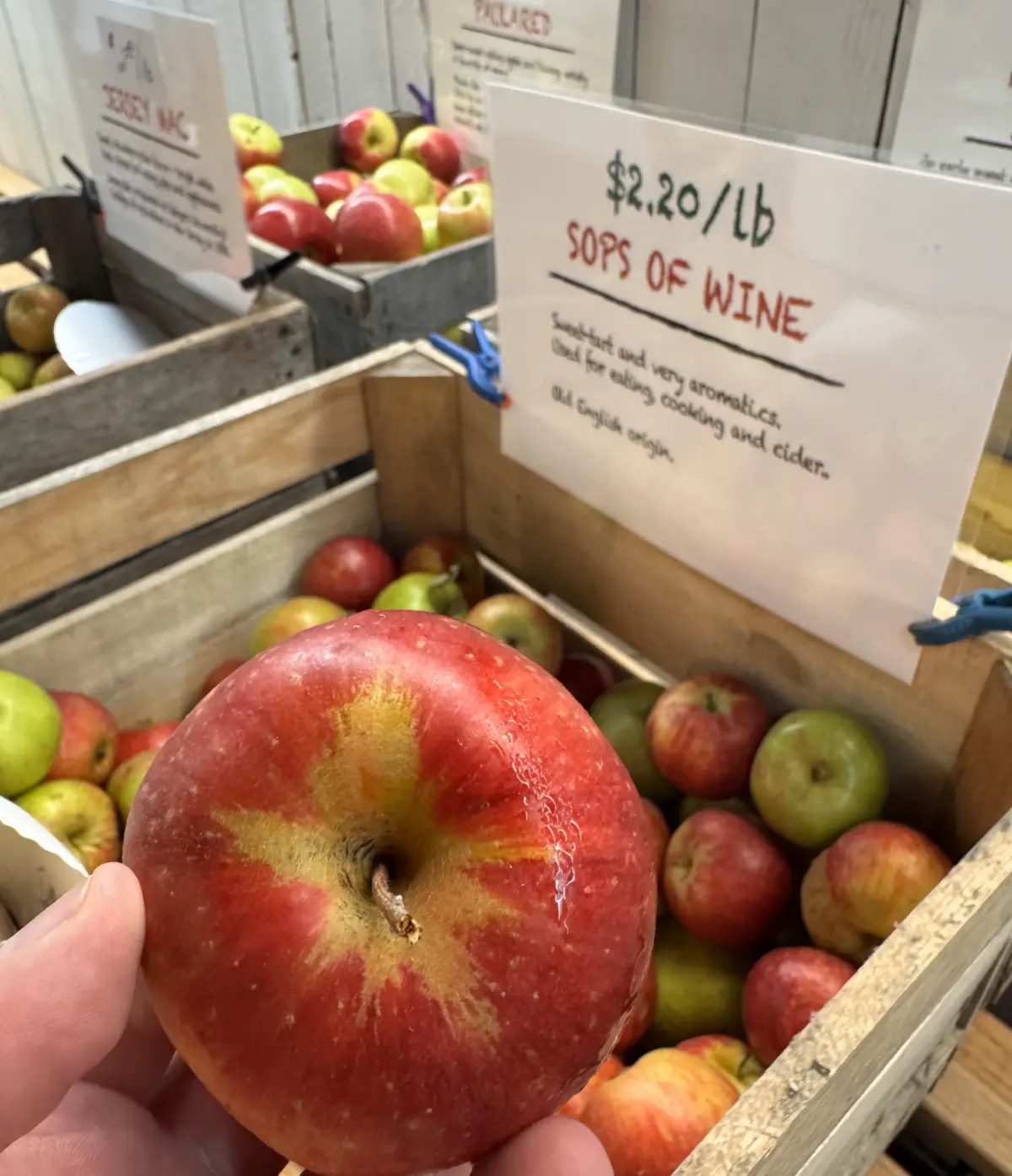
3. Sops of Wine: The Psychotronic Ghost
- Score: 3.5 / 10
- Profile: Mealy texture, gritty mouthfeel, sub-acid sweetness with vanilla and spice notes, muddled historical taxonomy.
Perhaps no specimen in the 2026 trials induced as much psychological distress as the Sops of Wine. Beyond its physical characteristics, the fruit acted as a cognitive trigger, persistently invoking cinematic hallucinations of historical figures consuming tomatoes under duress.
On the table, the physical reality of the fruit was largely disappointing. Exhibiting a mealy and gritty texture, it suggested advanced post-harvest degradation. While its flavor profile maintained interesting "sub-acid" properties—leaning slightly sweet with subtle undertones of vanilla and spice—the structural integrity had collapsed. Compounding the confusion was a taxonomic debate: while some pomological texts describe true Sops of Wine as possessing red-fleshed or red-streaked interiors, this specimen displayed standard white flesh, fueling suspicions that the moniker serves as a catch-all umbrella term for disparate historic types. It limped away with a 3.5 out of 10.
4. Fenceline Surprise: The Agrarian Catastrophe
- Score: 1.0 / 10
- Profile: Bland mush, faint pear mist, sandy mouthfeel, presumptive premature harvesting.
If the Fenceline Surprise offered any lesson, it is the danger of nomenclature setting expectations that reality cannot fulfill. Despite linguistic flirtations with continental pronunciation, the fruit delivered an unmitigated disaster of texture and flavor.
Described clinically as a "bland mush," the apple offered a fleeting, highly diluted whisper of pear juice before dissolving entirely into a textural experience comparable to masticating beach sand. Given signage at the point of purchase identifying it as a "firm apple," evaluators concluded that the specimen was either part of a defective batch or had been left to decompose off the branch long before reaching the consumer. Absent a visually pleasing exterior and a brief flash of pear essence, the score would have hit absolute zero; instead, it registers at 1.0.

5. Americus Crab: The Steampunk Inventor
- Score: 2.5 / 10
- Profile: Savory, hyper-tart, highly tannic, structurally armored, strictly non-culinary.
The Americus Crab entered the testing phase less as a fruit and more as a character from an Edwardian speculative fiction novel. Characterized by aggressive tannins and a tough, unyielding structure, this crabapple defied casual consumption.
It is inherently savory, intensely tart, and fortified with structural defense mechanisms that render it entirely unsuitable for eating out of hand. Yet, within the narrow confines of experimental pomology, it holds a perverse charm for those drawn to wild, uncultivated flavors. It earns a 2.5 for audacity, though not for utility.
6. Campfield (False?): The Revolutionary Exile
- Score: 4.1 / 10
- Profile: Chewy, callused-thumb texture, high tannins, dual-purpose cider heritage carrying deep colonial baggage.
Labeled cryptically as "(false)," the Campfield cultivar read to evaluators as a deceptive trickster fruit. Mechanically, it presented a chewy, unyielding texture akin to a callused thumb, featuring a cloying sweetness offset by heavy, astringent tannins that made the fruit feel as though it were consuming the consumer.
However, historical analysis elevates the specimen beyond its culinary limitations. Archival cross-referencing ties the Campfield apple to Matthew Canfield (alternately spelled Campfield), an anti-royalist Puritan migrant who arrived in North America during the Great Puritan Migration of 1637. As a founding father of New Haven, Norwalk, and Newark—where he is reportedly interred beneath City Hall—Canfield’s civic ordinances required freeholders to cultivate four acres of land, directly catalyzing early American orchard development and hard-cider production. Acknowledging its evolutionary destiny as a cider apple rather than a fresh-eating snack, the fruit captures a 4.1.

7. Graham: The Mastication Threshold
- Score: 8.0 / 10
- Profile: Extreme structural density, glacial fracture mechanics, shocking and unmistakable Juicy Fruit gum flavor profile.
The final evaluation of the current batch, Graham, tested the limits of human dental architecture. So dense and hard was this specimen that reviewers seriously contemplated reporting potential temporomandibular joint (TMJ) strain. Penetration required maximum physical exertion, and the flesh ultimately fractured with the geological violence of a calving glacier.
Yet, perseverance was extravagantly rewarded. Upon breaching the exterior armor, tasters encountered an intensely juicy pulp whose flavor profile defied all botanical logic: an unadulterated, screamingly accurate simulation of commercial Juicy Fruit gum. This surreal sensory experience propelled the apple to an 8.0 score, falling short of perfection only due to the sheer physical rehabilitation required to consume it.
Supporting Context & Metrics
The quantitative distribution of the 2026 evaluations highlights a stark bifurcation in modern heritage apple cultivation. The data demonstrates that while structural resilience (measured via acoustic snap and flesh density) generally correlates with higher scoring, extreme outliers on both ends of the spectrum rely heavily on secondary chemical markers—such as ester production mimicking confectioneries (Graham) or complex herbal aromatics (St Edmunds Pippin).
| Cultivar | Score (out of 10) | Primary Flavor Note | Structural Integrity |
|---|---|---|---|
| St Edmunds Pippin | 8.3 | Fennel Pollen & Sweet Tart | High (Sharp-Breaking) |
| Graham | 8.0 | Juicy Fruit Gum | Extreme (Glacial Fracture) |
| Kickapoo Spice | 6.9 | Nutmeg, Clove, Cut Grass | Dense (Low Juice) |
| Campfield (False?) | 4.1 | Tannin & Astringent Sweet | Chewy / Tough |
| Sops of Wine | 3.5 | Vanilla, Sub-acid Spice | Mealy / Gritty |
| Americus Crab | 2.5 | Savory, Hyper-Tart Crab | Tough / High Tannin |
| Fenceline Surprise | 1.0 | Faint Pear / Sand | Mushy / Degraded |
Official Statements & Industry Reception
Pomological societies and independent agricultural observers have responded to the release of Part Two with mixed anxiety and fascination. While commercial producers largely prioritize shelf-stable, uniform cultivars like the Honeycrisp or Gala, independent heritage orchardists have championed these trials for bringing visibility to historical, regionally specific varieties.

In a brief communiqué issued ahead of the upcoming northeastern travel circuit, lead reviewers underscored the philosophical importance of engaging with flawed fruits:
"Apples are weird like that. Some improve off the tree, some begin their descent to crap-town the moment they drop. To engage with the harvest is to accept the full spectrum—from the sublime, gum-flavored density of the Graham to the sandy betrayal of the Fenceline Surprise."
Future Outlook
As the 2026 autumn season progresses, the focus of the pomological community shifts northward. Field expeditions departing in the coming weeks will target historical orchards across New York State, New England, and the Canadian provinces.
Industry analysts anticipate that cooler northern microclimates will yield firmer, higher-acid specimens during this upcoming leg of the tour. Stakeholders, orchard curators, and apple enthusiasts have been formally invited to contribute local specimens for evaluation. Whether these future trials will unearth a cultivar capable of surpassing the elusive balance of the St Edmunds Pippin—or whether further dental casualties will be sustained in pursuit of the ultimate pomological specimen—remains to be seen. Further dispatches from the orchard front lines will be published as fieldwork progresses.