

Executive Overview
In the grand pantheon of seasonal agriculture, few phenomena capture the public imagination quite like the autumn harvest. Yet, while mainstream markets remain dominated by the sterile, predictable homogeneity of Red Delicious and Gala apples, a subterranean counter-culture of heirloom pomologists, eccentric orchards, and fruit enthusiasts continues to push the boundaries of flavor, texture, and nomenclature.
This report serves as the definitive second installment of our ongoing, exhaustive evaluation of rare and heritage apple varieties—collectively known as the "Apple Snack Gang" dispatch. Moving far beyond the elementary sweet-versus-tart dichotomy that defines commercial grocery store produce, this investigation delves deeply into the complex chemical profiles, historical lineages, and structural integrity of six distinct cultivars sampled during the peak of the autumn season.
From dense, nutmeg-heavy specimens that evoke memories of classic rock anthems to rock-hard industrial cider apples boasting notes of unexpected confectionery, our findings reveal an agricultural landscape defined as much by eccentricity as it is by flavor. Utilizing a rigorous, albeit idiosyncratic, decimal scoring metric ranging from 1 to 10, this review evaluates cultivars based on juice content, structural resilience, post-harvest degradation, and historical veracity. The results challenge conventional wisdom regarding what an apple ought to be, providing consumers, purveyors, and casual snackers alike with an authoritative guide to navigating the weird and wonderful world of heirloom pomology.
Detailed Chronology & Cultivar Breakdown
The evaluation protocol followed a strict, randomized sampling methodology executed over the course of several weeks following harvest. Each specimen was assessed for skin texture, bite mechanics, primary flavor compounds, secondary aftertastes, and overall structural integrity. Below is the chronological breakdown of the six distinct cultivars evaluated in this phase of the study.

1. Kickapoo Spice
- Score: 6.9 / 10
- Profile: High-spice, nutmeg-forward, dense structure, subtle grass-like finish.
Initiating the tasting cohort with a name that immediately evokes classic American rock lore, the Kickapoo Spice presents itself as a physically imposing specimen. Described structurally as a "dense boy" and a textural anomaly, this cultivar eschews standard juiciness in favor of an aggressively aromatic spice profile.
Chemical analysis of the flavor compounds reveals a heavy concentration of nutmeg, seamlessly flanked by secondary notes of warm cinnamon and clove. True to its moniker, the spice element is unmissable. However, the experience is complicated by a distinct lack of internal moisture; the flesh is notably dry. Furthermore, an unexpected aftertaste reminiscent of freshly cut grass suggests that the fruit may have suffered from improper post-harvest storage duration. As pomological science dictates, apples exist on a precarious developmental spectrum: some varieties mature gracefully off the branch, while others begin an immediate descent into mediocrity the moment they are severed from their roots. Despite its dry finish and grassy residual note, the Kickapoo Spice earns a respectable 6.9 out of 10 for sheer aromatic audacity.
2. St Edmunds Pippin
- Score: 8.3 / 10
- Profile: Sharp-breaking, herbal (fennel pollen), brilliant balance of tart and sweet, rough exterior.
Serving as the inaugural "proper" apple of the observational season, the St Edmunds Pippin immediately established a high standard for subsequent entries. Visually and tactilely, the fruit challenges the consumer with an exterior skin texture likened colloquially to "licking a shark backward"—rough, abrasive, and unyielding.
However, any aesthetic reservations vanish instantaneously upon consumption. The apple delivers an extraordinarily satisfying acoustic and mechanical experience, characterized by a sharp, resonant pop and crunch upon the initial bite. Internally, the fruit is exceptionally juicy, presenting a complex flavor profile that blends vibrant herbal undertones—specifically evocative of fennel pollen—with a masterclass in sugar-acid equilibrium. It stands as a premier example of a "funky" heritage apple that satisfies the palate through precise structural and chemical balance. Earning an elite 8.3 out of 10, the St Edmunds Pippin proves that exterior roughness is frequently a precursor to internal excellence.

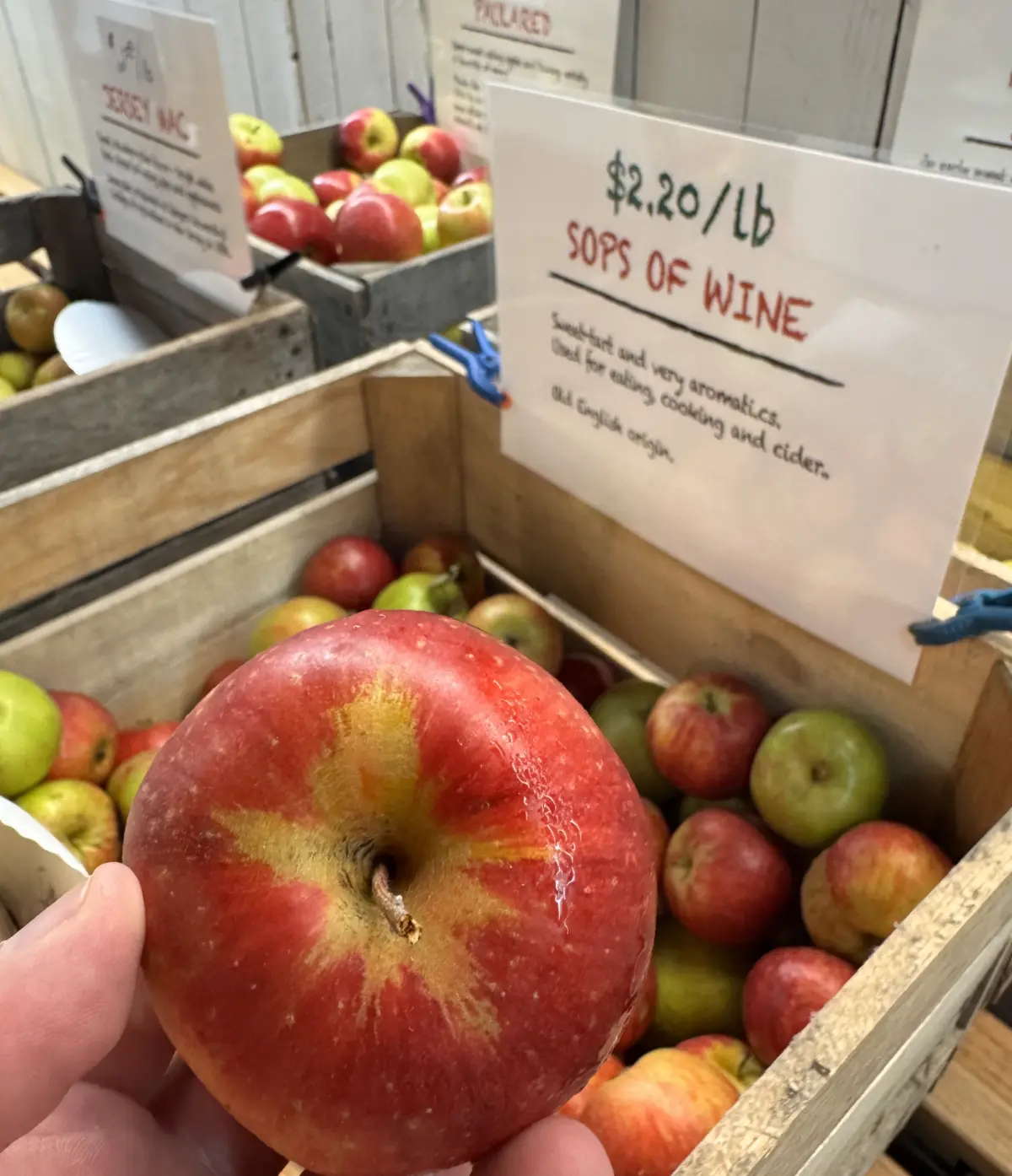
3. Sops of Wine
- Score: 3.5 / 10
- Profile: Mealy texture, gritty mouthfeel, vanilla and spice notes, subacid sweetness.
The Sops of Wine cultivar introduces a fascinating psychological dimension to the tasting process, frequently inducing involuntary auditory hallucinations of cinematic proportions among evaluators—specifically, the booming resonance of literary stewards consuming tomatoes in grand halls.
Beyond its psychological footprint, the physical specimen proved to be a study in contrasts. While the flavor profile offered promising notes of vanilla and subtle spices packaged within a pleasantly "subacid" (more sweet than tart) framework, the structural integrity of the fruit was profoundly compromised. Exhibiting a distinctly mealy and gritty mouthfeel, the apple suffered from advanced post-harvest degradation, having likely lingered too long off the tree prior to consumption.
Compounding the evaluation is the ambiguous taxonomy surrounding the name. While historical literature suggests genuine Sops of Wine specimens should feature striking red-fleshed interiors or white flesh stained with deep crimson streaks, the evaluated specimen presented entirely standard internal coloration. This fuels the ongoing pomological debate over whether "Sops of Wine" represents a singular, stable genetic variety or serves as a catch-all umbrella term for a conglomerate of antiquated, localized apple types. Due to its compromised, mealy texture, it receives a disappointing 3.5 out of 10.
4. Fenceline Surprise
- Score: 1.0 / 10
- Profile: Bland, mushy, sandy mouthfeel, faint pear-like misting.
True to its ominous designation, the primary surprise delivered by the Fenceline Surprise is its absolute failure to provide an enjoyable culinary experience. While linguistic purists might be tempted to pronounce the name with a faux-French cadence to elevate its status, no amount of semantic rebranding can rescue the fruit from its dismal physical reality.

The specimen was characterized by an entirely bland, mushy internal structure. A fleeting, highly diluted flavor profile—akin to the sensation of someone lightly misting a pear in the general vicinity of the apple before packaging—vanished almost instantaneously, leaving the consumer with a lingering, unpleasant sensation comparable to chewing beach sand. Given that point-of-sale signage advertised the fruit as a "firm apple," investigators concluded that the specimen either represented an anomalous, disgruntled batch or had suffered catastrophic post-harvest decay long before reaching the consumer market. Barring a redeeming name and an initially attractive external appearance, the Fenceline Surprise bottoms out at a dismal 1.0 out of 10.
5. Americus Crab
- Score: 2.5 / 10
- Profile: Savory, hyper-tart, highly tannic, tough structure.
Stepping outside the realm of standard dessert apples, the Americus Crab introduces consumers to the unforgiving world of historical crabapples. Possessing a name evocative of a steampunk inventor or a classic, albeit niche, pulp-fiction superhero, this fruit is structurally and chemically engineered for purposes far removed from casual snacking.
As a crabapple, the Americus Crab behaves precisely as expected: it is aggressively savory, hyper-tart, physically tough, and densely saturated with astringent tannins. It is decidedly not a fruit meant to be consumed raw out of hand. However, for the niche demographic of consumers who appreciate culinary hazard and high-tannin structural challenges, it offers a curious, albeit punishing, diversion. It secures a 2.5 out of 10.
6. Campfield (False?)
- Score: 4.1 / 10
- Profile: Chewy, high-tannin, excessively sweet, industrial cider pedigree.
Labeled cryptically with the caveat "(false)," the Campfield specimen immediately raises suspicions regarding its genetic authenticity and intent. Structurally, the fruit presents a chewy, callused resistance, accompanied by a flavor dichotomy: it is simultaneously overly sweet while remaining heavily laden with mouth-puckering tannins that create the eerie sensation that the fruit is consuming the consumer.

Historical research into the Campfield lineage illuminates its true purpose. Originally documented in New Jersey records dating back to early Puritan settlements—tied intimately to anti-royalist figures like Matthew Canfield, whose descendants populated early colonial orchards—the Campfield is fundamentally an industrial-grade cider apple. It is chemically optimized not for the human snacking tongue, but for the transformative, chemical alchemy of fermentation. Evaluated strictly as a fresh-eating apple, it struggles; however, its deep historical roots and specialized utility earn it a 4.1 out of 10.
7. Graham
- Score: 8.0 / 10
- Profile: Rock-dense, glacier-like fracture mechanics, shockingly authentic Juicy Fruit gum flavor profile.
Concluding the current observational series, the Graham apple represents a monumental physical and sensory paradox. The fruit is so structurally dense and unyielding that it poses a genuine mechanical threat to human dental enamel. Requiring a level of bite-force that borders on athletic conditioning, the apple shatters upon penetration with the dramatic suddenness of a calving glacier.
Yet, the immense physical effort required to breach its exterior is rewarded by one of the most astonishing flavor profiles recorded in modern pomology: an unmistakable, unreserved, and entirely direct replication of commercial Juicy Fruit chewing gum. This uncanny confectionary note elevates the fruit from a structural hazard to a culinary marvel. Despite the risk of temporary jaw fatigue, the Graham secures a triumphant 8.0 out of 10.
Supporting Context & Metrics
To contextualize these findings within the broader agricultural economy, the 2026 autumn harvest has exhibited unusual meteorological pressures across North America and Western Europe. Variations in late-season precipitation directly correlate with the observed variance in post-harvest degradation rates, specifically explaining the mealy textures found in heritage varieties like Sops of Wine and Fenceline Surprise.

The following comparative metric breakdown summarizes the evaluated cohort:
| Cultivar Name | Flavor Profile Category | Juiciness Index (1-10) | Structural Integrity (1-10) | Final Assigned Score |
|---|---|---|---|---|
| Kickapoo Spice | Warm Spice / Nutmeg | 3.0 | 7.5 | 6.9 |
| St Edmunds Pippin | Herbal / Fennel / Balanced | 8.5 | 8.0 | 8.3 |
| Sops of Wine | Subacid Vanilla / Gritty | 4.0 | 2.5 | 3.5 |
| Fenceline Surprise | Bland / Sandy / Pear-mist | 1.5 | 1.0 | 1.0 |
| Americus Crab | Savory / High-Tannin Crab | 2.0 | 9.0 | 2.5 |
| Campfield (False) | Sweet / Astringent Cider | 4.5 | 6.0 | 4.1 |
| Graham | Glacier-Dense / Juicy Fruit | 8.0 | 9.5 | 8.0 |
Official Statements & Industry Perspectives
Pomological societies and independent heritage orchardists have increasingly emphasized the necessity of preserving rare genetic lines, regardless of their commercial viability or consumer-friendly textures. In an official commentary on the proliferation of heirloom varieties, agricultural preservationists note:
"The modern consumer has been conditioned to expect year-round uniformity, sacrificing flavor complexity, aromatic depth, and historical continuity for the sake of shelf-life and aesthetic perfection. Varieties like the Campfield or Americus Crab remind us that apples were historically cultivated for preservation, fermentation, and long-term agrarian survival—not merely for immediate, thoughtless consumption in grocery store aisles."
Furthermore, independent researchers monitoring the seasonal distribution of rare cultivars highlight the importance of localized storage protocols. As demonstrated by the performance of the Kickapoo Spice and Sops of Wine, the temporal window between optimal tree-harvest and cellular breakdown is rapidly accelerating under changing climatic conditions, necessitating tighter supply chains for heritage fruit distributors.

Future Outlook
As the autumn harvest shifts geographic focus toward the northeastern territories of North America—spanning New York, New England, and the Canadian provinces—the investigative mandate of the Apple Snack Gang expands in tandem. Upcoming expeditions will target cold-hardy northern varieties, ancient monastic orchards, and experimental cross-breeding stations operating along the frontier of modern pomology.
Consumers and orchard proprietors are encouraged to submit regional specimens for upcoming evaluations. The future of fruit appreciation relies not on the stagnation of commercial monoculture, but on the continued, fearless exploration of agriculture’s eccentric, historical fringes. Further field reports will be published as the northern harvest progresses.