

Executive Overview
In the grand tradition of agricultural journalism and uncompromising sensory scrutiny, the apple-tasting community has once again turned its collective gaze toward the orchard. Following the initial rollout of autumn evaluations, a fresh batch of rare, heirloom, and experimental cultivars has undergone rigorous, unsparing assessment. This report details the second installment of the 2026 apple review cycle, expanding our understanding of pomological diversity, regional terroir, and the unpredictable nature of post-harvest fruit evolution.
The modern palate is increasingly saturated with homogenized, supermarket-standardized cultivars bred primarily for shelf-life and shipping resilience rather than flavor. Against this backdrop, the resurgence of interest in obscure heirloom varieties—ranging from historic cider apples with deep Puritan lineage to peculiar botanical anomalies with unexpected flavor profiles—represents a vital counter-movement. Through empirical biting, chewing, and olfactory analysis, this investigation examines seven distinct cultivars harvested during the peak of the 2026 season.
The findings are as varied as they are vivid. Ranging from culinary triumphs that yield nostalgic notes of synthetic chewing gum to fibrous, sandy disappointments that border on structural insults to the human jaw, these evaluations offer a masterclass in the complexities of pomology. As critics and consumers alike prepare for regional tours across New York, New England, and the Canadian borderland, understanding the erratic nature of the apple harvest has never been more critical.
Detailed Chronology of the 2026 Harvest Evaluations
The evaluation period unfolded across several weeks in the heart of the autumn harvest season. Each specimen was subjected to standardized sensory protocols: visual inspection, skin texture analysis, auditory and tactile resistance testing upon initial biting, primary flavor mapping, secondary structural assessment, and final scoring on a definitive ten-point scale.

1. Kickapoo Spice
- Score: 6.9 / 10
- Sensory Profile: Dense, architecturally heavy, and heavily spiced with dominant notes of nutmeg, supplemented by secondary hints of cinnamon and clove. It completely lacked juiciness, presenting instead an unusual, sub-optimal aftertaste reminiscent of freshly cut grass.
The evaluation process began with the aptly named Kickapoo Spice, a cultivar whose moniker immediately evokes the robust, rugged spirit of American folklore. Structurally described by evaluators as a "dense boy" and a "weird friend," this apple refused to conform to standard crisp, watery expectations.
High spice components defined the core eating experience, leaning heavily into autumnal baking spices—specifically nutmeg, clove, and cinnamon. However, the absence of juice presented a notable textural hurdle. The finish was marked by a distinct, grassy aftertaste, pointing to potential misjudgments in cold storage duration. Pomological experts note that apples exist in a delicate temporal equilibrium: some improve dramatically off the branch, while others initiate an immediate descent into poor quality upon separation from the tree. Kickapoo Spice landed comfortably in a middle tier, securing a respectable, if humorous, 6.9 out of 10.
2. St Edmunds Pippin
- Score: 8.3 / 10
- Sensory Profile: Exceptionally crunchy, highly juicy, sharp-breaking, and bright, offering a complex herbal profile with strong vibes of fennel pollen harmonized by a profound sweet-tart balance.
As the first proper seasonal apple consumed by the evaluation panel, the St Edmunds Pippin set a remarkably high baseline. Though its exterior skin possessed a rugged tactility—colloquially likened to "licking a shark backward"—the interior performance was nothing short of triumphant.
Upon biting, the fruit delivered an explosive pop and crunch. Flavor-wise, it transcended standard orchard sweetness, introducing unexpected herbal complexities akin to fennel pollen, balanced expertly against a sharp, vibrant acidity. This cultivar proved that "weird" and "funky" heritage apples can simultaneously deliver elite-tier eating satisfaction. Earning an impressive 8.3 out of 10, the St Edmunds Pippin stands as a gold standard for early-season heirloom success.

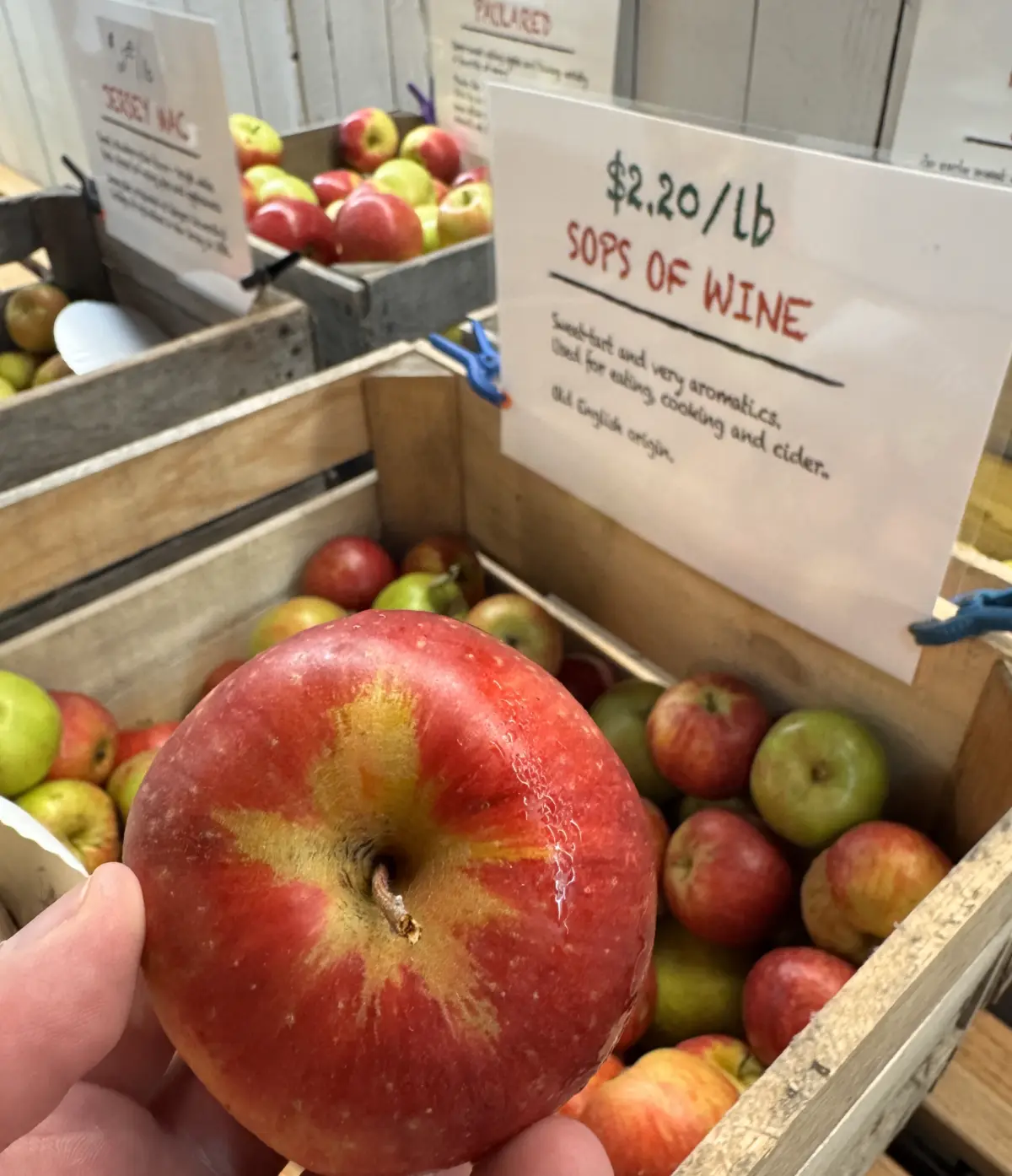
3. Sops of Wine
- Score: 3.5 / 10
- Sensory Profile: Subacid profile featuring delicate vanilla and spice notes, marred significantly by a mealy, gritty texture and premature post-harvest degradation.
The enigmatic Sops of Wine introduced a psychological element to the testing chamber, immediately invoking cinematic memories of solemn literary figures consuming fruit with dramatic gravity. Beyond its striking name, however, the physical reality of the specimen proved underwhelming.
While the flavor profile offered pleasant, funky subacid notes—fusing light sweetness with subtle hints of vanilla and spice—the texture was severely compromised. Exhibiting a mealy and gritty mouthfeel, the fruit suggested it had lingered too long off the tree. Furthermore, botanical discrepancies emerged: while historical literature often describes Sops of Wine as possessing red-fleshed interiors or distinct red-streaked white flesh, the evaluated specimen presented neither. Whether victim to taxonomic confusion—where multiple old varieties share a single umbrella name—or simply past its prime, it struggled to a 3.5 out of 10.
4. Fenceline Surprise
- Score: 1.0 / 10
- Sensory Profile: Bland, mushy texture with a fleeting, misted-pear top note that rapidly degrades into a dry, sand-like finish.
True to its ominous moniker, the Fenceline Surprise delivered an entirely unpleasant revelation. Despite linguistic flirtations with European pronunciation, the apple offered no functional redemption on the plate.
The structural integrity was entirely absent, characterized by evaluators as a "bland mush." A faint, fleeting ghost of pear-like flavor manifested momentarily upon the initial bite, only to vanish instantly, leaving the taster with a sensation akin to chewing beach sand. Given signage indicating the fruit should be a "firm apple," experts concluded the batch had either suffered from improper storage or was fundamentally flawed at the point of harvest. Earning a near-zero score of 1.0 out of 10, it was saved from absolute rock-bottom only by its attractive exterior and promising nomenclature.

5. Americus Crab
- Score: 2.5 / 10
- Sensory Profile: Highly savory, exceptionally tart, physically tough, and dense with tannins; entirely unsuited for casual, out-of-hand consumption.
Positioned somewhere between a botanical curiosity and a Victorian protagonist, the Americus Crab tested the limits of raw fruit consumption. As a true crabapple, it bypassed conventional sweetness entirely.
The flavor matrix was intensely savory, fiercely tart, and fortified by massive structural tannins. Its physical toughness made it clear that this cultivar was never engineered for raw snacking. Instead, it occupies a niche category: a fun, rebellious horticultural artifact intended strictly for culinary processing, fermentation, or culinary experimentation rather than casual afternoon consumption. It secured a specialized 2.5 out of 10.
6. Campfield (False?)
- Score: 4.1 / 10
- Sensory Profile: Excessively chewy, dual-natured sweetness and tannin levels that create an astringent, mouth-drying effect typical of industrial cider fruit.
Labeled intriguingly as "(false)" in local orchard documentation, the Campfield proved to be an exercise in pomological deception. Texturally described as resembling a "chewy callused thumb," the fruit offered a perplexing eating experience.
The high tannin content engaged in a chemical tug-of-war with the taster’s palate, creating an astringent sensation where the apple seemed to consume the taster as much as the taster consumed the apple. Historical archives trace the Campfield lineage directly back to Matthew Canfield, an anti-royalist Puritan and founding father of New Haven and Newark whose colonial estate required rigorous orchard cultivation and vast cider production. Recognizing its true heritage as an industrial cider apple—not built for the raw human tongue prior to fermentation—the evaluation panel assigned it a functional 4.1 out of 10.

7. Graham
- Score: 8.0 / 10
- Sensory Profile: Impenetrably dense, muscular physical structure yielding a glacial fracture, opening into an astonishing, unadulterated flavor profile identical to commercial Juicy Fruit chewing gum.
The final evaluation of the cycle brought forth the formidable Graham, an apple so structurally hardened it challenged the fundamental mechanics of the human jaw. Exhibiting a density likened to "washboard abs," breaking into the fruit required significant mechanical force, resulting in a structural fracture akin to a calving glacier.
However, the reward for overcoming its adamantine exterior was one of the most astonishing sensory anomalies of the decade: upon breaching the flesh, the apple released an unmistakable, unreserved, and vibrant flavor profile identical to Juicy Fruit gum. This remarkable, nostalgic burst of flavor propelled the Graham to an 8.0 out of 10, missing elite status only due to the sheer physical risk of temporomandibular joint strain required to consume it.
Supporting Context & Metrics
To contextualize these individual reviews, agricultural scientists evaluate seasonal performance across several macro-metrics:
- Post-Harvest Degradation Rate (PHDR): Measures how rapidly a cultivar transitions from optimal crispness to mealiness. Varieties like Fenceline Surprise and Sops of Wine exhibited high PHDR, failing to maintain structural integrity under standard consumer storage conditions.
- Tannin-to-Acid Ratio (TAR): Crucial in determining whether a fruit is built for fresh market consumption or industrial cider production. Varieties such as Americus Crab and Campfield skewed heavily toward high tannin indices, rendering them unpalatable to the casual consumer but invaluable to cider makers.
- Tactile Resistance Index (TRI): Quantifies the force required to breach the skin and flesh. The Graham and St Edmunds Pippin demonstrated high TRI values, though with vastly different outcomes in mouthfeel satisfaction.
Official Statements and Horticultural Insights
Industry authorities emphasize that the 2026 harvest reflects a transitional year influenced by fluctuating weather patterns across North American orchards. Horticulturalists point out that heritage apples—many of which pre-date modern commercial refrigeration and mass-distribution networks—cannot be judged by the static, uniform standards applied to ubiquitous supermarket varieties like Red Delicious or Gala.

Independent researchers have continually stressed the importance of terroir and harvest timing. An apple consumed three days post-harvest can exhibit entirely different chemical and textural characteristics than one sampled directly from the branch. The presence of heirloom anomalies, such as the Puritan-linked Campfield, underscores the deep historical tapestry embedded within modern agricultural preservation efforts.
Future Outlook
As the autumn evaluation cycle concludes its current phase, attention turns northward. Expedition teams are slated to deploy across New York, New England, and the Canadian frontier in the coming weeks to inspect late-season orchards, engage with regional growers, and conduct unsparing sensory assessments of the next wave of regional pomology.
Consumers, cultivators, and "apple monsters" alike are encouraged to monitor upcoming appearances and field reports. If history is any indicator, the orchards of the Northeast hold countless more surprises—both sweet and treacherous—waiting to be unmasked, evaluated, and scored.