For digital marketers, search engine optimization (SEO) professionals, and enterprise growth teams, the days of relying on manual, daily-updated spreadsheets are long gone. In the fast-paced ecosystem of modern search engines—where rankings shift by the minute, features like AI Overviews dynamically reshape search engine results pages (SERPs), and local intent dictates hyper-targeted visibility—having access to real-time, highly accurate data is non-negotiable.
Managing a large volume of keywords, tracking shifting competitor positions, monitoring complex SERP features, and correlating ranking movements across multiple search engines and devices requires robust, specialized software. SERP tracking tools have evolved into sophisticated intelligence platforms. They empower organizations to input target keywords, monitor specific SERP layouts, and instantly analyze how organic positioning directly impacts traffic, conversions, and, ultimately, the corporate bottom line.
This deep-dive review evaluates the critical features to look for in modern SERP tracking software, outlines industry best practices for mapping rankings to revenue, and provides an authoritative shortlist of the top seven tracking solutions for 2025. Whether you are looking for a dedicated, standalone rank tracker or a comprehensive all-in-one SEO suite, this guide breaks down how the market leaders stack up against each other.
Detailed Chronology: The Evolution of Rank Tracking
To understand why modern SERP tracking software is indispensable in 2025, it is helpful to examine how the landscape has evolved over the past decade:
The Spreadsheet Era (Early 2010s): SEO practitioners manually queried search engines—often forgetting to clear browser caches or factor in local geo-targeting—and painstakingly inputted positions into Microsoft Excel or Google Sheets. Data was sparse, subjective, and prone to severe human error.
The Rise of Automated Weekly Scrapers (Mid 2010s): Basic software emerged to scrape search engine results on a weekly basis. While this eliminated manual labor, the data was often stale by the time it was viewed, failing to keep pace with rapid algorithmic updates.
The Daily & On-Demand Revolution (Late 2010s – 2020s): Cloud-based infrastructure allowed tools to offer automated 24-hour updates and on-demand refresh buttons. Granular device separation (desktop vs. mobile) and hyper-local tracking (down to the zip-code level) became industry standards.
The AI and Multi-Feature Era (2025 and Beyond): Modern SERPs are no longer simple lists of ten blue links. They feature AI Overviews, People Also Ask (PAA) boxes, video carousels, and knowledge cards. Today’s top-tier tracking tools analyze over 50 distinct SERP features, integrating machine learning to identify content optimization gaps and forecast traffic potential before human analysts even spot the trend.
Supporting Context & Metrics: Why Invest in Advanced SERP Software?
Investing in enterprise-grade SERP tracking software is not merely about vanity metrics or chasing the elusive #1 spot on Google. It is a fundamental requirement for validating SEO efforts, justifying marketing budgets, and demonstrating concrete return on investment (ROI) to stakeholders.
Advanced tracking software allows digital marketing teams to:
Validate SEO strategies with granular data tied to specific business objectives.
Monitor keyword performance across diverse geographies—from international markets down to local neighborhoods.
Differentiate between mobile and desktop visibility to match shifting consumer behavior.
Identify content decay and capture "low-hanging fruit" optimization opportunities.
Scale reporting efforts through automated white-label dashboards and native third-party integrations.
When evaluating platforms, industry experts emphasize nine essential features that separate mediocre tools from elite market solutions.
The 9 Essential Features to Look for in SERP Tracking Software
When auditing the marketplace for the best SERP tracking software, professionals must prioritize platforms that deliver on specific functional requirements:
1. Accurate, On-Demand Ranking Updates
SERP positions fluctuate rapidly. Waiting days for a tool to refresh its database can mean missing critical traffic drops or algorithmic recovery windows. Elite trackers provide automated 24-hour updates alongside on-demand, single-click data refreshes. Platforms like AccuRanker lead this category by allowing users to instantly pull fresh ranking data on command.
Ranking in the traditional top three is only half the battle. Securing Position #0, AI Overviews, featured snippets, PAA expansions, and video carousels requires knowing precisely which keywords trigger these elements. Advanced software provides a unified view to track dozens of SERP features, mapping out precisely which content adjustments are needed to steal features from competitors.
3. Multi-Engine Compatibility
While Google commands the lion’s share of global search traffic, international campaigns or specific regional targets demand broader search engine coverage. Top-tier tools support tracking across major international and regional engines, including Bing, Baidu, Yandex, and YouTube.
4. Granular Geographic and Device Segmentation
A truly robust SERP tracker must offer high-level executive dashboards alongside hyper-local tracking capabilities. Whether you are running a multinational campaign or optimizing for a local storefront down to the zip-code level, the software must accurately filter data by location and separate mobile rankings from desktop performance (as exemplified by Semrush).
5. Mapping SERP Movements to Traffic and Revenue
Tracking rankings in a vacuum is insufficient. The most effective software integrates seamlessly with analytics suites like Google Analytics or Adobe Analytics. By combining keyword data, search volume, and Share of Voice with organic visitor metrics, bounce rates, and conversion goals, businesses gain a complete picture of how SEO impacts the bottom line.
6. Comprehensive Historical Performance Tracking
Point-in-time snapshots only tell part of the story. Historical trend analysis allows marketing teams to view the lifecycle of a target keyword over months or years, contrasting internal performance against aggressive market competitors.
7. Advanced Competitor Benchmarking
Because rankings constantly shift, identifying who is gaining or losing ground is vital. Effective platforms group keywords into strategic buckets (e.g., positions 1–3, 4–10, 11–50) to dynamically track visibility distribution against key industry rivals.
8. Robust Tagging and Segmentation
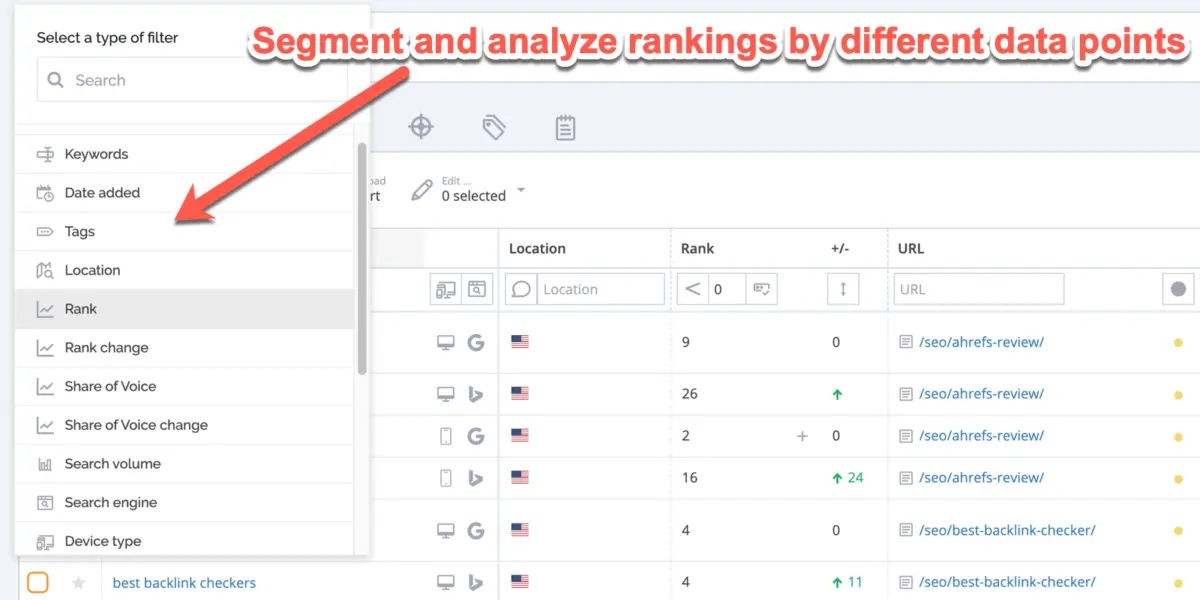
Not all keywords hold equal weight. Advanced categorization features allow users to segment data by topic, sales funnel stage, asset type, and device category, ensuring that marketing teams can analyze specific content clusters independently.
9. Native White-Label and Third-Party Reporting
Agencies and in-house teams alike need to communicate progress clearly to clients and executive boards. Top platforms offer native, scheduled white-label reporting alongside frictionless integrations with visualization tools like Google Looker Studio (formerly Data Studio) and Databox.
The 7 Best SERP Tracking Tools for 2025
The market features countless options, but our research highlights a carefully curated shortlist divided into dedicated standalone trackers and comprehensive all-in-one SEO platforms.
1. AccuRanker
Type: Standalone SERP Tracker
Trusted By: Over 32,000 companies, including HubSpot, IKEA, and Kinsta.
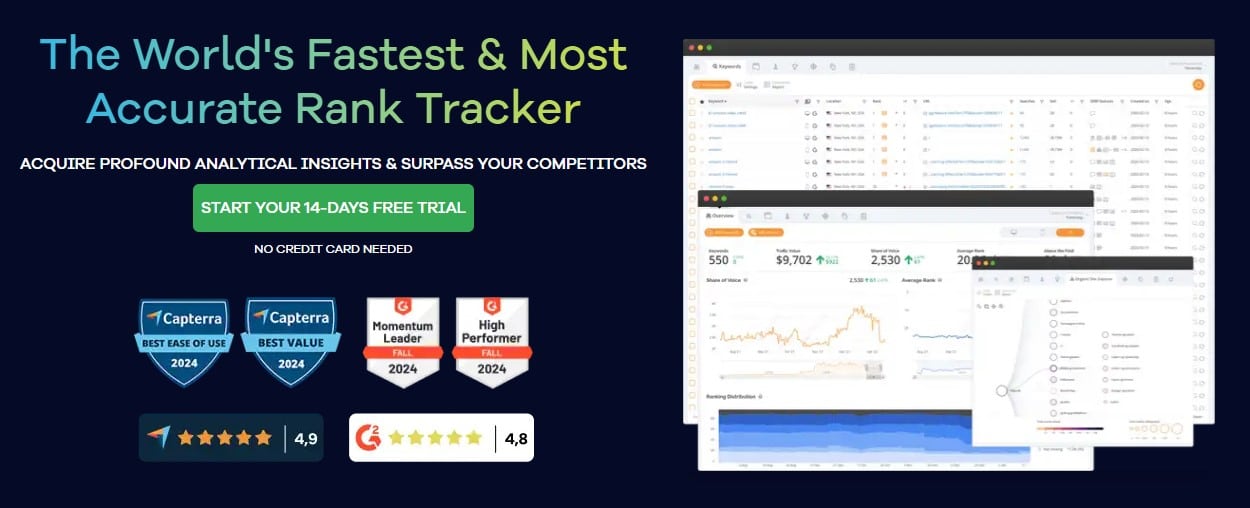
Overview: AccuRanker is widely recognized as one of the fastest and most accurate standalone keyword ranking trackers on the market. Designed specifically for agencies and enterprise brands, it provides lightning-fast on-demand data updates, deep analytics integrations, and robust Share of Voice tracking.
Best Features: On-demand data refreshing, comprehensive SERP feature analysis across 50+ elements, deep Google/Adobe Analytics integrations, and advanced tag segmentation.
Pricing: Subscription plans scale based on tracked keywords, starting at $116/month for up to 1,000 keywords.
2. Semrush Position Tracker & SERP Gap Analyzer
Type: All-in-One SEO Suite Component
Trusted By: Over 10 million users, including Samsung, Vodafone, and Booking.com.
Overview: Semrush is an industry titan in digital marketing. Its Position Tracking tool rivals the accuracy of dedicated standalone trackers, offering hyper-local tracking down to the zip-code level and seamless device segmentation. Additionally, its App Center features the SERP Gap Analyzer, an innovative tool that scans search results to uncover under-optimized content and integrate seamlessly with Google Search Console.
Best Features: Highly accurate daily tracking, localized map-pack monitoring, competitor visibility distribution graphs, and the AI-driven SERP Gap Analyzer.
Pricing: Comprehensive SEO platform plans start at $139.95/month.
3. ProRankTracker
Type: Standalone SERP Tracker
Trusted By: 60,000+ customers globally.
Overview: ProRankTracker is a scalable, cost-effective standalone solution built to handle large keyword volumes across multiple languages, devices, and global locations. It is a favorite among agencies and video marketers needing reliable local and international visibility data.
Best Features: Multi-language support, accurate local/global tracking, robust reporting suites, and intuitive mobile applications.
Pricing: Plans start at an accessible entry point of $39/month.
4. Advanced Web Ranking (AWR)
Type: Standalone SERP Tracker
Trusted By: Thousands of professionals and enterprise brands (including Microsoft).
Overview: Advanced Web Ranking is a veteran enterprise-grade tracking tool renowned for its deep customization capabilities, extensive search engine coverage, and flexible white-label reporting framework.
Best Features: Unlimited user accounts on most plans, deep competitor discovery, enterprise-level data security, and flexible API access.
Pricing: Subscription tiers begin at $99/month.
5. SERPWatcher (by Mangools)
Type: All-in-One Platform Component (Mangools)
Trusted By: Major brands including Airbnb and Adidas.
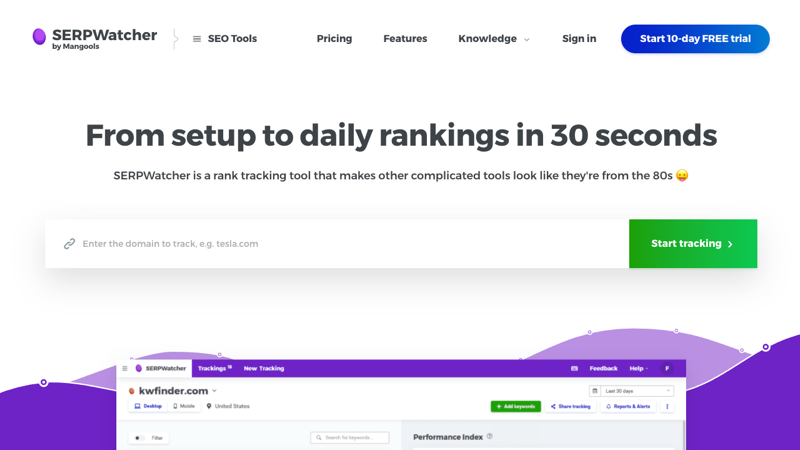
Overview: SERPWatcher is designed for users who value simplicity and visual clarity. Powered by the Mangools ecosystem, it introduces a unique Performance Index metric that gauges total organic traffic potential based on current keyword positions and search volumes.
Best Features: Visual Performance Index metric, user-friendly interface, automated alert systems for ranking shifts, and bundled access to SERPChecker.
Pricing: Mangools plans start at $29.90/month, making it one of the most budget-friendly options available.
6. SE Ranking
Type: All-in-One SEO Suite
Overview: SE Ranking simulates user behavior across precise geographic locations and search engines to capture 100% accurate data. It balances a robust feature set with an intuitive user experience tailored for small-to-midsize businesses and digital agencies.
Best Features: Precise geo-location tracking, comprehensive competitor research modules, automated reporting, and professional auditing tools.
Pricing: Starting at $52/month based on daily updates for 500 keywords.
7. Nightwatch
Type: Standalone SERP Tracker
Trusted By: Shopify, Scotiabank, and Coinbase.
Overview: Nightwatch stands out for its unmatched geographic scale, allowing users to pull accurate ranking data from over 107,296 distinct global locations. Its clean, modern interface makes complex data digestible for teams of all sizes.
Best Features: Massive global location database, robust segmentation, automated white-label reporting, and sophisticated site auditing integrations.
Pricing: Includes a 14-day free trial, with paid plans starting at $32/month for 250 keywords.
Official Statements & Industry Perspectives
Industry leaders continue to emphasize the strategic value of leveraging modern tracking tech stacks. Matthew Howells-Barby, Co-Founder of TrafficThinkTank, notes:
"It’s by far the best keyword ranking tracker in the market and has a ton of great reporting functions. If you want visibility on large volumes of keywords housed within a nice dashboard—this is for you."
Echoing the importance of visual reporting and data integration, Ian Howells, Co-Founder of Traffic Think Tank, adds:
"The thing that really got me using them heavily in the last month or two is their Looker Studio connector. Combining the tag feature, as well as the Share of Voice metric… has been a big help in making these reports immediately digestible."
Future Outlook
As search engines continue to evolve through artificial intelligence, semantic search integration, and hyper-personalized results pages, the role of SERP tracking software will only grow more critical. In 2025 and beyond, successful digital marketers will not simply look at where they rank—they will analyze the composition of the SERP itself.
Choosing the right tool ultimately depends on your organization’s specific needs:
If you require a dedicated, lightning-fast standalone tracker with unmatched on-demand data capabilities, AccuRanker remains the gold standard.
If you prefer a comprehensive all-in-one ecosystem that combines elite position tracking with deep technical auditing and innovative gap analysis, Semrush is the premier choice.
For budget-conscious startups and lean agencies, accessible options like SERPWatcher or ProRankTracker offer exceptional value without sacrificing core accuracy.
Evaluate your workflow, audit your keyword volume, and select a SERP tracker that not only monitors your positions today but future-proofs your organic growth strategy for tomorrow.