

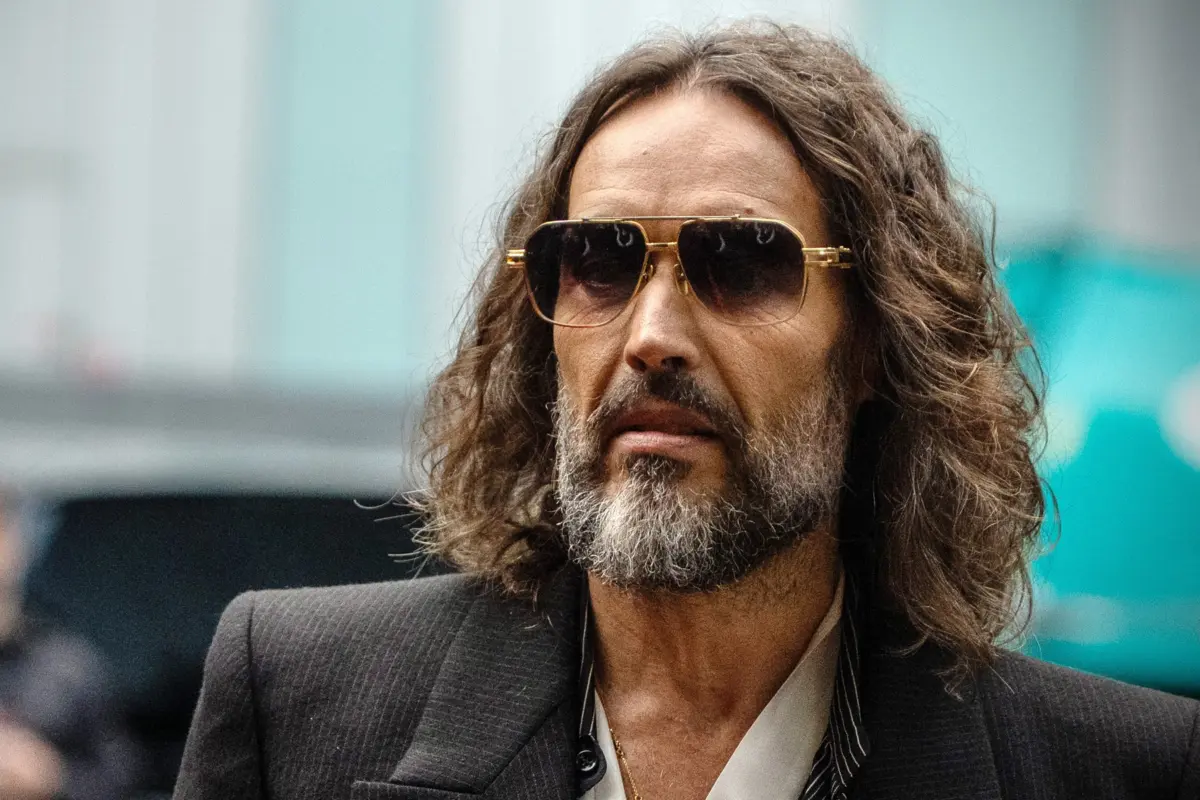
LONDON — Opening statements commenced on Wednesday in the high-stakes criminal trial of comedian and actor Russell Brand. British prosecutors laid out a damning case before the court, characterizing the 51-year-old entertainer as a serial sexual predator who allegedly treated the pursuit and conquest of women as a game driven by an insatiable, unchecked appetite.
Brand faces a total of seven criminal charges spanning a decade of alleged misconduct between 1999 and 2009. The charges include one count of indecent assault, three counts of rape, and three counts of sexual assault, involving six distinct complainants. Brand has formally pleaded not guilty to all charges and has consistently denied any criminal wrongdoing.
As the proceedings unfold in a London courtroom—attended by Brand alongside his wife, illustrator Laura Gallacher—the trial is projected to last at least six weeks, casting a long shadow over Brand’s multifaceted career in entertainment and his subsequent reinvention as a right-leaning digital commentator and conspiracy theorist.
Executive Overview
The legal reckoning facing Russell Brand represents a watershed moment for accountability within the British entertainment industry, bridging an era of unchecked celebrity culture with modern legal scrutiny. Once celebrated for his flamboyant persona, rapid-fire wit, and counter-cultural charm, Brand now sits at the defense table answering to grave allegations brought by six women who claim they were targeted, manipulated, and assaulted during the height of his mainstream success.
Lead prosecutor Riel Karmy-Jones KC did not mince words during her opening address to the jury. She detailed a pattern of behavior characterized by an aggressive sense of entitlement, arguing that Brand viewed women merely as instruments for his gratification. The prosecution’s strategy relies heavily on demonstrating a consistent modus operandi across multiple decades and varying locations—from broadcasting studios to private residences—arguing that separate, uncoordinated accounts from six different women paint a cohesive picture of predation behind the scenes of Brand’s meteoric rise to fame.
Detailed Chronology of Allegations
The prosecution’s case spans a ten-year timeline from 1999 to 2009, capturing pivotal phases of Brand’s professional trajectory as he transitioned from an up-and-coming radio and television personality to a fixture of British media and Hollywood cinema.
According to court filings and opening statements, the six complainants did not know one another prior to coming forward, yet their testimonies share striking similarities regarding Brand’s behavior: an initial charm offensive, sudden and unwanted physical escalation, and the subsequent use of humor or abrupt departures to deflect accountability.
1. The 1999 Incident: A Private Residence
The earliest allegation dates back to 1999. One of the complainants testified that she had invited Brand to her room. According to her statement, she stepped away to use the bathroom, only to return and find Brand partially naked. She alleged that he proceeded to rape her, describing a psychological state of "drifting out of her head, knowing there was nothing she could do" to stop the assault.
2. The 2001 MTV Incident
The second complainant alleged that Brand targeted her in 2001 while she was working at MTV, a role that brought her into close proximity to the burgeoning television host. She claims Brand physically grabbed her without her consent, establishing a pattern of workplace and professional boundary violations.
3. The 2004 Party Incident
In 2004, a third woman alleged that Brand physically dragged her into a bathroom during a social gathering and proceeded to assault her, demonstrating what prosecutors described as a blatant disregard for personal autonomy in social settings.
4. The 2005 Capital Radio Incident
By 2005, Brand was a prominent fixture on British airwaves. A fourth complainant testified that while working at Capital Radio, Brand groped and kissed her forcefully as she physically fought back against his advances.
5. The 2009 Professional and Private Incidents
Two separate allegations date from 2009. The fifth complainant alleged that she was forced to massage Brand while he pressed his face into her groin area against her will.
The sixth complainant stated that she initially agreed to engage in consensual sexual activity with Brand, but alleged that he intentionally removed the condom without her knowledge or consent ("stealthing") and refused to stop when she explicitly told him to do so.
"Six women, separate women, different allegations," Karmy-Jones told the jury. "When you hear them, I have no doubt that you will find their evidence compelling."
Supporting Context & Metrics
The Arc of a Controversial Career
To understand the environment in which these alleged offenses occurred, legal analysts point to Brand’s rapid ascent through the ranks of British media. Emerging in the early 2000s as a host for MTV and the BBC, Brand cultivated an edgy, boundary-pushing persona that merged rock-star aesthetics with self-deprecating humor about his struggles with drug addiction and hyper-sexuality.
His transition to Hollywood yielded prominent roles in studio comedies such as 2008’s Forgetting Sarah Marshall and 2010’s Get Him to the Greek, alongside a high-profile, short-lived 14-month marriage to pop superstar Katy Perry.
The 2023 Investigative Catalyst
The legal proceedings follow a joint investigative exposé broadcast in 2023 by the documentary Russell Brand: In Plain Sight (produced by Channel 4’s Dispatches, The Times, and The Sunday Times). The documentary brought anonymous historical allegations into the public sphere, prompting police inquiries and encouraging additional women to come forward to law enforcement authorities.
Brand’s Public Statements and Admissions
In the wake of the documentary’s release and subsequent media scrutiny, Brand launched a defense via his online independent media channels, denying all allegations of non-consensual sexual activity. However, his public commentary has frequently acknowledged the ethical complexities of his past behavior during his peak years of fame.
During an interview in April with media personality Megyn Kelly, Brand discussed his past sexual conduct—including an acknowledged relationship with a 16-year-old when he was 30 years old—while attributing his past actions to rampant drug addiction and severe narcissism.
"Consensual sex with a lot of people, when there is a strong power differential, as there is when you are a famous man who has the ability to attract women that I had at that time, I think involves exploitation. I think it is exploitative," Brand remarked in April. "I recognize that my sexual conduct in the past was selfish and I did not apply enough consideration, barely any I suppose, really, to how that sex was affecting other people."
Despite these reflections on the exploitative nature of power dynamics and fame, Brand’s defense counsel maintains that his past encounters, however hedonistic or morally questionable, did not cross the line into criminality.
Official Statements & Prosecution Strategy
The Crown Prosecution Service (CPS) has structured its case around dismantling the defense’s anticipated framing of the encounters as misunderstood or regrettable hookups. Prosecutor Riel Karmy-Jones characterized Brand’s psychological framework during the decade in question as fundamentally juvenile and self-absorbed.
"He was a flirt with a huge sexual appetite — childlike in his expectation that his every desire should be met," Karmy-Jones stated in court. Under this framework, she argued, women were viewed by the defendant as "simply a means to an end — that end being groping them, sexually or indecently assaulting them, or vaginally, orally, or anally raping them."
Karmy-Jones emphasized the indiscriminate nature of Brand’s alleged conduct: "The circumstances of the offending were as wide and as varied as the defendant’s career. His strong desire for some form of sexual contact was indiscriminate and voracious."
According to the prosecution, a hallmark of Brand’s alleged methodology was emotional evasion. Following the alleged assaults, witnesses reported that Brand would behave as though nothing extraordinary had occurred, frequently making swift exits or refusing to acknowledge the events in subsequent interactions, leaving victims isolated and disoriented.
Future Outlook & Industry Implications
As the trial moves past opening statements and into the presentation of witness testimony, the broader implications for Russell Brand’s public life and digital empire hang in the balance.
In recent years, Brand successfully pivoted away from mainstream entertainment into the alternative media landscape, cultivating a massive following as an independent podcaster and political commentator focused on spiritual wellness, skepticism of institutional authorities, and anti-establishment conspiracies. His online platforms have served as both his primary megaphone and his financial lifeblood following his departure from mainstream Hollywood and British broadcasting agencies.
A conviction on any of the severe charges he faces—particularly the counts of rape—would permanently alter his status, carrying profound legal penalties including potential imprisonment. Conversely, an acquittal would validate his long-standing claims of innocence and allow him to challenge the credibility of the journalistic investigations that brought his historical conduct to light.
The trial is projected to run for approximately six weeks, with jurors expected to hear extensive testimony from the six complainants, law enforcement officers, and character witnesses as both sides present their arguments to the London court.