

Executive Overview
In the rapidly accelerating landscape of artificial intelligence and digital content creation, few brand revivals have generated as much industry intrigue as the modern incarnation of LimeWire. Once notorious as a peer-to-peer file-sharing titan of the 2000s, the platform has completed a radical reinvention. Today, LimeWire operates at the intersection of generative artificial intelligence (AI), decentralized blockchain infrastructure, and creator-economy monetization.
No longer just a relic of early internet media distribution, LimeWire has re-emerged as a cutting-edge AI content publishing platform known as LimeWire Studio. By merging state-of-the-art generative models—such as Stable Diffusion and DALL-E—with automated non-fungible token (NFT) minting, ad-revenue sharing, and its native utility token ($LMWR), the platform provides a comprehensive toolkit for modern digital artists, musicians, and designers.
This deep-dive investigation explores LimeWire Studio’s technical architecture, its unique monetization frameworks, its subscription pricing tiers, and its broader implications for the future of digital asset ownership and AI-driven creative expression.
Detailed Chronology: From the P2P Era to the AI Frontier
The 2000s: The Napster Successor and Legal Battles
To understand the significance of LimeWire’s current trajectory, one must contextualize its origins. Launched in 2000, the original LimeWire was a Java-based file-sharing client that allowed millions of users to swap MP3s, videos, and software. At its peak, it was one of the most downloaded software applications in the world. However, the platform became the focal point of massive copyright infringement litigation by the Recording Industry Association of America (RIAA). In October 2010, a federal judge ordered the shutdown of the network, seemingly ending the LimeWire saga for good.
The 2022–2023 Pivot: Entering the Web3 and NFT Space
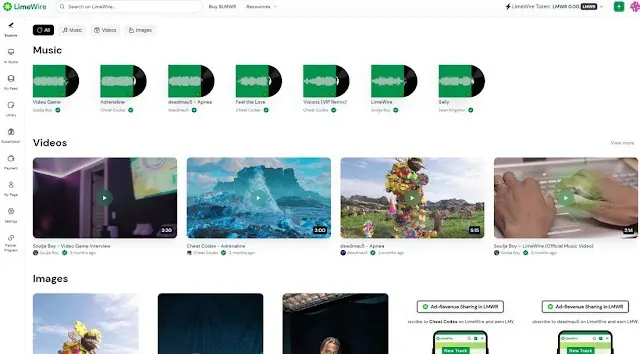
Over a decade later, the LimeWire brand was acquired by new ownership with a vision to repurpose its immense brand recognition for the Web3 era. Initially relaunching as a digital collectibles marketplace specifically tailored for music and pop-culture assets, the platform attracted major mainstream endorsements. High-profile artists and musicians—including Deadmau5, Soulja Boy, and Sean Kingston—began utilizing the ecosystem to publish exclusive music, videos, and digital artwork as NFTs.
The Generative AI Revolution and LimeWire Studio
Recognizing the shifting tides of the digital creator economy toward generative technologies, LimeWire executed a secondary pivot. The platform integrated sophisticated AI image generation tools directly into its publishing suite. By combining AI creation tools with its existing Web3 infrastructure, LimeWire successfully bridged the gap between automated content generation and decentralized monetization, transforming users from passive consumers into active digital entrepreneurs.
Supporting Context & Metrics: Inside the LimeWire AI Ecosystem
LimeWire Studio’s architecture is built on accessibility, flexibility, and financial empowerment. The ecosystem is defined by several core components that differentiate it from competing platforms like Midjourney or standard generative tools.
1. Advanced AI Image Generation Models
At its core, LimeWire’s AI Studio supports some of the most robust generative models available in the open-source and commercial AI space, including:
- Stable Diffusion 2.1 & Stable Diffusion XL (SDXL): Offering high-resolution outputs, incredible photorealism, and advanced prompt adherence.
- DALL-E 2: Providing versatile, concept-driven artistic creations.
Users can interface with these models using natural language prompts ranging from simple descriptive phrases to highly detailed parameters. Furthermore, LimeWire allows creators to seamlessly switch between diverse artistic styles, such as:
- Cinematic
- Digital Art
- Pixel Art
- Anime
- Analog Film
Additional features, such as customizable samplers and prompt guidance, give both novice creators and experienced digital artists fine-grained control over their final outputs. Crucially, LimeWire is actively developing its own proprietary AI model, signaling a move toward native technological independence.
2. Automated Blockchain Minting (NFTs)
One of LimeWire Studio’s most innovative features is its automated minting pipeline. Once a user generates an image, music track, or video and chooses to publish it, the platform automatically mints the creation as an NFT on either the Polygon or Algorand blockchain.
This process embeds a unique digital signature into the artwork, establishing verifiable authenticity and provable ownership. Creators retain total control over distribution:
- Public Releases: Content is discoverable by the entire LimeWire community, allowing enthusiasts to trade the digital collectibles freely.
- Subscriber-Only Access: Content is locked behind a paywall, available exclusively to premium followers who subscribe to the creator’s page.
3. The Creator Economy and Royalty Frameworks
LimeWire introduces a sustainable secondary-market economy for digital art. When fans collect and trade a creator’s digital assets within the LimeWire community, the original creator automatically earns a 2.5% royalty on every subsequent trade. This creates a perpetual passive income stream tied to the appreciation and circulation of their digital portfolio.
Official Statements and Revenue Architecture
LimeWire’s economic model stands apart from traditional social media and ad-supported content networks by redirecting a significant portion of platform revenue directly back to the creators.
Ad Revenue Sharing
When creators publish content on LimeWire, they are eligible to receive up to 70% of all ad revenue generated when other users view their images, music, and videos on the platform. This shifts the financial paradigm of digital design, allowing casual hobbyists and professional artists alike to monetize their creative output from day one.
The LMWR Token Economy
All earnings generated through ad revenue shares and marketplace sales are distributed in $LMWR, LimeWire’s native utility cryptocurrency token.
- Monthly Distributions: Earnings are paid out monthly in $LMWR tokens.
- External Liquidity: Creators can easily trade their $LMWR tokens on major centralized and decentralized crypto exchange platforms, including Kraken, ByBit, and Uniswap.
- Platform Utility: Beyond cashing out, users can spend $LMWR tokens directly on the platform to purchase additional credits for generative AI tools.
Pricing Plans and Membership Tiers
To accommodate everyone from casual experimenters to enterprise-level digital design studios, LimeWire offers a tiered subscription model alongside a complimentary entry point.
| Plan Tier | Monthly Price | Monthly Credits | Est. Image Generations | Ad Revenue Share | Key Perks |
|---|---|---|---|---|---|
| Free Tier | $0 | 10 Credits | Up to 20 images/day | 50% | Basic AI tools, standard access |
| Basic Plan | $9.99 | 1,000 Credits | Up to 2,000 images | 50% | Pro profile badge, faster generation, ad-free |
| Advanced Plan | $29.00 | 3,750 Credits | Up to 7,500 images | 60% | Early access to new AI models, full history |
| Pro Plan | $49.00 | 5,000 Credits | Up to 10,000 images | 70% | Maximum revenue share, priority generation |
| Elite Plan | $99.00 | 11,250 Credits | Up to 22,500 images | 70% | Highest credit allotment, enterprise-grade priority |
Note: All paid tiers include a Pro profile badge, full creation history logs, accelerated image generation speeds, and an ad-free user experience.
Future Outlook: Beyond Images into Audio and Video
LimeWire’s strategic roadmap indicates that the platform’s current focus on AI image generation is merely the foundation. Executives have confirmed aggressive expansion plans to roll out AI music and video generation tools in the near future.
As generative video and audio technologies mature, integrating these modalities into a unified platform equipped with automated NFT minting and crypto-native monetization could position LimeWire Studio as a dominant force in Web3 content creation. By democratizing access to high-end AI tools, eliminating complex blockchain onboarding hurdles, and rewarding creators with tangible financial upside, LimeWire has successfully rewritten its legacy—transforming from a symbol of digital copyright disruption into a foundational pillar of the modern creator economy.