In the hyper-competitive digital landscape of today, visibility is the ultimate currency. Securing sustainable organic traffic requires more than just guesswork or superficial keyword stuffing; it demands a data-driven, systematic approach to understanding search intent, analyzing competitors, and structuring content architecture. Among the myriad of enterprise-grade search engine optimization (SEO) suites available, Semrush remains a powerhouse platform, boasting a massive database comprising over 24 billion keywords.
For digital marketers, business owners, and SEO professionals alike, navigating this vast ocean of data can be daunting without a clear playbook. This comprehensive guide details an advanced, end-to-end framework for leveraging Semrush’s premier keyword research instruments—specifically the Keyword Manager, Keyword Magic Tool, and Keyword Gap analyzer. By implementing the strategic workflows detailed below, organizations can uncover immediate low-hanging fruit, systematically reverse-engineer competitors, generate profitable topical authority maps, and seamlessly scale their content production pipelines.
Detailed Chronology: A Step-by-Step Framework for Semrush Keyword Research
To maximize organic return on investment (ROI), marketers must execute keyword research in a deliberate sequence. Rushing straight into broad brainstorming often results in targeting ultra-competitive terms that yield little to no conversions. Instead, a structured, chronological approach ensures that immediate traffic gains are captured first, followed by aggressive competitor analysis and topical cluster development.
For websites with an established content footprint, the absolute best place to start is not by chasing brand-new keywords, but by optimizing the search terms you are already ranking for. Google often tests existing pages on pages one and two, presenting an immediate opportunity for quick traffic gains with minimal effort.
Navigate to Organic Research: Open the Semrush SEO Toolkit and access the Organic Research >> Positions report by inputting your domain. This generates a comprehensive list of every keyword your site currently ranks for within Google’s top 100 positions.
Apply Advanced Filters: To isolate the most actionable opportunities, apply precise filters for Position, Search Volume, and Keyword Difficulty (KD). The sweet spot for quick wins typically lies in positions 4 through 15—pages that are agonizingly close to the lucrative first three slots. Set a minimum search volume threshold relevant to your niche and cap the Keyword Difficulty to ensure you aren’t fighting an uphill battle against domain authorities.
Segment and Save: Review the filtered keyword set and transfer the best candidates into a dedicated list inside the Semrush Keyword Manager. Segment your targets into clear lists—such as Existing and New—to prevent redundancy and streamline tracking.
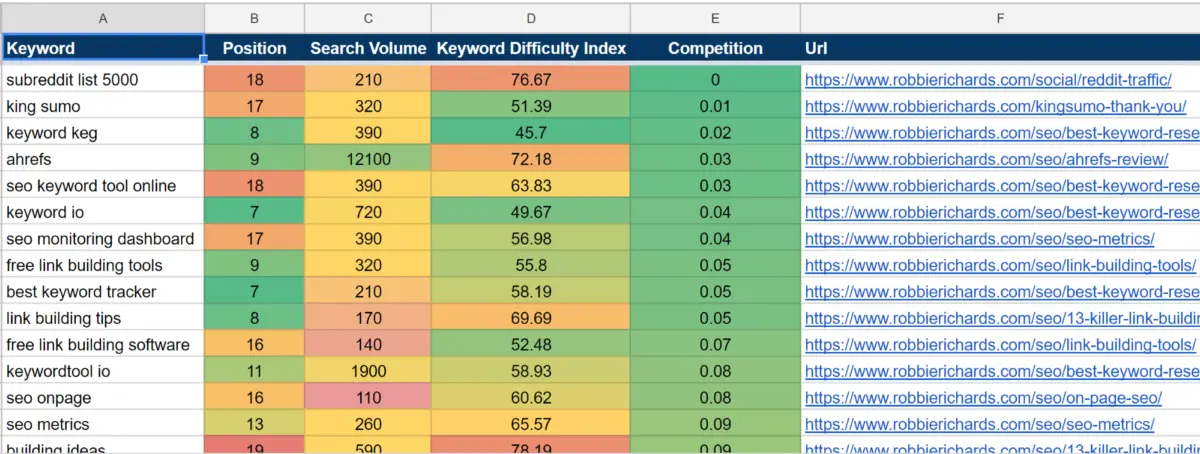
(Pro Tip: For teams preferring external analysis, export the position 4–15 dataset and paste it into a standardized spreadsheet template. Automated conditional formatting can then highlight high-volume, low-competition keywords instantly.)
Phase 2: Reverse-Engineering Competitor Dominance
Once existing opportunities are captured, the next logical step is to look outward. Analyzing what is already working for top competitors bypasses months of trial and error, revealing high-intent keywords that are actively driving conversions for your rivals.
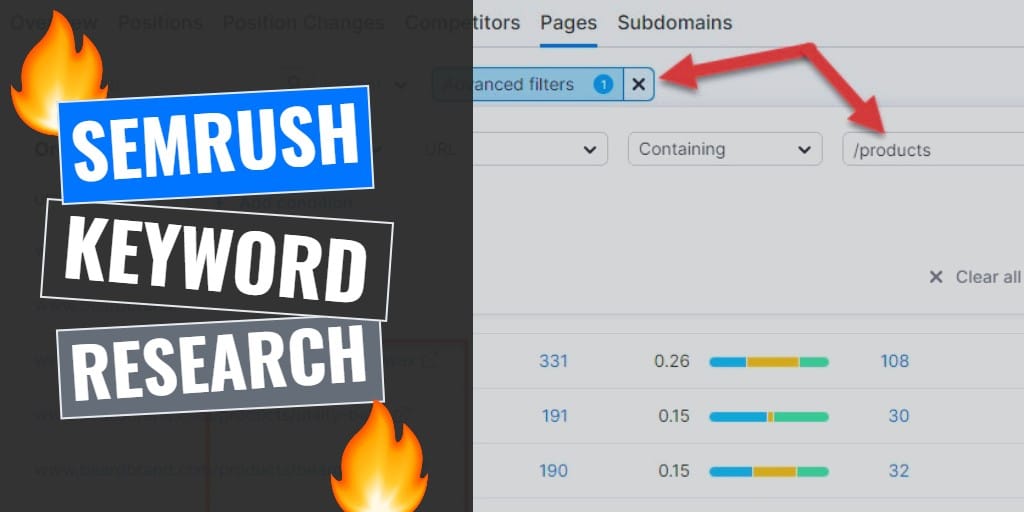
Top Pages Report Analysis: Input a primary competitor’s domain (for example, an ecommerce brand entering "Beardbrand") into the SEO Toolkit and navigate to Organic Research >> Pages. This surfaces the exact URLs driving the lion’s share of their organic traffic.
Subfolder Filtering: To refine the data, apply a URL filter targeting specific sections of the competitor’s site. For ecommerce stores, filtering by /products/ highlights direct monetization opportunities. For professional service firms (such as legal or medical practices), filtering by /legal-services/ isolates high-intent service pages.
Keyword Modifiers: If competitors do not use rigid subfolder structures, deploy keyword modifiers. Filtering for terms like "best," "review," "software," or "vs" immediately exposes high-intent commercial and transactional queries ideal for affiliate or direct-to-consumer monetization.
Phase 3: Executing Comprehensive Keyword Gap Analysis
The Semrush Keyword Gap Tool allows users to compare up to five competitor domains against their own simultaneously, exposing crucial blind spots in their content strategy.
Missing Keywords: This view highlights all the valuable organic and paid keywords your competitors rank for, but your domain does not.
Weak Keywords: This report pinpoints terms where your website currently ranks lower than your competitors, signaling pages that require urgent content optimization, expansion, or a fresh internal linking strategy.
PPC-Organic Cross-Analysis: Uniquely, Semrush allows marketers to evaluate paid versus organic gaps. By analyzing keywords your competitors are actively bidding on in Google Ads, you can identify high-converting commercial intent terms. Brands can utilize paid search ("air cover") to bid on high-intent keywords while they patiently build their organic rankings.
Phase 4: Scaling Topical Authority with the Keyword Magic Tool
With competitor insights secured, expanding your topical footprint requires the Keyword Magic Tool. By entering broad seed terms, marketers can unlock thousands of variations.
Advanced filtering options are crucial here. To target middle-funnel prospects in the consideration stage, apply modifier filters like "alternative," "comparison," or specific competitor brand names (e.g., "Ahrefs vs Semrush"). These comparison terms capture high-intent buyers actively evaluating solutions, driving referral traffic that converts exceptionally well into commissions or sales. Additionally, filtering by question modifiers ("how," "what," "why") unlocks massive low-competition informational keyword sets.
Phase 5: Building Topical Clusters in the Keyword Manager
Modern search engines do not rank isolated web pages; they reward holistic topical authority. Semrush’s Keyword Manager enables users to build or upload custom keyword lists and automatically group them into semantic topical clusters.
Create Clusters: Input up to five seed keywords along with your domain context, and the tool will automatically segment hundreds of keywords into logical topical groupings.
Evaluate Content References: Before drafting content, hover over the "Content References" metric to see how competitors are ranking. If competitors utilize dedicated, siloed landing pages for specific sub-topics (e.g., "hit and run attorney" vs. a broad "personal injury lawyer" page), you must build a dedicated sub-service landing page to capture that specific cluster effectively.
Supporting Context & Metrics: The Anatomy of Modern SEO Data
Understanding the core metrics underpinning Semrush’s interface is essential for executing a profitable strategy. Data without interpretation can lead teams astray.
Metric / Tool
Primary Purpose
Strategic Application
Keyword Difficulty (KD%)
Measures how hard it would be to rank in the top 10 organic results for a given keyword (scored 0-100%).
Helps resource-constrained teams prioritize low-to-medium difficulty terms for faster ranking wins.
Search Intent
Categorizes keywords into Informational, Navigational, Commercial, or Transactional.
Ensures the content format matches what the user actually wants (e.g., a blog post vs. a product page).
Traffic Potential / Volume
Estimates the average monthly searches for a keyword over a 12-month period.
Gauges potential market reach and prioritizes high-impact content production.
Keyword Gap Tool
Cross-references multiple competitor domains against your own.
Uncovers blind spots, missing keywords, and ranking weaknesses in real-time.
Furthermore, one of Semrush’s greatest architectural strengths is its tool integration. Unlike fragmented SEO tech stacks that require endless data exports and CSV imports, Semrush links its ecosystems natively. Once a refined keyword list is finalized in the Keyword Manager, marketers can instantly push those terms directly into the Position Tracking tool for long-term rank monitoring, or seamlessly transfer them to the SEO Writing Assistant to guide real-time content creation, optimization, and structural formatting.
Official Statements and Industry Perspective
Industry veterans and SEO practitioners continually emphasize the shift away from volatile, single-keyword targeting toward comprehensive topical ecosystems. As search engines evolve through sophisticated semantic indexing and AI-driven updates, the emphasis has shifted entirely to user intent and content depth.
"When working with a website that has an existing content footprint, the absolute best place to start is your existing keyword rankings. Capturing quick organic traffic gains from positions 4 through 15 builds immediate momentum," notes leading SEO strategist Robbie Richards in his comprehensive digital marketing guides.
Furthermore, enterprise data analysts point out that integrating paid search data with organic keyword gap analysis provides an unmatched competitive advantage. Brands that utilize paid search intelligence to validate commercial intent before investing heavily in long-form organic content production consistently see higher conversion rates and superior marketing ROI. By treating paid search as an incubator for organic strategy, businesses eliminate the financial risk of targeting unproven search queries.
Future Outlook: The Evolution of Keyword Research in an AI-Driven Era
As the digital marketing horizon shifts toward artificial intelligence search integration (such as Google’s Search Generative Experience and AI-powered conversational search engines), the fundamentals of keyword research are undergoing a profound transformation. Traditional keyword volume metrics are no longer the sole arbiters of success; instead, semantic relevance, entity-based optimization, and hyper-targeted user intent reign supreme.
In this rapidly changing environment, tools like Semrush are becoming increasingly indispensable. The ability to automatically cluster thousands of keywords based on search engine result page (SERP) feature overlap ensures that content marketers do not accidentally cannibalize their own rankings. As search engines grow smarter, the winners will be those organizations that utilize integrated data platforms to map out comprehensive topical authority, answer nuanced user questions at every stage of the buyer journey, and efficiently execute scalable content operations.
By mastering the framework outlined in this guide—from capturing quick-win existing rankings and conducting rigorous competitor gap analyses to constructing robust topical clusters—marketers can future-proof their digital strategies and secure long-term, compounding organic growth.