The landscape of search engine optimization (SEO) continues to evolve at a relentless pace. As search engines integrate advanced artificial intelligence, dynamic rich snippets, and personalized localized results into their core architectures, tracking keyword performance has become vastly more complex. Gone are the days when a static, manually updated daily spreadsheet could provide an accurate picture of a brand’s organic search visibility. Today’s digital marketing ecosystem demands automated, high-precision tools capable of monitoring massive keyword volumes, volatile SERP features, and multi-device performance across diverse geographic zones in real time.
Investing in a robust Search Engine Results Page (SERP) tracking solution is no longer a luxury for enterprise brands and scaling agencies; it is a fundamental business necessity. Accurate rank tracking provides the primary empirical validation for SEO investments, bridging raw technical efforts with tangible business metrics like organic traffic growth, customer acquisitions, and bottom-line revenue.
This comprehensive review examines the current state of SERP tracking software. We will evaluate the essential features required to extract actionable intelligence from modern search engine result pages and provide a detailed analysis of the seven best SERP tracking tools available in 2025. Whether you are looking for a hyper-focused standalone tracker or a comprehensive all-in-one SEO suite, this guide will help you navigate the market and select the ideal solution for your specific operational goals.
Detailed Chronology and Evolution of SERP Tracking
To understand the sophisticated nature of today’s SERP tracking tools, it is helpful to trace how rank tracking has evolved alongside search engine algorithms over the past two decades.
Phase 1: The Era of Manual Spreadsheets and Basic Scraping (Early 2000s)
In the early days of search engine optimization, tracking rankings was a manual, tedious endeavor. SEO professionals would open a web browser, type a target keyword into Google or Yahoo, and scroll through pages of results to find their client’s URL. These positions were logged into local Microsoft Excel spreadsheets. As campaign sizes scaled, basic desktop scrapers emerged. These primitive tools used simple IP rotation and screen-scraping techniques to parse search result pages, though they were constantly plagued by CAPTCHAs, IP bans, and high error rates.
Phase 2: The Rise of Cloud-Based Automated Trackers (2010–2018)
As cloud computing matured, the SEO industry witnessed the birth of dedicated, cloud-hosted SERP tracking platforms. Tools like Advanced Web Ranking, AccuRanker, and ProRankTracker revolutionized the market by offloading data processing to robust server infrastructures. Agencies and enterprise brands could now monitor thousands of keywords daily without managing local software installations. However, tracking during this era was largely one-dimensional, focusing almost exclusively on traditional blue links and generic desktop positioning within major national markets.
Phase 3: The Multi-Device, Localized, and Feature-Rich SERP (2019–2023)
The rapid shift toward mobile-first indexing completely transformed search engine result pages. SERP trackers had to adapt rapidly to monitor desktop and mobile rankings simultaneously. Furthermore, Google began aggressively deploying a wide array of SERP features—such as Knowledge Panels, People Also Ask (PAA) boxes, local map packs, and video carousels—pushing traditional organic listings further down the page. SERP trackers evolved into complex intelligence platforms capable of categorizing pixels, tracking zip-code-level local rankings, and measuring "Share of Voice" rather than just static numeric positions.
Phase 4: The AI-Driven Search Era (2024–2025 and Beyond)
Today, the integration of generative AI into search engines—exemplified by Google’s AI Overviews and conversational search experiences—has introduced unprecedented volatility into the SERPs. Modern SERP trackers in 2025 are engineered to capture these dynamic layouts, helping marketers identify precisely which queries trigger AI summaries, map competitor dominance across non-traditional elements, and tie keyword movements directly to revenue analytics through advanced CRM and data warehouse integrations.
Many organizations struggle to justify ongoing SEO retainers or in-house development budgets because they view search visibility as an abstract metric. A professional-grade SERP tracking tool serves as the vital link between technical optimization and financial return on investment (ROI).
Correlating Rankings with Traffic and Conversions
Knowing that a keyword moved from position 8 to position 3 is interesting, but understanding how that movement impacts pipeline revenue is transformative. Advanced trackers integrate seamlessly with enterprise analytics platforms like Google Analytics 4 and Adobe Analytics. By merging keyword data (search volume, intent, and ranking position) with web analytics data (organic users, bounce rates, goal completions, and transaction values), businesses can construct holistic landing page reports. These reports clearly illustrate which content assets are driving high-intent traffic and directly contributing to company growth.
Granularity: Location, Device, and Language
Consumer search behavior is inherently contextual. A user searching for "best coffee shop" in downtown Chicago sees a completely different SERP than someone searching for the same term in a Chicago suburb. Effective SERP tracking must reflect this geographical nuance.
Top-tier tools offer granularity ranging from national campaigns down to precise zip-code or city-level tracking. Similarly, because mobile conversion paths differ significantly from desktop experiences, segregating desktop and mobile ranking data is crucial for diagnosing traffic dips and optimizing user experience workflows.
Essential Features to Look for in Modern SERP Tracking Software
When evaluating and comparing SERP tracking solutions for your organization, ensure the platform incorporates the following nine critical features:
1. On-Demand Ranking Updates and High Data Accuracy
Search engine rankings fluctuate constantly throughout the day due to algorithmic updates, personalized search results, and competitive shifts. Relying on weekly or sluggish batch updates leaves your team blind to emerging threats or sudden algorithm penalties. You need tools that provide automated daily checks paired with an on-demand refresh button, allowing you to instantly pull fresh data following major site deployments or algorithm rollouts.
2. Comprehensive SERP Feature Monitoring
Securing a top-three organic position is only half the battle. Modern SERPs are dominated by AI Overviews, featured snippets, local packs, and image carousels. Your chosen tracker must identify which of your targeted keywords trigger these features and monitor whether your domain—or your competitors—currently controls them. This insight dictates whether you need a minor content tweak to capture a Position #0 featured snippet or a complete structural overhaul.
3. Multi-Engine Support
While Google commands the lion’s share of global search traffic, ignoring alternative search engines can leave blind spots in your digital strategy. Whether you are managing local campaigns that rely heavily on Bing, international portfolios targeting markets reliant on Baidu or Yandex, or video-first strategies centered on YouTube, your rank tracker should support all major search ecosystems.
4. Zip-Code and Localized Tracking
For multi-location businesses, franchises, and local service providers, national ranking data is virtually useless. Ensure the platform allows you to monitor rankings at the state, city, and zip-code levels to accurately measure local pack visibility and localized organic performance.
5. Historical Rank Performance and Trend Analysis
A single snapshot in time does not tell the full story. Comprehensive historical data allows SEO professionals to analyze long-term trends, evaluate the impact of past optimizations, and benchmark performance against competitors across extended time horizons (e.g., year-over-year or multi-year views).
6. Advanced Competitor Benchmarking
SEO is a zero-sum game; when your rankings improve, someone else’s drop. Effective tools group your keywords into logical position buckets (e.g., Positions 1–3, 4–10, 11–50) and track competitor distribution over time. This highlights aggressive market movers and exposes vulnerabilities in your competitor’s content strategy.
7. Keyword Tagging and Data Segmentation
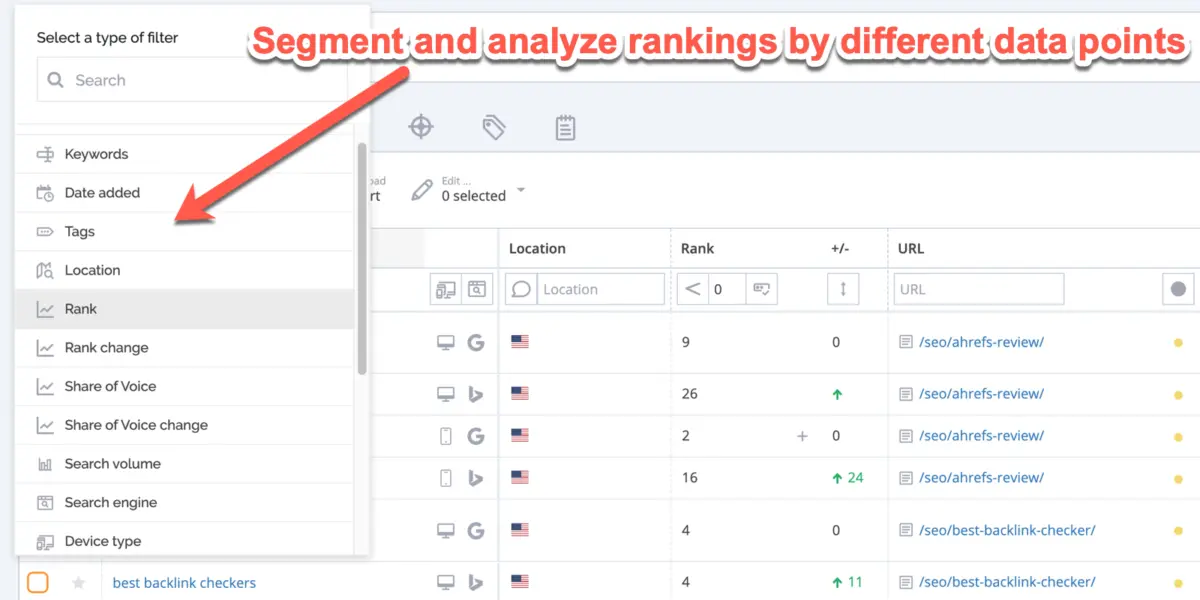
Monitoring thousands of unorganized keywords creates administrative chaos. Robust tools provide sophisticated tagging and filtering capabilities, allowing you to segment your keyword portfolio by product category, funnel stage (TOFU, MOFU, BOFU), content type, or geographic region.
8. Custom White-Label Reporting and Integrations
For agencies and enterprise consultants, client reporting is a major touchpoint for demonstrating value. Native white-label reporting options, automated email scheduling, and seamless integrations with visualization platforms (such as Google Looker Studio or Databox) ensure your stakeholders receive clean, digestible, and branded performance summaries.
In-Depth Review: The 7 Best SERP Tracking Tools for 2025
The market features countless options, ranging from hyper-specialized standalone tools to robust modules embedded within expansive all-in-one SEO suites. Below is our curated shortlist of the seven best SERP tracking tools for 2025.
1. AccuRanker
Type: Standalone SERP Tracker
Best For: Agencies, enterprise brands, and professionals demanding hyper-fast, on-demand data accuracy.
Overview: Trusted by over 32,000 companies—including industry giants like HubSpot, IKEA, and Kinsta—AccuRanker is widely regarded as the gold standard for dedicated standalone rank tracking. It combines blazing-fast performance with comprehensive data depth.
Key Features:
Automated daily updates with instantaneous on-demand data refreshing.
Deep SERP Analysis tracking over 50 distinct SERP features.
Comprehensive Share of Voice (SoV) analytics.
Advanced integrations with Google Analytics and Adobe Analytics to map rankings to revenue.
Native white-label reporting and a robust Looker Studio connector.
Pricing:
Subscription tiers scale based on tracked keyword volume, starting at $116/month for up to 1,000 keywords.
2. Semrush (Position Tracker & SERP Gap Analyzer)
Type: All-in-One SEO Platform with Advanced Rank Tracking
Best For: Marketing teams and enterprises looking for an all-encompassing SEO suite with world-class rank tracking capabilities.
Overview: Semrush serves over 10 million marketing professionals worldwide. Its Position Tracking Tool rivals the accuracy of dedicated standalone trackers while providing access to an immense ecosystem of keyword research, backlink analysis, and technical auditing tools.
Key Features:
Hyper-accurate daily tracking across desktop, mobile, and local map packs down to the zip-code level.
Comprehensive competitor comparison matrices and ranking distribution buckets.
Bonus App Center Integration (SERP Gap Analyzer): Scans search result pages to uncover under-optimized content, integrates with Google Search Console, and provides automated, actionable recommendations to capture low-hanging fruit keywords.
Pricing:
Comprehensive platform plans start at $139.95/month.
3. ProRankTracker
Type: Standalone SERP Tracker
Best For: Agencies, international businesses, and video marketers seeking a scalable, cost-effective tracking solution.
Overview: Trusted by over 60,000 users, ProRankTracker delivers robust, highly accurate tracking and reporting features across global search engines and localized markets without requiring an enterprise-tier budget.
Key Features:
Extensive international search engine coverage across multiple languages.
Comprehensive video rank tracking (YouTube optimization).
Automated client reporting and professional PDF exports.
Pricing:
Plans start at an accessible $39/month.
4. Advanced Web Ranking (AWR)
Type: Standalone SERP Tracker
Best For: In-house teams and enterprise agencies requiring highly customized reporting and deep historical data.
Overview: Advanced Web Ranking is a veteran player in the SEO space, trusted by major enterprises like Microsoft. Known for its exceptional flexibility, AWR excels at managing massive keyword portfolios across complex organizational hierarchies.
Flexible data segmentation across business units, brands, and regions.
Robust API access for custom data warehousing and BI tool integration.
Pricing:
Subscription tiers begin at $99/month.
5. SERPWatcher (by Mangools)
Type: All-in-One Platform Module (Mangools Suite)
Best For: Small businesses, startups, and freelancers looking for simplicity, beautiful UI, and affordability.
Overview: Developed by Mangools, SERPWatcher is designed to strip away the complexity often associated with enterprise SEO tools. Trusted by brands like Airbnb and Adidas, it focuses on intuitive design and core visibility metrics.
Key Features:
Unique Performance Index metric that calculates overall organic traffic potential based on current rankings and search volumes.
Clean, visually engaging dashboards that are instantly digestible for non-technical stakeholders.
Bundled access to complementary tools like SERPChecker for qualitative SERP analysis.
Pricing:
Mangools bundles start at $29.90/month, making it one of the most budget-friendly options on the market.
6. SE Ranking
Type: All-in-One SEO Platform
Best For: Small-to-medium agencies and growing businesses seeking an all-in-one platform with precise tracking algorithms.
Overview: SE Ranking offers a feature-rich, highly reliable position tracking tool that simulates actual user behavior in precise geographic locations to ensure 100% data fidelity.
Key Features:
Complete search engine coverage across all major search networks, devices, and locations.
Comprehensive competitor ranking insights and historical data access.
Automated reporting and professional white-label capabilities.
Pricing:
Plans start at $52/month (based on daily tracking for 500 keywords).
7. Nightwatch
Type: Standalone SERP Tracker
Best For: Brands and agencies needing ultra-precise local tracking and advanced data visualization.
Overview: Nightwatch stands out for its staggering global reach, pulling accurate ranking data from over 107,000 distinct geographic locations. It is trusted by high-growth tech companies and enterprise brands such as Shopify, Coinbase, and Scotiabank.
Key Features:
Unmatched global location targeting.
Advanced segmentation and custom data filtering.
Flexible tiering suitable for freelancers up to massive enterprise organizations.
Pricing:
Paid plans begin at $32/month for up to 250 keywords, backed by a 14-day free trial.
Official Statements and Industry Expert Perspectives
Industry leaders continue to emphasize the shifting role of rank tracking in modern digital marketing strategies.
Matthew Howells-Barby, Co-Founder of TrafficThinkTank, notes:
"It’s by far the best keyword ranking tracker in the market and has a ton of great reporting functions. If you want visibility on large volumes of keywords housed within a nice dashboard—this is for you."
Reinforcing the importance of streamlined client communication, Ian Howells, Co-Founder of Traffic Think Tank, highlights the integration capabilities of modern tools:
"The thing that really got me using them heavily in the last month or two is their Looker Studio connector. Combining the tag feature, as well as the Share of Voice metric, has been a big help in making these reports immediately digestible."
Future Outlook: What Lies Ahead for SERP Tracking in 2025 and Beyond?
As we look toward the remainder of 2025 and into the future, several technological trends will shape the evolution of SERP tracking software:
Deeper AI Integration: As generative search engines alter traditional click-through rate curves, rank trackers will increasingly measure "Share of Screen" rather than traditional numeric positions. Tracking visibility within AI summaries and conversational answers will become standard practice.
Real-Time Predictive Analytics: Future trackers will leverage machine learning models to forecast ranking drops before they happen, analyzing minor algorithm shifts and competitive content velocity to provide proactive optimization warnings.
Hyper-Personalized Local Intelligence: With mobile and voice search emphasizing hyper-local intent, rank tracking tools will expand their localized simulation engines to cover hyper-granular coordinates down to neighborhood blocks.
Making Your Final Choice
Selecting the right SERP tracking tool depends entirely on your organizational structure, budget, and operational scale. If your primary objective is lightning-fast, dedicated standalone rank tracking with peerless data accuracy, AccuRanker remains the definitive choice. Conversely, if you require an expansive, all-in-one digital marketing suite that seamlessly blends rank tracking with deep keyword research and technical auditing, Semrush provides unmatched value.
Evaluate your keyword volume, geographic scope, and reporting requirements, take advantage of free trials where available, and equip your team with the precision intelligence necessary to dominate the search results in 2025.