

Amidst a grueling literary tour schedule, the ongoing demands of finalizing a manuscript, and the domestic stewardship of a newly acquired canine companion named Cooper, the pursuit of serious pomological research remains an unyielding imperative. While comprehensive, long-form apple evaluations have been temporarily sidelined in favor of triage, the sheer volume of seasonal fruit consumed necessitated a consolidated dispatch: the capsule review.
This installment marks the continuation of an ongoing, highly subjective culinary taxonomy that began in earnest with past evaluations—such as the benchmark Wild Twist review of February 2026. Rather than presenting uniform perfection, the 2026 harvest reveals itself as a landscape of profound agricultural chaos. Varieties fluctuate wildly from season to season, shifting from lackluster duds to sublime masterpieces, challenging the consumer to approach every orchard visit with equal parts curiosity and deep skepticism.

This report details ten distinct cultivars sampled across regional orchards, notably Vermont’s Scott Farm and Wisconsin’s Brightonwoods. It synthesizes tasting notes, structural metrics, texture profiles, and unapologetically idiosyncratic flavor descriptors into an authoritative, if admittedly whimsical, autumn ledger.
Detailed Chronology: Ten Cultivars Under the Microscope
The 2026 evaluation window captures a cross-section of heritage, regional, and unusual apples. Each specimen was subjected to empirical biting, chewing, and aromatic profiling.

1. Gravenstein
- Origin / Source: Scott Farm, Vermont (Originated in Denmark)
- Score: 7.5 / 10
- Profile: Historical confusion aside—Gravenstein was undeniably the physician, not the legendary literary monster—this Danish import proved to be a delightful surprise despite varied historical experiences with the variety. While falling slightly short of maximum crispness, it compensates with an abundance of juice and an intricate flavor architecture dominated by notes of vanilla, rooibos tea, honey, and elderflower. The skin provides an optimal tactile "pop" without proving deleterious to the mastication experience.
2. Hubbardston Nonesuch
- Origin / Source: Scott Farm, Vermont
- Score: 3.7 / 10
- Profile: Bearing a moniker reminiscent of a Depression-era agrarian drifter or a purveyor of unverified medicinal tonics, the Hubbardston Nonesuch failed to capture the imagination. Across two separate tastings, the fruit delivered an initial tongue-scrubbing astringency that quickly dissolved into a bright, hollow nothingness punctuated by faint floral hints of elderflower. A subsequent tasting revealed a sweeter, sub-acid profile that completely lacked structural zip, evaporating from the palate as rapidly as a literary phantom. Decimals were deployed for the score purely to lend an aura of unearned mathematical precision.
3. Lamb Abbey Pearmain
- Origin / Source: Regional harvest
- Score: 7.5 / 10
- Profile: Five years prior, this historical abbey-associated cultivar registered as a mundane, utterly forgettable experience. The 2026 iteration, however, represents the platonic ideal of seasonal fruit. Boasting a rugged crunch, a precise balance of acidity and sweetness, and a classic profile underpinned by bright tangerine citrus and a bizarrely pleasant umami-savory MSG undercurrent, it defies simplistic categorization. This dramatic turnaround reinforces a core pomological truth: apples are chaotic entities that shift wildly from season to season.
4. Hewes Crab
- Origin / Source: Specialty orchard stock
- Score: 5.0 / 10
- Profile: Commonly misidentified in casual shorthand, crabapples represent a fascinating class of fruit utilized primarily for hard cider production, jelly, or—in a pinch—as non-lethal projectiles to signal mild social disapproval toward minor humans. The Hewes Crab (or Virginia Crab) leans heavily into cider utility rather than fresh consumption. Though structurally dry and slightly mealy, its flavor profile is wonderfully eccentric: a collision of pear, pineapple, and savory tamarind that resolves into a startling, complex butterscotch finish.
5. Opalescent
- Origin / Source: Regional orchard stock
- Score: 8.0 / 10
- Profile: In the pantheon of agricultural glow-ups, the Opalescent achieves legendary status. Following a dismal, 2.5-out-of-10 drubbing in the previous year’s trials, the 2026 batch underwent a radical reinvention. Dense, remarkably crisp, and bursting with a tart-sweet berry punch underscored by delicate floral aromatics, this cultivar vaulted instantly from unmitigated dud to undeniable stud.
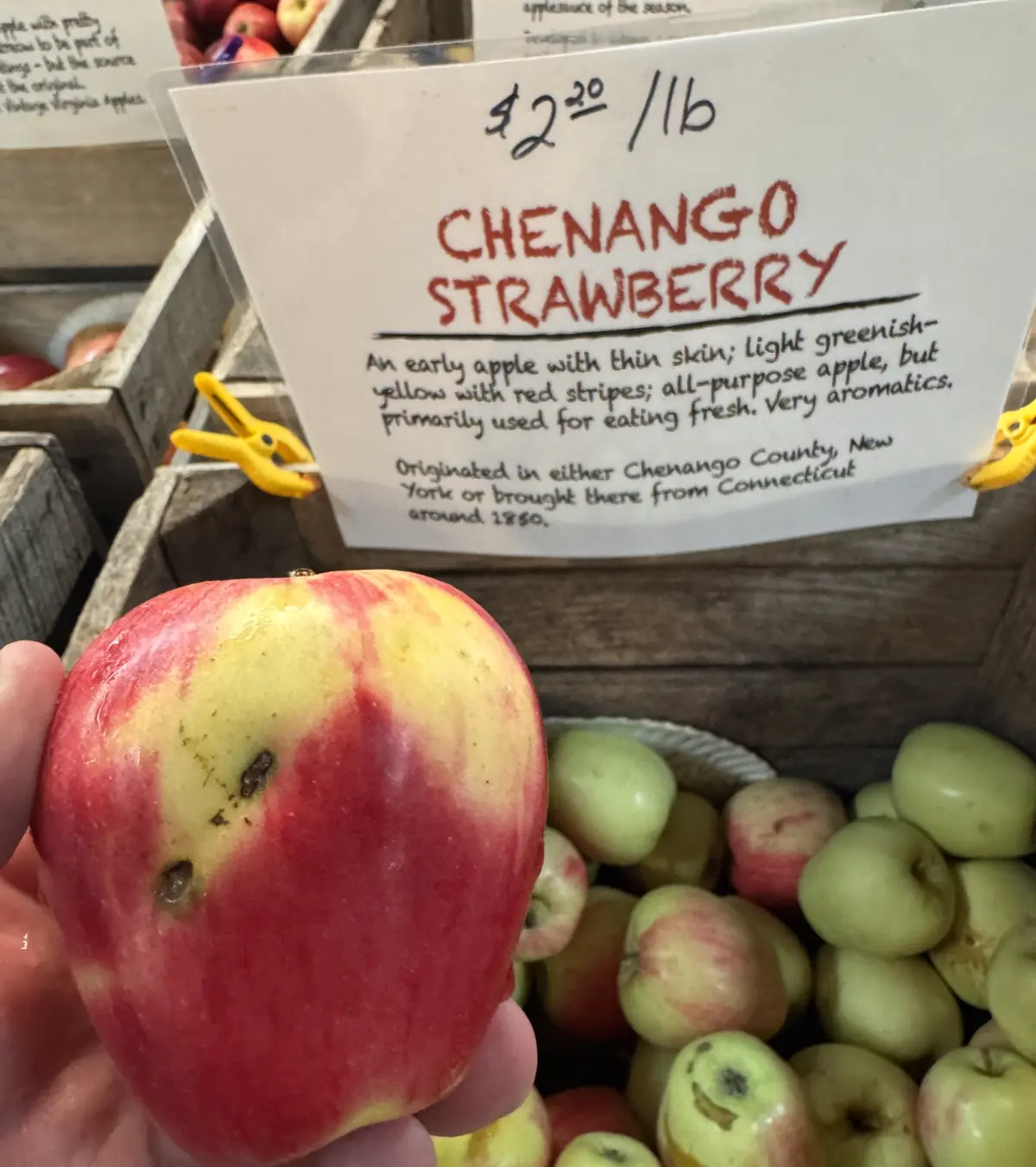
6. Chenango Strawberry
- Origin / Source: Brightonwoods Orchard, Wisconsin
- Score: 4.0 / 10
- Profile: While sharing no narrative connection to cinematic revenge thrillers, this Wisconsin acquisition excelled purely in the olfactory department. Upon contact, the fruit emitted a profound, authentic strawberry aroma—a rare truth in advertising within the fruit kingdom. Unfortunately, the textural reality proved tragic: a gushy, pre-applesauced mush that bypassed the need for human dental intervention entirely.
7. William’s Pride
- Origin / Source: Regional harvest
- Score: 6.3 / 10
- Profile: Distinguished primarily by its pronounced anatomical posterior—a rare visual trait among standard cultivars—William’s Pride offers a soft, highly obliging texture that stops short of true mealiness. Dripping with juice, it delivers an autumnal aftertaste heavy on warming pie spices like cinnamon, clove, and nutmeg, capped by a bizarre tertiary note reminiscent of the air inside a vintage used bookstore. While respectable, it ultimately lacks the aggressive tartness required for true greatness.
8. Blenheim Orange
- Origin / Source: Regional harvest
- Score: 7.0 / 10
- Profile: A formidable, dense specimen, the Blenheim Orange features a skin so resilient it feels like breaching industrial plastic packaging with human incisors. Once compromised, however, the interior reveals the sunny, vibrant disposition of a Cox’s Orange Pippin: electric lemon zest and bright floral zip. Its primary structural flaw lies in its sheer density; eating it evokes the crushing gravitational forces of a localized black hole, yet the flavor profile easily redeems the physical effort.
9. Golden Nugget
- Origin / Source: Regional harvest
- Score: 5.9 / 10
- Profile: Aesthetically challenging, the Golden Nugget resembles an ogre’s discarded dermal blemish retrieved from a damp ditch. Its initial profile delivers an unyielding, unripened green tartness that rapidly evolves into the aggressive flavor profile of a banana picked directly from its branch while profoundly, defiantly green. Despite defying conventional culinary logic, the fruit exerts a strange, compelling grip on the palate, hinting at untapped potential if subjected to prolonged cold storage maturation.
10. Doctor Harvey
- Origin / Source: Regional harvest
- Score: 5.1 / 10
- Profile: Classified historically as a culinary cooking apple, this heritage variety is functionally too soft for structural pie integrity, threatening to dissolve entirely into formless pastry goop. Nevertheless, it boasts a defining characteristic: an astonishing, peerless skin tension that yields an ASMR-grade "pop" upon biting. Accompanied by a gushing flood of berry-flavored wine cooler juice that evacuates the palate with criminal swiftness, it clears the threshold primarily on the strength of its acoustic acoustics.
Supporting Context & Metrics: The Pomological Chaos Matrix
To contextualize the vast qualitative spread of the 2026 harvest, researchers must analyze the interplay between environmental volatility and genetic expression. Apples do not conform to industrial manufacturing standards; they are biologically reactive variables.
- The Seasonal Variance Factor: As demonstrated by the dramatic redemption of the Opalescent (surging from 2.5 to 8.0) and the steady evolution of the Lamb Abbey Pearmain, single-season snapshots are fundamentally flawed. Orchards subjected to erratic precipitation, temperature swings, and localized soil variances produce wild fluctuations in sugar accumulation and structural integrity.
- Texture vs. Flavor Disconnect: Modern consumers frequently conflate crispness with quality. However, cultivars like the Chenango Strawberry prove that high aromatic fidelity can coexist with complete structural collapse, whereas the Blenheim Orange demonstrates that extreme physical density can successfully house exceptional citrus brightness.
- The Specialty Index: Heritage and crabapple varieties (such as the Hewes Crab) occupy a liminal space between agricultural history and wild foraging. Their utility often transcends fresh eating, serving vital roles in fermentation economies and tactical social messaging.
Official Statements & Field Notes
Reflecting on the grueling logistics of simultaneous book touring through New Hampshire, Vermont, Ottawa, and Rhinebeck, New York, alongside the introduction of a high-energy canine named Cooper, field analysts emphasize the necessity of maintaining rigorous tasting standards amidst chaos.

"Apples are a chaos fruit. Eris knew it," notes the lead evaluator, emphasizing that absolute objectivity in pomology is an illusion. "Any opinions offered here should be viewed subjectively and, honestly, suspiciously. I am not an appleologist."
Field operations will continue as the tour transitions deeper into New England orchards, with strict warnings issued regarding auxiliary family members unknowingly dragged into sacrificial orchard excursions.

Future Outlook & Promotional Dispatches
The 2026 apple evaluation campaign remains active. With numerous regional orchards still slated for inspection during the New England leg of the current literary circuit, consumers should anticipate subsequent dispatches detailing further heritage and commercial cultivars.
For readers seeking to channel the erratic, unpredictable energy of the autumn harvest into a literary medium, related explorations of agrarian malevolence remain available. The novel Black River Orchard—exploring the dark intersection of sinister orchards and corrupted pomological specimens—is currently available in stores. Signed and personalized copies can be secured directly through the Doylestown Bookshop for direct home delivery.

Further updates, numerical volatility ratings, and crunch-test disclosures will follow as the frost sets in.