

Executive Overview
In a landmark achievement for precision cosmology, an international consortium of scientists has successfully measured the precise abundance of helium generated during the universe’s first five minutes. Published across a series of five papers in The Astrophysical Journal, this breakthrough cuts the margin of uncertainty down to an astonishing 0.5 percent—tripling the accuracy of previous empirical estimates.
Leveraging 130 hours of deep-space observation via the formidable Large Binocular Telescope (LBT), the research team bypassed conventional observational bottlenecks by targeting exceptionally pristine, dwarf galaxies acting as cosmic time capsules. This meticulous methodology not only refines our empirical timeline of the Big Bang but also establishes a stringent testing ground for the Standard Model of particle physics. By isolating specific helium and hydrogen spectral lines with unprecedented fidelity, the findings afford astrophysicists a high-resolution window into the thermodynamic and subatomic conditions that prevailed nearly 13.8 billion years ago.
Detailed Chronology & Methodology: Rewriting the Rules of Cosmological Measurement
For decades, the standard approach to determining primordial elemental abundance relied on brute-force statistical extrapolation. Researchers would catalog sprawling datasets of numerous galaxies, measuring their chemical compositions and using complex mathematical models to "work backward," attempting to subtract the chemical output of successive generations of stellar nucleosynthesis. While valuable, this traditional method accumulated systematic uncertainties, capping precision thresholds well above the critical tolerances required by modern theoretical physics.
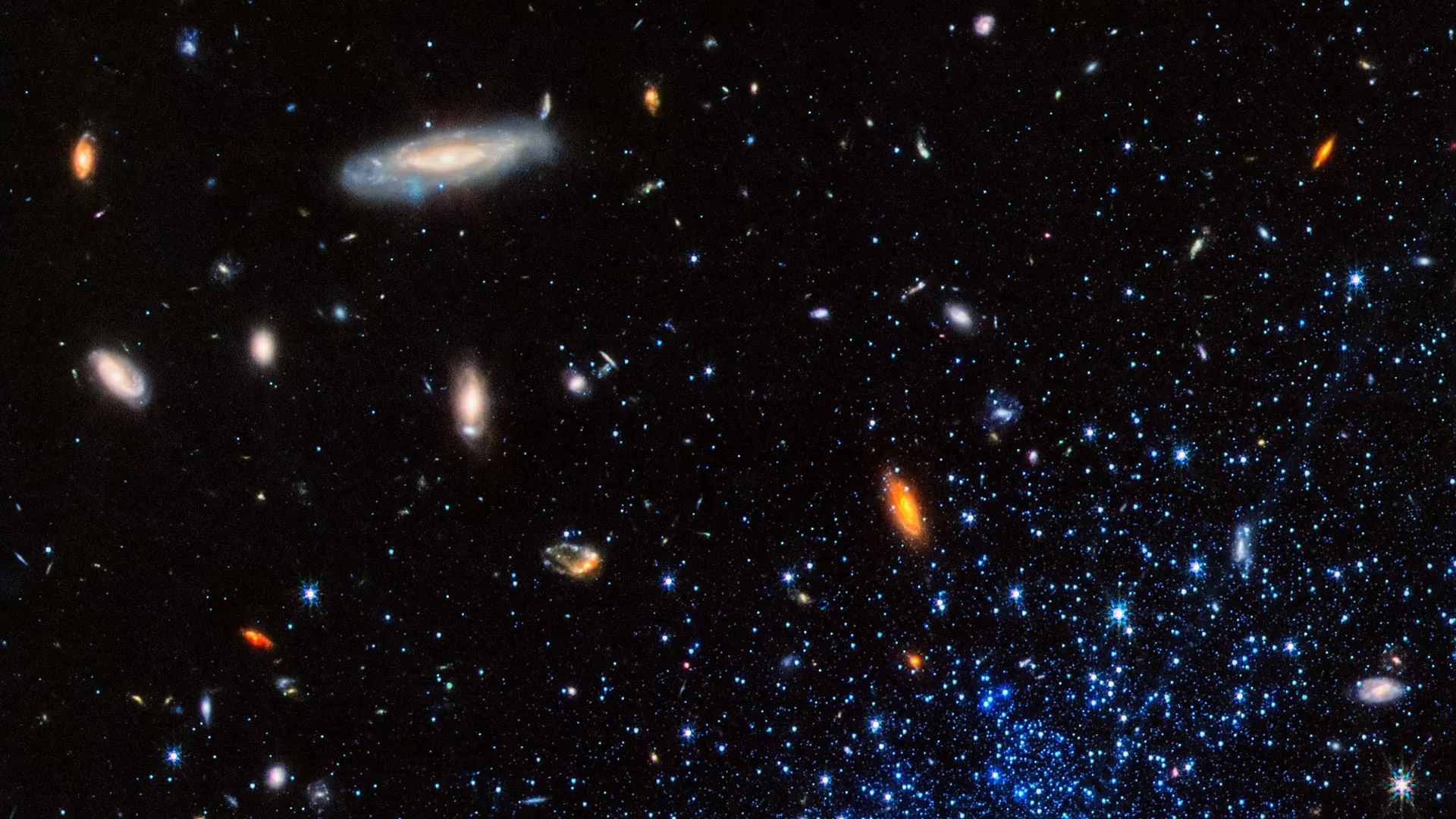
The newly published study discarded this scattershot approach in favor of a targeted, surgical strategy. The international team curated a select sample of 15 remarkably pristine, chemically unevolved, small, and distant galaxies. Because these cosmic systems have experienced minimal star formation and chemical enrichment over cosmic time, their current gas compositions closely mirror the primordial soup forged in the immediate aftermath of the Big Bang.
To squeeze every drop of diagnostic clarity from these distant targets, the team turned to the Large Binocular Telescope, utilizing advanced facility-class spectrographs engineered at Ohio State University. Known as the Multi-Object Double Spectrographs (MODS), these instruments represent a triumph of optical and mechanical engineering.
[Target: 15 Pristine Dwarf Galaxies]
                 │
                 ▼
[Observation: 130 Hours via Large Binocular Telescope (LBT)]
                 │
                 ▼
[Data Acquisition: MODS Spectrographs (Simultaneous >10 Helium / 15 Hydrogen Lines)]
                 │
                 ▼
[Analysis: Correction for Subtle Systematic Errors]
                 │
                 ▼
[Result: Primordial Helium Measurement at 0.5% Uncertainty]
Rather than measuring isolated spectral features sequentially—a process that introduces calibration drift and compounding errors—the MODS instruments simultaneously captured more than 10 distinct helium spectral lines alongside 15 hydrogen lines. This simultaneous multi-line profiling enabled researchers to cross-calibrate signals in real-time, identifying and neutralizing micro-sources of observational error that had plagued past generations of space and ground-based telescopes. Accounting for these minute second-order effects was the linchpin that drove measurement uncertainty beneath the elusive one-percent threshold, culminating in the final 0.5-percent margin.
Supporting Context & Metrics: The Physics of the First Five Minutes
To understand the profound nature of this achievement, one must contextualize helium’s role within the broader framework of modern cosmology. The Big Bang theory rests upon three foundational observational pillars:
- The ongoing expansion of the universe, first mapped via galactic redshifts by Edwin Hubble.
- The Cosmic Microwave Background (CMB), the fossil radiation field echoing from recombination, mapped down to exquisite precision by the Planck and WMAP satellites.
- Big Bang Nucleosynthesis (BBN), which dictates the primordial abundances of light elements—principally hydrogen, helium-3, helium-4, and deuterium—forged during the initial evolutionary epochs.
While the expansion rate and the CMB have been subjected to exhaustive, high-precision probing over the past thirty years, primordial helium measurements have historically lagged. This discrepancy was primarily driven by observational limitations rather than theoretical disinterest. Helium is ubiquitous in the universe, but separating the helium manufactured inside stars over billions of years from the primordial baseline forged in the first few minutes of the cosmos is an immensely complex geochemical puzzle.
By resolving this ambiguity, the new 0.5-percent measurement unlocks critical predictive power. The precise ratio of helium to hydrogen in the early universe is intimately tied to the expansion rate of space and the density of baryonic (ordinary) matter during the first five minutes. Furthermore, this metric provides a direct proxy for counting the number of neutrino families—elusive, weakly interacting subatomic particles that flooded the early cosmos.
Because the expansion rate of the early universe dictates how quickly temperatures dropped, it directly governed the neutron-to-proton ratio just before nucleosynthesis froze out. This, in turn, fixed the final abundance of helium-4. Therefore, any deviation between theoretical predictions from the Standard Model and these ultra-precise empirical measurements could signal the presence of exotic physics, such as sterile neutrinos, unaccounted-for relativistic particles, or anomalous dark-sector interactions.
Official Statements & Institutional Perspectives
The success of the project is the culmination of decades of collaborative technical development, international grant navigation, and relentless data reduction.
Evan Skillman, Distinguished Professor in the School of Physics and Astronomy within the University of Minnesota College of Science and Engineering, characterized the undertaking as a defining moment in his professional life:
"This is a physics experiment on a grand scale and one of the biggest findings in my entire 40-year career," said Skillman. "It’s a fundamental number that tells us specifically about the conditions of our Universe in its first five minutes. It has diagnostic power that speaks directly to the Standard Model of Physics."
Skillman noted that scientific proposals routinely feature ambitious performance metrics, but rarely do physical outcomes match projected tolerances with such exactitude.
"We promised a half-percent uncertainty in our proposal, and we got there," Skillman added. "In the unpredictable world of science, that doesn’t happen very often."
The instrumentation enabling this milestone required generational planning. Richard Pogge, Distinguished Professor of Astronomy in the College of Arts and Sciences at Ohio State University, underscored the grueling timeline required to bring the MODS spectrographs from blueprint to operational reality:
"The MODS spectrographs took 12 years to build from conception to first light on sky," Pogge explained. "This is the kind of project we designed them to do, and to see them deliver is enormously satisfying. It’s not every day you can help build instruments that measure something fundamental about our Universe."
The multi-institutional breadth of the collaboration reflects the modern reality of "Big Science," uniting observational specialists, theoretical astrophysicists, and instrumentalists across global divides. The paper’s authorship pool includes leading researchers from the University of Minnesota Twin Cities, Ohio State University, Gonzaga University, Northwestern University, The University of Texas at Austin, Indiana University, the University of California Santa Cruz, the University of Illinois, the Universidad Nacional Autónoma de México, and TRIUMF.
Future Outlook: Implications for Fundamental Physics and Next-Generation Astronomy
As these five papers reverberate through the astrophysical community, the broader implications of a 0.5-percent primordial helium measurement are already sparking follow-up theoretical investigations.
Primordial elemental abundances serve as a bridge connecting microscopic particle physics with macroscopic cosmology. Now that the helium benchmark has reached this tier of precision, theorists are re-running Monte Carlo simulations of BBN to cross-examine current determinations of the baryon-to-photon ratio against measurements derived from the Planck satellite’s CMB data. Any tension between the CMB-derived baryon density and the BBN-derived density acts as an immediate diagnostic canary in the coal mine, pointing toward either undiscovered systematic errors or cracks in the cosmological framework itself.
Moreover, the methodological framework established by this team opens a clear roadmap for future observational campaigns. As next-generation ground-based facilities—such as the Extremely Large Telescope (ELT) and the Giant Magellan Telescope (GMT)—come online over the next decade, astronomers will be able to apply the MODS simultaneous multi-line profiling technique to even fainter, more distant, and more pristine dwarf galaxies at higher redshifts.
Ultimately, this breakthrough affirms that precision cosmology is no longer confined to mapping the spatial distribution of galaxies or the thermal fluctuations of the cosmic microwave background. By looking deeply into the chemical composition of dwarf galaxies and isolating the microscopic signatures of primordial nucleosynthesis, scientists are successfully reading the ancestral diary of the cosmos—page by page, line by line, down to a fraction of a percent.