

Executive Overview
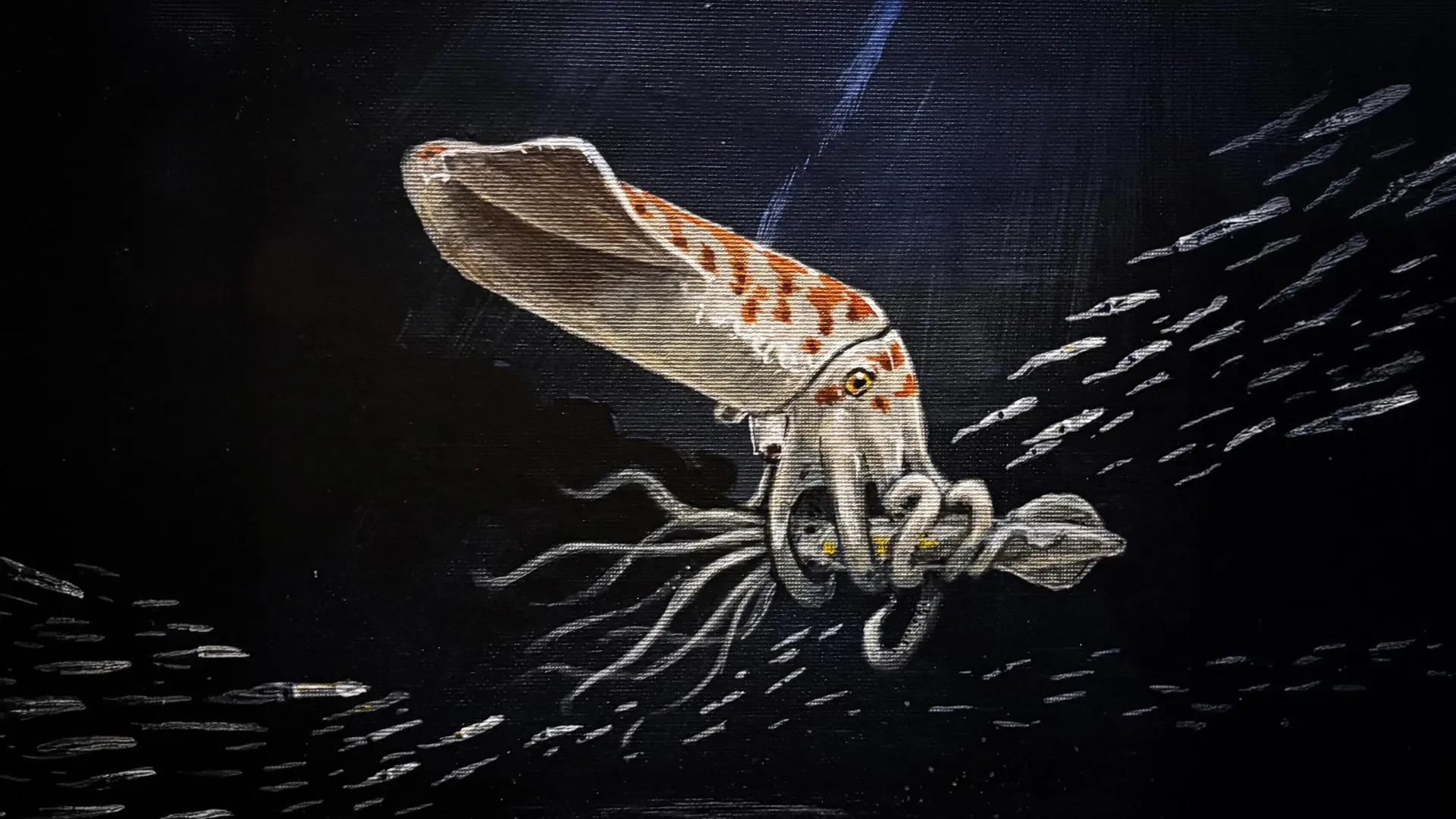
Paleontologists have officially unveiled a remarkable new chapter in prehistoric marine history with the description of Wyoteuthis linsterorum, an extraordinarily rare and physically distinct squid relative that cruised the shallow waters of an ancient North American inland sea approximately 160 million years ago. Hailing from the Middle Jurassic Period, this newly identified cephalopod belongs to an extinct group known as belemnites—relatives of modern squids, cuttlefish, and octopuses characterized by robust, internal calcareous skeletons.
What sets Wyoteuthis linsterorum apart from every other belemnite discovered in over two centuries of rigorous scientific study is its radical, unprecedented morphology. Rather than possessing the slender, bullet-like internal shell typical of its taxonomic order, this creature boasts an unusually thick, barrel-shaped internal skeleton. This unprecedented anatomical feature has earned it the informal yet descriptive scientific moniker of the "chunkiest" or "fattest" belemnite ever recorded in the fossil record.
Recovered from the fossil-rich deposits of Wyoming’s Sundance Formation, the discovery bridges critical gaps in our understanding of Mesozoic marine ecosystems. An international research collaborative spanning the United States, the United Kingdom, and New Zealand utilized cutting-edge computed tomography (CT) scanning to analyze the specimens nondestructively. Their findings, published in the scientific journal Papers in Palaeontology, reveal not only a radically distinct morphology but also unexpected phylogenetic connections to ancient belemnite lineages long thought to have vanished prior to the Jurassic.
This comprehensive report details the discovery’s three-decade evolution from a forgotten museum specimen to a published scientific landmark, examines the ecological implications of its unusual build, explores the collaborative efforts of the international research team, and honors the legacy of the citizen scientist whose sharp eye brought the fossil to light.
Detailed Chronology
The path from the initial discovery of Wyoteuthis linsterorum to its formal scientific description spans nearly thirty years, highlighting the vital relationship between amateur fossil collectors and professional academic institutions.
Phase I: The First Encounter (Late 1990s)
The story of Wyoteuthis linsterorum began in the late 1990s at the Wyoming Dinosaur Center. Dr. Burkhard Pohl, the institution’s founder, was sorting through regional invertebrate collections when he flagged a specimen that defied standard classification. While the Sundance Formation is famous for yielding millions of belemnite guards—locally nicknamed "squid butts"—this particular fossil possessed a girth and barrel-like configuration that dwarfed standard variations.
Despite its obvious anomalies, the specimen lacked a structural twin for comparative analysis. In paleontology, naming a new species based on a single, aberrant outlier carries high risks of misclassification, as the morphology could theoretically represent a pathological deformity or an extreme individual variation within an established species. Consequently, the fossil was cataloged, placed in a storage drawer, and remained unstudied for years.
Phase II: The Second Specimen and the Breakthrough (2019)
The catalyst for the species’ formal identification arrived more than twenty years later. Fossil collector Cliff Linster, an amateur paleontologist with a keen eye for geological anomalies, discovered a second, remarkably preserved specimen of the same oversized belemnite near the town of Ten Sleep, Wyoming. Recognizing that he had found something extraordinary, Linster contacted the Wyoming Dinosaur Center and donated the specimen to the institution in 2019.
The arrival of Linster’s donation provided researchers with the vital second data point needed to confirm that the oversized skeletons were not isolated abnormalities, but rather representatives of a distinct, previously unknown evolutionary lineage.
Phase III: Global Collaboration and Advanced Analysis (2020–2024)
With two specimens available, local paleontologists realized the project required specialized global expertise. Bill Wahl, a veteran Wyoming paleontologist who recognized that the fossils "stuck out like a sore thumb," spearheaded the formation of an international research group. The team incorporated belemnite specialist Alexey Ippolitov, then a PhD student at Victoria University of Wellington in New Zealand, and prominent vertebrate and invertebrate paleontologist Dr. Dean Lomax of The University of Manchester and the University of Bristol.
To peer inside the fossils without risking structural damage, the team subjected the calcareous guards to high-resolution computed tomography (CT) scanning. The digital cross-sections exposed internal growth lines and structural architectures that linked the specimens to an ancient belemnite family presumed extinct millions of years before the Jurassic.
Phase IV: Formal Publication and Bittersweet Legacy (2024)
The culmination of decades of preservation, curation, and international research materialized in the peer-reviewed pages of Papers in Palaeontology. The genus name Wyoteuthis was chosen to honor the state of Wyoming as the cradle of the discovery, while the specific epithet linsterorum was dedicated to Cliff Linster and his family in recognition of their contributions to science. Tragically, Cliff Linster passed away in June, shortly before the official publication of the paper. Although he did not live to see his discovery in print, he was fully aware of the research underway and knew his find had achieved permanent status in the annals of paleontological history.
Supporting Context & Metrics
To fully grasp the anatomical significance of Wyoteuthis linsterorum, one must examine the baseline biology and historical record of belemnites within the Mesozoic fossil record.
The Anatomy of a Belemnite
Belemnites were prolific marine cephalopods that dominated Jurassic and Cretaceous oceans. They possessed soft bodies, complex eyes, tentacles equipped with hooks or suckers, and an internal ink sac—closely mirroring the ecological niche of modern squid. However, unlike modern squids (most of which feature a flexible, internal proteinaceous pen known as a gladius), belemnites developed a heavy, bullet-shaped internal limestone (calcium carbonate) skeleton divided into three primary zones:
- The Phragmocone: The chambered, cone-shaped upper portion that provided buoyancy.
- The Proostracum: A forward-projecting extension of the phragmocone.
- The Rostrum (or Guard): The solid, bullet-shaped lower defensive and ballast structure that fossilizes with exceptional frequency.
Quantitative Comparison: Typical vs. Wyoteuthis
Across the Sundance Formation of Wyoming—a geologic formation that preserves an ancient inland sea—collectors routinely recover millions of standard belemnite guards, predominantly belonging to the genus Pachyteuthis.
-
Standard Sundance Belemnites (Pachyteuthis):
- Length: 5 to 10 centimeters (2.0 to 3.9 inches).
- Width/Diameter: 1 to 2 centimeters (0.4 to 0.8 inches).
- Morphology: Slender, tapered, and aerodynamic.
-
Wyoteuthis linsterorum:
- Length of Rostrum: Approximately 10 centimeters (3.9 inches).
- Width/Diameter of Rostrum: An extraordinary 6 centimeters (2.4 inches).
- Estimated Total Animal Length: Approximately 60 centimeters (24 inches or two feet), including arms and tentacles.
The sheer volumetric difference is staggering. While standard belemnites resemble elongated rifle bullets, Wyoteuthis approximates the proportions of a miniature barrel or an elongated egg, yielding a mass significantly greater than any contemporary species in the Sundance sea.
Official Statements
The discovery has generated considerable excitement within the global paleontological community, underscoring how private collectors and academic researchers continue to rewrite evolutionary histories.
Dr. Dean Lomax (Honorary Research Fellow, The University of Manchester; 1851 Research Fellow, University of Bristol):
"I met Cliff and Sandy [Linster] in 2009, when I spent a week digging up a dinosaur bonebed on their property in northern Montana. I have fond memories of that dig, listening to Cliff share his passion for fossils, including this belemnite. I’m honored to help name this fossil after Cliff. It’s bittersweet that he didn’t get to see it published, but it’s wonderful that we can immortalize him and his family name in the history of paleontology. The find is incredibly rare, which might be due to some ecological adaptations to the environment at the time. Perhaps its rarity is a result of narrow specialization."
Alexey Ippolitov (Belemnite Specialist and PhD Student, Victoria University of Wellington):
"I was deeply surprised to encounter such an unusual specimen from a group that has already been studied extensively for more than 200 years. A possible explanation for their morphology is that their relatively large size gave them an advantage when hunting co-occurring smaller belemnites of the genus Pachyteuthis. Modern squid, after all, are hardly picky when it comes to prey: they readily hunt not only other species of cephalopods, but sometimes even their own kind."
Jessica Lippincott (Wyoming Paleontologist and Study Coauthor):
"After spending years fossil hunting in Wyoming and collecting countless fossils of the common Pachyteuthis belemnites here in Wyoming, this one is unlike anything I have ever seen! It goes to show that we are still finding new species of fossils all the time, and people who rockhound or collect invertebrate fossils can also contribute to science."
Bill Wahl (Wyoming Paleontologist):
"The specimen stuck out like a sore thumb compared with the countless others found in the region. Its unusual proportions immediately signaled that we were dealing with an outlier that required modern diagnostic techniques to understand."
Future Outlook and Paleontological Implications
The formal description of Wyoteuthis linsterorum opens multiple avenues for future research in invertebrate paleontology, evolutionary biology, and paleoecology.
Reassessing Mesozoic Marine Food Webs
The discovery of a barrel-shaped, heavyweight belemnite forces paleoecologists to reconsider trophic dynamics in the Sundance Sea. Modern cephalopods are famously opportunistic apex predators of the invertebrate world. The robust rostrum and massive overall build of Wyoteuthis suggest it may have occupied a specialized predatory niche—potentially targeting schools of smaller belemnites or armored invertebrates that slender-bodied competitors could not efficiently subdue or process.
Phylogenetic Re-evaluations via CT Imaging
The unexpected structural similarities linking Wyoteuthis to an archaic belemnite family long thought extinct prior to the mid-Jurassic demonstrate the power of non-destructive CT scanning in invertebrate paleontology. Historically, taxonomy within this group relied exclusively on external macroscopic features of the guard. By examining internal micro-structures, researchers anticipate that other "anomalous" museum specimens worldwide may be re-evaluated, potentially revealing "ghost lineages"—taxa that survived in isolated refugia long after their primary radiation period ended.
Public Exhibition and Educational Impact
Both known type specimens of Wyoteuthis linsterorum are now on permanent public display at the Wyoming Dinosaur Center in Thermopolis, Wyoming. By housing these specimens in a regional museum situated near their discovery site, the institution ensures that both local community members and international researchers can study the physical evidence of this Jurassic anomaly.
Ultimately, Wyoteuthis linsterorum stands as a testament to the mysteries still locked within well-traveled geological formations. It reinforces the reality that even after two centuries of intensive study, the fossil record holds countless surprises, waiting only for a sharp-eyed observer in the field and a dedicated team in the laboratory to bring them to light.