


Executive Overview
Artificial intelligence has officially crossed the threshold from experimental novelty to foundational business infrastructure. For the modern freelance writer, ignoring the paradigm shift is no longer a viable strategy—it is a fast track to professional obsolescence. Yet, a stark bifurcation has emerged across the freelance economy. On one side are writers struggling to stay afloat, caught in a false dichotomy of either shunning AI entirely out of ideological purity or using it as a lazy shortcut to churn out derivative, easily detectable fluff.
On the other side are thriving professionals. These top-tier earners view large language models (LLMs) and specialized research platforms not as replacements for human thought, but as elite administrative and operational assistants. By delegating the friction-heavy, tedious mechanics of the writing lifecycle—such as overcoming the blank page, organizing fragmented research, and tracking client acquisition metrics—they free up cognitive bandwidth for what truly drives value: deep analysis, original sourcing, expert interviews, and interpersonal relationship-building.
This report examines 10 high-impact, strategic workflows that demonstrate how freelance writers can safely and effectively integrate AI into their daily operations to multiply output, slash administrative drag, and elevate the quality of their final work.
Detailed Chronology: The Evolution of the AI-Assisted Writing Workflow
The integration of artificial intelligence into creative workflows did not happen overnight. Understanding how the industry arrived at this current juncture helps contextualize why certain AI applications succeed while others fail.
- Phase 1: The Novelty Era (2022–2023): The mainstream introduction of generative AI tools sparked widespread panic across the creative sector. Early adopters treated LLMs as direct content generators, prompting them to write entire articles from scratch. The result was a flood of homogenized, formulaic content characterized by repetitive phrasing and a distinct lack of original insight, which clients quickly learned to spot and penalize.
- Phase 2: The Backlash and Saturation (2023–2024): As search engines and corporate content managers grew wise to low-effort AI copy, a fierce backlash ensued. Freelancers who relied entirely on automated drafting saw their rates plummet and contracts evaporate. The consensus shifted: pure generative AI writing was a dead-end commodity.
- Phase 3: The Augmentation Paradigm (2025–Present): Today, the most successful independent creators have pivoted toward augmentation. Rather than asking AI to write for them, they use it to manage the periphery of the writing process. AI has evolved into a cognitive sparring partner, a structural architect, an advanced research assistant, and an automated CRM manager.
This evolution has redefined what it means to be a "writer" in the digital age. The value is no longer locked up in the physical act of stringing words together—anyone can prompt a model to do that. Instead, value is derived from the unique lens, critical thinking, strategic oversight, and human connection that the writer injects into the final product.
10 Ways to Supercharge Your Freelance Writing with AI
1. Beating the Blank Page Syndrome
The psychological barrier of the blinking cursor has derailed more writing deadlines than writer’s block ever did. Staring at an empty document trying to manufacture the "perfect" opening sentence is an inefficient use of high-level cognitive energy.
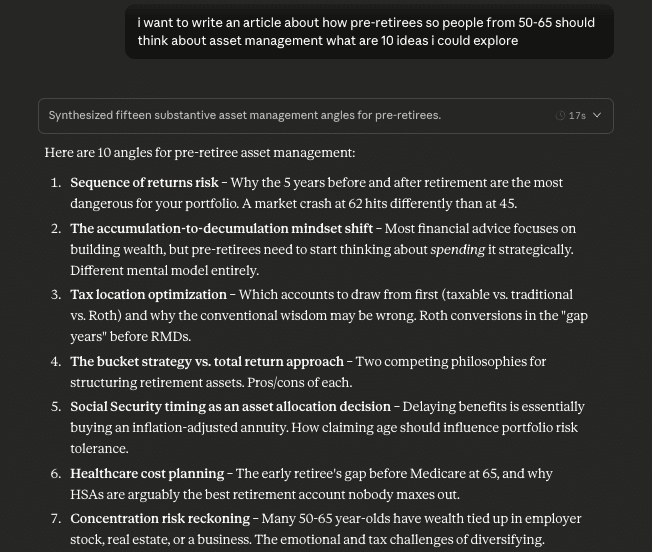
The AI Workflow: Instead of asking ChatGPT or Claude to write your article, use them as creative catalysts. Prompt the tool to generate 10 disparate structural angles for your topic, provide alternative opening hooks, or list out-of-the-box questions a sophisticated reader might ask.
- The Golden Rule: Do not accept the output verbatim. The objective is simply to shatter the paralysis. By reacting to flawed or alternative ideas, your brain is immediately forced into a decision-making state, transforming a blank page into a living canvas.
2. Architectural Outlining
Before a single paragraph of prose is drafted, structural integrity must be established. Whether constructing a comprehensive blog post, a thought-leadership article, or a cold pitch, a robust outline prevents messy tangents and structural collapses.
The AI Workflow: Feed your core topic, target audience parameters, and primary goals into your preferred LLM. Ask it to suggest a logical architecture, complete with subheadings and section breakdowns. For advanced workflows, establish a standardized intake prompt template. Paste in your messy, unorganized notes—raw research quotes, data points, and disjointed thoughts—and let the AI organize them into a coherent sequence. You can then selectively adopt, reject, or modify the suggested framework.

3. Accelerated Research Triage
Freelance journalism and content marketing demand exhaustive background research. Sifting through dense regulatory reports, multi-page academic studies, and endless industry blogs consumes hours of unbillable time.
The AI Workflow: Leverage specialized discovery engines like Perplexity Pro to rapidly surface verified statistics, trends, and direct source citations. For long-form documents or competitor articles, paste the text into an LLM and command it to extract key statistics, summarize the core arguments, and highlight potential data anomalies.
- Operational Efficiency: This acts as a high-speed triage system. You can determine whether an external source actually contains the information you need in two minutes rather than twenty—preventing the frustrating discovery that a seemingly "groundbreaking" statistic is actually a decade old.
4. Drafting Strategic Cold Emails and LOIs
Continuous business development relies on sending Letters of Introduction (LOIs) and cold pitches to prospective clients and marketing agencies. However, writing hundreds of introductory emails leads rapidly to message fatigue.
The AI Workflow: Use AI to generate foundational drafts for your outreach emails. Request five distinct variations scaled by tone or length. Crucially, reserve the final 20% of the work for yourself. Use the AI’s output as a scaffolding to build upon, but ensure the opening sentence is hyper-personalized. Cross-reference the target company’s recent press releases, conference awards, or newly published case studies to craft an individualized hook that no automated model could replicate.
5. High-Conversion Headlines and Hooks
An exceptional article remains unread if its headline fails to capture attention. Crafting compelling, non-clickbait titles that balance curiosity with specific authority is notoriously difficult.
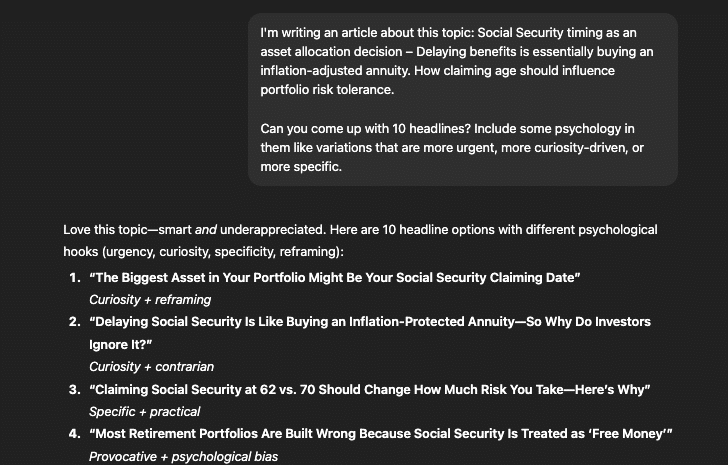
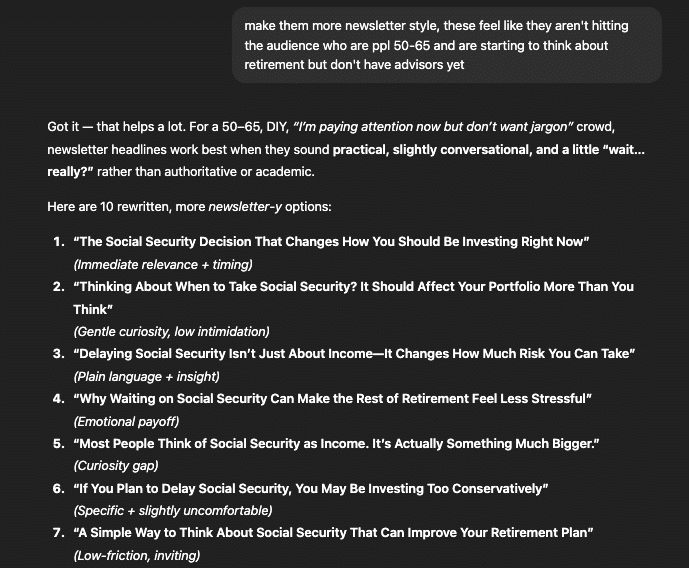
The AI Workflow: Input your article’s core thesis and request 10 distinct headline variations tailored to specific psychological drivers—urgency, curiosity-gap, or direct benefit. If the initial options miss the mark, provide qualitative feedback: "These are too generic; make them punchier and more authoritative." Often, the best headline emerges organically by hybridizing components from two or three different AI-generated suggestions. Apply the exact same iterative process to craft magnetic, high-retention opening hooks.
6. Rigorous Editing and Proofreading
Human eyes are notoriously blind to their own errors. After reading through a 2,000-word draft five times, your brain automatically fills in missing words and glides past awkward syntax.
The AI Workflow: Deploy advanced syntax and grammar checkers like Grammarly for continuous, real-time micro-editing. For macro-structural evaluations, paste your draft into an LLM with specific prompt conditioning: "Act as an aggressive developmental editor. Flag wordiness, unclear transitions, and logical gaps." You can even instruct the model to role-play as your target reader, asking it to highlight precisely where they might lose interest or feel confused. You retain total editorial control over every suggested revision.
7. Automated Content Repurposing
Maximizing return on investment from a single piece of writing is essential for modern content operations. A comprehensive 1,500-word blog post should never live in isolation.

The AI Workflow: Feed your published article into an LLM and systematically mine it for multi-platform distribution assets. Instruct the generator to:
- Extract 5 distinct data-driven hooks optimized for professional networking platforms.
- Draft a multi-part discussion thread breaking down the core arguments.
- Summarize key takeaways for an internal email newsletter.
By letting AI parse the heavy lifting of content reframing, you transform a single writing assignment into a robust, multi-channel promotional campaign without doubling your workload.
8. Expert Interview Preparation
Subject Matter Expert (SME) interviews form the bedrock of authoritative journalism. The quality of your questions dictates the quality of the quotes you secure.
The AI Workflow: Before stepping onto a call, brief your AI assistant on the interviewee’s background, professional history, and the specific thematic angle of your piece. Ask the model to generate 10 probing, non-obvious questions designed to elicit granular, specific anecdotes rather than canned corporate answers. If you are stepping into an unfamiliar industry, this rapid-fire preparation ensures you skip the elementary basics and immediately command the expert’s respect.
9. Streamlining Transcript Analysis
After an intensive SME interview, you are left with an exhaustive, unstructured wall of verbatim text from transcription tools like Otter.ai. Manually searching through this audio log for a specific quote can derail your production schedule.
The AI Workflow: Utilize native conversational search features within your transcription software or export the transcript into an LLM. Prompt the AI to isolate specific thematic clusters, summarize the expert’s primary takeaways, or retrieve exact mentions of specific keywords.
- Verification Protocol: Always cross-reference AI-retrieved quotes against the original audio recording or raw transcript before publication to ensure absolute contextual accuracy and eliminate interpretive hallucinations.
10. Automated Marketing and CRM Tracking
Freelancers historically despise administrative tracking, leading to abandoned spreadsheets, lost follow-ups, and an opaque pipeline.
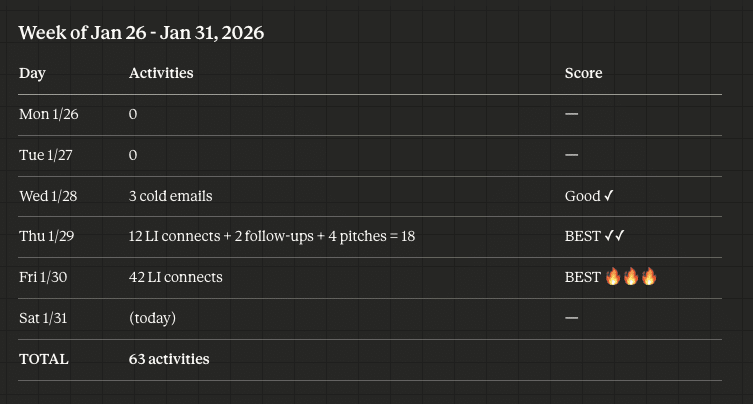
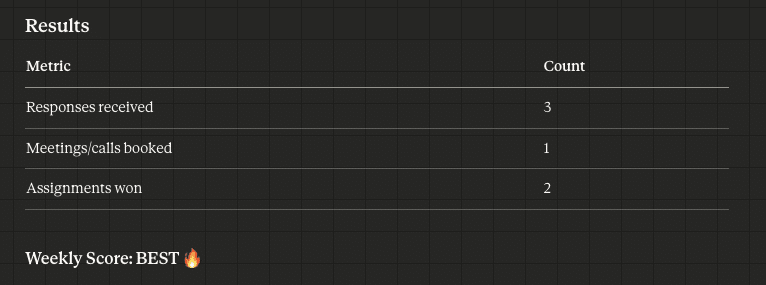
The AI Workflow: Implement a natural-language CRM workflow using advanced conversational models like Claude Cowork. At the end of a marketing session, feed the unstructured data of your outreach activities into the model: date, client contacted, asset sent, and response status. At month-end, prompt the AI for a comprehensive performance audit: "How many LOIs did I send, what was my response rate, and which niche subset generated the highest conversion to discovery calls?" You can even incorporate gamification protocols—such as weekly performance scorecards—to keep your business development engine motivated and mathematically optimized.
What NOT to Do With AI
While the expansion of capabilities is unprecedented, certain boundaries must be maintained to preserve professional integrity:
- Do Not Outsource Original Thinking: If you delegate your core thesis, unique voice, and strategic worldview to an algorithm, you become a commodity.
- Do Not Publish Unverified Facts: AI models are prone to hallucinations. Relying on an LLM for unsourced statistical data without manual verification invites catastrophic reputational damage.
- Do Not Ignore Client Guidelines: Always respect client stipulations regarding the use of generative tools. Transparency and adherence to contract terms are paramount.
Supporting Context & Metrics
The transformation of the freelance economy is backed by shifting macroeconomic indicators. Industry data reveals that independent creators who successfully adopt auxiliary AI workflows increase their weekly output volume by upwards of 40% while simultaneously reporting lower levels of administrative burnout. Conversely, writers who reject automation find themselves squeezed out of fast-paced content ecosystems, struggling to compete with peers who can efficiently research, outline, and repurpose material at scale.
[Traditional Writing Workflow]  --> 100% Manual Effort (High Fatigue, Slow Output)
[AI-Augmented Workflow]         --> Automated Research, Outlines & Repurposing
                                    (Low Friction, High-Value Human Focus)
Future Outlook
The trajectory of artificial intelligence in freelance writing points toward deeper ambient integration. Over the coming years, standalone applications will coalesce into unified, agentic workflows where administrative tracking, initial research triage, and content distribution run seamlessly in the background.
However, the core thesis remains immutable: Technology commoditizes execution while elevating authenticity. As automated text generation becomes ubiquitous, the market value of true human expertise, original investigative reporting, empathetic interviewing, and genuine relationship-building will skyrocket. The freelancers who thrive in the future will not be those who let machines do their thinking, but those who use machines to free up the time required to think more deeply than ever before.