For digital marketers, search engine optimization (SEO) professionals, and agency executives alike, the modern Search Engine Results Page (SERP) is an unpredictable, hyper-dynamic battleground. Gone are the days when a simple, manually updated spreadsheet could capture the true health of a website’s organic footprint. Today’s search environment is characterized by rapid algorithmic shifts, hyper-localized search results, multi-device variability, and an ever-expanding array of SERP features—ranging from AI-driven summaries and featured snippets to video carousels and People Also Ask (PAA) boxes.
To validate SEO efforts, justify capital expenditure, and accurately forecast revenue attribution, modern brands must deploy enterprise-grade SERP tracking software. Relying on sporadic data or outdated manual tallies no longer suffices. Organizations need real-time, on-demand ranking updates, granular location-based metrics, and deep competitor analysis.
This comprehensive review examines the current landscape of SERP tracking technology heading into 2025. By evaluating nine essential feature sets—ranging from multi-engine support and historical tracking to revenue attribution and white-label reporting—we analyze the top standalone tools and all-in-one SEO platforms currently dominating the market. Whether you manage a boutique agency or a multinational enterprise, this guide provides the authoritative insights required to select the ideal tracking infrastructure for your digital strategy.
Detailed Chronology: The Evolution of Rank Tracking
The methodology of tracking search engine visibility has undergone a dramatic transformation over the past two decades. Understanding this evolution explains why modern software has become indispensable to digital operations.
Phase 1: The Manual Era (Early 2000s)
In the nascent days of search optimization, webmasters and early SEO practitioners relied heavily on manual lookups. Professionals would open a browser, clear their cache, type in target keywords, and manually record rankings in Microsoft Excel spreadsheets. This approach assumed a static, uniform search result for every user. However, as search engines began personalizing results based on user history, local IP addresses, and device types, manual spreadsheets quickly became obsolete, yielding dangerously inaccurate metrics.
Phase 2: Automated Desktop Scraping (Late 2000s – Early 2010s)
As keyword volumes expanded into the thousands, desktop-based software solutions emerged. These tools ran on local machines, using proxies to scrape search engine results pages on a scheduled basis. While this eliminated manual data entry, these systems suffered from frequent IP bans, slow processing speeds, and infrastructure crashes. Data synchronization across distributed agency teams remained a persistent bottleneck.
Phase 3: Cloud-Based SaaS and On-Demand Architecture (Mid-2010s – 2020s)
The maturation of cloud computing ushered in the modern era of Software-as-a-Service (SaaS) rank tracking. Centralized cloud infrastructure allowed providers to deploy massive proxy networks, delivering automated daily updates without straining local hardware. Crucially, this era introduced on-demand data refreshing, granular zip-code-level targeting, and robust API integrations connecting rank data directly to visualization layers like Google Data Studio (now Looker Studio) and Databox.
Phase 4: The AI-Integrated SERP Ecosystem (2025 and Beyond)
Today, the traditional blue link is sharing significant screen real estate with generative search features, AI overviews, and dynamic multimedia modules. Modern SERP trackers have evolved past simple position monitoring. Leading tools now integrate advanced semantic analysis, intent classification, and automated content gap identification to help brands capture volatile SERP features and protect their organic market share.
Investing in enterprise-grade SERP tracking software is not merely about vanity metrics or celebrating a jump from position four to position two. It is about establishing a verifiable link between SEO performance and core business objectives.
The Financial Imperative: Tying SERP Movement to Revenue
A common challenge for digital marketers is demonstrating return on investment (ROI) to C-suite executives. Advanced SERP tracking solutions bridge this gap by integrating ranking data directly with analytics platforms like Google Analytics or Adobe Analytics.
By combining key performance indicators (KPIs)—such as keyword position, search volume, and Share of Voice (SoV)—with bottom-line metrics like organic traffic, bounce rates, conversion goals, and revenue generation, businesses gain a holistic view of their digital health. For instance, AccuRanker’s Landing Pages report consolidates these data streams, allowing teams to isolate precisely which URLs and keywords are driving profitable conversions.
Nine Essential Features of Modern SERP Tracking Software
When evaluating software options, industry professionals should look for platforms that incorporate the following nine critical capabilities:
Accurate On-Demand Ranking Updates: Rapidly fluctuating search results demand real-time data refreshing. Waiting days for scheduled updates leaves teams blind to algorithmic penalties or sudden traffic surges.
SERP Feature Monitoring: The ability to track over 50 distinct SERP features (such as AI Overviews, featured snippets, and local packs) enables brands to identify immediate opportunities to steal "Position #0" from competitors.
Multi-Engine Support: Comprehensive tracking should extend beyond Google to encompass global and regional search engines like Bing, Baidu, Yandex, and YouTube.
Granular Geographic and Device Segmentation: Campaigns often require tracking down to the zip-code or city level, alongside distinct comparisons between mobile and desktop rendering.
Traffic and Revenue Attribution: Native integrations with analytics suites to map ranking changes directly to user behavior and financial conversions.
Historical Rank Performance: Access to deep historical trend lines to analyze long-term algorithmic resilience and evaluate historical competitor trajectories.
Competitive Intelligence: Automated categorization of keywords into rank brackets (e.g., positions 1–3, 4–10, 11–50) to monitor shifting market share against primary rivals.
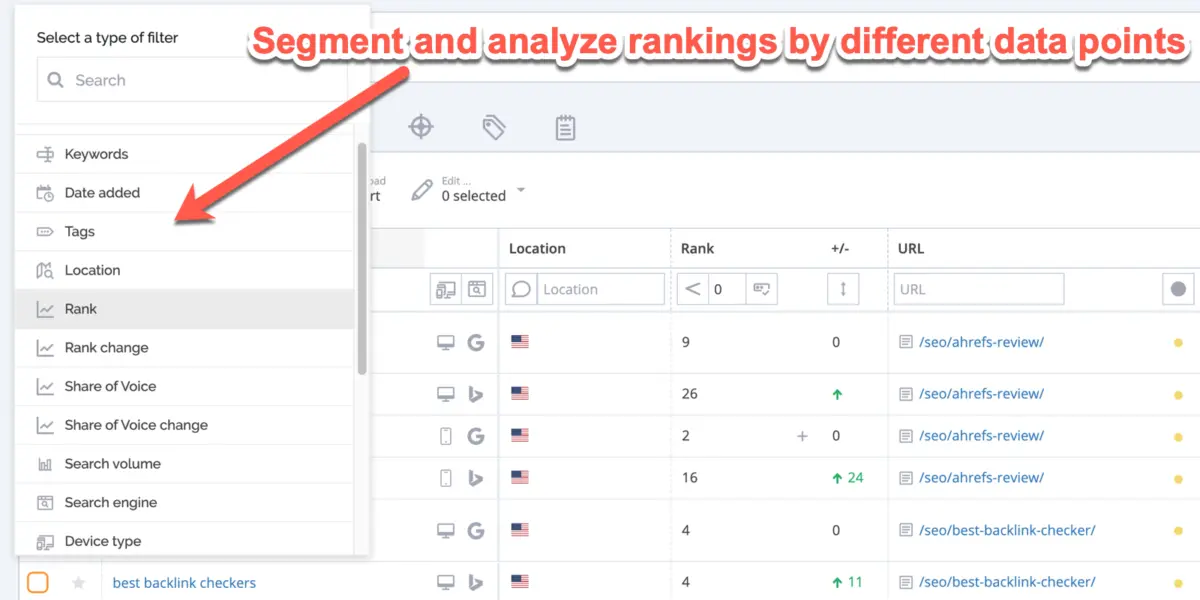
Advanced Tagging and Segmentation: The ability to slice and dice data by content type, funnel stage, topic cluster, or custom tags.
White-Label Reporting and API Access: Automated, client-ready reporting delivered natively or streamed seamlessly into external dashboards via robust API and data studio connectors.
Official Industry Perspectives & Expert Commentary
To contextualize the software landscape, industry leaders emphasize the necessity of robust data visualization and high-frequency updates.
"It’s by far the best keyword ranking tracker in the market and has a ton of great reporting functions. If you want visibility on large volumes of keywords housed within a nice dashboard—this is for you." — Matthew Howells-Barby, Co-Founder, TrafficThinkTank
The integration of rank data into modern agency workflows has also streamlined client communication. According to Ian Howells, Co-Founder of Traffic Think Tank:
"The thing that really got me using them heavily in the last month or two is their data connector. Combining the tag feature, as well as the Share of Voice metric… has been a big help in making these reports immediately digestible for clients."
The 7 Best SERP Tracking Tools for 2025
The market features countless rank-tracking applications, split between dedicated standalone trackers and comprehensive all-in-one SEO suites. Below is the curated shortlist of the top tools for 2025.
1. AccuRanker (Best Standalone SERP Tracker)
Trusted by over 32,000 companies—including enterprise giants like HubSpot, IKEA, and Kinsta—AccuRanker is widely recognized as the gold standard for speed and accuracy in standalone rank tracking.
Best Features: Automated daily updates coupled with instant on-demand data refreshes; comprehensive tracking of 50+ SERP features; robust multi-engine support (Google, Bing, Baidu, Yandex, YouTube); and deep landing-page analytics that merge rank metrics with Google Analytics data.
Who It Is For: SEO agencies, enterprise brands, and professionals who demand instantaneous data updates and granular API access.
Pricing: Tiered subscriptions based on tracked keyword volume, starting at $116/month for up to 1,000 keywords.
2. Semrush Position Tracker and SERP Gap Analyzer (Best All-in-One Platform)
As a dominant all-in-one digital marketing suite serving over 10 million users (including Samsung and Vodafone), Semrush offers a position tracking module that rivals dedicated tools in speed and precision.
Best Features: Highly accurate daily position tracking across global and local map packs; granular device and location segmentation; and the innovative SERP Gap Analyzer app in the Semrush App Center, which scans search results to uncover under-optimized content and low-hanging fruit via Google Search Console integration.
Who It Is For: Digital marketing agencies, e-commerce brands, and enterprises seeking an all-in-one platform with scalable SERP tracking.
ProRankTracker is a scalable, highly reliable standalone tracking solution utilized by over 60,000 users worldwide.
Best Features: Extensive multi-language support, accurate local pack tracking, video ranking capabilities for YouTube marketers, and comprehensive progress reporting.
Who It Is For: SEO agencies, international enterprises, and video marketers seeking robust data across diverse geographic regions.
Pricing: Entry-level plans starting at $39/month.
4. Advanced Web Ranking – AWR (Best for Enterprise Reporting)
Advanced Web Ranking is a veteran standalone SERP tracker utilized by major enterprises and tech firms like Microsoft.
Best Features: Highly customizable white-label reporting engines, robust multi-device tracking, and flexible user-permission controls for distributed agency teams.
Who It Is For: In-house marketing teams and enterprise agencies managing complex, multi-stakeholder reporting requirements.
Pricing: Subscriptions starting at $99/month.
5. SERPWatcher by Mangools (Best for Simplicity & Usability)
Developed by Mangools, SERPWatcher is designed for users who want accurate data without navigating bloated, overly complex interfaces.
Best Features: The proprietary Performance Index metric, which evaluates organic traffic potential across all tracked keywords; clean, intuitive data visualizations; and bundled access to complementary tools like SERPChecker.
Who It Is For: Freelancers, startups, and small-business owners looking for streamlined, user-friendly SEO software.
Pricing: Bundled plans starting at $29.90/month.
6. SE Ranking (Best Value All-in-One Alternative)
SE Ranking is a versatile all-in-one SEO platform equipped with a robust Position Tracking module that simulates real user behavior across precise geographic locations.
Best Features: 100% accurate location-based simulation, comprehensive competitor rankings history, and integrated site audit tools.
Who It Is For: Small-to-medium agencies and growing businesses needing a balanced toolkit at a competitive price point.
Pricing: Subscriptions starting at $52/month (based on daily updates for 500 keywords).
7. Nightwatch (Best for Hyper-Local & Global Scale)
Nightwatch is a sophisticated daily SERP tracker trusted by major global brands like Shopify and Coinbase, renowned for its ability to pull data from over 107,000 precise global locations.
Best Features: Exceptional geographic granularity, clean data segmentation, and flexible reporting dashboards.
Who It Is For: Organizations ranging from independent consultants to large enterprises requiring hyper-local international tracking.
Pricing: Paid plans start at $32/month for up to 250 keywords, backed by a 14-day free trial.
Future Outlook: The Next Generation of SERP Intelligence
As we look toward the remainder of 2025 and beyond, the function of SERP tracking software will continue to expand in scope and sophistication. The rapid integration of generative AI within search engine result pages means that traditional ranking positions (1 through 10) will share industry focus with "zero-click" informational cards and conversational AI summaries.
Future-proof SERP tracking tools will need to transcend simple grid positioning. We anticipate greater emphasis on semantic visibility metrics, automated intent classification, and predictive modeling that forecasts how algorithmic shifts will impact pipeline revenue before traffic drops materialize.
For digital strategists, selecting the right platform today is an essential foundational step. Whether you choose the lightning-fast, dedicated precision of AccuRanker or the expansive, all-in-one analytical power of Semrush, investing in a robust SERP tracking infrastructure ensures your organization remains agile, competitive, and profitable in an increasingly complex digital ecosystem.