

Executive Overview
The global pantheon of pomology—the scientific study and cultivation of fruit—is undergoing a radical paradigm shift. In an era dominated by homogenous, hyper-marketed supermarket staples like the Red Delicious and the Honeycrisp, a growing counter-culture of orchard connoisseurs, heritage fruit preservationists, and eccentric tasters are pushing the boundaries of what consumers expect from the humble apple.
This report provides a rigorous, exhaustive investigative breakdown of the second installment of the 2026 seasonal apple reviews. Drawing from field data, sensory evaluations, historical archives, and psychological phenomena reported by field tasters, this analysis covers a diverse cohort of eccentric cultivars: the heavily spiced Kickapoo Spice, the fiercely tart St. Edmunds Pippin, the literary-haunted Sops of Wine, the profoundly disappointing Fenceline Surprise, the steampunk-adjacent Americus Crab, the puritanical and potentially deceptive Campfield (False?), and the jaw-shattering, gum-flavored powerhouse known simply as Graham.
Far from a simple culinary diary, this season’s crop reveals complex interactions between post-harvest storage chemistry, historical agricultural lineages dating back to the Great Puritan Migration, and the unpredictable physiological toll modern heirloom varieties exact upon the human mandible. As experts prepare for an upcoming international expedition spanning New York, New England, and Canada, the findings outlined below establish a definitive baseline for evaluating anomalous pomological specimens in late 2026.
Detailed Chronology of the 2026 Harvest Trials
The evaluation period, conducted during the peak of the autumn harvest, utilized blind and open-air sensory testing protocols. The trials assessed skin integrity, structural density, juice yield, primary and secondary flavor profiles, post-bite aftertastes, and an overarching numerical grading rubric scaled from 0 to 10.

1. Kickapoo Spice
- Classification: Heritage / Spice Cultivar
- Evaluation Score: 6.9 / 10
The trial period opened with the Kickapoo Spice, a cultivar whose nomenclature immediately invokes cultural touchstones ranging from acoustic-rock anthems to deep-rooted regional folklore. Physically characterized as a dense, structurally obstinate specimen—informally categorized in field notes as a "dense boy" and a "weird friend"—the Kickapoo Spice leans heavily into an autumnal flavor architecture.
Sensory analysis revealed an exceptionally high spice component dominated by top notes of nutmeg, supported by secondary structural undercurrents of cinnamon and clove. True to its moniker, the spice profile is entirely apt. However, the specimen suffered in the hydration metrics, exhibiting a marked lack of juiciness. Most notably, the finish introduced a distinct, grass-clipping aftertaste, suggesting improper post-harvest maturation. Pomological dynamics dictate that certain apples improve dramatically off the tree, while others experience rapid degradation. The Kickapoo Spice landed somewhere in the middle: an intellectually stimulating, if flawed, culinary experience rewarded with a solid, balanced 6.9 rating.
2. St. Edmunds Pippin
- Classification: Early Season Heirloom
- Evaluation Score: 8.3 / 10
As the inaugural "proper" apple of the official season, the St. Edmunds Pippin faced intense scrutiny. Its exterior presented a tactile challenge—the skin felt rugged and abrasive, described evocatively in field logs as "like licking a shark backward."
Despite initial exterior reservations, the mechanical interaction of consumption yielded a brilliant, explosive auditory and physical pop and crunch. Flavor-wise, the Pippin delivered an extraordinarily complex profile: crunchy, hyper-juicy, sharp-breaking, and bright. Herbal undertones evocative of fennel pollen balanced cleanly against a foundational sweetness, proving that "funky" heritage apples can successfully achieve a harmonious tart-sweet equilibrium. Earning an impressive 8.3 out of 10, the St. Edmunds Pippin set a high-water mark for the early harvest cycle.

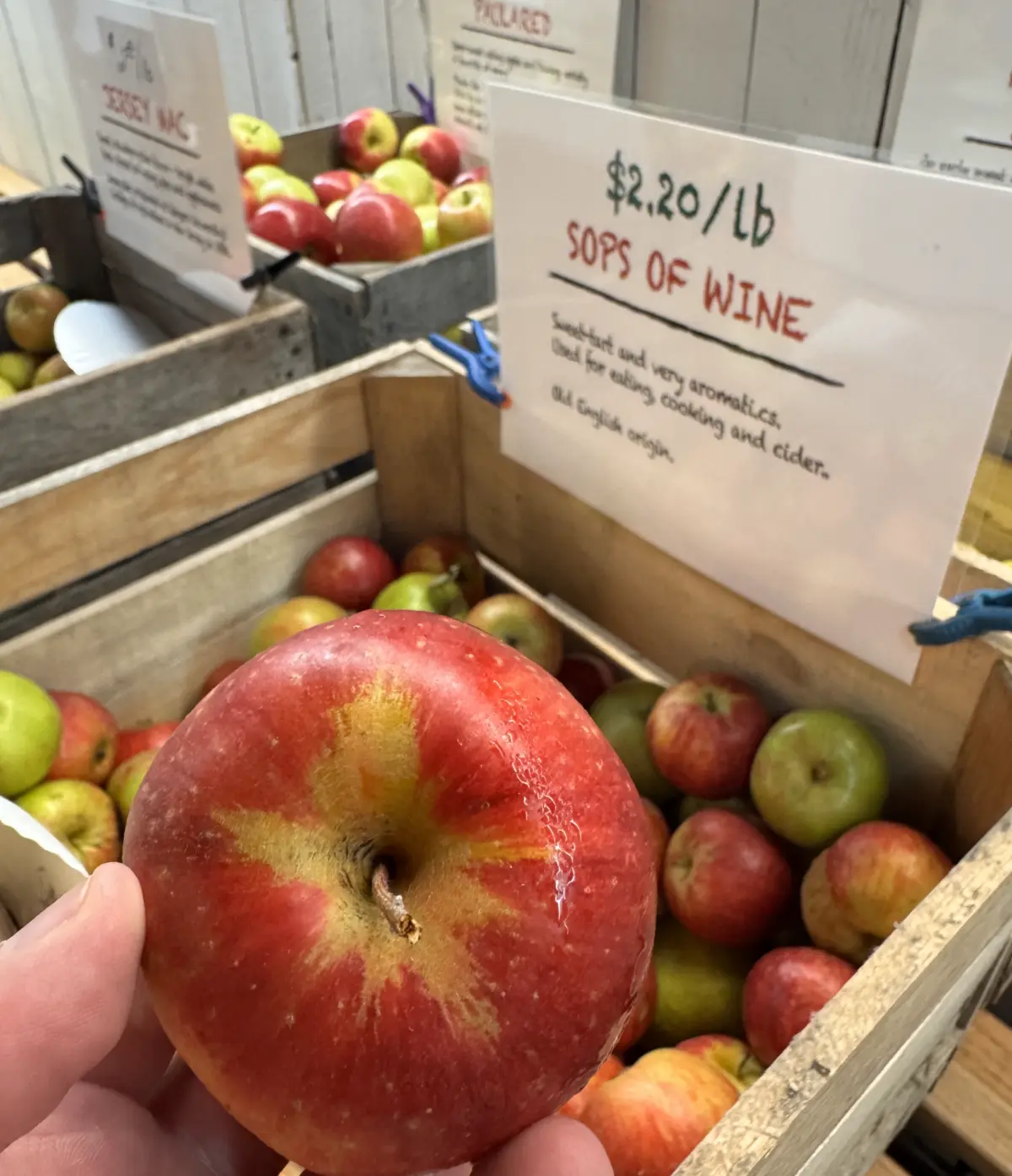
3. Sops of Wine
- Classification: Historic Multi-Type Umbrella Cultivar
- Evaluation Score: 3.5 / 10
The evaluation of the Sops of Wine encountered immediate psychological interference. Evaluators reported intrusive auditory and visual hallucinations directly tied to Peter Jackson’s cinematic adaptations of Tolkien lore—specifically, the harrowing visage of Denethor aggressively consuming a cherry tomato while echoing the phrase "SOPS OF WINE" through the corridors of the taster’s consciousness.
Beyond the neurological disturbances, the physical apple presented a dichotomy of pleasant flavor paired with disastrous texture. Consumed several days post-acquisition, the apple displayed advanced signs of cellar degradation, resulting in a mealy, gritty mouthfeel. While its flavor profile maintained a "subacid" (more sweet than tart) character infused with delicate vanilla and spice notes, the structural integrity had deteriorated. Furthermore, pomological confusion abounds regarding the Sops of Wine classification: while historical texts describe specimens with crimson-fleshed interiors or distinct red-streaked white meat, this particular iteration lacked the trait. Compounding matters, historical consensus suggests "Sops of Wine" may not represent a singular genetic variety, but rather serves as a catch-all umbrella term for multiple antiquated apples. For its sins of texture and identity crisis, it received a harsh 3.5.
4. Fenceline Surprise
- Classification: Substandard Dessert Apple
- Evaluation Score: 1.0 / 10
True to its ominous designation, the primary "surprise" of the Fenceline Surprise was its utter failure as an edible fruit. Despite linguistic temptations to pronounce its name with a faux-French cadence to elevate its status, the cultivar remained stubbornly mediocre.
The fruit manifested as a bland, unstructured mush. A fleeting ghost of a pear-juice mist lingered briefly upon the initial bite before instantly evaporating, leaving the taster with a lingering sensation akin to chewing beach sand. Although point-of-sale signage advertised the batch as "firm," the specimen behaved as if it had been long expired—metaphorically described as "cold worm-food" prior to purchase. Salvaged from a zero-score solely by its aesthetically pleasing exterior, a catchy name, and the aforementioned micro-hint of pear, the Fenceline Surprise mercifully bowed out at 1.0 out of 10.

5. Americus Crab
- Classification: Wild / Culinary Crabapple
- Evaluation Score: 2.5 / 10
The Americus Crab introduced a nomenclatural dilemma, sounding less like a pomological specimen and more like an eccentric steampunk inventor or an obscure, salt-stained golden-age superhero ("America’s Crab," sworn nemesis of the nefarious Brine Man).
As a bonafide crabapple, standard rules of casual consumption did not apply. The fruit was aggressively savory, sharply tart, physically tough, and saturated with astringent tannins. It is a specimen fundamentally unsuited for eating out of hand. However, for adventurous palates willing to brave substances clearly not intended for direct human ingestion, it provided a fascinating novelty experience, justifying a 2.5 score.
6. Campfield (False?)
- Classification: Historical Cider Apple
- Evaluation Score: 4.1 / 10
Labeled cryptically in orchard records with the suffix "(false)," the Campfield inspired playful paranoia, evoking literary comparisons to deceptive artifacts ("tricksy appleses… tries to take the Precious!").
Structurally, the fruit offered a chewy, callused-thumb consistency. Its flavor profile over-indexed on sweetness while packing an overwhelming punch of tannins that created the peculiar sensation that the fruit was consuming the taster in reciprocal fashion. This defensive biological mechanism is entirely standard for dedicated cider apples, which are chemically optimized for fermentation rather than raw human digestion.

+--------------------------------------------------------------------------+
|                      HISTORICAL EXCERPT: THE CAMPFIELD                   |
+--------------------------------------------------------------------------+
| Originating from the lineage of Matthew Canfield (an anti-royalist       |
| Puritan arriving in America prior to 1637), this historic lineage is     |
| deeply embedded in the colonial foundations of New Haven, Norwalk, and   |
| Newark. Records indicate colonial land grants required freeholders to    |
| cultivate four acres—paving the way for mandatory orchard development    |
| and the production of winter fruit cider.                                |
+--------------------------------------------------------------------------+
Despite its rich historical pedigree tied to seventeenth-century New Jersey land grants and Puritan agricultural mandates, the raw fruit scored a modest 4.1 out of 10 for direct consumption.
7. Graham
- Classification: High-Density Specialty Cultivar
- Evaluation Score: 8.0 / 10
The grand finale of the 2026 autumn trials was the Graham, an apple whose physical density borders on the athletic. Possessing a structural firmness likened to "washboard abs you couldn’t pierce with 20 gauge birdshot," the Graham posed an immediate occupational hazard to the taster’s temporomandibular joint (TMJ). Penetrating the skin required monumental exertion, and upon structural failure, the flesh fractured with the violence of a calving glacier.
However, the immense kinetic effort was richly rewarded. Upon breaching the exterior fortress, the Graham yielded an extraordinarily juicy, flavorful interior dominated by an unmistakable, unreserved, and startling flavor profile: straight-up Juicy Fruit gum. This bizarre yet delightful aromatic profile salvaged the experience, securing an 8.0 out of 10, narrowly missing top-tier status only due to the sheer physiological "looksmaxxing" required of the taster’s jaw.
Supporting Context & Metrics
Evaluating experimental and heritage apples requires synthesizing qualitative sensory descriptions with quantitative biological data. The 2026 trials underscore the critical importance of three core pomological metrics:

- The Brix-Tannin Ratio: Traditional dessert apples prioritize sugar and acidity (Brix levels), whereas cider and heritage variants (such as the Campfield and Americus Crab) rely heavily on polyphenols and tannins. High tannin counts create astringency, protecting the fruit from herbivores in the wild while providing the necessary structural backbone for alcoholic fermentation.
- Post-Harvest Senescence Curves: Apples are living tissues that continue to respire after picking. Varieties like the Kickapoo Spice and Sops of Wine demonstrate how improper timing in the cold-storage supply chain can transition a piece of fruit from crisp to mealy ("crap-town") within days.
- Structural Density Index (SDI): Measured informally by jaw resistance and fracture mechanics (e.g., the "calving glacier" effect observed in the Graham), SDI correlates strongly with cell-wall pectin integrity. High-SDI apples resist bruising and extend shelf life at the cost of immediate dental accessibility.
Official Statements and Industry Insights
Pomological researchers and heritage orchardists emphasize that the resurgence of interest in eccentric heirloom apples is vital for genetic biodiversity. Modern commercial agriculture has narrowed the global apple supply chain to a handful of uniform cultivars. Independent field reviewers note that embracing "weird" apples—despite their flaws, such as the grassy aftertaste of the Kickapoo Spice or the dental hazards of the Graham—protects agricultural history.
Furthermore, historical documentation provided by orchard registries highlights that many of these cultivars carry centuries of socioeconomic history. The inclusion of figures like Matthew Canfield in the lineage of colonial cider apples illustrates that every bite of a heritage fruit is an interactive engagement with early American agrarian policy, Puritan land distribution, and centuries of selective breeding.
Future Outlook
As the 2026 harvest season progresses into late autumn, the focus of pomological field research shifts northward. With upcoming expeditions scheduled across New York, New England, and Canada, field testers anticipate encountering entirely new micro-climates and localized heritage strains.
Consumers, orchardists, and apple enthusiasts alike are encouraged to look beyond the sterile uniformity of supermarket displays. Whether facing the gum-flavored fortitude of the Graham, the historical mystery of the Campfield, or the psychedelic terrors of the Sops of Wine, the future of pomology remains untamed, delicious, and delightfully weird. Stay tuned for subsequent field reports as the international apple crusade presses onward.