

Executive Overview
In the grand tradition of agricultural journalism and subjective gastronomy, the autumn pomological audit has returned. Amidst a chaotic whirlwind of canine acquisition (specifically, the integration of a brand-new dog named Cooper), a grueling multi-leg national book tour, and the impending completion of a major manuscript, the pursuit of the season’s finest and foulest apples remains unyielding.
While comprehensive, in-depth monograph reviews have yielded to the pressures of an overstaturated schedule, the appetite for Malus domestica has only intensified. What follows is an exhaustive, first-round capsule critique of ten distinct apple varieties sampled across historic northeastern orchards. From the sublime redemption of long-maligned cultivars to the baffling, uncanny-valley sensory profiles of rare crabapples, this report embraces the chaos fruit in all its eccentric glory.

Detailed Chronology of Tastings
The current evaluation cycle spans harvests sourced from premier agricultural institutions, notably Vermont’s Scott Farm and Wisconsin’s Brightonwoods Orchard. Each specimen has been subjected to rigorous, highly subjective sensory analyses—evaluating skin elasticity, flesh density, aromatic pungency, and ephemeral flavor notes ranging from rooibos tea to used bookstore air.
1. Gravenstein
- Origin: Scott Farm, Vermont (Heritage Danish Cultivar)
- Score: 7.5 / 10
Historically a source of frustration for American orchardists, this iteration of the Gravenstein delivered a surprisingly delightful profile. While falling slightly short of peak crispness, it more than compensated with an exceptional juice yield and a complex flavor architecture. Tasters noted profound secondary notes of vanilla, rooibos tea, and delicate whispers of honey and elderflower. A resilient skin offered a satisfying culinary pop without detracting from the mouthfeel.

2. Hubbardston Nonesuch
- Origin: Scott Farm, Vermont
- Score: 3.7 / 10
Bearing a nomenclature more reminiscent of a Depression-era snake oil salesman than a noble fruit, the Hubbardston Nonesuch proved to be an exercise in sensory deception. Consecutive tastings weeks apart revealed an initial tongue-scrubbing astringency that rapidly deteriorated into a flat, bright white nothingness, occasionally punctuated by fleeting floral whispers. Subsequent samples exhibited a sub-acid sweetness that vanished as quickly as it arrived. It stands as a cautionary tale of a flavor profile that ghosts the palate.
3. Lamb Abbey Pearmain
- Origin: Historic Heirloom Stock
- Score: 7.5 / 10
Revisited after a five-year hiatus that yielded largely underwhelming, pedestrian results, the Lamb Abbey Pearmain staged a magnificent comeback. Abandoning its prior mediocrity, this specimen emerged as a near-platonic ideal of the fruit: a crunchy-crisp structural integrity, a harmonious balance of tartness and sugar, and a subtle tangerine-citrus accent. Most fascinating was a faint, pleasing umami savory note. The turnaround underscores a vital horticultural truth: apples are chaos fruits, fluctuating wildly across seasons.

4. Hewes Crab (Virginia Crab)
- Origin: Specialized Orchard Stock
- Score: 5.0 / 10
Traditionally relegated to hard cider production, wildlife feed, or the assertive social statement of tossing small projectiles at irritating children, the Hewes Crab is an unconventional experience. Mealy and virtually devoid of free juice, its salvation lies in its bizarre flavor trajectory. The palate is treated to an eccentric collision of pear, pineapple, and savory tamarind, concluding with an unexpected, highly satisfying butterscotch finish.
5. Opalescent
- Origin: Regional Orchard Batch
- Score: 8.0 / 10
In what can only be described as a staggering pomological glow-up, the Opalescent completely shed the ignominy of last year’s brutal 2.5 rating. This year’s batch showcased dense, ultra-crisp flesh bursting with a tart-sweet berry profile underpinned by a gentle floral breeze. From absolute dud to certified stud, it represents one of the season’s most triumphant redemptions.

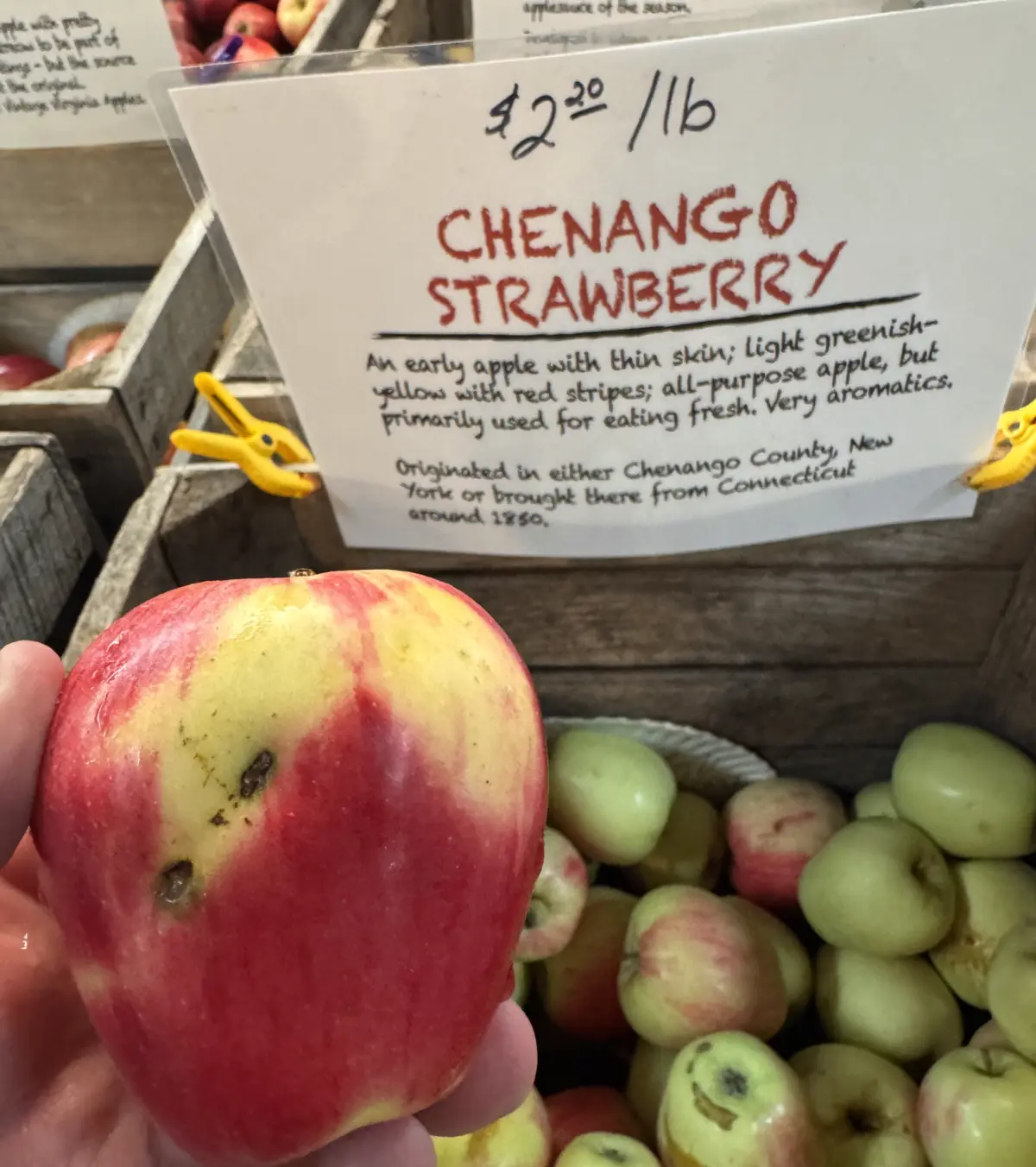
6. Chenango Strawberry
- Origin: Brightonwoods Orchard, Wisconsin
- Score: 4.0 / 10
Sourced from Wisconsin’s famed Brightonwoods, the Chenango Strawberry instantly impressed upon the olfactory senses with a genuine, unmistakable burst of fresh strawberries. Unfortunately, the textural reality proved catastrophic. The flesh suffered from an advanced stage of gushy, mealy pre-saucing, rendering mastication entirely optional—and ultimately leaving a promising aromatic profile trapped inside a structural disaster.
7. William’s Pride
- Origin: Regional Harvest
- Score: 6.3 / 10
Characterized by a uniquely bulbous morphology, William’s Pride offers a softer bite that stops well short of mealy degradation. The flavor profile leans heavily into autumnal nostalgia, dripping with juices that leave behind warming pie spices like cinnamon, clove, and nutmeg. A bizarre tertiary note—reminiscent of the atmospheric air inside a dusty used bookstore—elevates the experience from ordinary to memorably eccentric.

8. Blenheim Orange
- Origin: Heirloom Stock
- Score: 7.0 / 10
Encased within a formidable, plastic-like skin that acts as a physical barrier to entry, the Blenheim Orange demands persistence. Once breached, the dense interior reveals the sunny, bright disposition of a Cox’s Orange Pippin. Its flavor is a masterclass in floral zips and electric lemon tickles, though its density flirts dangerously with the gravitational pull of a black hole.
9. Golden Nugget
- Origin: Regional Harvest
- Score: 5.9 / 10
Visually resembling a goblin butt canker or an object pried from the back of an ogre, the Golden Nugget is deeply aesthetically challenged. Its flavor profile is equally confrontational, leading with an unripened, green smack of tartness that abruptly morphs into the exact taste of a banana picked while still hanging from the branch. It is an objectively flawed fruit that somehow captivates through sheer sensory confusion.

10. Doctor Harvey
- Origin: Ancient Heritage Cultivar
- Score: 5.1 / 10
Though officially classified as a cooking apple, Doctor Harvey’s structural softness makes it a prime candidate for premature "pie goop." However, it redeems itself through a singular physical attribute: an ASMR-worthy skin pop that stands virtually unmatched in the annals of pomology. The initial burst of flavor mimics a berry-flavored wine cooler before rapidly fleeing the crime scene.
Supporting Context & Metrics
Evaluating heirloom and specialty apples requires acknowledging the radical variability of agricultural outputs. As demonstrated by the drastic year-over-year score differentials in varieties like the Opalescent (surging from 2.5 to 8.0) and the Lamb Abbey Pearmain, environmental factors, storage duration, and harvest timing dictate success.

[Pomological Variance Metrics]
+-------------------------+--------------------+--------------------+
| Cultivar                | Texture Integrity  | Flavor Complexity  |
+-------------------------+--------------------+--------------------+
| Gravenstein             | Moderate           | High (Vanilla/Tea) |
| Hubbardston Nonesuch    | Variable           | Low (Ghosting)     |
| Lamb Abbey Pearmain     | High (Crisp)       | High (Umami/Citrus)|
| Hewes Crab              | Low (Mealy)        | Bizarre (Butter.)  |
| Opalescent              | Dense / Crisp      | High (Berry/Floral)|
| Chenango Strawberry     | Degraded (Mushy)   | High (Aromatic)    |
| William’s Pride         | Soft / Juicy       | Moderate (Spicy)   |
| Blenheim Orange         | Extreme (Dense)    | High (Lemon/Floral)|
| Golden Nugget           | Tough              | Eccentric (Banana) |
| Doctor Harvey           | Soft               | Fleeting (Wine)    |
+-------------------------+--------------------+--------------------+
Official Statements & Authoritative Insights
Pomological observers note that regional microclimates across New England and the Midwest continue to produce anomalous flavor markers—such as the "used bookstore" finish of William’s Pride or the structural density of the Blenheim Orange.
Independent experts maintain that consumer expectations must adapt to the "chaos fruit" paradigm. Flavor stability is secondary to regional expression, and subjective evaluations remain the gold standard of modern apple criticism.

Future Outlook
As the autumn harvest progresses, the audit will expand into new geographical territories. Subsequent evaluation legs will venture deeper into New England orchards, where further heirloom specimens await discovery.
For enthusiasts seeking a companion piece to their pomological explorations, the intersection of fiction and agriculture is readily available. The critically acclaimed thriller Black River Orchard—a deep dive into sinister groves and deeply unsettling fruit—is currently available in signed, personalized editions through the Doylestown Bookshop.

Further updates, scores, and sensory breakdowns will follow as the harvest season reaches its inevitable, sticky conclusion.