

Executive Overview
The landscape of search engine optimization (SEO) has shifted dramatically. Gone are the days when a digital marketer could rely on static, manually updated Excel spreadsheets to monitor a handful of keywords once a week. In the modern search ecosystem—dominated by hyper-personalized results, localized map packs, continuous core algorithm updates, and the rising prominence of AI-driven search experiences—precision, speed, and scale are paramount.
To accurately validate search engine optimization efforts and justify enterprise-level marketing budgets, professionals need real-time, granular visibility. They require insights that link raw ranking movements directly to traffic, user behavior, conversions, and, ultimately, bottom-line revenue. This comprehensive review examines the current state of SERP (Search Engine Results Page) tracking technology, breaks down the essential features every modern SEO stack requires, and analyzes the top seven SERP tracking tools dominating the market in 2025.

Whether you are an in-house enterprise SEO manager juggling international domains, an agency director managing hundreds of local clients, or a startup founder trying to capture organic market share, choosing the right SERP tracker can mean the difference between explosive growth and stagnation.
Detailed Evolution: From Manual Spreadsheets to Real-Time AI Intelligence
To understand where SERP tracking is heading, it is vital to trace how the discipline has evolved over the past decade.

Phase 1: The Manual Era
In the early days of SEO, tracking was a tedious manual process. Practitioners would open an incognito browser window, type in a target search query, and scroll through pages of results to find their client’s URL. These positions were recorded in local spreadsheets. This approach was inherently flawed: it suffered from extreme human bias, failed to account for localized search variations or personalized user history, and consumed countless billable hours that could have been spent on strategic execution.
Phase 2: Automated Desktop Scrapers
As search engines grew more complex, desktop-based software emerged. These tools utilized local proxies to scrape search engine results pages on a scheduled basis. While they relieved the burden of manual data entry, they were notoriously unstable. Frequent algorithm changes by major search engines routinely broke the scrapers, resulting in massive data gaps, IP blocks, and unreliable metrics.

Phase 3: Cloud-Based Infrastructure and the API Economy
Today, the industry relies on sophisticated, cloud-native SaaS platforms. Modern SERP trackers leverage distributed proxy networks, machine learning algorithms, and robust APIs to pull real-time data across global and hyper-local data centers. They no longer just track a static "blue link" position; they capture complex SERP features—including AI-driven summaries, featured snippets, People Also Ask (PAA) boxes, knowledge cards, and video carousels—providing an holistic view of digital real estate.
Supporting Context & Metrics: Why SERP Tracking is the Foundation of ROI
Investing in high-performance SERP tracking software is not merely an operational expense; it is a strategic imperative. Without accurate data, marketing teams operate in the dark, unable to prove the efficacy of their campaigns to stakeholders.

1. Validating SEO Investments
SEO is famously a long-term play. Stakeholders and C-suite executives want proof that capital injected into content creation, technical audits, and link building is yielding results. Granular SERP tracking software allows teams to demonstrate incremental progress long before those gains fully materialize in top-line organic traffic reports.
2. Safeguarding Against Volatility
Search engines deploy thousands of updates every year. A sudden drop in rankings can wipe out a company’s revenue pipeline overnight. Advanced trackers provide instant alerts and historical trend lines, allowing technical teams to diagnose whether a dip is part of a broader industry-wide core update, a local fluctuation, or a technical error on the website.

3. Key Metrics to Monitor
When evaluating platforms, modern enterprises look beyond basic rank positions. Key metrics include:
- Share of Voice (SoV): Measuring the percentage of total organic search visibility a brand commands within its target keyword universe compared to competitors.
- SERP Feature Ownership: Tracking how often a brand captures high-value real estate like position zero or AI overviews.
- Landing Page Revenue Attribution: Tying keyword movements directly to Google Analytics or Adobe Analytics revenue data.
9 Essential Features to Look for in Modern SERP Tracking Software
Not all SERP trackers are created equal. When evaluating software options for your organization, ensure the platform supports these nine core capabilities:

1. On-Demand, Real-Time Ranking Updates
SERP positions fluctuate rapidly throughout the day. Waiting days for a weekly scheduled update is unacceptable in fast-moving industries. Leading tools automatically update keyword sets every 24 hours while offering on-demand manual refresh buttons to pull fresh data instantly.
2. Comprehensive SERP Feature Monitoring
Ranking #1 is no longer the sole objective. With the rise of AI Overviews, featured snippets, and video carousels, a large portion of clicks happens above the traditional organic results. A top-tier tracker must monitor dozens of SERP features, highlighting opportunities to steal "Position #0" from competitors.

3. Multi-Engine Support
While Google commands the lion’s share of global search traffic, ignoring alternative search engines can leave blind spots. Depending on your target demographic or geographical market, your tracker should support Bing, Baidu, Yandex, and YouTube.
4. Granular Location and Device Filtering
Search results vary drastically depending on whether a user is searching from a desktop in New York or a mobile device in London. Look for software that enables tracking down to the zip code or city level, with explicit segmentation between mobile and desktop rankings.

5. Revenue and Traffic Attribution
Data in a silo is useless. The best platforms integrate seamlessly with analytics suites (like Google Analytics and Adobe Analytics) to map keyword movements and landing page performance directly to conversions and revenue.
6. Deep Historical Data and Trending
A single day’s ranking is just a data point; historical trends tell the real story. Access to long-term historical performance enables teams to analyze how seasonal trends or past algorithm updates affected their domain versus the competition.

7. Advanced Competitor Benchmarking
Understanding your own ranking is only half the battle. You must monitor competitor movements to identify emerging threats and unexploited keyword gaps. Look for tools that bucket keywords by position ranges (e.g., 1–3, 4–10, 11–50) to simplify comparative analysis.
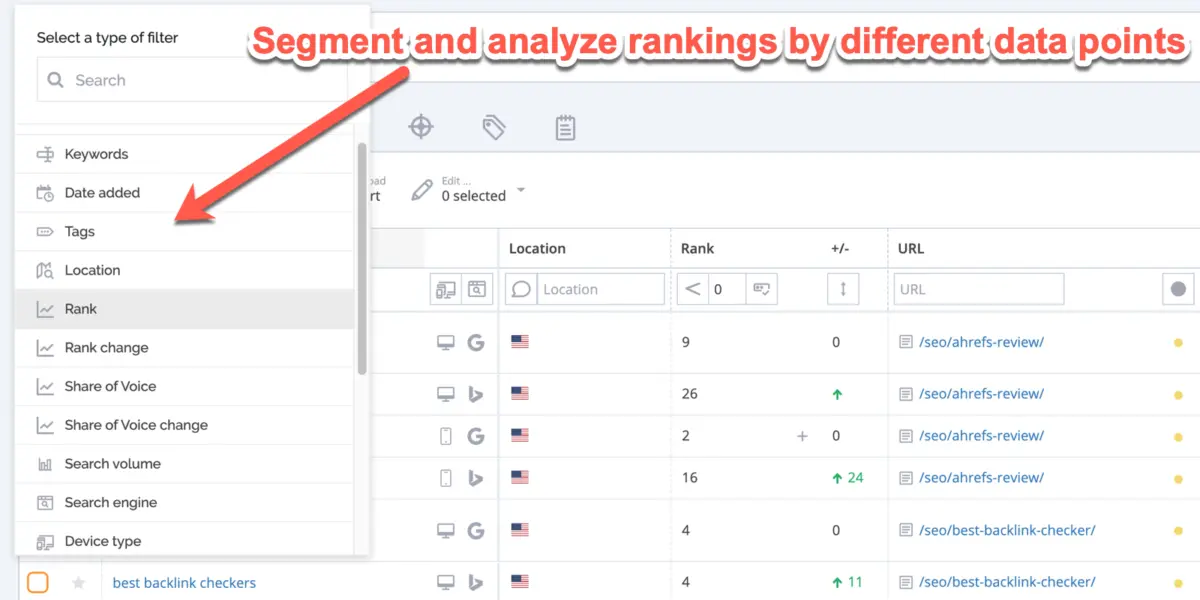
8. Custom Tagging and Segmentation
As keyword portfolios scale into the thousands, organization becomes critical. Robust tagging functionality allows you to segment your data by content type, marketing funnel stage, product category, or geographic target.

9. White-Label Reporting and Integrations
For agencies and large enterprises, client-ready reporting is essential. The software should either offer native white-label PDF report generation or robust API connectors to feed data into dashboarding platforms like Looker Studio (formerly Google Data Studio) and Databox.
The 7 Best SERP Tracking Tools for 2025
The market is saturated with options, but a select few platforms stand out. Below is our curated shortlist of the best dedicated SERP trackers and all-in-one SEO platforms for 2025.

1. AccuRanker
- Type: Standalone SERP Tracker
- Best For: Agencies, enterprise brands, and professionals requiring hyper-accurate, on-demand data.
- Overview: Trusted by over 32,000 companies—including industry giants like HubSpot, IKEA, and Kinsta—AccuRanker is widely regarded as the premier standalone keyword rank tracker on the market. It combines lightning-fast data refreshes with deep analytics integrations.
- Standout Features: On-demand data updates, robust Share of Voice tracking, comprehensive SERP feature analysis across 50+ features, and seamless Looker Studio integration.
- Pricing: Starts at $116/month for up to 1,000 tracked keywords.
2. Semrush (Position Tracker & SERP Gap Analyzer)
- Type: All-in-One SEO Platform
- Best For: Digital marketing teams seeking a comprehensive suite alongside industry-leading rank tracking.
- Overview: Serving over 10 million users globally, Semrush is a powerhouse all-in-one marketing platform. Its Position Tracking Tool rivals the accuracy of dedicated trackers while embedding within a massive ecosystem of competitive intelligence tools.
- Standout Features: Localized map-pack tracking, device segmentation, historical ranking distributions, and the innovative SERP Gap Analyzer app in the Semrush App Center, which scans SERPs to uncover under-optimized content and quick-win optimization opportunities.
- Pricing: Subscription plans start at $139.95/month.
3. ProRankTracker
- Type: Standalone SERP Tracker
- Best For: SEM agencies, international brands, and video marketers looking for cost-effective scale.
- Overview: Trusted by over 60,000 users, ProRankTracker delivers high-volume tracking capabilities across global search engines and multiple languages without breaking the bank.
- Standout Features: Extensive localization, multi-language support, accurate video rank tracking, and flexible reporting dashboards.
- Pricing: Starts at $39/month.
4. Advanced Web Ranking (AWR)
- Type: Standalone SERP Tracker
- Best For: In-house enterprise teams and agencies managing massive keyword volumes.
- Overview: A veteran player in the SEO space, AWR is trusted by major enterprises like Microsoft. It is engineered for heavy-duty reporting, white-label client management, and extensive competitor benchmarking.
- Standout Features: Cloud-based architecture, highly customizable reporting engines, and robust API access.
- Pricing: Starts at $99/month.
5. SERPWatcher (by Mangools)
- Type: All-in-One SEO Platform (Modular)
- Best For: Small businesses, startups, and freelancers wanting simplicity and value.
- Overview: Part of the Mangools suite (trusted by brands like Airbnb and Adidas), SERPWatcher is celebrated for its clean, intuitive user interface and its proprietary Performance Index, which calculates organic traffic potential at a glance.
- Standout Features: Performance Index metric, interactive visual charts, and an easy learning curve.
- Pricing: Starts at $29.90/month.
6. SE Ranking
- Type: All-in-One SEO Platform
- Best For: Small-to-medium agencies and growing businesses.
- Overview: SE Ranking has carved out a stellar reputation for providing 100% accurate ranking data by closely simulating actual user behavior within precise geographical locations.
- Standout Features: Accurate local rank tracking, competitor research modules, and automated reporting.
- Pricing: Starts at $52/month.
7. Nightwatch
- Type: Standalone SERP Tracker
- Best For: Enterprises and agencies tracking hyper-local and global campaigns simultaneously.
- Overview: Nightwatch stands out for its massive geographic coverage, pulling data from over 100,000 distinct locations worldwide with exceptional accuracy.
- Standout Features: Global location database, advanced site audit integration, and clean data visualization.
- Pricing: Starts at $32/month for up to 250 keywords.
Future Outlook: The Next Generation of SERP Tracking
As we look toward the horizon of digital marketing, SERP tracking technology is undergoing its next major metamorphosis. The integration of generative artificial intelligence into search engine results pages means that traditional "blue link" rankings are increasingly supplemented—or outright replaced—by conversational AI answers, dynamic knowledge panels, and zero-click interfaces.
Future-proof SERP tracking software will need to go beyond positional tracking. We can expect platforms to incorporate:

- AI Overview Sentiment Analysis: Tracking whether a brand is positively or negatively represented in AI-generated search summaries.
- Predictive Rank Modeling: Leveraging machine learning to forecast how upcoming technical site changes or content updates will impact future SERP volatility.
- Omnichannel Visibility Scores: Unified metrics that blend traditional organic search rankings with social search discovery and vertical-specific search engines.
Conclusion: Making Your Choice
Selecting the right SERP tracking software ultimately depends on your organization’s specific scale, budget, and operational requirements. If your workflow demands an uncompromised, hyper-fast standalone tracker with world-class agency features, AccuRanker remains the gold standard. If you prefer an all-in-one ecosystem where deep keyword tracking is paired with robust content and technical SEO audits, Semrush is an unmatched investment.
Evaluate your keyword volume, reporting needs, and integration stack today to ensure your business maintains a competitive edge in an increasingly volatile search landscape.